If you think SEO is simply about repeating keywords until Google takes notice, you are not alone. Many small and medium-sized business owners start there, then wonder why their site stays buried on page three. The truth is that SEO (Search Engine Optimisation) is a much broader discipline that shapes how your entire online presence is discovered, evaluated, and ranked. This guide walks you through what SEO really means, how search engines decide who appears at the top, the three foundational pillars every SME needs to understand, and the practical steps you can take right now to start improving your visibility.
Table of Contents
- What does SEO actually mean?
- How do search engines rank websites?
- The three pillars of SEO explained
- Getting started with SEO for your business
- Why most SEO shortcuts do not work for SMEs
- How Fylde Digital can boost your business’s SEO
- Frequently asked questions
Key Takeaways
| Point | Details |
|---|---|
| SEO is more than keywords | Visibility online depends on combining content, technical, and trust factors, not just keywords. |
| Understand Google’s ranking process | Site discovery, indexing, and ranking are driven by relevance, usability, and expertise. |
| Apply all three SEO pillars | On-page, off-page, and technical efforts together give the strongest SEO results for small businesses. |
| Avoid shortcuts for lasting impact | True, lasting SEO growth relies on sustainable strategies, not hacks or quick-fixes. |
What does SEO actually mean?
SEO stands for Search Engine Optimisation. In plain terms, it is the practice of making your website more attractive and easier to understand for search engines like Google, Bing, and others. When someone searches for a service you offer, SEO determines whether your business appears on page one or gets lost somewhere nobody scrolls to.
The most persistent myth about SEO is that it boils down to cramming as many keywords as possible into your content. This idea belongs firmly in the past. Modern SEO is about relevance, usability, authority, and technical performance working together. Google’s algorithms have grown sophisticated enough to detect and penalise low-quality, keyword-heavy content. What they reward instead is a site that genuinely serves its visitors.
SEO best practices confirm this: on-page, off-page, and technical optimisation together drive more relevant traffic and higher visibility. Think of it as a three-legged stool. Remove one leg and the whole thing wobbles.
Here is why SEO matters practically for your business:
- Visibility without ongoing ad spend. Unlike paid advertising, organic rankings do not stop the moment you reduce your budget. Once earned, they continue to work for you.
- Credibility by association. Appearing at the top of search results signals trustworthiness to potential customers. Many people skip adverts and click the first organic result precisely because they associate it with authority.
- Targeted traffic. Good SEO attracts people who are already searching for what you offer. These are warm leads, not cold ones.
- Competitive advantage. Your competitors are either investing in SEO or missing the opportunity. Either way, there is ground to gain.
“The businesses that win online are not always the biggest. They are the ones that show up consistently when the right people are looking.”
The strategic value of SEO for small and medium businesses is often underestimated precisely because results build gradually rather than arriving overnight. But that steady accumulation of visibility is also what makes it durable.
How do search engines rank websites?
Having set the stage for why SEO matters, let us break down what happens when you type a search query into Google. Understanding this process removes a lot of mystery and helps you focus your efforts where they actually count.
Search engines operate in three stages: crawling, indexing, and ranking. Automated crawlers discover pages, index them, and rank them based on relevance, quality, and user experience. Here is what each stage looks like in practice:
- Crawling. Google sends out automated bots (sometimes called spiders) to follow links across the internet and discover web pages. If your site has broken links, pages blocked by incorrect settings, or poor internal linking, these bots may miss important content entirely.
- Indexing. Once a page is discovered, Google analyses its content and adds it to its enormous database. This is the index. Only indexed pages can appear in search results. If your pages are not indexed, they are effectively invisible.
- Ranking. When someone performs a search, Google sorts its index using a complex algorithm that considers hundreds of signals. These include keyword relevance, page quality, loading speed, mobile usability, and the trustworthiness of the site.
| Stage | What happens | What can go wrong |
|---|---|---|
| Crawling | Bots follow links to find pages | Broken links, blocked pages |
| Indexing | Page content is analysed and stored | Thin content, duplicate pages |
| Ranking | Pages sorted by quality and relevance | Poor user experience, weak authority |
The takeaway here is that how search engines rank pages is not random or mysterious. It follows logic. Optimising for true ranking signals rather than relying on keyword tricks is the most defensible long-term strategy. This means aligning your site with what Google values: relevance to the user’s intent, high-quality and useful content, and a strong, trustworthy reputation built over time.
Think of keyword tricks like a shortcut through a field. It might save you time today, but it rarely leads where you want to go and often leaves you further from the destination.
The three pillars of SEO explained
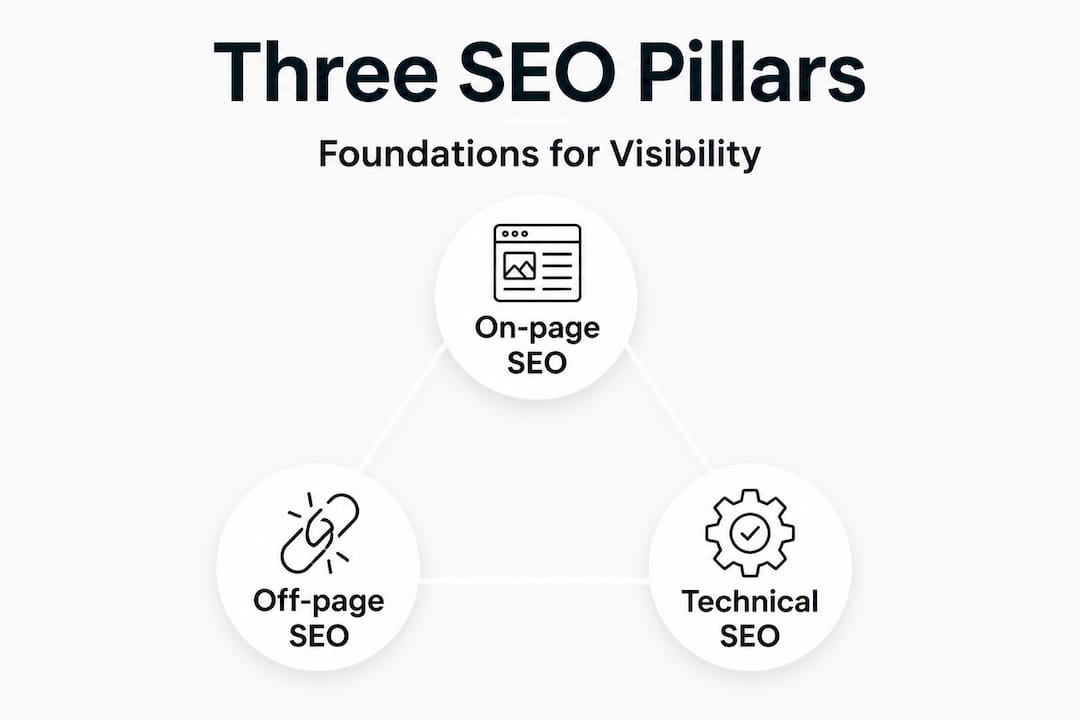
Once you understand how search engines work, the next step is knowing where to focus your energy. A practical way to structure your SEO is through three pillars: on-page SEO, off-page SEO, and technical SEO. Each one addresses a different part of what search engines evaluate.
| Pillar | Focus area | Examples |
|---|---|---|
| On-page SEO | Content and page elements | Keywords, headings, meta descriptions, image alt text |
| Off-page SEO | External signals and authority | Backlinks, brand mentions, social shares |
| Technical SEO | Site performance and structure | Page speed, mobile-friendliness, crawlability |
On-page SEO is everything that lives on your website itself. This includes the words you write, the headings you use, the titles and descriptions that appear in search results, and how your images are labelled. The goal is to make each page clearly communicate its topic to both visitors and search engines. A well-written product or service page that answers real questions your customers ask is worth far more than a page stuffed with repeated phrases.

Off-page SEO is about your reputation beyond your own website. The most important off-page signal is backlinks, which are links from other websites pointing to yours. A backlink from a respected local directory, an industry publication, or a partner organisation tells Google that your site is credible. Content and social sharing also play a role here, since mentions and shares across platforms contribute to your overall authority in your sector.
Technical SEO is the foundation everything else rests on. If your site loads slowly, crashes on mobile, or has structural problems that prevent Google from crawling it properly, the best content in the world will not save your rankings. Website user experience is now a direct ranking factor. Google measures how long visitors stay on your pages, how quickly they leave, and whether they can navigate your site intuitively.
The key insight here is balance. Many businesses invest heavily in one pillar while ignoring the others. A site with brilliant content but no backlinks struggles to compete. A site with strong links but a broken mobile experience loses visitors before they even read a word.
Pro Tip: Run a basic audit of all three pillars every quarter. You do not need specialist software to start. Check your Google Search Console for technical errors, review your most important pages for content quality, and ask a few trusted contacts whether your site appears on reputable directories in your industry.
Getting started with SEO for your business
Understanding the pillars is one thing. Putting them to work is another. Here is a practical, step-by-step approach that any SME owner can begin with, regardless of technical background.
-
Conduct keyword research. Identify the specific words and phrases your potential customers actually type into search engines. Free tools like Google’s Keyword Planner or even Google’s autocomplete suggestions can reveal what your audience is looking for. Focus on phrases that reflect genuine intent, such as “plumber in Blackpool” or “accountant for small business near me,” rather than broad, highly competitive terms.
-
Improve your site structure. A logical, well-organised website helps both visitors and search engines. Use clear page titles, organise content into categories, and ensure that every important page can be reached within a few clicks from your homepage. Internal linking, pointing from one page to another within your own site, helps search engines understand the relationship between your content.
-
Create value-rich content. Write content that genuinely answers your customers’ questions. This could be a service page that clearly explains what you offer, a blog post addressing a common problem, or a case study showing real results. Optimising your site means making structure, content, and authority work together to increase visibility.
-
Claim your Google Business Profile. This is one of the most powerful quick wins available to any local business. A verified and fully completed Google Business Profile pushes your business into map results and local search listings. Include accurate contact details, opening hours, photos, and encourage satisfied customers to leave reviews.
-
Fix technical issues. Slow loading times are one of the most common and most damaging issues for small business websites. Use Google’s free PageSpeed Insights tool to check your site’s performance and identify specific fixes. Compressing images, removing unnecessary plugins, and choosing a reliable hosting provider can make a significant difference.
Practical SEO strategies like these build momentum over time. And if you are planning a website update, understanding how SEO and website redesign interact can protect rankings you have already earned and build from a stronger foundation.
Pro Tip: Set up Google Search Console for free today. It shows you which search terms are bringing visitors to your site, which pages are performing well, and where technical issues exist. It is one of the most valuable tools available and costs nothing to use.
Why most SEO shortcuts do not work for SMEs
Here is the uncomfortable truth that many people selling SEO services would rather not tell you. The tactics that promise fast results almost always carry significant risk, and for small or medium-sized businesses, that risk is rarely worth taking.
We see it regularly. A business discovers that competitor sites are ranking well, panics, and pays for a package promising “guaranteed rankings” or “1,000 backlinks for £50.” These approaches involve what the industry calls black-hat tactics: low-quality links from irrelevant sites, spun content, hidden text, and other methods designed to game the algorithm. They can produce short-term movement in rankings. But Google adapts constantly, and what worked as a shortcut last year is often penalised this year.
Aligning with Google’s ranking signals is more sustainable and more successful than chasing keyword shortcuts. This is not idealistic advice. It is a practical observation based on how the algorithm actually behaves over time.
For an SME, the stakes are especially high. A Google penalty can drop a site off the first five pages overnight. Recovering from that damage takes months of corrective work and often requires unpicking links or content that was deliberately created to manipulate rankings. The cost in time, money, and lost leads is almost always far greater than the short-term gain ever delivered.
The better approach is to build real relevance. That means publishing content that genuinely helps your audience, earning links from sources that are respected in your industry, and investing in a website that is fast, accessible, and easy to use. When you compare SEO vs PPC strategies, organic SEO built on solid foundations consistently delivers the strongest return over any medium or long-term period.
Our view at Fylde Digital is straightforward: sustainable growth comes from matching your content and user experience with what real people (and search engines) value. Shortcuts are a distraction from the work that actually moves the needle.
How Fylde Digital can boost your business’s SEO
Knowing what SEO involves is a great starting point. Putting it into action consistently is where many SME owners find they need support.
At Fylde Digital, we work with small and medium-sized businesses across the Fylde Coast and beyond to build SEO strategies grounded in the fundamentals that deliver lasting results. Whether you need a specialist SEO Blackpool service, want to explore our SEO best practices guide, or are looking for a web design for SEO solution that gives your rankings a solid technical foundation, we are here to help. We offer a free website and SEO review so you can see exactly where your opportunities lie before committing to anything. Get in touch today and find out how we can make your business more visible to the right customers.
Frequently asked questions
How long does SEO take to show results?
SEO improvements usually begin to appear within three to six months, but growth continues over time with consistent effort and the compounding effect of quality content and earned authority.
What is the difference between SEO and PPC?
SEO builds free, organic traffic over time while PPC generates paid traffic instantly but stops the moment your advertising budget ends. Both have their place, but SEO provides more durable long-term returns.
Do I need technical knowledge to start SEO for my business?
You do not need to be a technical expert. Basic improvements can be made using guides and free tools, and a structured approach to SEO covering on-page, off-page, and technical elements makes it accessible for business owners at any stage.
Is keyword stuffing still effective?
No. Keyword stuffing is actively penalised by search engines. Aligning with Google’s ranking signals around query relevance, usability, and genuine expertise will always outperform keyword tricks in the long run.