Most small and medium-sized businesses know they need to market online. What trips them up is the pace of change. This digital marketing guide 2026 is written specifically for SMBs who want to cut through the noise, apply strategies that actually produce results, and measure whether those results are real. From understanding AI-driven search behaviour to fixing broken attribution models, the pages below give you a practical, up-to-date roadmap. No theory for the sake of it. Just what works, what to do first, and how to know if it’s working.
Table of Contents
- Key takeaways
- Getting the foundations right first
- Executing your 2026 digital marketing strategy
- Measuring what actually matters
- Common pitfalls and how to avoid them
- My honest take on SMB digital marketing in 2026
- How Fyldedigital helps SMBs grow in 2026
- FAQ
Key takeaways
| Point | Details |
|---|---|
| First-party data is your foundation | Collect and govern your own customer data before running any paid or personalised campaigns. |
| AI is an operational tool, not a shortcut | Use AI to automate workflows and free up time for strategy, not to replace strategic thinking. |
| Multi-touch attribution beats last-click | Replacing last-click models can produce 26% higher ROI by accurately crediting every channel. |
| Focus on three must-win channels | Concentrated effort on the right channels outperforms spreading budget thinly across many platforms. |
| Measure, review, and cut the bottom 20% | Reviewing marketing spend quarterly and removing underperformers is now a core discipline, not optional. |
Getting the foundations right first
Before you execute a single campaign, you need to be honest about your starting position. Many SMBs jump straight to tactics and then wonder why results are inconsistent. The answer is almost always found in weak foundations rather than weak tactics.
First-party data collection is where this starts. With third-party cookies increasingly unreliable, the customer data you collect directly through your website, email list, and CRM is your most valuable asset. Set up proper consent mechanisms, store data cleanly, and know what you actually have before you try to use it.
Beyond data, assess your internal skills honestly. A third of companies outsource digital marketing specifically because of skill gaps, and that figure is growing as the discipline becomes more technical. Knowing what you can do well in-house and what you should bring in external expertise for is a strategic decision, not an admission of failure.
The foundations checklist every SMB should work through:
- Audit your current website performance, speed, and mobile usability
- Map your customer journey from first awareness to repeat purchase
- Define three to five measurable marketing objectives tied to business goals
- Identify which data you are currently collecting and where the gaps are
- Choose your core platforms and tools before adding complexity
Connected marketing systems that support lead capture, nurturing, and retention create predictable growth. An integrated approach beats a collection of disconnected campaigns every time.
Pro Tip: Before investing in any new tool or channel, spend one hour auditing what your existing platforms are actually telling you. Most SMBs are sitting on unused data that could answer the questions they are paying to answer elsewhere.
Executing your 2026 digital marketing strategy
This is where the real work happens. A practical digital marketing guide 2026 needs to cover the major channels and technologies in a way that tells you not just what to do, but in what order and why.

1. Build AI into your workflow
Generative AI is production-ready in 2026. The businesses winning with it are not the ones using it to write slightly faster blog posts. They are the ones using it to automate entire workflows: content briefs, ad copy variants, email sequences, performance reporting. Deloitte’s research recommends automating end-to-end workflows so that marketers can spend their time on strategy and creative direction rather than repetitive production tasks.
AI-driven campaigns see 22% higher ROI and launch 75% faster than manual equivalents. Those are numbers worth taking seriously.
2. Personalise at scale with zero-party data
Zero-party data is information your customers volunteer directly, such as survey responses, quiz answers, or product preferences shared during sign-up. It is more accurate than inferred data and sidesteps privacy concerns entirely. Use it to create personalised email sequences, product recommendations, and ad retargeting that feels relevant rather than intrusive. Personalised AI-driven messaging can drive revenue uplifts of 15 to 25%.
3. Optimise for AI-driven search
SEO best practices 2026 look different to what they did even two years ago. Search engines now surface AI-generated answers at the top of results pages, which means your content needs to build genuine topical authority rather than simply targeting individual keywords. Covering a subject thoroughly and consistently signals expertise to both human readers and search algorithms.
Pro Tip: Create content clusters rather than isolated articles. A pillar page on your main topic supported by six to ten related articles builds the kind of topical authority that earns visibility in AI-generated search results.
4. Social media and creator marketing
Social media marketing strategies 2026 are moving away from broadcast and towards community. Micro-communities centred on specific interests or identities outperform broad brand accounts on engagement metrics. Working with micro-creators who have genuine authority in your niche delivers better results per pound spent than chasing large influencer follower counts.
Fragmented consumer attention means you cannot be everywhere and do it well. Choose three channels that match where your audience actually spends time, then create platform-native content for each rather than repurposing the same post across all of them.
Channel comparison: where to focus your SMB budget
| Channel | Best for | 2026 priority |
|---|---|---|
| Organic search (SEO) | Long-term visibility and trust | High |
| Email marketing | Nurturing and retention | High |
| Paid social (Meta, LinkedIn) | Targeted acquisition | Medium |
| Content marketing | Authority building | High |
| Paid search (Google Ads) | Immediate lead generation | Medium |
| Short-form video (TikTok, Reels) | Awareness with younger audiences | Medium |
5. Paid advertising and conversion rate optimisation
Paid advertising without conversion rate optimisation is money in a leaky bucket. Before increasing your ad spend, review your landing pages, load times, and calls to action. A 1% improvement in conversion rate often delivers better returns than a 20% increase in ad budget.
Measuring what actually matters
Getting measurement right is where most SMBs leave significant money on the table. The data is there. The problem is how it is being read.
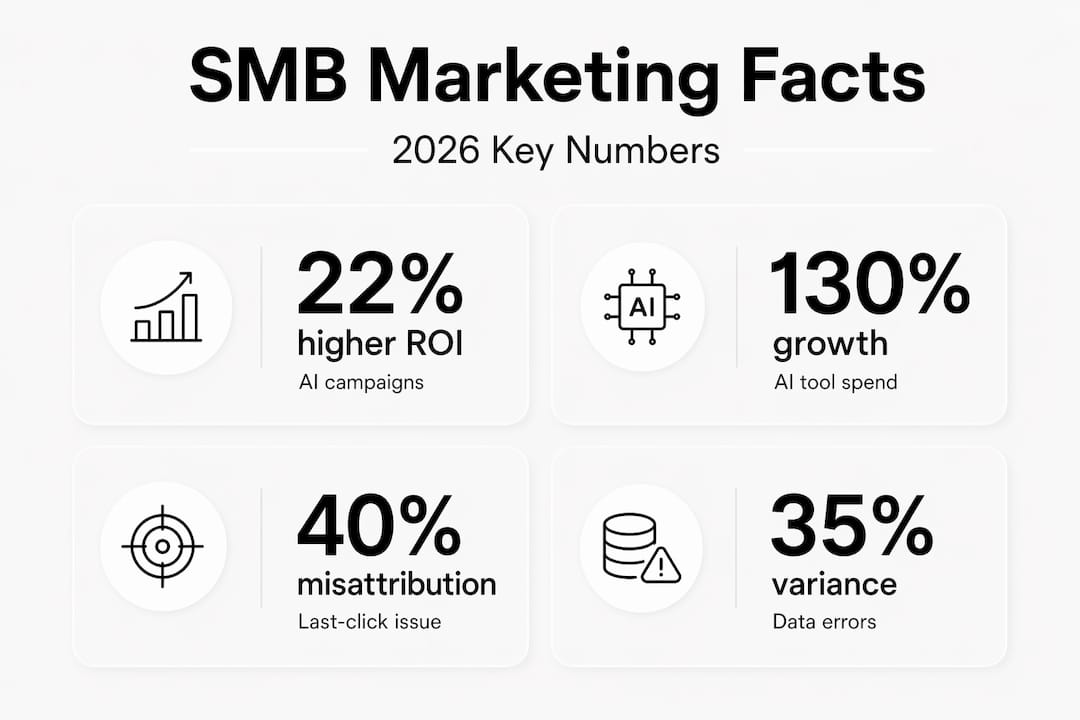
The problem with last-click attribution. Last-click attribution misattributes up to 40% of conversions, which means you are probably over-investing in the final touchpoint and under-investing in the channels that built awareness and intent earlier in the journey. Multi-touch attribution models spread credit across all the touchpoints a customer experienced, giving you a much more accurate picture of what is actually driving results.
Cross-channel data integration is the next step. When your website analytics, email platform, CRM, and ad accounts are feeding into a single dashboard, you can see the full customer journey rather than isolated snapshots. Tools like Google Looker Studio make this achievable for SMBs without enterprise budgets.
Key metrics to track across your marketing performance:
- Cost per acquisition (CPA): What you actually pay to win a customer, not just a click
- Customer lifetime value (CLV): How much a customer is worth over time, not just on first purchase
- Return on ad spend (ROAS): Revenue generated per pound of paid advertising
- Organic traffic growth: A measure of whether your SEO and content effort is compounding
- Email open and click rates by segment: Tells you whether your personalisation is working
Data integrity issues cause up to 35% variance in reported marketing ROI. If your data is messy, your decisions will be too. Establish a monthly data audit process to catch discrepancies early.
Marketing must now be accountable for measurable outcomes. The practical discipline that follows from this is reviewing your marketing spend every quarter and cutting the bottom 20% of performers. Reinvest that budget into what is working. Over time, this compounds significantly.
For a deeper look at which numbers to prioritise, the key digital marketing metrics guide from Fyldedigital covers the metrics that genuinely move businesses forward.
Common pitfalls and how to avoid them
Even businesses with strong foundations and clear strategies run into problems. The good news is that most of these problems are predictable.
Over-reliance on AI without strategy. AI tools are genuinely useful, but they execute on the direction you give them. If your strategy is vague, the output will be vague. Use AI to accelerate well-defined tasks rather than to substitute for thinking.
Spreading budget too thin. Investment in AI marketing tools is projected to grow over 130% in the next three years, which means more options, not fewer decisions. Resist the temptation to try every new platform or tool. More channels with less resource produces worse results than fewer channels executed well.
Neglecting brand authenticity. Trust and authenticity are economic assets in an environment flooded with AI-generated content. Customers can sense when content is generic. The businesses that maintain a distinctive voice and genuine point of view will stand out precisely because so many others are leaning on automated production.
Spending too much time on tactical firefighting. Marketers spend roughly 70% of their time on today’s work and only 30% on future planning. If that ratio sounds familiar, block time specifically for strategy review each week. Treat it as non-negotiable.
Pro Tip: When you feel overwhelmed by the number of digital marketing options available, ask one question: which single activity is most likely to bring in a qualified lead this month? Start there and build outwards.
Building internal capability alongside outsourcing specific functions is the most practical route for most SMBs. Keep measurement and content strategy in-house where possible, and bring in specialists for technical SEO, paid advertising, or web design where the skill ceiling is highest.
My honest take on SMB digital marketing in 2026
I’ve worked with enough small businesses to know that the biggest obstacle is rarely budget or tools. It’s the habit of jumping to tactics before the strategy is clear.
I’ve seen businesses spend thousands on paid ads pointing to a website that wouldn’t convert a warm lead. I’ve seen others chasing every new platform while their email list, their most direct line to customers, was gathering dust. The pattern is consistent. Tactics feel productive. Strategy feels slow. But strategy is what makes the tactics pay off.
My view on AI is probably more measured than you will read in most places. It genuinely is operational infrastructure now, as Deloitte puts it. But the businesses using it well are the ones who defined their workflows clearly before they automated them. Automating a broken process just produces bad output faster.
On measurement, the 26% ROI improvement from better attribution is real, but the bigger win is psychological. When you can see clearly which activities are working, you stop wasting money on the ones that are not. That clarity is what most SMBs actually lack.
Build your systems. Measure honestly. Cut what is not working. And do not let the pace of technology change make you feel like you are always behind. You are not.
— tibor
How Fyldedigital helps SMBs grow in 2026
If this guide has highlighted gaps in your current approach, Fyldedigital is built to help SMBs close them without the overhead of a large agency.
Fyldedigital’s services cover professional web design built to convert visitors into enquiries, targeted SEO campaigns that build long-term organic visibility, and social media management that creates genuine engagement rather than vanity metrics. Every strategy is tailored to your business goals, your audience, and the channels most likely to produce results for your sector.
Whether you are starting from scratch or looking to get better returns from an existing digital presence, the team at Fyldedigital works with businesses across the Fylde Coast and beyond. Request a free website or SEO review and get an honest assessment of where the opportunities are and what it would take to act on them. No obligation, no jargon. Just practical guidance grounded in the realities of 2026 digital marketing.
FAQ
What is the most important digital marketing trend for SMBs in 2026?
AI integration into workflows is the single most impactful shift, with AI-driven campaigns delivering 22% higher ROI and significantly faster campaign launches. The priority is building AI into repeatable tasks so your team can focus on strategy.
How many digital marketing channels should an SMB focus on?
Focus on three channels that match where your audience spends time. Spreading budget across too many platforms dilutes effort and produces weaker results than concentrating on a smaller number done well.
Why is last-click attribution a problem for small businesses?
Last-click attribution credits only the final touchpoint before a purchase, which misattributes up to 40% of conversions. This leads SMBs to overspend on bottom-of-funnel channels and underinvest in the awareness activities that actually start the buying journey.
When should an SMB outsource digital marketing?
Outsource when internal skill gaps are slowing results or when the cost of hiring in-house exceeds the cost of a specialist partner. Keeping measurement and content strategy in-house while outsourcing technical areas like SEO or paid advertising is a sensible approach for most businesses.
How do I know if my digital marketing is actually working?
Track cost per acquisition, customer lifetime value, and organic traffic growth rather than vanity metrics like impressions. Reviewing these figures monthly and cutting the bottom 20% of spend each quarter is the discipline that separates businesses that grow from those that stand still.