Your logo is not your brand identity. It is part of it, but only a small part. Brand identity is the complete visible and verbal system your business uses to express who you are, what you stand for, and why customers should choose you over anyone else. Get it right and it becomes one of your most powerful marketing assets. Get it wrong, or ignore it entirely, and even a good product struggles to build the recognition and trust it deserves.
Table of Contents
- Key takeaways
- What brand identity really means
- The core elements of brand identity
- Why brand identity matters for your business
- How to define and build your brand identity
- Brand identity examples and pitfalls to avoid
- My take on brand identity for smaller businesses
- Ready to build a brand that gets noticed?
- FAQ
Key takeaways
| Point | Details |
|---|---|
| Identity goes beyond the logo | Brand identity includes your name, colours, typography, photography style, tone of voice, and the rules governing them. |
| Identity and image are different | Your brand identity is what you create; brand image is how customers actually perceive you. |
| Consistency protects recognition | Without clear governance rules, visual drift erodes the recognition you have worked hard to build. |
| Strategy comes first | Defining your mission, values, and audience before designing anything produces a more coherent and durable identity. |
| SMEs benefit from early systems | Creating style guides and templates early keeps identity consistent across every person who works on your brand. |
What brand identity really means
Brand identity is the organised, intentional system of visual and verbal elements a business uses to present itself consistently at every customer touchpoint. Think of it as your brand’s outward expression. The industry term you will see used by marketers and designers is brand identity system, because it really is a system rather than a collection of random design choices.
Brand identity encompasses your name, logo, colour palette, typography, photography style, tone of voice, and the rules that govern how all of these elements work together. Each component has a job to do, and they are most effective when they operate as a unified whole.
It helps to understand how brand identity relates to two closely connected terms. Here is the framework that clarifies the relationships:
- Brand identity is what your organisation deliberately creates. It is your intentional expression.
- Branding is the ongoing process of communicating and applying that identity across your marketing.
- Brand image is the perception that forms in the customer’s mind as a result.
These three concepts are distinct but interconnected. You control your identity and your branding process. You cannot directly control your brand image, but a strong, consistent identity is the most reliable way to shape it in your favour.
One more distinction worth making: brand identity is not the same as brand personality. Brand personality refers to the emotional character of a brand, the human traits customers associate with it. Identity is the tangible, designed expression of that character. Both matter for marketing success, but they are separate tools.
The core elements of brand identity
A well-built brand identity system has several layers. Understanding each one helps you see why no single element is sufficient on its own.
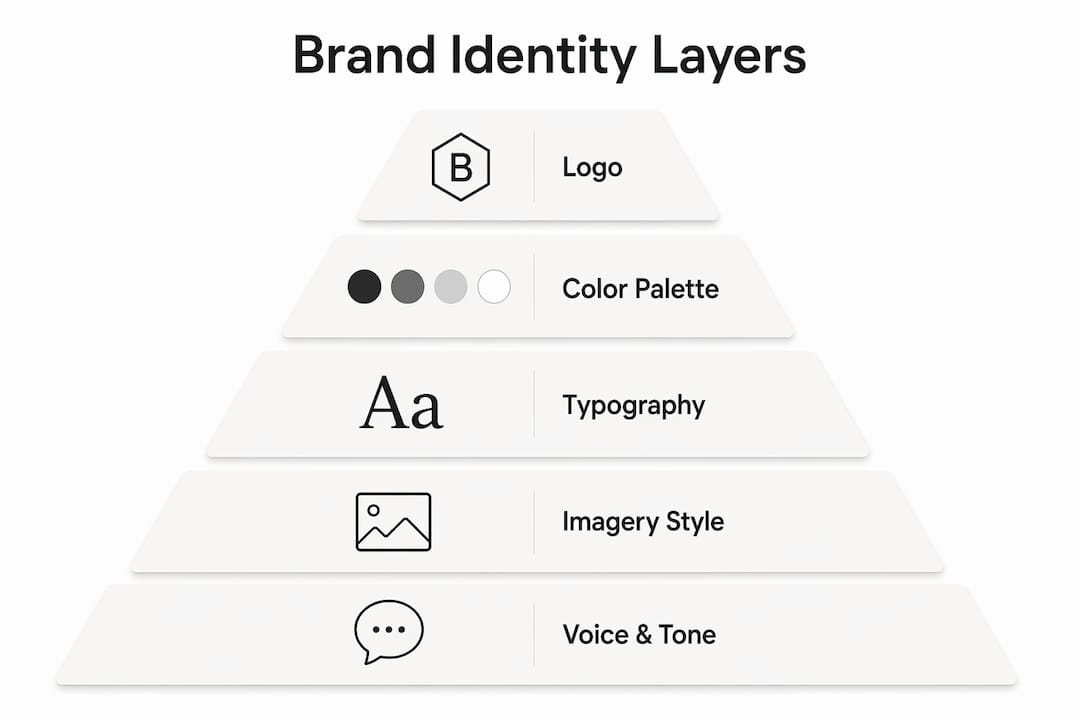
| Element | What it does | Example of poor application |
|---|---|---|
| Logo | Primary visual mark and shorthand for recognition | Multiple versions in use with no clear primary mark |
| Colour palette | Creates visual consistency and emotional association | Random colours used across different materials |
| Typography | Signals personality and aids readability | Three different fonts used across website, print, and social media |
| Photography/illustration style | Sets the visual tone and emotional register | Stock photos mixed with branded imagery inconsistently |
| Tone of voice | Expresses brand personality through language | Formal on the website but casual on social media |
| Governance rules | Specifies how every element is applied correctly | No documented standards, leaving each designer to decide |
The governance layer is the one most businesses overlook. You can invest in a beautiful logo and a thoughtfully chosen colour palette, but without documented application rules specifying things like logo clear space, minimum sizes, and acceptable colour combinations, each designer or freelancer you work with will make their own decisions. Over time, those small deviations compound into something that no longer looks or sounds like the same brand.
Pro Tip: When briefing a designer, ask not just for logo files but for a mini brand guidelines document covering your colour codes (in HEX, RGB, and CMYK), your approved typefaces, and at least three examples of correct logo usage.
Every element should express something real about your business. Your colour palette is not decoration. Research consistently shows that colour influences emotional response, so your choices should reflect the feeling you want customers to associate with you. The same logic applies to typography. A serif font carries different associations from a geometric sans-serif. Choose with intention, not habit.
Why brand identity matters for your business
For small and medium-sized businesses, a clear brand identity is not a luxury. It is a practical tool that directly affects how many leads you attract, how well your marketing performs, and how long customers stay with you.

A strong brand identity drives better customer recognition, deeper emotional connection, and measurably stronger marketing effectiveness. When people can recognise your business instantly, they spend less time evaluating you and more time engaging with what you offer. That is a direct commercial benefit.
Here is what a well-defined identity does for an SME in practical terms:
- Builds recognition across touchpoints. Whether someone sees your social media post, your van livery, or your website, they immediately know it is you. Consistency builds familiarity, and familiarity builds trust.
- Attracts the right audience. A focused identity signals who you are for and who you are not for. That self-selection saves you time and marketing spend.
- Supports every piece of marketing you produce. When your identity is clear, briefing designers, writing copy, and choosing imagery all become faster and more consistent.
- Differentiates you from competitors. In a crowded market, a distinctive identity gives people a reason to remember you specifically.
The risk of ignoring this is not abstract. Inconsistent brand identity does not just look untidy. It actively undermines the recognition you have worked to build, creates confusion in the customer’s mind, and makes your marketing feel less credible. For an SME competing against larger, better-resourced businesses, that is a real disadvantage.
It is also worth noting that brand identity shapes customer experience well beyond visual design. The way your team speaks on the phone, the language in your email confirmations, and the tone of your invoices all contribute to the impression customers form. Identity, applied properly, runs through every interaction.
How to define and build your brand identity
Building a brand identity that actually works for your business follows a clear sequence. Starting with design before strategy is the most common mistake.
- Define your brand strategy first. Before choosing a colour or typeface, get clear on your mission, your core values, and the audience you serve. These three anchors should inform every design decision that follows.
- Articulate your tone of voice. Write down three to five words that describe how your brand communicates. Add examples of sentences you would and would not say. This makes your voice reproducible by anyone writing on your behalf.
- Commission or create your visual elements. With your strategy defined, work with a designer to develop your logo, colour palette, and typography. Provide your strategy brief so the design has meaning, not just aesthetics.
- Document everything in a brand guidelines document. This does not need to be a 60-page PDF. A clear, practical style guide covering your logo rules, colour codes, typefaces, and voice guidelines is enough to keep a small team aligned. Accessible style guides and templates are particularly valuable for SMEs working with freelancers, agencies, and in-house staff simultaneously.
- Apply your identity consistently from day one. Your website, your social media profiles, your email signature, and your printed materials should all speak the same visual and verbal language.
- Review and refresh at intervals. A brand identity is not static. As your business grows and your market shifts, revisit your identity to check it still reflects who you are and where you are going.
Pro Tip: Use a shared folder or brand management tool to store your logo files, colour swatches, and fonts in one place. Give everyone who works on your marketing access to it. This single habit prevents most of the inconsistency problems SMEs face.
For businesses thinking about how to build a digital brand, this same process applies directly. Your website is often the most visible expression of your brand identity, so it deserves particular attention when it comes to consistency.
A useful internal resource for SMEs exploring branding services options can help you understand what professional support looks like and what questions to ask a potential agency.
Brand identity examples and pitfalls to avoid
Looking at real businesses helps make these concepts concrete. Consider a well-regarded independent coffee shop. Its identity might include a hand-drawn logo, a warm earthy colour palette, conversational copy, and photography that always features real people rather than styled product shots. Every element signals the same thing: approachable, authentic, community-focused. Remove any one element and the message weakens. Change the colour palette to corporate blue and grey and the identity collapses entirely.
Now consider what most small businesses actually get wrong:
- Treating the logo as the entire identity. Many businesses invest in a good logo and then stop, leaving the rest of their brand expression unplanned and inconsistent.
- Skipping governance. Without clear rules, different designers create different versions of your materials, and visual drift accumulates gradually until your brand no longer feels cohesive.
- Confusing brand identity with brand image. You cannot fix a poor brand image by updating your logo. If the gap between your intended identity and customer perception is wide, the problem is usually in delivery and consistency, not design.
- Ignoring tone of voice. Businesses that invest in strong visuals but write their own copy without any voice guidelines often produce mixed messages that undermine their visual identity.
- Never revisiting the guidelines. An identity document written at launch and then forgotten stops serving the business within a few years as the team, the market, and the product evolve.
Building a consistent brand identity system also helps SMEs compete effectively against larger enterprises. When your identity is tight and well-governed, your marketing looks and feels as credible as a business ten times your size. That perception carries real commercial weight.
My take on brand identity for smaller businesses
I have worked with a lot of SMEs on their branding, and the pattern I see most often is this: business owners understand they need a logo, get one made, and then treat the work as done. The identity sits in a single PDF that nobody looks at, and within 18 months the brand looks like it belongs to three different companies.
Here is the part that most branding advice skips. For a small business, the biggest identity problem is not design quality. It is that brand identity captures the firm’s meaning intent, and most SMEs have never explicitly defined what that meaning is. They have not written down what they stand for or how they want to make customers feel. Without that foundation, even a beautifully designed logo cannot do its job.
My honest view is that most SMEs do not need a large budget to build a strong identity. They need clarity and discipline. Spend time writing your brand strategy before you commission a single design asset. That hour of thinking will save you months of inconsistent marketing further down the line. And please do not let “we are too small for brand guidelines” be the reason you skip the governance step. A one-page document with your logo files and colour codes is enough to start.
— tibor
Ready to build a brand that gets noticed?
If you have been working through this guide and realise your business identity needs more structure, Fyldedigital can help. We work with small and medium-sized businesses across the Fylde Coast and beyond to create consistent, purposeful brand identities that translate directly into stronger marketing results.
From professional web design that expresses your identity online to logos and branding services that give you a complete, governed identity system, we tailor every project to your business goals and audience. If you want a brand that builds recognition, attracts the right customers, and makes your marketing work harder, get in touch with Fyldedigital today for a free review.
FAQ
What is brand identity in simple terms?
Brand identity is the complete set of visual and verbal elements a business uses to present itself consistently, including its logo, colours, typography, and tone of voice. It is the intentional expression of what your brand stands for.
What is the difference between brand identity and brand image?
Brand identity is what your business creates and controls. Brand image is how customers actually perceive you. The goal of good branding is to close the gap between the two.
What are the main elements of brand identity?
The core elements include your logo, colour palette, typography, photography or illustration style, tone of voice, and the governance rules that specify how all of these are applied consistently.
Why is brand identity important for small businesses?
A clear brand identity builds customer recognition, supports every piece of marketing you produce, and helps you stand out from competitors. Without it, inconsistent presentation erodes trust and makes your marketing less effective.
How do I start building a brand identity?
Start with your brand strategy by defining your mission, values, and audience. From there, develop your visual and verbal elements, document the rules in a style guide, and apply them consistently across every customer touchpoint.