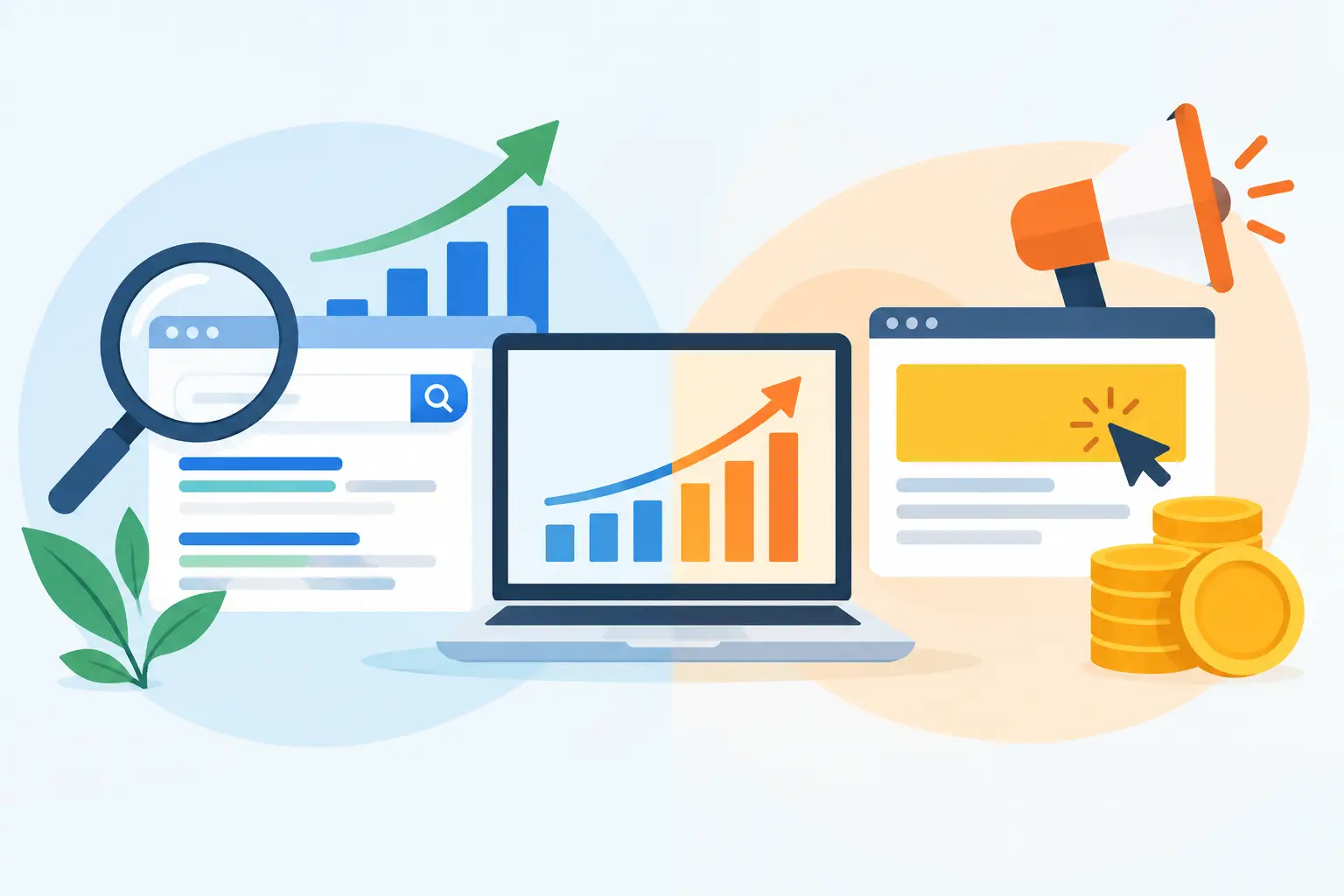
SEO terminology is the set of specialised words and phrases that describe the practice of improving a website’s visibility in search engines. Understanding this language is not optional for small business owners in 2026. It is the difference between briefing an agency with confidence and nodding along without knowing what you are paying for. SEO covers technical setup, content quality, structured data, and external signals to improve how your site ranks. Tools like Moz, Ahrefs, and Semrush have built entire knowledge bases around this vocabulary because the terms genuinely matter. This guide gives you a practical, plain-English walkthrough of the concepts that drive real results.
What are the core SEO terms every small business should know?
SEO, or Search Engine Optimisation, is the practice of improving your site’s organic visibility so that the right people find you without paid advertising. Organic traffic is the visitors who arrive through unpaid search results. The more relevant your content and the stronger your site’s authority, the more organic traffic you attract.
A SERP, or Search Engine Results Page, is the page Google or Bing displays after someone types a query. Your goal is to appear as high as possible on that page. The algorithm is the set of rules a search engine uses to decide which pages rank where. Google updates its algorithm hundreds of times per year, which is why SEO is an ongoing process rather than a one-time task.

Crawling and indexing are two distinct steps. Crawling is when a search engine bot visits your pages to read their content. Indexing is when those pages are stored in the search engine’s database and become eligible to appear in results. If your pages are not indexed, they will not rank, regardless of how good the content is.
Search intent is the underlying goal users have when they type a query. The four categories are informational, navigational, commercial, and transactional. Matching your content to the correct intent is one of the most direct ways to improve your rankings.
Here is a quick reference for the terms covered above:
| Term | Definition |
|---|---|
| SEO | Improving organic search visibility through content, technical setup, and authority |
| SERP | The results page a search engine displays after a query |
| Algorithm | Rules a search engine uses to rank pages |
| Crawling | A bot visiting and reading your web pages |
| Indexing | Storing crawled pages in the search engine’s database |
| Search intent | The goal behind a user’s search query |
| Organic traffic | Visitors arriving through unpaid search results |
Pro Tip: Use Google Search Console to check which of your pages are indexed and spot any crawling errors before they affect your rankings.
How has keyword research evolved, and why does it matter in 2026?
Keyword research is the process of identifying the words and phrases your potential customers type into search engines. For years, the dominant approach was to chase the highest search volume. That approach is now outdated.
Modern keyword research prioritises business value over volume to drive leads and brand awareness rather than raw traffic numbers. A keyword with 200 monthly searches that attracts buyers is worth more than one with 20,000 searches that attracts browsers. This shift matters because AI-powered search features, including Google’s AI Overviews and tools like Perplexity, are absorbing informational queries without sending clicks to your site. The traffic that reaches you needs to convert.
Keyword research has also expanded beyond Google. Platforms like Amazon, Reddit, and YouTube are now legitimate search channels. Understanding what people ask on Reddit, for example, reveals the exact language your customers use when they are genuinely confused or curious. That language belongs in your content.
Here is a practical framework for prioritising keywords in 2026:
- List your core services or products. Start with what you actually sell, not what gets searched most.
- Identify the search intent. Is the searcher looking to buy, compare, or learn? Match your page type to the intent.
- Check click potential. If Google’s SERP for a keyword is dominated by AI Overviews or featured snippets, organic clicks will be low. Prioritise keywords where traditional results still appear.
- Filter by business value. Ask whether ranking for this keyword would bring enquiries, leads, or purchases. If the answer is no, deprioritise it.
- Research prompt-style queries. AI search tools respond to conversational questions. Include natural-language phrases in your content to capture this growing traffic source.
- Use Semrush or Ahrefs to validate demand. Check that real search volume exists before investing in content creation.
Pro Tip: Search your target keyword in Google and study the “People also ask” section. Those questions reveal exactly what your audience wants to know, and answering them directly in your content improves your chances of appearing in featured snippets.
For a deeper look at how these trends are reshaping digital marketing, the 2026 marketing trends analysis from Fyldedigital covers the broader picture well.
What are the main categories of SEO and how do they differ?
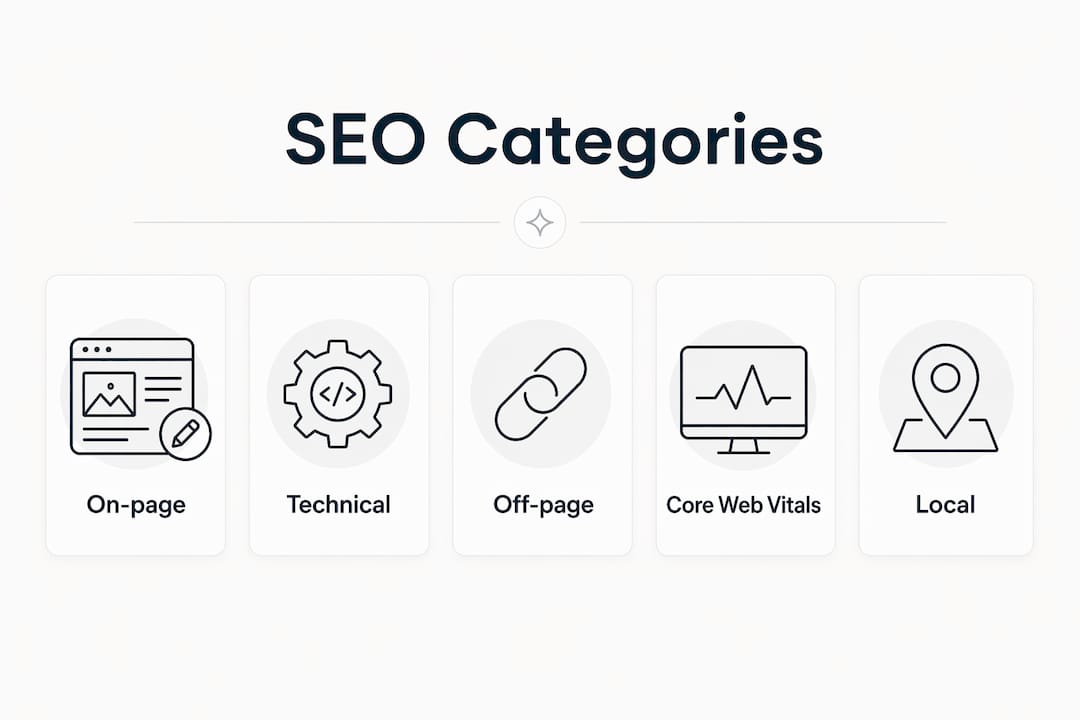
SEO terminology falls into five clear categories. Each one addresses a different part of how search engines find, evaluate, and rank your site. Understanding the categories helps you spot where your own site is weak.
On-page SEO focuses on optimising content and HTML source code, including title tags, meta descriptions, header tags, alt text, and content structure. A title tag is the clickable headline that appears in search results. A meta description is the short summary beneath it. Both influence whether someone clicks your result, even though meta descriptions are not a direct ranking factor.
Technical SEO addresses crawlability, canonical tags, redirects, schema markup, and site speed. A canonical tag tells search engines which version of a page is the definitive one, preventing duplicate content issues. Schema markup is structured data code that helps search engines understand your content and display rich results, such as star ratings or FAQ boxes, directly in the SERP.
Off-page SEO covers everything that happens away from your website. Quality backlinks from relevant sites carry more authority and influence rankings more than volume alone. One link from a respected industry publication outweighs fifty links from unrelated directories.
Core Web Vitals are performance metrics measuring real-world user experience, covering load time, interactivity, and visual stability. Google uses these as ranking signals. A slow or visually unstable page will lose ground to a faster competitor, even if the content is superior.
Local SEO is the practice of optimising your presence for location-based searches. It includes your Google Business Profile, local citations, and location-specific content. For businesses serving a defined area, local SEO is often the highest-return activity available.
| Category | Key terms | Primary goal |
|---|---|---|
| On-page SEO | Title tags, meta descriptions, header tags, alt text | Optimise content relevance and click-through rate |
| Technical SEO | Canonical tags, schema markup, site speed, redirects | Enable crawling, indexing, and rendering |
| Off-page SEO | Backlinks, domain authority, link building | Build site authority and trust |
| Local SEO | Google Business Profile, citations, local keywords | Rank for location-based searches |
| Core Web Vitals | LCP, INP, CLS | Improve user experience and page performance |
Pro Tip: Run a free Core Web Vitals check using Google PageSpeed Insights. It scores your pages and tells you exactly what to fix, in plain language.
How does understanding SEO terminology improve your marketing results?
Knowing the language of SEO changes how you work, not just what you know. The practical benefits show up in three specific areas.
Better content decisions. When you understand search intent, you stop writing content that feels right and start writing content that matches what people are actually searching for. A page targeting a transactional keyword needs a clear call to action and product information. A page targeting an informational keyword needs depth and answers. Confusing the two wastes your time and your budget.
Stronger agency and developer relationships. Understanding SEO language enables clearer strategy implementation, technical auditing, and campaign optimisation. When an agency mentions canonical tags or anchor text, you can engage with the recommendation rather than simply approving it. That engagement leads to better briefs, fewer revisions, and campaigns that reflect your actual business goals. You can explore what this looks like in practice through Fyldedigital’s guide on choosing SEO agency support.
Sharper reporting literacy. SEO reports are full of terms like domain authority, click-through rate, impressions, and bounce rate. If you cannot interpret these figures, you cannot tell whether your investment is working. Knowing that a high impression count with a low click-through rate means your title tags need work, for example, turns a confusing spreadsheet into a clear action plan.
Here are the specific areas where terminology knowledge pays off most directly:
- Meta tag optimisation: Knowing what title tags and meta descriptions do means you can write or approve them with purpose rather than guesswork.
- Backlink strategy: Understanding that quality outweighs quantity stops you wasting money on low-value link-building packages.
- Site structure: Knowing how internal links distribute authority helps you plan your website’s architecture to support your most important pages.
- Analytics interpretation: Terms like organic sessions, conversion rate, and dwell time become useful signals rather than noise.
- Content briefs: You can brief writers with specific intent targets, keyword clusters, and heading structures rather than vague topic descriptions.
The small business SEO strategies guide from Fyldedigital shows how these concepts apply in real campaigns.
Key takeaways
SEO terminology is the foundation of every effective digital marketing decision, and mastering it gives small business owners direct control over their visibility, their agency relationships, and their results.
| Point | Details |
|---|---|
| Start with core terms | Understand SEO, SERP, crawling, indexing, and search intent before anything else. |
| Prioritise business-value keywords | Filter keywords by lead and conversion potential, not search volume alone. |
| Know your SEO categories | On-page, technical, off-page, local, and Core Web Vitals each require different actions. |
| Use terminology to manage agencies | Shared language leads to better briefs, clearer audits, and stronger campaign results. |
| Keep learning as SEO evolves | AI search and Core Web Vitals are reshaping rankings; staying current protects your visibility. |
Why I think most small businesses are learning SEO terminology in the wrong order
Most guides start with the technical terms because they are the most impressive to list. Canonical tags, hreflang attributes, schema markup. They read like authority. But in my experience, the businesses that see the fastest improvement are the ones that start with intent and keywords, not with technical infrastructure.
The reason is simple. You can have a perfectly crawlable, technically flawless website that ranks for nothing useful because nobody thought carefully about what their customers are actually searching for. The terminology that matters first is the terminology that connects your business to real demand: search intent, keyword clusters, and the difference between informational and transactional queries.
The role of AI search engines in modern SEO is also shifting which terms deserve your attention in 2026. Prompt research and click potential are now as important as traditional keyword volume. Small businesses that understand this shift early will hold an advantage over those still chasing high-volume terms that AI Overviews now answer without a click.
My honest recommendation: spend thirty minutes with Semrush’s keyword research tool before you touch a single title tag. The vocabulary will follow naturally once you understand what you are trying to achieve.
— tibor
How Fyldedigital helps small businesses put SEO into practice
Understanding SEO terminology is the first step. Applying it to your website and marketing campaigns is where the real work begins.
Fyldedigital works with small and medium-sized businesses across the Fylde Coast and beyond, translating SEO concepts into practical strategies that improve rankings and generate enquiries. Whether you need a full SEO best practices review or a website built with search visibility in mind from the ground up, the team brings the technical knowledge and plain-English communication that local businesses need. If you are ready to stop guessing and start ranking, request a free SEO review today and find out exactly where your site stands.
FAQ
What does SEO terminology mean?
SEO terminology is the set of specialised terms used to describe the techniques and concepts involved in improving a website’s organic search visibility. It covers areas including keyword research, on-page optimisation, technical SEO, and link building.
What is the difference between on-page and technical SEO?
On-page SEO covers content and HTML elements such as title tags, meta descriptions, and header tags. Technical SEO addresses the infrastructure of your site, including crawlability, site speed, canonical tags, and schema markup.
Why does search intent matter for SEO?
Search intent is the goal behind a user’s query, categorised as informational, navigational, commercial, or transactional. Matching your page content to the correct intent is one of the most direct ways to improve rankings and attract visitors who are likely to convert.
What are Core Web Vitals?
Core Web Vitals are Google’s performance metrics measuring real-world user experience, specifically load time, interactivity, and visual stability. Google uses these as ranking signals, so a slow or unstable page can lose ground even with strong content.
How do I start learning SEO terminology as a beginner?
Begin with the foundational terms: SEO, SERP, organic traffic, keywords, and search intent. Tools like Semrush, Ahrefs, and Moz each offer free glossaries and tutorials that build your knowledge progressively without overwhelming you at the start.