SEO performance monitoring is the ongoing measurement of specific, business-linked indicators that show whether your website is attracting the right visitors and converting them into leads or sales. Knowing how to monitor SEO performance is not optional for a small business owner who wants predictable growth. Without a clear view of what is working, you are spending time and budget on guesswork. This guide gives you a practical framework for measuring SEO success through focused metrics, structured routines, and the right tools.
Which SEO metrics and KPIs matter most for your business?
Tracking 5–7 core KPIs focused on organic conversions, traffic volume, and search visibility is the recommended starting point for any business owner. That number is deliberate. Fewer metrics keep your attention on what drives revenue rather than what merely looks impressive in a report.
The metrics that matter most fall into four categories: traffic, engagement, conversions, and technical health. Organic traffic volume tells you how many people find you through search. Click-through rate (CTR) shows whether your page titles and descriptions are compelling enough to earn the click. Organic conversions, meaning enquiries, purchases, or sign-ups that originate from organic search, connect your SEO effort directly to revenue. Non-branded search visibility reveals how well you rank for terms that new customers use before they know your name.

Vanity metrics like raw pageviews or total keyword rankings often look good but fail to demonstrate business impact. A page that ranks for 500 keywords but generates zero enquiries is not an asset. It is a distraction. Prioritising business-linked KPIs keeps your SEO investment honest.
Pro Tip: Build your KPI set around the question “Does this metric tell me whether I am making more money from search?” If the answer is no, remove it from your weekly dashboard.
| Category | Key metric | What it tells you |
|---|---|---|
| Traffic | Organic sessions | Volume of visitors from search |
| Engagement | Click-through rate | How well your listings attract clicks |
| Conversions | Organic leads or sales | Direct business impact of SEO |
| Technical health | Crawl errors and index coverage | Whether Google can access your pages |
How to set up an effective SEO monitoring routine
Structure is what separates businesses that improve their SEO from those that simply hope it works. A tiered monitoring cadence divides your attention efficiently: daily checks for anomalies, weekly reviews for trends, and monthly deep dives for strategic decisions.
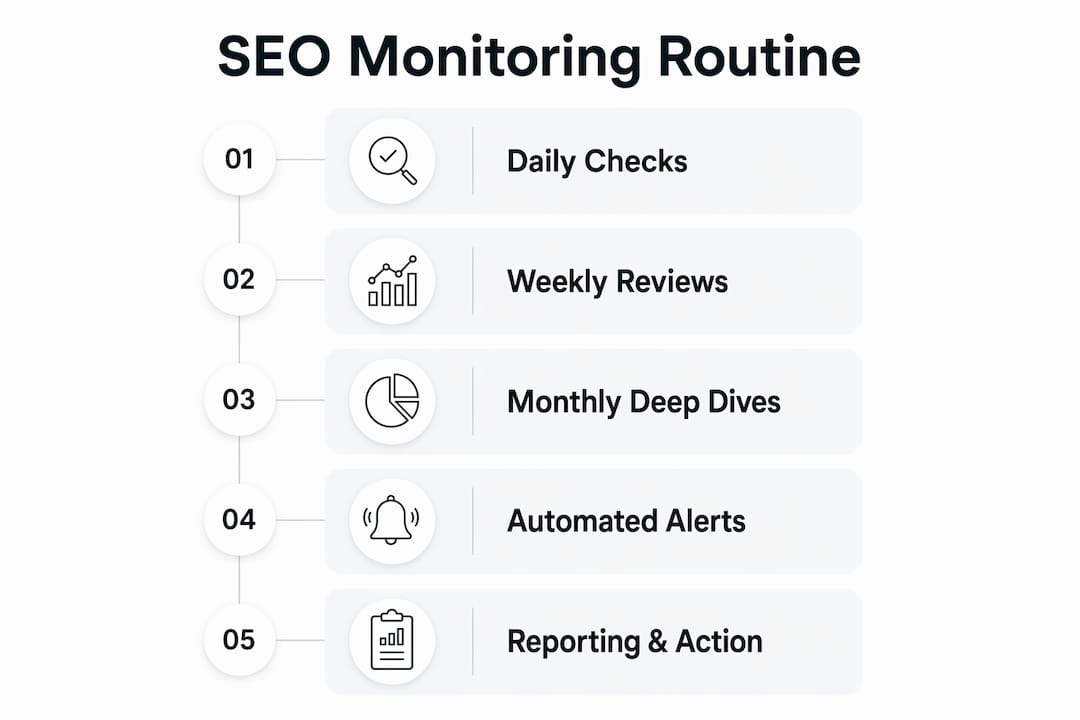
Daily checks (approximately 15 minutes)
Daily monitoring is not about obsessing over rankings. It is about catching problems before they cost you traffic. Spend roughly 15 minutes each day on the following:
- Check Google Search Console for new crawl errors or manual actions
- Scan for sudden drops in organic sessions using GA4 real-time or daily reports
- Review any automated alerts you have set for indexing issues or broken links
- Confirm that your key landing pages are still indexed and loading correctly
Weekly reviews (30–45 minutes)
Weekly reviews focus on trends rather than individual data points. Look at keyword position changes for your top 10–20 target terms. Review CTR shifts in Google Search Console, because a falling CTR on a stable ranking page signals a title or description problem. Check user engagement metrics in GA4, particularly bounce rate and session duration on your most important pages.
Monthly deep dives (approximately 60 minutes)
Monthly reviews lasting around 60 minutes are where you assess the bigger picture. Evaluate organic conversion rates, review your backlink profile for new links and lost links, and calculate your SEO ROI by comparing organic revenue against your investment in content and technical work. This is also the right time to update your digital marketing goals based on what the data shows.
Pro Tip: Set automated alerts in Google Search Console and GA4 for traffic drops exceeding 20% week on week. Automated alerts let you respond to problems before rankings deteriorate further.
What tools do you need to track website SEO performance?
The right tools remove the manual effort from SEO performance tracking and give you clean, reliable data. You do not need a large budget to get started. The most important data sources are free.
Google Search Console is the single most important tool for any business owner. It shows you which queries bring visitors to your site, your average position for those queries, your CTR, and any technical issues Google has found. Google Analytics 4 (GA4) sits alongside it, showing you what visitors do after they arrive, including whether they convert. Together, these two platforms cover the majority of what you need for day-to-day monitoring.
Building a monitoring dashboard that integrates data from Google Search Console, GA4, and a rank tracker simplifies spotting trends and sharing results with colleagues or clients. A custom dashboard removes the need to log into multiple platforms every day. You can build a basic version using Google Looker Studio, which connects to both Google Search Console and GA4 for free.
Pro Tip: Create a focused keyword set of 20–50 terms that represent your most valuable pages. Tracking hundreds of keywords creates noise. A tight list tied to your core SEO strategy keeps your attention on what matters.
| Tool type | Primary use | Expertise required |
|---|---|---|
| Google Search Console | Query data, indexing, CTR | Beginner |
| Google Analytics 4 | Traffic, conversions, behaviour | Beginner to intermediate |
| Rank tracker | Keyword position monitoring | Beginner |
| Crawl tool | Technical site health | Intermediate |
| Reporting dashboard | Visualisation and sharing | Beginner to intermediate |
How do you analyse and interpret SEO performance data?
Raw data does not improve your rankings. Interpretation does. The goal of analysing your SEO data is to answer one question: what should I do differently next month?
SMART goals (Specific, Measurable, Achievable, Relevant, Time-bound) are the framework that separates meaningful analysis from reacting to noise. A SMART SEO goal looks like this: “Increase organic enquiries from the services page by 15% over the next 90 days.” That goal tells you exactly which page to watch, which metric to track, and when to evaluate. Without that structure, every fluctuation feels like a crisis.
Segment your data rather than looking at site-wide averages. Break organic traffic down by landing page, device type, and location. A page that performs well on desktop but poorly on mobile may have a layout or speed issue rather than an SEO problem. Segmentation reveals the real cause.
Look for patterns across at least 90 days before drawing conclusions. SEO success measurement requires focusing on metrics tied to business goals, including assisted conversions, to fully capture SEO’s contribution to revenue. A visitor who finds you through search, leaves, and returns directly to buy still represents an SEO win. Multi-touch attribution in GA4 helps you see that contribution.
When reporting to stakeholders, match the metric to the audience:
- For business owners or directors: organic revenue, organic leads, and SEO ROI
- For marketing teams: keyword rankings, CTR, and organic session trends
- For technical teams: crawl errors, page speed scores, and index coverage
Refer to real examples when you can. The SEO growth case study from Fyldedigital shows how consistent monitoring and focused KPI tracking translate into measurable ranking improvements and lead growth over time.
Key takeaways
Effective SEO performance monitoring requires a focused set of 5–7 business-linked KPIs, a structured daily, weekly, and monthly review cadence, and the right combination of tools to turn data into decisions.
| Point | Details |
|---|---|
| Focus on 5–7 KPIs | Track organic conversions, traffic, CTR, and search visibility rather than vanity metrics. |
| Use a tiered cadence | Daily 15-minute checks, weekly trend reviews, and monthly 60-minute deep dives keep monitoring manageable. |
| Start with free tools | Google Search Console and GA4 cover the majority of what small businesses need to track SEO performance. |
| Set SMART goals | Specific, time-bound goals separate meaningful data changes from normal fluctuations. |
| Segment your data | Break results down by landing page and device to find the real cause of performance changes. |
What I have learned from years of monitoring SEO
The most common mistake I see business owners make is tracking too many metrics and acting on too few of them. They build dashboards with 30 data points, feel reassured by the volume of information, and then make no changes because nothing is clear enough to act on. Tracking too many metrics leads to analysis paralysis. The discipline is in cutting, not adding.
The second lesson is about patience. SEO is not a tap you turn on. It is closer to tending a garden. You plant content, fix technical issues, build links, and then wait for results to compound. The businesses I have seen succeed with SEO are the ones that commit to a monthly review cadence and stick to it even when the numbers are flat. Consistency beats intensity every time.
The third thing I would tell any business owner is this: tie every KPI to a business outcome before you start tracking it. If you cannot explain why a metric matters to your revenue or lead generation, remove it. The key digital marketing metrics that move the needle are almost always fewer than you think. Ruthless focus on those metrics is what separates businesses that grow through search from those that chip away without direction.
— tibor
How Fyldedigital supports your SEO performance tracking
Knowing what to track is one thing. Having the time and expertise to act on it is another. Fyldedigital works with small and medium-sized businesses across the Fylde Coast and beyond to set up professional SEO monitoring services that are built around your specific business goals, not generic templates.

From a full SEO audit and custom KPI dashboard to monthly reporting and hands-on optimisation, Fyldedigital gives you a clear picture of where your organic traffic comes from and what it is worth. If you are ready to move from guessing to knowing, request a free SEO review at Fyldedigital and find out exactly where your site stands today.
FAQ
What is SEO performance monitoring?
SEO performance monitoring is the regular measurement of key indicators, such as organic traffic, keyword rankings, and conversions, to assess whether your SEO activity is delivering business results.
How often should I check my SEO metrics?
Daily checks for critical anomalies take around 15 minutes, while monthly strategic reviews take approximately 60 minutes. Weekly trend reviews sit between the two and focus on keyword and engagement changes.
Which SEO metrics should a small business track?
Focus on organic sessions, organic conversions, click-through rate, search visibility, and crawl health. These five core metrics align SEO activity with business outcomes without creating data overload.
What tools do I need to monitor SEO performance?
Google Search Console and Google Analytics 4 are the two most important tools and both are free. A rank tracker and a crawl tool add depth for businesses ready to go further.
How do I know if my SEO is actually working?
Set SMART goals tied to specific business outcomes, such as a target number of organic enquiries per month. SMART goal frameworks help you distinguish genuine progress from normal fluctuations in search traffic.
Recommended
- SEO Review for Small Business That Drives Growth – Fylde Digital – Web Design SEO Social Media
- SEO Growth Case Study: What Actually Works – Fylde Digital – Web Design SEO Social Media
- Website SEO Audit Checklist for Better Rankings – Fylde Digital – Web Design SEO Social Media
- Small business SEO checklist: your 2026 guide