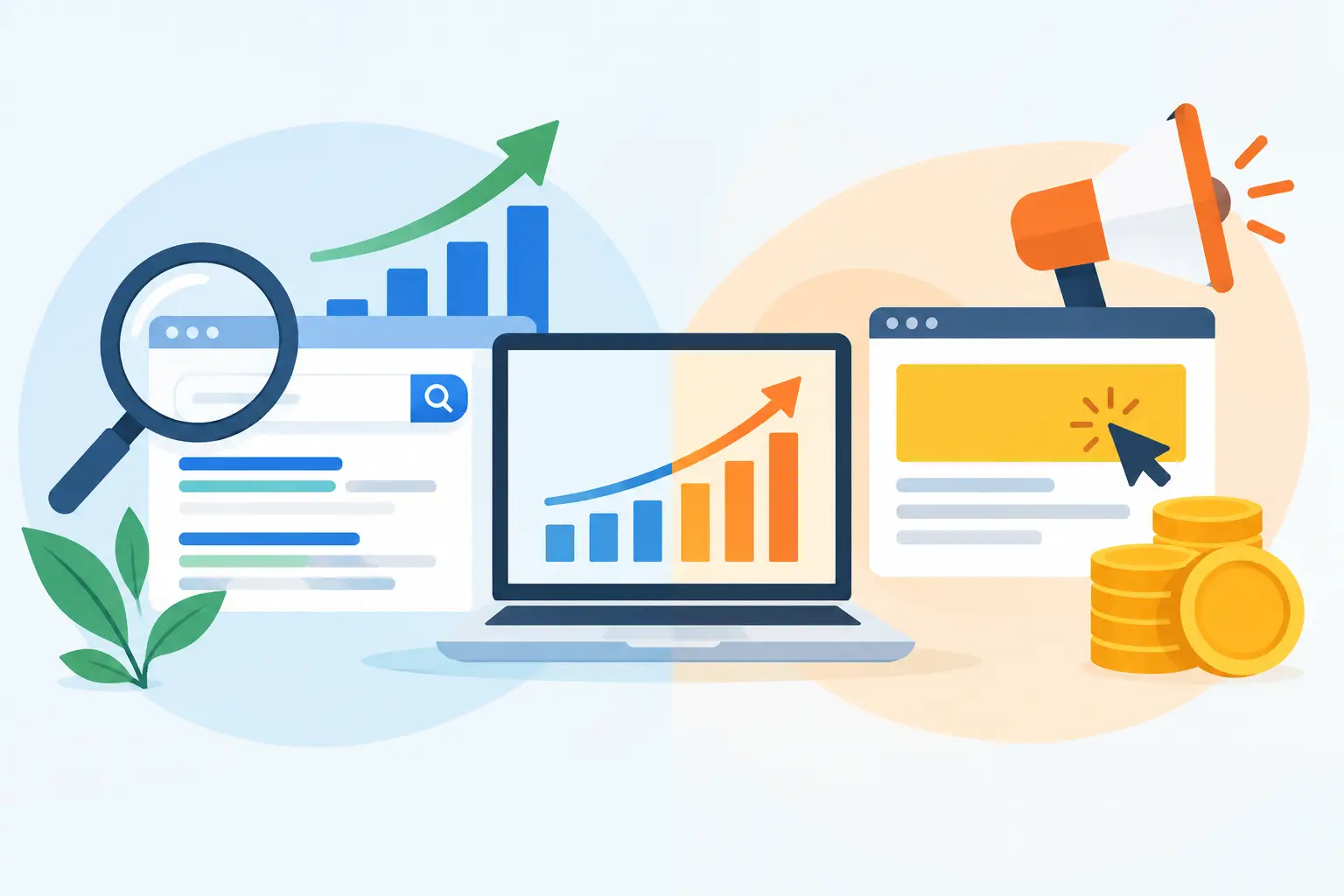
Off-page SEO is defined as every optimisation action taken outside your own website to improve its authority, trust, and position in search engine results. Where on-page SEO shapes what your site says, off-page SEO shapes what the wider web says about you. It covers backlinks, brand mentions, and social signals, all of which act as external votes of confidence in your business. Search engines treat these signals as evidence that your site deserves to rank. For small and medium-sized businesses, understanding off-page optimisation is not optional. It is the difference between a website that sits quietly in the dark and one that consistently attracts enquiries.
What is off-page SEO and which factors drive it?
Off-page SEO is the collection of external signals that tell search engines your website is credible and worth ranking. Think of it as your online reputation. Just as a new restaurant earns trust through word of mouth and press coverage rather than its own menu, your website earns authority through what others say about it.
Backlinks remain a top ranking factor, acting as direct votes from one site to another. They come in three forms: natural links earned without asking, manual links acquired through outreach, and self-created links placed in directories or forums. Natural links carry the most weight because they signal genuine endorsement. Manual outreach links are the workhorse of most SEO campaigns, while self-created links carry the least value and the highest risk.
Brand mentions are a second major signal. A mention of your business name on a respected news site or industry blog tells search engines you exist and matter, even when there is no hyperlink attached. Unlinked brand mentions still help search engines build entity recognition and topical authority. That means every press feature, podcast appearance, or directory listing contributes to your standing.
Local citations, which are consistent listings of your business name, address, and phone number across directories such as Google Business Profile, Yell, and Bing Places, are particularly important for location-specific searches. Social media engagement does not directly influence rankings, but social visibility amplifies content exposure, which leads to earned links over time. Influencer outreach works on the same principle: third-party validation from a trusted voice carries weight with both audiences and algorithms.
| Off-page factor | SEO impact | Your control level |
|---|---|---|
| Editorial backlinks | Very high | Moderate (via outreach) |
| Unlinked brand mentions | Medium | Low to moderate |
| Local citations | High for local search | High |
| Social media signals | Indirect | High |
| Influencer endorsements | Medium to high | Moderate |
How has off-page SEO evolved with E-E-A-T?
Off-page SEO now extends well beyond link counting. Google’s quality framework, known as E-E-A-T (Experience, Expertise, Authoritativeness, and Trustworthiness), has made the credibility of the people and organisations behind content a direct ranking consideration. This is a significant shift for small businesses.
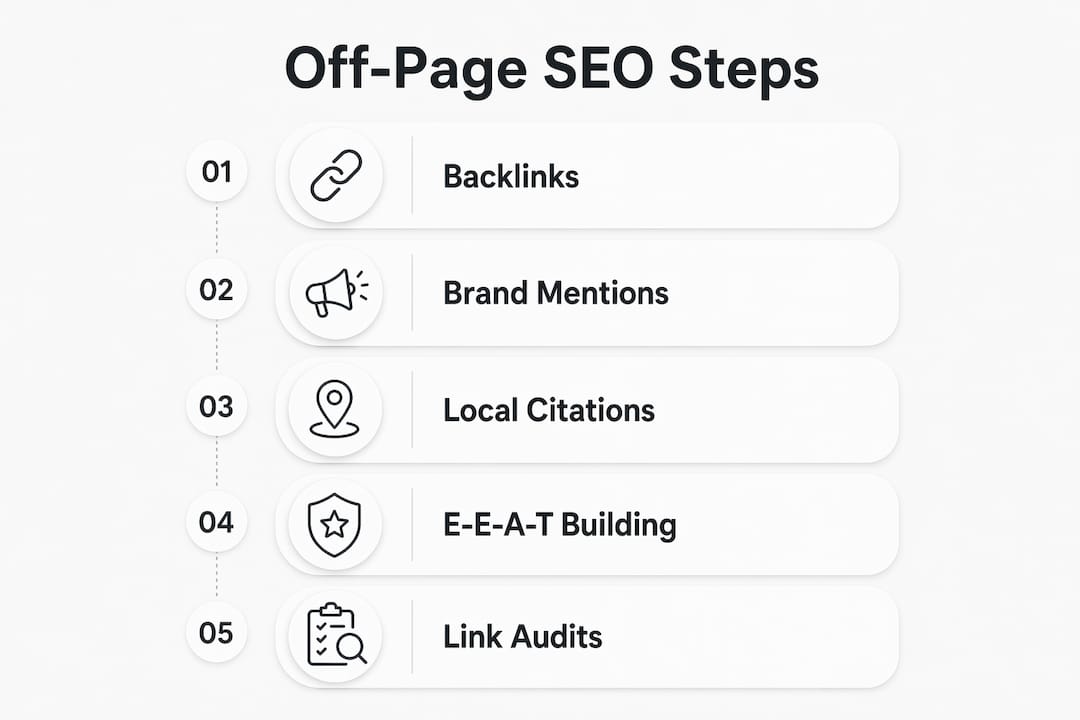
Building E-E-A-T involves verifying expert author credentials, including professional profiles, verifiable experience, and third-party coverage. A business owner who appears in a trade publication, contributes a guest article to an industry site, or earns a testimonial from a recognised body is actively building E-E-A-T through off-page activity. These signals tell search engines that real, qualified people stand behind the content.
Original research and data are now among the most powerful off-page assets a business can produce. Embedding original statistics early in content increases the chance of external sites citing it, which generates natural backlinks without manual outreach. A single well-researched industry report can attract links from journalists, bloggers, and trade bodies for months after publication.
The practical implications for your off-page SEO checklist are clear:
- Build a credible author profile with a professional biography and verifiable credentials.
- Seek coverage in trade publications, local press, and industry directories.
- Produce original research, surveys, or data reports that others will want to reference.
- Use infographics to make data shareable across social platforms and blogs.
- Pursue guest articles on reputable, niche-relevant sites rather than generic directories.
Pro Tip: Place your key statistic or research finding within the first two paragraphs of any content you publish. AI tools and journalists scan the opening of an article first. If your data appears early, it is far more likely to be cited.
Why does quality beat quantity in link building?
Link building is the process of acquiring hyperlinks from other websites to your own. The common misconception is that more links always mean better rankings. Topical relevance is significantly more valuable than sheer volume. A single link from a respected industry publication in your sector carries more weight than fifty links from unrelated, low-quality directories.
Editorial placement matters enormously. Links embedded within article bodies significantly outperform those in footers or sidebars. A link woven into the body of a relevant article signals genuine endorsement. A link buried in a footer signals little more than a paid placement.
“Spammy or black hat link-building practices are heavily penalised by search engines, threatening brand reputation and rankings. White hat link-building strategies that create genuine value produce sustainable rankings and protect reputation.” — Link building, Wikipedia
The risks of cutting corners are real. Buying links in bulk, participating in link schemes, or using private blog networks can trigger a Google penalty that strips your rankings overnight. Recovery from a manual penalty can take months and requires a formal reconsideration request. The sustainable path is slower but far more durable.
White hat link building tactics worth prioritising include:
- Guest posting on genuine, editorially controlled publications in your niche.
- Creating linkable assets such as original research, case studies, and free tools.
- Earning coverage through digital PR and press releases.
- Building relationships with journalists and bloggers who cover your sector.
- Pursuing local SEO strategies that include citation building and community partnerships.
What practical steps improve your off-page SEO?
Improving your off-page presence starts with knowing where you currently stand. A website SEO audit will reveal your existing backlink profile, identify toxic links that may be dragging your rankings down, and highlight gaps where competitors have earned links you have not.
Follow a structured process:
- Audit your backlink profile. Use a reputable tool to identify which sites link to you, the quality of those links, and any links that look spammy or irrelevant.
- Build a prospect list. Research which sites link to competitors or cover topics in your niche. These are your most likely outreach targets.
- Create a linkable asset. Produce one piece of original content, such as a survey, industry report, or detailed case study, that gives other sites a genuine reason to link to you.
- Monitor brand mentions. Set up alerts for your business name. When someone mentions you without linking, contact them and request a hyperlink. Tracking unlinked mentions and following up recovers lost link authority.
- Engage on social media. Share your content consistently. Social visibility does not directly move rankings, but it puts your content in front of people who may link to it.
- Build local citations. Submit your business details to Google Business Profile, Bing Places, Yell, and relevant trade directories. Consistency in your name, address, and phone number across all listings is critical.
| Step | Action | Expected outcome |
|---|---|---|
| Backlink audit | Identify existing links and toxic ones | Clear baseline for outreach |
| Prospect research | Find niche-relevant link targets | Focused outreach list |
| Linkable asset creation | Publish original research or case study | Natural link acquisition |
| Mention monitoring | Track and convert unlinked mentions | Recovered link authority |
| Citation building | List business in key directories | Stronger local rankings |
Pro Tip: When reaching out to request a link, reference the specific article where your mention appears and suggest the exact anchor text you would like used. Editors are far more likely to act on a precise, low-effort request than a vague one.
Small business SEO strategies that combine all six steps above consistently outperform those that focus on a single tactic. Off-page SEO compounds over time. Each new link, mention, and citation adds to a growing body of external evidence that your business is the right answer for your customers’ searches.
Key takeaways
Off-page SEO is the most durable way to build search authority, because it depends on what others say about you rather than what you say about yourself.
| Point | Details |
|---|---|
| Definition is clear | Off-page SEO covers all external signals, including backlinks, mentions, and citations, that influence rankings. |
| Quality beats quantity | One topically relevant editorial link outperforms dozens of generic directory links. |
| E-E-A-T matters now | Author credentials and third-party coverage are active ranking considerations, not optional extras. |
| Mentions have value | Unlinked brand mentions build entity recognition; converting them to links recovers lost authority. |
| Process drives results | Auditing, outreach, asset creation, and citation building together produce compounding gains over time. |
I have worked with small businesses that have spent months perfecting their on-page content, only to wonder why their rankings barely moved. The answer is almost always the same: their off-page profile is thin. A well-written page with no external authority behind it is like a brilliant CV with no references. It says all the right things, but gives the reader no reason to trust it.
The temptation to buy links or use shortcuts is understandable when results feel slow. I have seen businesses fall into that trap and spend far longer recovering from a penalty than they would have spent building links properly. The importance of off-page SEO is not just about rankings today. It is about building an asset that keeps paying out as your business grows.
One trend worth watching closely is the rise of AI-driven search. Tools like Perplexity and ChatGPT increasingly cite sources directly, and the pages they cite most often are those with strong external authority and original data. Off-page SEO is no longer just a Google game. Building genuine authority now positions your business to be cited by AI tools as well as ranked by traditional search engines.
My honest advice: treat off-page SEO as a long-term relationship-building exercise rather than a technical task. Write content worth citing, build relationships with people who cover your industry, and monitor your brand consistently. The results are slower to appear than a paid ad, but they are far harder for a competitor to undo.
— tibor
How Fyldedigital can support your SEO growth
Building off-page authority takes time, consistency, and a clear plan. Fyldedigital works with small and medium-sized businesses across the UK to develop SEO campaigns that go beyond the basics, covering backlink outreach, local citation building, and content strategies designed to earn genuine links.
If your website is not generating the enquiries it should, the issue is often a weak off-page profile sitting behind an otherwise solid site. Fyldedigital’s SEO and web design services are built for businesses that want measurable results without the guesswork of doing it alone. You can also explore the full range of SEO strategies available to find the approach that fits your business best. Request a free SEO review and find out exactly where your off-page profile stands today.
FAQ
What is off-page SEO in simple terms?
Off-page SEO is everything done outside your website to improve its ranking in search engines. It includes earning backlinks, building brand mentions, and managing local citations.
What is link building and why does it matter?
Link building is the process of acquiring hyperlinks from other websites to your own. More than 90% of top-ranking Google pages have at least one referring domain, making backlinks one of the strongest ranking signals available.
How long does off-page SEO take to show results?
Off-page SEO typically takes three to six months to produce visible ranking improvements. Results compound over time as your backlink profile grows and search engines build confidence in your site’s authority.
Do social media shares help with SEO?
Social media shares are not a direct ranking factor, but they expand content reach and increase the chance of earning natural backlinks. Greater visibility leads to more people discovering and linking to your content.
What is the difference between on-page and off-page SEO?
On-page SEO covers everything within your website, such as content, headings, and page speed. Off-page SEO covers external signals like backlinks and brand mentions that validate your site’s authority to search engines.