Chatbot marketing is a digital marketing strategy that uses automated conversational software to engage website visitors, capture leads, answer enquiries, and promote products or services across websites, messaging apps, and social platforms — all without requiring a human agent to be present. According to IBM, it sits at the intersection of customer service and demand generation, making it one of the few tactics that can simultaneously reduce support costs and increase conversion rates.
TL;DR — what to do next:
- Define one clear goal (lead capture, support deflection, or product discovery) before choosing any platform
- Pick the channel your customers already use: website chat, WhatsApp, or Facebook Messenger
- Build and test a single short conversational flow before scaling
- Review your ICO obligations on data collection and consent before going live
Table of Contents
- What is chatbot marketing and why does it matter for your business?
- The main types of chatbot marketing you can use
- What chatbot marketing delivers — and where it falls short
- How to implement chatbot marketing: a step-by-step checklist
- AI-powered vs rule-based chatbots: which one does your business need?
- Which metrics actually tell you if your chatbot is working?
- Real-world chatbot marketing examples for UK businesses
- What does chatbot marketing cost, and how long does it take?
- Common chatbot marketing mistakes and how to avoid them
- How Fyldedigital approaches chatbot marketing projects
- Key takeaways
- The gap between chatbot hype and what actually works
- Fyldedigital can design and integrate your first chatbot
- Useful sources and further reading
What is chatbot marketing and why does it matter for your business?
Chatbot marketing, as IBM defines it, is the practice of deploying conversational software to interact with users, respond to enquiries, and promote products or services across digital channels. The definition sounds straightforward, but the business case is more interesting than the label suggests.
A chatbot is, in effect, your website’s first salesperson. It is available at 2 AM when your team is not, it never forgets to ask a qualifying question, and it can route a warm lead straight into your CRM before a human ever gets involved. For UK SMEs managing lean marketing teams, that combination of availability and consistency is genuinely difficult to replicate any other way.
The shift from clunky FAQ pop-ups to genuinely useful conversational tools has been driven by two things: better natural language processing (NLP) and the mainstream arrival of large language models like those behind OpenAI’s ChatGPT. Modern AI chatbots can follow up, summarise, and hold context across a conversation in a way that traditional search or static forms simply cannot. That changes what is possible for a business with a modest budget.
The main types of chatbot marketing you can use
Not every chatbot serves the same purpose. Choosing the wrong type for your goal is one of the most common reasons implementations underperform. Coursera’s overview of chatbot marketing distinguishes between rule-based and AI-powered bots, but the more useful split for marketers is by function.
-
Lead-generation bots. Designed to capture name, email, and a qualifying detail in exchange for a resource, quote, or callback. They pair naturally with lead generation website design and work well on high-intent landing pages. The handoff to CRM is the critical step.
-
Product recommendation bots. Common in e-commerce, these ask a few preference questions and surface relevant products, reducing the decision load on the shopper. Persado notes that personalised automated messages can reduce cart abandonment and keep customers engaged post-purchase with shipping updates.
What chatbot marketing delivers — and where it falls short
The benefits are real, but they come with conditions attached.
What you gain:
- 24/7 availability without staffing costs
- Consistent qualification of every inbound enquiry, regardless of volume
- Faster response times, which directly affect conversion rates on high-intent pages
- Personalised product or content recommendations at scale
- Reduced load on your customer service team for repetitive queries
Sprout Social’s research on chatbot marketing confirms that social media chatbots can automate FAQs, gather feedback, and improve retention when paired with proper analytics. ControlHippo’s analysis cites measurable uplifts in lead engagement and conversion rates for businesses that implement chatbots well, though the precise figures vary considerably by industry and implementation quality — treat any single percentage you see in vendor marketing with appropriate scepticism.
Where chatbots fall short:
- NLP is still imperfect. Even well-trained AI bots misread intent, particularly with regional phrasing, abbreviations, or emotionally charged messages.
- Poor escalation rules frustrate users. A bot that cannot hand off to a human at the right moment actively damages trust.
- Badly designed flows create brand risk. A chatbot that loops, contradicts your website copy, or gives incorrect pricing information is worse than no chatbot at all.
- Ongoing maintenance is non-negotiable. A bot trained on last year’s product catalogue will mislead customers and erode confidence.
GDPR risk callout: Any chatbot that collects a name, email address, or phone number is processing personal data under UK GDPR. The ICO requires that you have a lawful basis for that processing, that you inform users clearly at the point of collection, and that you can respond to data-subject access requests — including deleting chat logs on request. This is not optional, and many off-the-shelf chatbot tools are not configured for UK compliance out of the box.
How to implement chatbot marketing: a step-by-step checklist
Salesforce’s complete guide to chatbot marketing recommends defining clear objectives, choosing a platform that integrates with your CRM, designing flows that provide genuine value, and continuously optimising by analysing chat logs. That is sound advice. Here is how to make it concrete for a UK business.
1. Define your objective and KPIs
Pick one primary goal: lead capture, support deflection, or product discovery. Attach a measurable KPI to it (e.g., number of qualified leads per week, or percentage of support queries resolved without human escalation).
2. Map the customer journey and identify high-intent triggers
Where do visitors drop off? Which pages attract your most qualified traffic? These are the right places to introduce a chatbot, not your homepage by default.
3. Choose your channel
Website live chat is the most common starting point. WhatsApp Business API suits businesses with an existing mobile-first customer base. Facebook Messenger works well for social-driven campaigns. SMS is effective for post-purchase follow-up and appointment reminders.
4. Select a platform using these criteria:
| Evaluation dimension | What to look for |
|---|---|
| CRM integration | Native connectors to your CRM (e.g., HubSpot, Salesforce, Zoho); webhook support for custom setups |
| NLP capability | Rule-based decision trees vs. AI/NLP; consider IBM Watson Assistant for enterprise-grade intent recognition |
| Channels supported | Website, WhatsApp, Messenger, SMS — confirm which are included at your pricing tier |
| Pricing band | Entry-level tools start from free; mid-range AI platforms typically run £50–£300/month; bespoke builds vary |
| Setup time | DIY rule-based: days to weeks; AI-powered with CRM integration: 4–8 weeks minimum |
| Analytics and reporting | Conversation logs, completion rates, drop-off points, CSAT scores |
5. Plan your conversational flows
Keep the first flow short: three to five steps maximum. Write in plain English, match your brand voice, and always offer an exit to a human or a contact form.
6. Integrate with CRM and analytics
Map the lead fields your CRM expects. Set up webhooks for event-driven updates (e.g., when a user completes the qualification flow). Build escalation routing so unresolved conversations reach the right person. Salesforce’s guidance highlights duplicate detection and lead routing as the two integration steps most often skipped.
7. Handle privacy and consent
Add a clear data-collection notice at the start of any flow that captures personal data. Confirm your vendor encrypts data in transit and at rest. Document your lawful basis for processing. Check the ICO’s guidance on chatbots and automated decision-making before launch.
8. Test with real users
Run the flow with five to ten people outside your team before going live. They will find gaps your internal testers miss.
9. Launch, measure, and iterate
Review conversation logs weekly in the first month. Identify where users drop off or give unexpected answers. Update flows accordingly.
Pro Tip: Start with the narrowest possible scope — one flow, one channel, one goal — and instrument every step. A small, well-measured pilot gives you the data to justify a larger build. A broad, under-measured launch gives you noise.
AI-powered vs rule-based chatbots: which one does your business need?
The distinction matters more than most guides acknowledge. Coursera’s chatbot marketing overview draws the line clearly: rule-based bots follow decision trees, while AI-powered bots use NLP to interpret user intent and generate contextually relevant responses.
Rule-based bots are the right choice when:
- Your use case is simple and predictable (FAQs, booking confirmations, opening hours)
- Your conversation volume is low to moderate
- Your team has limited technical resource for ongoing model training
- You need fast deployment and low cost
AI-powered bots make sense when:
- Conversations are open-ended and users phrase the same question dozens of different ways
- You want personalisation at scale (product recommendations, dynamic content)
- Volume is high enough to justify the setup and maintenance investment
- You need the bot to hold context across a multi-turn conversation
Three platforms illustrate the capability spectrum well. IBM Watson Assistant is an enterprise-grade NLP platform with strong intent recognition and integration options, suited to businesses with complex dialogue requirements. OpenAI’s ChatGPT powers open-ended, generative conversation and excels at summarisation and follow-up, but requires guardrails for hallucination risk and brand-safe output. boost.ai specialises in conversational AI for enterprise customer service, with a focus on high-volume deflection and deep CRM integration.
The honest answer for most UK SMEs: start rule-based. A well-designed decision tree will outperform a poorly configured AI bot every time, and it is far easier to maintain.
Which metrics actually tell you if your chatbot is working?
Deploying a chatbot without measuring it is the equivalent of running a paid campaign with no conversion tracking. These are the KPIs that matter:
- Conversations started: raw volume; tells you whether the trigger placement is working
- Goal completion rate: the percentage of conversations that reach the intended outcome (lead captured, query resolved, booking made)
- Escalation rate: how often users request or are transferred to a human; a high rate signals flow gaps
- Qualified leads captured: the number that meet your CRM criteria and enter a nurture sequence
- CSAT score: post-conversation satisfaction rating; a quick one-question prompt works well
- Time to resolution: for support bots, how long from first message to resolved query
- Conversion rate from chat: the percentage of chatbot conversations that result in a sale, booking, or form submission
A practical optimisation workflow:
- Export conversation logs at the end of each week for the first 30 days
- Identify the three steps with the highest drop-off rate
- Rewrite those steps: simplify the language, reduce the number of options, or add a human escalation point
- A/B test the revised flow against the original for two weeks
- Measure the lift in goal completion rate and CSAT
- After 90 days, review the full flow end-to-end and retire any steps that no longer reflect your product or offer
Salesforce recommends treating chat log analysis as a standing agenda item in your marketing review, not a one-off task. The businesses that see the strongest results are those that treat their chatbot as a dynamic asset, not a deployment they can walk away from.
Real-world chatbot marketing examples for UK businesses
Abstract guidance only goes so far. These scenarios show how chatbot marketing plays out in practice across common UK business types.
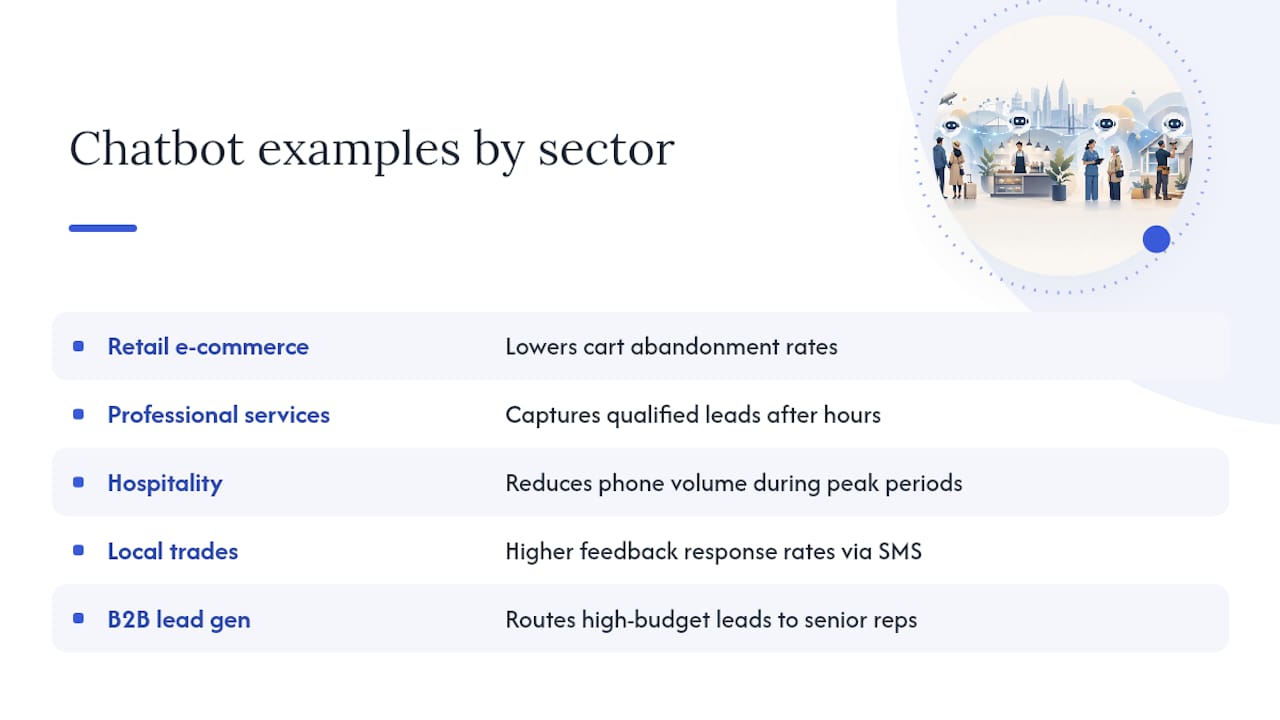
Retail e-commerce: A clothing retailer adds a recommendation bot to its product category pages. The bot asks two questions (occasion and size preference) and surfaces three relevant items. Cart abandonment on those pages falls because the decision load on the shopper is reduced. Post-purchase, a WhatsApp bot sends shipping updates automatically, cutting inbound “where is my order?” queries by a significant margin.
Professional services: A small accountancy firm uses a lead-gen bot on its homepage. The bot asks three qualifying questions (business type, turnover band, current pain point) and routes the visitor to the relevant service page or books a 20-minute discovery call directly into the calendar. The firm captures qualified leads outside office hours without adding headcount.
Hospitality: A Lancashire hotel uses a Messenger bot to handle room availability queries and direct bookings for specific package offers. The bot handles the initial enquiry and passes confirmed interest to the reservations team, reducing phone volume during peak periods.
Local trades: A plumbing and heating company uses an SMS bot to send appointment reminders and collect post-visit feedback. Response rates to the feedback prompt are higher than email, and the data feeds directly into their Google review request sequence.
B2B lead generation: A software reseller uses a website chat bot to qualify inbound traffic from paid campaigns. Visitors who indicate a budget above a set threshold are routed to a senior sales rep; those below are offered a self-serve resource. The result is a cleaner pipeline and less time wasted on unqualified calls.
Sprout Social’s research supports this: social chatbots that are instrumented with analytics and used to push contextually relevant offers consistently outperform those deployed as generic FAQ tools.
What does chatbot marketing cost, and how long does it take?
Budget and timeline expectations vary widely, and most vendor websites are not transparent about the full picture. Here is a realistic breakdown for UK SMEs.
Typical cost bands:
- DIY rule-based setup: Free to approximately £50/month for entry-level platforms with limited integrations. Setup time: one to three weeks if you have someone who can write conversational copy and configure basic logic.
- Mid-range AI implementation: £50–£300/month in platform fees, plus one-off build costs of £500–£3,000 depending on flow complexity and CRM integration requirements. Timeline: four to eight weeks.
- Bespoke integration with CRM and custom NLP: £3,000–£15,000+ as a project cost, with ongoing retainer for maintenance and retraining. Timeline: eight to sixteen weeks or more.
Factors that move the price and timeline:
- Number of conversational flows and languages required
- Depth of CRM integration (native connector vs. custom webhook build)
- Volume of content creation (conversation scripts, fallback responses, escalation messages)
- Testing and QA cycles, particularly for regulated industries
- GDPR compliance work: privacy notices, data mapping, vendor due diligence
SAS research on generative AI adoption for marketers notes that the hidden cost in AI-driven chatbot projects is rarely the platform licence — it is the content, governance, and ongoing iteration that organisations underestimate at the outset.
Common chatbot marketing mistakes and how to avoid them
Most chatbot failures are predictable. They tend to cluster around the same handful of decisions.
Do / don’t:
- Do define a single goal for your first bot. Don’t try to handle support, lead gen, and product recommendations in one flow.
- Do build a clear escalation path to a human. Don’t leave users trapped in a loop with no exit.
- Do review conversation logs regularly. Don’t deploy and ignore.
- Do write in plain, conversational English that matches your brand voice. Don’t use formal, legalistic language in chat — it kills engagement.
- Do test with real users before launch. Don’t rely on internal testing alone.
- Do keep your flows updated when products, prices, or policies change. Don’t let a bot give outdated information for months.
GDPR best practice for UK operations:
The ICO is clear that chatbots collecting personal data must comply with UK GDPR. Practically, this means:
- Display a concise privacy notice at the start of any data-collecting flow
- Apply data minimisation: collect only what you genuinely need
- Set a retention period for chat logs and delete them when it expires
- Confirm your vendor encrypts data in transit and at rest
- Document how you will handle data-subject access requests and deletion requests from chat logs
- If your bot makes automated decisions that significantly affect users, check whether Article 22 obligations apply
Maintenance checklist:
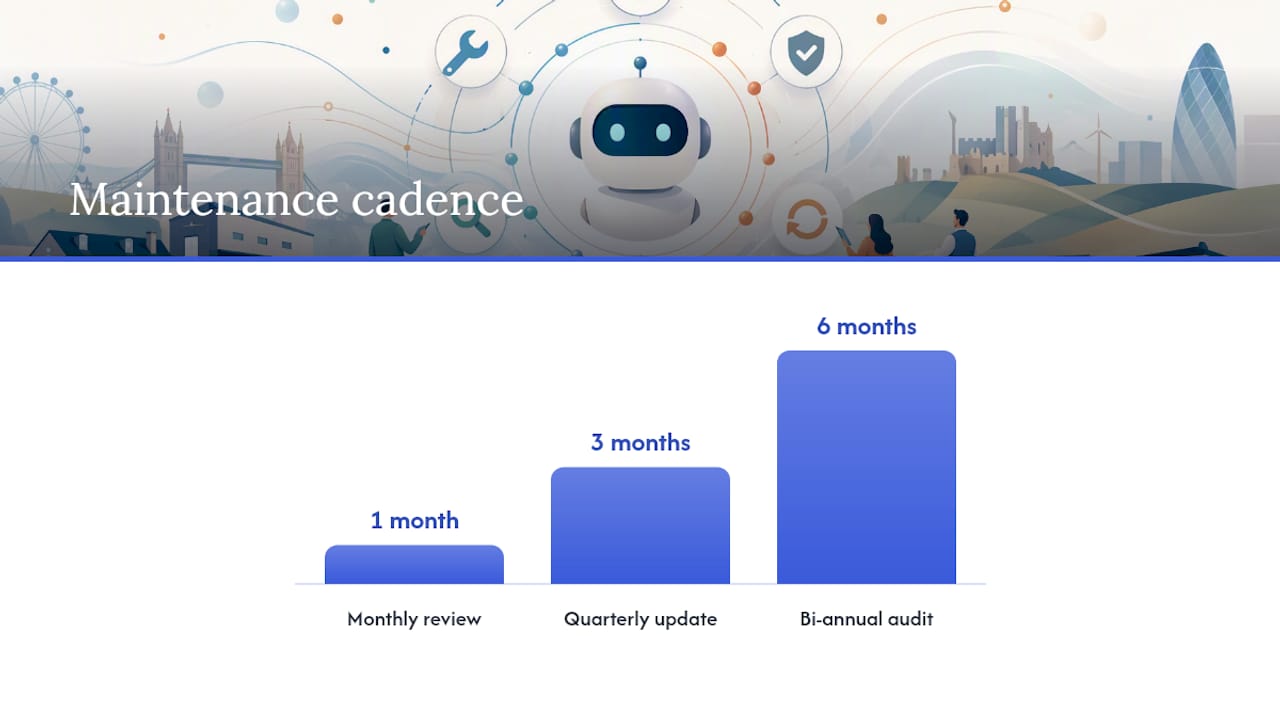
- Monthly: review conversation logs for new drop-off points or unanswered queries
- Quarterly: update flows to reflect product, pricing, or policy changes; retrain AI models with new data
- Bi-annually: full flow audit; review vendor compliance documentation; update your data-processing records
Pro Tip: Assign a named owner for the chatbot in your team. Bots without a clear owner drift: flows go stale, logs go unread, and the first sign of a problem is usually a customer complaint rather than a metric.
How Fyldedigital approaches chatbot marketing projects
At Fyldedigital, chatbot marketing projects follow a structured process that connects strategy to measurable outcomes. The work does not start with a platform choice — it starts with understanding what your business actually needs the bot to do.
Our process:
- Discovery: review your current customer journey, identify high-intent touchpoints, and agree on one primary goal
- Goal setting and KPI definition: attach measurable targets before any build begins
- Journey mapping: document the conversational flows, decision points, and escalation rules
- Build and configure: set up the platform, write conversation scripts, and connect to your CRM
- Integration and testing: map lead fields, configure webhooks, test with real users
- Handover and training: your team understands how to read the analytics and update flows
- Ongoing optimisation retainer: monthly log reviews, quarterly flow updates, and performance reporting
Deliverables typically include:
- Conversation scripts and fallback responses
- CRM integration plan and field-mapping documentation
- Analytics dashboard configured to your KPIs
- GDPR compliance checklist and vendor due diligence notes
- Maintenance retainer options for ongoing iteration
*Author: tibor | |
If you want to see what a well-designed chatbot flow could look like for your business, a free conversation design review is a practical first step. It takes 30 minutes and gives you a clear picture of where a bot would add the most value.
Key takeaways
Chatbot marketing works best when you start narrow, measure everything, and treat the bot as a living asset that needs regular attention, not a one-off deployment.
| Point | Details |
|---|---|
| Clear definition | Chatbot marketing uses automated conversational software to engage visitors, capture leads, and handle support across digital channels. |
| Start with one goal | Define a single objective (lead capture, support deflection, or product discovery) before choosing a platform or building any flow. |
| GDPR is non-negotiable | UK businesses must display a privacy notice, minimise data collection, and be able to respond to data-subject requests from chat logs, per ICO guidance. |
| Measure what matters | Track goal completion rate, escalation rate, qualified leads captured, and CSAT — not just conversation volume. |
| Fyldedigital’s approach | Fyldedigital handles discovery, journey mapping, CRM integration, GDPR compliance checks, and ongoing optimisation for UK SMEs. |
The gap between chatbot hype and what actually works
Most of the noise around chatbot marketing focuses on the technology: which AI model is most capable, which platform has the best NLP, which integration is most sophisticated. That framing leads businesses to over-invest in capability they do not yet need and under-invest in the thing that actually determines success: the quality of the conversational design.
A rule-based bot with three well-written flows and a clean CRM integration will outperform an AI-powered bot with poorly mapped journeys and no escalation logic. Every time. The technology is a multiplier on the quality of the underlying thinking — not a substitute for it.
The other thing that gets underplayed is maintenance. Businesses treat a chatbot launch like a website launch: a project with a start and an end. But a chatbot that is not regularly updated with new product information, revised pricing, and refreshed flows becomes a liability. It gives wrong answers confidently, which is worse than giving no answer at all.
The businesses that see genuine returns from chatbot marketing are the ones that treat it as a channel, not a feature. They assign ownership, review logs, update flows, and measure outcomes against real business goals. That discipline is less exciting than the technology, but it is where the results actually come from.
Fyldedigital can design and integrate your first chatbot
If you have read this guide and you know chatbot marketing is the right next step, the question is not which platform to choose — it is how to design a flow that actually converts. That is where most businesses get stuck, and it is exactly what Fyldedigital does well.
Fyldedigital works with UK SMEs to design, build, and integrate chatbot flows that connect directly to your CRM, comply with ICO guidance, and are built around your specific customer journey. Whether you need a lead-gen bot on a new website or a support deflection flow on an existing one, the starting point is the same: a free conversation design review that maps your highest-value touchpoints and gives you a clear brief before any build begins.
Our digital marketing services cover conversation design, CRM integration, analytics configuration, GDPR compliance checks, and ongoing maintenance retainers — so you are not left managing a bot that drifts out of date. If you are also planning a new site build, our web design service in Blackpool includes chat placement and conversion-focused UX as standard.
Get in touch with Fyldedigital to book your free review and find out what a well-designed chatbot could do for your enquiry rate.
Useful sources and further reading
- The Complete Guide to Chatbot Marketing | Salesforce
- What Is Chatbot Marketing? | IBM
- What is chatbot marketing? | Coursera
- How to use AI chatbots and what to know about these artificial intelligence tools | CNET
- Chatbot marketing: Drive engagement and growth | Sprout Social
- Chatbot Marketing — Glossary | Persado
- SAS research: gen‑AI for marketers (PDF)
- What is Chatbot Marketing? Definition, Example & Strategies | ControlHippo