Content pillars are the recurring themes your brand consistently posts about, from tips and tutorials to behind-the-scenes stories. The practical target is 3–5 pillars: pick one narrow core pillar you’ll be known for, then add one or two adjacent pillars for variety. Get this right and your content calendar fills itself; your metrics start meaning something, too.
TL;DR:
- Focusing on three to five content pillars ensures a balance between variety and consistency, avoiding content fatigue or dilution of focus.
- A core pillar should be based on your strongest audience engagement and expertise, supported by one or two adjacent themes that expand your reach.
- Choosing formats that suit each pillar—such as carousels for education or Reels for behind-the-scenes—helps streamline content creation and platform optimization.
- Regular audits and performance reviews over at least a quarter help identify underperforming pillars and prevent strategy stagnation or resource waste.
- Small businesses should keep pillars simple, with two to three formats each, to create a sustainable weekly rhythm capable of adapting to team capacity and platform changes.
Table of Contents
- What are social media content pillars, and why do they matter?
- Common pillar types worth building a calendar around
- How to choose your 3 to 5 pillars, step by step
- Turning each pillar into formats your team can actually produce
- Building a weekly rhythm you can actually sustain
- Measuring pillar performance and knowing when to adapt
- Where pillar strategies usually go wrong
- How Fyldedigital operationalises content pillars for small businesses
- What actually breaks pillar strategies in the real world
- Let Fyldedigital turn your pillars into a working calendar
- Sources
What are social media content pillars, and why do they matter?
A content pillar is a theme, not a format. “Customer education” is a pillar. A carousel, a Reel, and a how-to thread are all formats you could use to deliver it. Mixing these two up is where most small teams go wrong. They think they need ten different types of content when really they need three or four things to say and several ways of saying each one.
The value of pillars is what they remove from your week: the blank-page moment every Monday when someone has to decide what on earth to post. Sprout Social frames pillars as the throughline that keeps a feed coherent even when the formats underneath it change constantly. That coherence matters to your audience, who start to recognise what you’re for, and it matters to the platform’s own algorithm, which reads consistent theming as a signal of relevance.
Why 3 to 5, specifically? Fewer than three and you’ll struggle to fill a calendar without repeating yourself. More than five and you dilute focus, both for your team producing the content and for the algorithm trying to work out what you’re about. Later’s research into brand strategy backs a narrow core-plus-adjacent structure: one pillar you niche hard into for authority, and one or two supporting pillars that keep the feed from feeling one-note.
That structure looks like this in practice:
- Core pillar: the theme that defines your brand’s expertise, posted most frequently
- Adjacent pillar one: a related theme that broadens appeal without diluting focus
- Adjacent pillar two (optional): used sparingly, often for culture or trend-driven content
- Retired or seasonal pillars: themes you test, then drop if they underperform
Get the balance wrong in either direction and you’ll feel it within a month. Too narrow, and your team runs out of ideas by week three. Too broad, and nothing you post builds on what came before.
Common pillar types worth building a calendar around
Most brands, regardless of sector, draw from the same five categories. What differs is the mix and the emphasis.
- Educational content. How-to posts, tips, mini-tutorials, and myth-busting. A bakery might post “three signs your sourdough starter needs feeding”; an accountancy might post “the expense categories most sole traders forget.” This is usually the strongest candidate for a core pillar because it’s evergreen and shareable.
- Promotional content. Product highlights, offers, launches, and seasonal pushes. Necessary, but rarely the pillar to lead with. Audiences tolerate promotional content in small doses, ideally 10 to 20% of a feed, not as the dominant theme.
- Community and social proof. User-generated content, testimonials, reviews, and customer stories. A gym reposting a member’s transformation photo, or a software company sharing a client’s onboarding win. This pillar does more trust-building per post than almost anything else, because it’s someone else vouching for you.
- Behind-the-scenes content. Culture, process, and people. Footage of a workshop floor, a team member explaining their role, a “how we make it” sequence. This pillar humanises a brand that would otherwise feel corporate, and it tends to outperform on watch time because people are naturally curious about process.
- Inspirational, entertaining, or trending content. Quotes, memes, trend-jacking audio, seasonal humour. Use this pillar deliberately and sparingly. It’s the one most likely to drift off-brand if left unchecked, but it’s also often what earns you new followers who then stick around for the educational content.
Sprout Social describes a simplified version of this mix as the “three Es”: engage, entertain, and educate. It’s a useful shorthand if you’re building your first pillar set from scratch and want a mental model rather than five categories to memorise.
How to choose your 3 to 5 pillars, step by step
You don’t need a workshop or a brand strategist to land on the right pillars. You need forty minutes and access to your own analytics.
- Start with business goals and audience needs, not content ideas. What does the business need social media to do? Generate leads, build community, support customer service, drive footfall? What does your audience actually come to your page wanting? These two answers should overlap. If they don’t, that’s your first insight.
- Audit your last 20 posts. Pull them into a spreadsheet with three columns: theme, format, and performance (reach, saves, comments, clicks, whichever matters most for that platform). Patterns emerge fast. You’ll usually find you’re already posting three or four recurring themes, just without naming them. This audit-driven approach, moving from audience needs to a content audit before defining pillars, is the backbone of most workable pillar frameworks.
- Pick your narrow core pillar first. This should be the theme where you have genuine authority, where your audit shows the strongest engagement, and where you could produce content weekly without running dry. Name it specifically. “Educational content” is too vague; “practical money-saving tips for landlords” is a pillar.
- Add one or two adjacent pillars. These support the core without competing with it. Define each one in a single sentence so anyone on your team could brief a post against it without asking you first.
- Run a 6 to 12 week test. Post against your new pillars, track the same metrics you used in the audit, then compare. This is the same audit-to-audience-to-format sequencing that separates a pillar strategy that survives contact with reality from one that only ever existed on a slide.
Pro Tip: If your audit throws up a theme that performs brilliantly but doesn’t fit any obvious pillar, don’t force it into an existing category. Test it as a fourth pillar for one review cycle before deciding whether it earns a permanent slot or gets folded into something else.
Turning each pillar into formats your team can actually produce
A pillar is a theme; a format is the vehicle. The mistake is picking one format per pillar and sticking with it until it goes stale. Give each pillar two or three formats and rotate.
- Educational pillar works well as carousels (step-by-step visuals), short-form video walkthroughs, or a pinned thread on X breaking down a process.
- Community pillar suits Reels featuring real customers, quote-card testimonials, and repost-and-caption formats for user-generated content.
- Behind-the-scenes pillar thrives on unpolished vertical video and Stories, less on static graphics, because the appeal is authenticity, not production value.
- Promotional pillar performs best as a short, punchy Reel or a single clean graphic. Avoid dressing it up as anything longer.
Channel choice follows the same logic as format choice. Short-form video (Reels, TikTok, YouTube Shorts) rewards the behind-the-scenes and entertaining pillars, where movement and personality do the work. LinkedIn rewards the educational pillar in written or carousel form, particularly for B2B audiences who scroll it during work hours. X still rewards threads and real-time commentary, which suits trend-driven content more than polished promotional pushes.
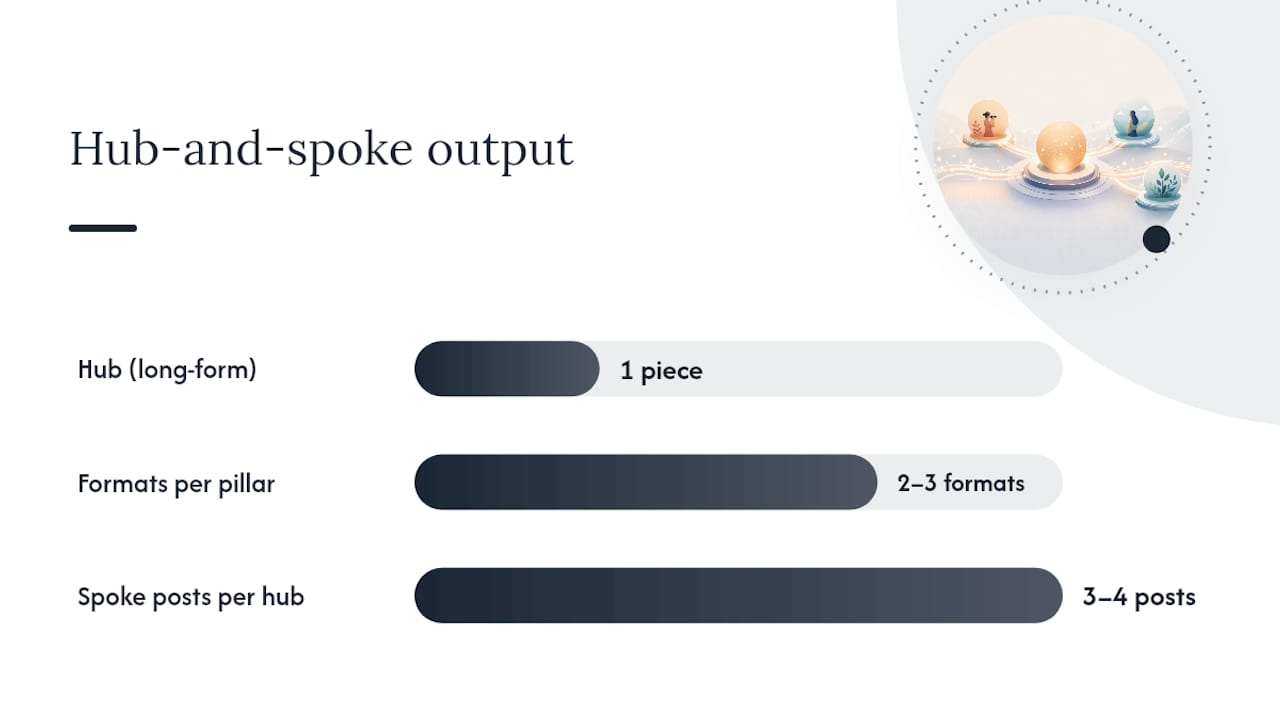
Shopify’s guide to pillar-and-cluster content describes a hub-and-spoke model worth borrowing here: build one long-form “hub” piece per pillar (a blog post, a video, a guide), then cut three or four “spoke” posts from it for social. One piece of source material, several weeks of content. It’s the fastest way to stop treating every post as a from-scratch creative task.
Building a weekly rhythm you can actually sustain
The right rhythm depends on your team size, not on what a competitor is doing. Trying to match an agency’s five-post-a-day cadence with one part-time marketer is how pillars collapse within a month.
- Three posts a week suits a solo marketer or founder-led account. Rotate: one core-pillar post, one adjacent-pillar post, one flex slot for community content or a trending moment.
- Five posts a week suits a small dedicated team. Two core-pillar posts, two adjacent, one flex slot, ideally batched and scheduled a week ahead rather than produced daily.
- Agency-managed cadences typically run five to seven posts weekly across two or three platforms, with pillar allocation adjusted monthly based on performance data rather than fixed forever.
That third option matters more than it used to. Recent HubSpot data shows 64% of marketers now post less than daily, a shift away from volume-for-volume’s-sake and towards a sustainable, repeatable rhythm most small teams can actually hold.
Build a simple content brief template with five fields: pillar, format, platform, hook angle, and call to action. Fill it in during a batch-planning session rather than post by post, and repurpose one hub piece into three or four spoke posts using the content calendar approach most agencies use to plan a month at a time.

Pro Tip: Leave one flex slot per week unplanned. It absorbs trending audio, a timely news hook, or a last-minute customer story, so your rigid pillar structure doesn’t crack the moment something genuinely newsworthy happens.
Measuring pillar performance and knowing when to adapt
Different pillars earn their keep in different ways, so measure them differently. Educational posts should be judged on saves and shares, the clearest signal that someone found the content useful enough to return to. Promotional posts live or die on click-through and conversion. Community posts should be tracked on comments and reshares, since the whole point is other people amplifying your credibility. Behind-the-scenes content is best judged on watch time and completion rate.
Run two review cycles:
- Monthly: a quick check of which pillar is over or under-represented in the calendar, adjusted for the following month.
- Quarterly: a full pillar review comparing performance against the previous quarter, using the same metrics from your original audit.
Treat small-sample results cautiously. One viral post doesn’t validate a pillar, and one flop doesn’t kill it. Kontentino’s framework treats pillars as a living system: review, don’t abandon. A practical decision rule worth adopting is to retire a pillar after two consecutive quarters of poor performance, rather than after a single bad month.
Where pillar strategies usually go wrong
Most pillar failures trace back to one of four habits.
- Too many pillars. Six or seven themes usually means two or three are near-duplicates. Merge them.
- Confusing formats for pillars. If your “pillar list” includes “Reels” and “carousels,” that’s a format list wearing a pillar hat. Rename it by theme, not by delivery method.
- Ignoring platform differences. A pillar that performs on Instagram may need a completely different format, or a different pillar altogether, on LinkedIn. Don’t force one script across every channel.
- Treating pillars as permanent. Set a review trigger, whether that’s a quarter, a follower milestone, or a platform algorithm change, so pillars evolve rather than fossilise.
How Fyldedigital operationalises content pillars for small businesses
Choosing pillars is the easy half. Producing against them, week after week, with a small team and a full inbox, is where most businesses stall. That’s the gap Fyldedigital’s social media management service is built to close: pillar definition, a working content calendar, and the actual production of posts against it, rather than a strategy document nobody has time to execute.
In practice that means auditing your existing posts the same way this guide describes, building a calendar structured around your core and adjacent pillars, and producing content in batches so nothing depends on someone remembering to post on a Tuesday. Case studies and specific client outcomes vary by sector and are available on request.
If you’re not sure whether your current mix of content actually maps to a coherent set of pillars, or whether your posting rhythm matches your team’s real capacity, a free website and social media review is the simplest way to find out where the gaps are before committing to a full programme.
What actually breaks pillar strategies in the real world
Most pillar failures aren’t strategic. They’re logistical. A business sets three sensible pillars in January, and by March the person responsible for the “behind-the-scenes” pillar has left, or got busy, and nobody replaced that content. The pillar isn’t wrong; the resourcing behind it was never realistic.

We’ve seen the same pattern repeatedly: a core pillar chosen on instinct rather than audit data underperforms for two months, then gets swapped for whatever the founder’s personal Instagram happens to favour that quarter. The fix isn’t more enthusiasm. It’s running the 6 to 12 week test properly, with the same metrics tracked at the start and the end, before deciding a pillar isn’t working.
For a small team, three pillars with two formats each is almost always more sustainable than five pillars with one format each. Fewer moving parts survive a busy month.
— tibor
Let Fyldedigital turn your pillars into a working calendar
Most guides stop at “choose your pillars” and leave you to figure out production, scheduling, and reporting alone. Fyldedigital’s social media management service picks up exactly where this guide ends: defining your core and adjacent pillars, building the calendar around them, and producing the actual posts, so pillar strategy doesn’t sit in a document while your feed goes quiet.

A typical engagement includes a content audit of your existing posts, a pillar and calendar build using the content calendar framework outlined above, monthly batch production, and a quarterly review comparing pillar performance against your original goals. If print or promotional material sits alongside your social output, that’s covered too, so your themes stay consistent across every channel a customer sees. Request a free website and social media review to see exactly where your current content mix has gaps, and what a properly resourced pillar programme would look like for your business.
Sources
- How to use content pillars to build your social strategy | Later
- A guide to social media content pillars | Sprout Social
- Content pillars strategy: framework that works | Kontentino
- Types of content pillars and how to implement them | Shopify