AI search extends core SEO rather than replacing it. Google confirms that generative AI features build on the same ranking and quality systems as traditional search, so the fundamentals still carry the weight. What changes is the finish line: your content now has to be technically accessible, structured for extraction, and backed by facts an AI system can verify before they get quoted.
TL;DR:
- Ensuring your content is crawlable, structured, and has updated “last modified” dates prevents losing AI citations and improves visibility in generative search results.
- Correctly implementing schema markup, avoiding hidden content, and placing direct answers early under question headings enhance extractability and verifiability for AI systems.
- Monitoring AI search performance with dedicated tools and logs helps track referral traffic, citation frequency, and conversion metrics, which are now key business indicators.
- Using AI for content ideation and drafting is effective only when final facts and statistics are verified by humans to maintain trust and credibility.
- Maintaining core SEO practices like internal linking, high-quality content, and strong brand authority remains crucial alongside AI-specific optimizations.
Table of Contents
- AI search and SEO checklist: priorities to fix this week
- Can AI crawlers actually access your content?
- How do you make content extractable and citable?
- Which reports show your AI search visibility?
- Should you let AI write your SEO content?
- Does traditional SEO still matter for AI search?
- Fylde Digital’s take on making AI SEO work in practice
- Your 1 day, 1 week, 1 month AI SEO plan
- Where to go deeper on AI SEO
- Sources
AI search and SEO checklist: priorities to fix this week
You don’t need a full rebuild to start earning AI citations. Most sites are losing visibility to a handful of fixable issues, and fixing them in the right order matters more than doing everything at once.
- Confirm crawlability and indexing first. If a page isn’t indexed by Google, it has no route into AI Overviews or any generative answer. Check Search Console before touching anything else.
- Write headings as direct questions, then answer them in the first sentence underneath. AI systems lift self-contained answers, not paragraphs that build up to a point.
- Add schema markup and named attribution. FAQ, Article, and Organization schema give AI crawlers structured signals about who said what, and when.
- Strip out hidden content. Facts locked inside accordions, tabs, or images with no alt text are effectively invisible to most AI crawlers.
- Add visible “last updated” dates. Pages refreshed within two months tend to earn more AI citations than stale ones, according to Search Engine Land’s analysis of AI SEO.
Pro Tip: Run one priority page through this checklist before rolling it out site-wide. You’ll likely find the same common issues repeating, which makes subsequent pages faster to fix.
None of this replaces a proper technical SEO audit, but it’s the fastest route to catching the obvious blockers first.
Can AI crawlers actually access your content?
This is the question most teams skip, and it’s the one that quietly kills their AI visibility. A beautifully structured page is worthless if the crawler never sees it.
- Check your robots.txt file for accidental blocks on AI user agents. Many sites default to blocking bots they don’t recognise, which can shut out legitimate AI crawlers along with the spam ones.
- Submit and maintain an up-to-date XML sitemap. It’s the clearest signal you can send about which pages matter.
- Test JavaScript rendering. Many AI crawlers don’t execute JavaScript the way a browser does, so content loaded client-side can simply vanish from their view. Server-side rendering or pre-rendering solves this.
- Use Google Search Console and Bing Webmaster Tools to confirm indexing status and check generative-feature eligibility for your priority pages.
If your site relies heavily on JavaScript frameworks, this is worth treating as a genuine technical project rather than a quick tweak. A guide to technical SEO covers rendering options in more depth if you’re rebuilding a site from the ground up.
How do you make content extractable and citable?
Structure decides whether an AI system can lift your content cleanly, or skips it for a competitor’s tidier answer. Microsoft Advertising is explicit about this: AI systems parse for structure, clarity and verifiability when deciding what to quote.
Put your direct answer in the first one or two sentences under a question-style heading. Don’t build up to it with three paragraphs of context first. AI systems favour content that answers the question immediately and completely, in a form that can stand alone once lifted out of your page.
- Use bullet lists and short tables for anything resembling a fact, a comparison, or a step-by-step process.
- Name your sources, cite dates, and include statistics with attribution. Unattributed claims are far less likely to get quoted than ones with a checkable origin.
- Keep critical facts out of images, embedded PDFs, and expandable content sections. If it isn’t in the page’s readable HTML, most AI crawlers won’t find it.
AI referrals are already a measurable revenue channel. Microsoft Advertising reports large year-on-year growth in AI-driven referral traffic to top websites, and early data suggests these visitors convert at meaningfully higher rates than average organic traffic.
Search Engine Land frames this whole discipline as generative engine optimisation, or GEO, sitting alongside AEO (answer engine optimisation) and LLMO (large language model optimisation). The terminology varies by publication, but the requirement is consistent: extractability, verifiability, and semantic clarity.
Which reports show your AI search visibility?
You can’t manage what you don’t measure, and AI visibility now needs its own tracking layer alongside your usual organic metrics.
- Google Search Console’s generative AI performance report shows impressions and clicks specifically from AI Overviews, separate from standard organic results.
- Bing Webmaster Tools gives comparable indexing and performance data for Microsoft’s AI-powered search features.
- AI visibility platforms, including tools like Adobe LLM Optimizer, track citation frequency and map AI referrals to conversions, treating AI mentions as a measurable business outcome rather than a vanity metric.
- Server log analysis can reveal AI crawler visits directly, which is useful for confirming whether bots are reaching pages that Search Console hasn’t caught up on yet.
Track referral share and citation frequency as ongoing KPIs, not one-off audits. Adobe’s positioning here is worth taking seriously: AI visibility is becoming a board-level metric, not just an SEO team’s internal dashboard.
Should you let AI write your SEO content?
Used well, generative tools speed up the unglamorous parts of SEO. Used badly, they quietly wreck the trust signals that get content cited in the first place.
- Use AI for ideation, keyword clustering, and drafting meta descriptions, where speed matters more than precision.
- Never let AI generate final statistics, quotes, or factual claims without a human checking the original source.
- Build a source list for every article and require sign-off before publishing anything with a number attached to it.
- Set a review cadence so AI-assisted drafts get the same editorial scrutiny as human-written ones, including an E-E-A-T check on author expertise.
Pro Tip: Treat every AI-drafted statistic as a placeholder until a named source confirms it. It takes thirty seconds and it’s the difference between a citable page and a retracted one.
Does traditional SEO still matter for AI search?
Yes, and it’s the foundation everything else sits on. Crawlability, clean internal linking, and solid page experience remain the baseline requirement, not a legacy checklist to phase out.
- Keep investing in the core SEO fundamentals that already drive your organic rankings.
- Layer extractability and verifiability checks into your existing content audits, rather than running them as a separate project.
- Build brand authority deliberately. AI systems favour sources they’ve seen cited elsewhere, so consistent mentions across the web compound over time.
Google’s own guidance backs this framing directly: generative features are an extension of existing quality systems, not a parallel algorithm requiring separate tactics from scratch.
Fylde Digital’s take on making AI SEO work in practice
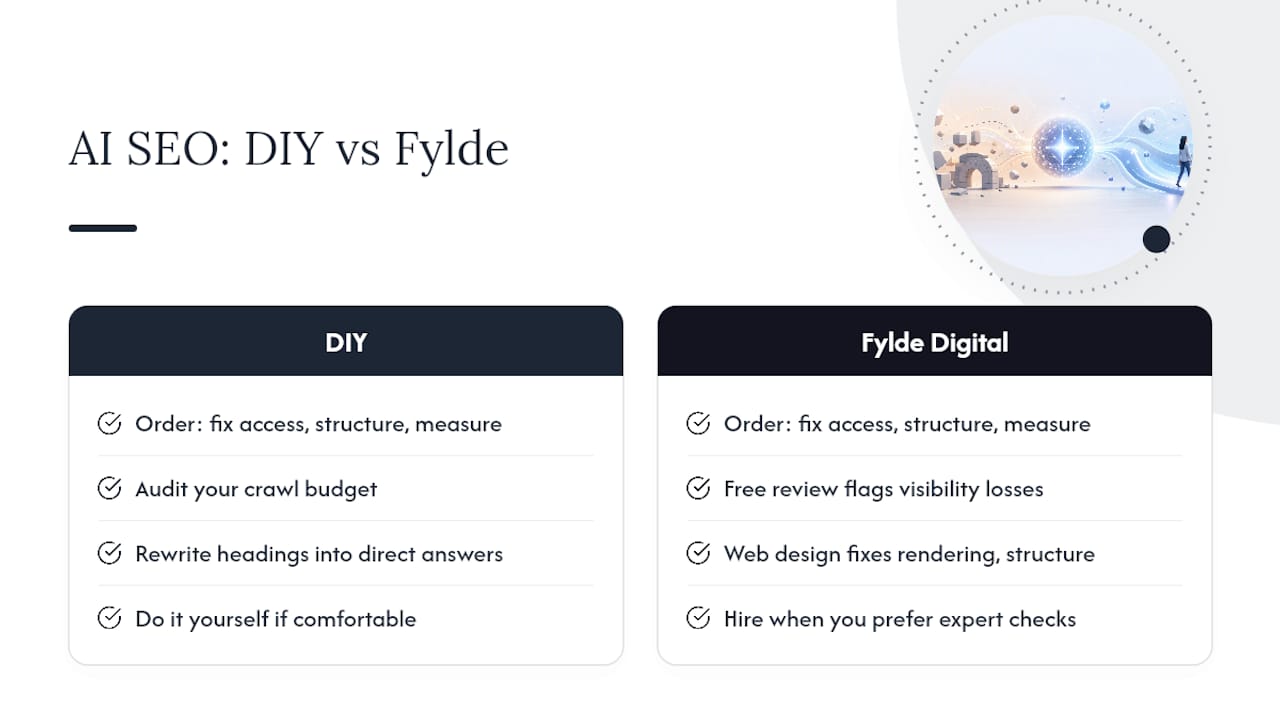
We treat AI search as an extension of the technical and content work we already do for clients, not a bolt-on service. A site with broken crawlability or thin content won’t get cited by AI systems any more than it ranks well in traditional search, so the order of operations matters: fix access, then structure, then measure.
Not every business needs external help here. If you’re comfortable auditing your own crawl budget and rewriting headings into direct answers, do it yourself. If you’d rather have someone check the technical detail properly, Fylde Digital’s SEO services start with a free review that flags exactly where your site is losing AI and organic visibility. For sites needing deeper technical rebuilds, our web design work tackles rendering and structure issues at the source.
— tibor
Your 1 day, 1 week, 1 month AI SEO plan
Spread the work rather than trying to fix everything simultaneously.
- Day one: Check robots.txt, submit your sitemap, confirm indexing in Search Console, and unblock any AI crawlers accidentally caught in a blanket rule.
- Week one: Rewrite your top ten pages with question-style headings, direct-answer openings, and FAQ schema.
- Month one: Refresh outdated statistics, audit priority URLs for extractability, and run manual citation tests across ChatGPT, Perplexity, and Google’s AI Overviews.
Where to go deeper on AI SEO
For primary guidance, read Google’s generative AI optimisation documentation and Microsoft’s notes on AI search answers. Search Engine Land’s AI SEO guide and The Lead Lab’s 2026 marketing trends round out the wider context.
Sources
- Optimizing your website for generative AI features on Google Search
- Optimizing your content for inclusion in AI search answers
- Adobe LLM Optimizer | SEO in 2026 fundamentals