A digital marketing audit is a structured evaluation of every online marketing channel you operate, designed to measure what is working, what is wasting budget, and where your biggest growth opportunities lie. Think of it as a health check for your entire digital presence. Done properly, it connects your marketing activity directly to business outcomes like revenue, Customer Acquisition Cost (CAC), and Return on Ad Spend (ROAS). Tools like Google Analytics 4, Semrush, and Google Search Console provide the raw data. This guide gives you the framework to turn that data into decisions that move your business forward.
What key areas should your digital marketing audit cover?
A thorough digital marketing audit covers every channel where your business has an online presence. Missing even one area can leave a significant gap in your understanding of performance. The sections below outline the core components every SME should review.
Website and technical SEO
Your website is the foundation of your digital marketing. Page load speed should be under 3 seconds, since slow pages directly reduce conversions and damage search rankings. Check mobile responsiveness, crawlability, broken links, and Core Web Vitals scores. A dedicated website SEO audit checklist will help you work through technical issues systematically rather than guessing where problems lie.

Content performance
Review whether your existing content aligns with user intent at each stage of the buyer journey. Pages that attract traffic but generate no enquiries are a signal that content is misaligned with what visitors actually need. Look at organic rankings, time on page, and scroll depth to understand where content is falling short.
Social media presence
Social media audits go beyond follower counts to measure engagement rates, referral traffic, and direct contribution to revenue goals. A large following that generates no website visits or leads is a vanity metric. Reviewing your social media management approach across each platform will reveal which channels deserve more investment and which are simply consuming time.
Paid media efficiency
For any paid campaigns, ROAS is the primary metric. Review audience targeting, ad creative performance, and landing page alignment. A campaign with a strong click-through rate but a poor conversion rate usually signals a disconnect between the ad promise and the landing page experience.
Email marketing health
Effective email audits analyse list health, open rates, click-through rates, unsubscribe rates, deliverability scores, and automation performance. Email consistently delivers the highest ROI of any digital channel, so a poorly maintained list or broken automation sequence is a direct revenue leak.
Analytics setup validation
Before drawing any conclusions from your data, confirm your tracking is accurate. Poorly configured analytics produce misleading results that lead to bad decisions.
Pro Tip: Run a quick audit of your Google Analytics 4 goals and conversion events before you review any other data. If your tracking is broken, every other finding in your audit is built on sand.
Which tools and metrics will make your audit effective?
The right tools make the difference between an audit that produces genuine insight and one that produces a spreadsheet nobody acts on. The table below maps the most useful platforms to the metrics they measure best.
| Tool | Primary use | Key metrics to extract |
|---|---|---|
| Google Analytics 4 | Website behaviour and conversions | Conversion rate, bounce rate, traffic source breakdown |
| Google Search Console | Organic search performance | Impressions, click-through rate, average position |
| Semrush or Ahrefs | SEO and competitive benchmarking | Domain authority, keyword rankings, backlink profile |
| Meta Ads Manager | Paid social performance | ROAS, cost per lead, frequency |
| Mailchimp or Klaviyo | Email campaign health | Open rate, click rate, unsubscribe rate |
Accurate analytics setup, including GA4 event tracking and UTM parameters on every campaign link, is the prerequisite for trustworthy audit data. UTM parameters tell you exactly which campaign, channel, and piece of content drove a conversion. Without them, your attribution data is largely guesswork.
The most important shift in mindset here is moving away from vanity metrics. Linking audit findings to revenue outcomes like CAC and generated revenue is what separates a useful audit from a reporting exercise. Tracking your key digital marketing metrics against business KPIs rather than channel-specific benchmarks alone gives you a far clearer picture of where to invest.
Pro Tip: Set up a simple dashboard in Google Looker Studio that pulls GA4, Search Console, and your paid media data into one view. Reviewing one screen instead of four separate platforms saves hours and makes patterns far easier to spot.
How to conduct a digital marketing audit step by step
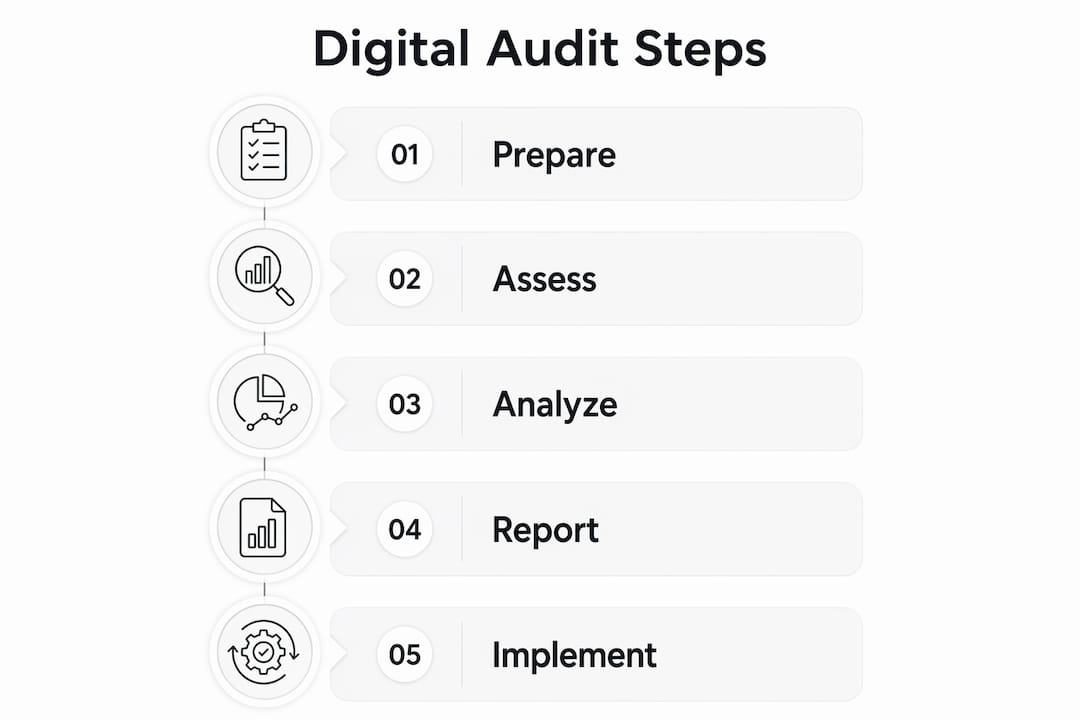
A structured process prevents the audit from becoming an overwhelming data dump. Follow these six steps to move from preparation through to a plan you can actually execute.
-
Set clear audit goals. Define what you want the audit to answer before you collect a single data point. Are you trying to reduce CAC, improve organic traffic, or identify why paid campaigns are underperforming? A focused question produces a focused audit.
-
Gather and organise your data. Pull reports from Google Analytics 4, Google Search Console, your CRM, paid media platforms, and email tools. Organise data by channel in a single document or spreadsheet so you can compare performance side by side.
-
Review channel-specific performance. Work through each channel systematically. Identify what is performing above expectations, what is underperforming, and what has no measurable impact at all. Approach this like a detective: base every conclusion on data evidence, not assumptions. Thorough, inquisitive analysis that maps your actual digital footprint is what produces reliable findings.
-
Benchmark against competitors. Use Semrush or Ahrefs to compare your organic keyword rankings, backlink profile, and content gaps against two or three direct competitors. This step often reveals opportunities your internal data alone would never surface.
-
Prioritise improvements by impact and effort. Not every finding deserves equal attention. Categorise action items as high impact and low effort for quick wins, high impact and high effort for planned projects, and low impact for the backlog. This prevents the common mistake of spending weeks on a minor fix while a major revenue leak goes unaddressed.
-
Build a 90-day roadmap. Translate your prioritised findings into a concrete plan with owners, deadlines, and success metrics. A 90-day window is short enough to maintain momentum and long enough to see measurable results from SEO and content improvements.
| Priority category | Action type | Timeline |
|---|---|---|
| High impact, low effort | Quick wins: fix broken links, update meta titles | Weeks 1 to 2 |
| High impact, high effort | Planned projects: site redesign, content strategy | Weeks 3 to 12 |
| Low impact, any effort | Backlog: minor copy tweaks, social profile updates | Post 90 days |
Common mistakes that undermine your audit findings
Even a well-intentioned audit can produce misleading conclusions if you fall into these traps.
-
Focusing on output metrics instead of business impact. Page views, follower counts, and impressions tell you very little about whether your marketing is generating revenue. Audits that focus on CAC and ROAS rather than surface metrics produce findings that finance directors and business owners actually care about.
-
Trusting broken tracking data. If your GA4 setup has misconfigured events or missing UTM tags, your conversion data is unreliable. Always validate your analytics configuration before drawing conclusions from it.
-
Treating conflicting channel signals as a problem. It is normal for paid media to show strong ROAS while organic traffic is declining, or for email to drive conversions that GA4 attributes to direct traffic. Cross-channel attribution is imperfect. Look for patterns across a 90-day period rather than reacting to single-week anomalies.
-
Conducting a one-off audit and moving on. Marketing audits should be a recurring function, with annual full audits supplemented by quarterly channel reviews and monthly campaign checks. A single audit captures a moment in time. Regular cadence builds a picture of trajectory.
“The audit is not the destination. It is the starting point for a continuous improvement cycle that keeps your marketing aligned with where your business is actually heading.”
Key takeaways
A digital marketing audit produces genuine business value only when findings are linked directly to revenue metrics like CAC and ROAS, not surface-level channel statistics.
| Point | Details |
|---|---|
| Start with accurate tracking | Validate GA4 and UTM setup before analysing any channel data. |
| Cover all core channels | Audit website SEO, content, social, paid media, and email in every review. |
| Prioritise by impact and effort | Use a simple matrix to identify quick wins and schedule complex projects. |
| Link findings to revenue | Measure CAC and ROAS, not just page views or follower counts. |
| Audit on a regular cadence | Run annual full audits, quarterly channel reviews, and monthly campaign checks. |
Why most audits I see never get acted on
I have reviewed a lot of marketing audits over the years, and the pattern that frustrates me most is not poor data collection. It is the gap between findings and action. Businesses invest time pulling reports from Semrush, GA4, and their CRM, produce a thorough document, and then file it away because nobody owns the next step.
The audits that actually change business outcomes share one characteristic: they are built around a question that the business owner genuinely needs answered. Not “how is our marketing performing?” but “why is our cost per lead 40% higher than it was six months ago?” That specificity forces the audit to produce a conclusion rather than a catalogue of observations.
I also think the annual full audit model is underused by SMEs. Most small businesses either audit reactively when something goes wrong, or not at all. Building a quarterly review into your calendar, even a lightweight one covering a single channel, keeps your strategy current as algorithms, platforms, and customer behaviour shift. The digital marketing space in 2026 moves quickly enough that a strategy built on 18-month-old data is already working against you.
The other thing worth saying plainly: you do not need to be a data analyst to run a useful audit. You need the right questions, the right tools, and the discipline to act on what you find. The digital marketing guide for small businesses we publish at Fyldedigital covers the broader strategic context if you want to see how auditing fits into a full annual marketing plan.
— tibor
How Fyldedigital can support your audit and growth
If your audit has surfaced issues with your website, SEO performance, or paid media strategy, acting on those findings quickly is what turns insight into results. Fyldedigital works with SMEs across the Fylde Coast and beyond to translate audit findings into concrete improvements, from professional web design that converts visitors into enquiries, to targeted SEO campaigns that build long-term organic visibility.

Whether you need a full website overhaul, a focused SEO improvement plan, or ongoing digital marketing support, Fyldedigital offers free website and SEO reviews to help you understand exactly where to focus. Get in touch today to take the next step from audit findings to measurable growth.
FAQ
What is a digital marketing audit?
A digital marketing audit is a structured review of all your online marketing channels, including your website, SEO, paid media, social media, and email, to measure performance and identify improvements. It connects marketing activity to business outcomes like revenue and Customer Acquisition Cost.
How often should I conduct a digital marketing audit?
Annual full audits covering all channels should be supplemented by quarterly reviews of individual channels and monthly checks on active campaigns. This cadence keeps your strategy current without creating unnecessary workload.
Which tools do I need to run a digital marketing audit?
Google Analytics 4 and Google Search Console are the minimum requirements for any audit. Adding Semrush or Ahrefs for SEO benchmarking and your paid media platform’s native reporting gives you a complete picture across all channels.
What is the biggest mistake in a digital marketing audit?
The most common mistake is focusing on output metrics like page views and follower counts rather than business-impact metrics like CAC and ROAS. An audit that cannot answer “is this marketing generating revenue?” is not producing useful findings.
How long does a digital marketing audit take?
A thorough audit of a small to medium-sized business typically takes between one and three days of focused work, depending on the number of active channels and the quality of existing data. Building a 90-day action plan from the findings adds another half day.