Many small and medium-sized businesses struggle to know how to build a digital brand that genuinely stands out. You might have a logo, a website, and a few social media profiles, yet feel like your online presence lacks coherence or momentum. The problem is rarely a shortage of effort. It is usually a shortage of structure. This guide walks you through a step-by-step digital branding process covering strategy, identity, execution, and measurement so you can build something that earns recognition, generates leads, and grows with your business.
Table of Contents
- Key takeaways
- Building your digital brand foundation
- Creating and organising your brand identity assets
- Executing your brand across online channels
- Measuring your digital brand’s impact
- My honest take on digital brand building
- How Fyldedigital can help you build your brand
- FAQ
Key takeaways
| Point | Details |
|---|---|
| Strategy before assets | Define your purpose, audience, and positioning before creating a single visual element. |
| Consistent brand identity | Use a style guide and asset management system to prevent brand drift across all channels. |
| Execution across touchpoints | Apply your brand consistently on your website, social media, email, and search listings. |
| Measure branded demand | Use Search Console’s branded query filter to track how well your brand is growing in search. |
| Governance prevents drift | Approvals and workflows keep your brand consistent as your team or output grows. |
Building your digital brand foundation
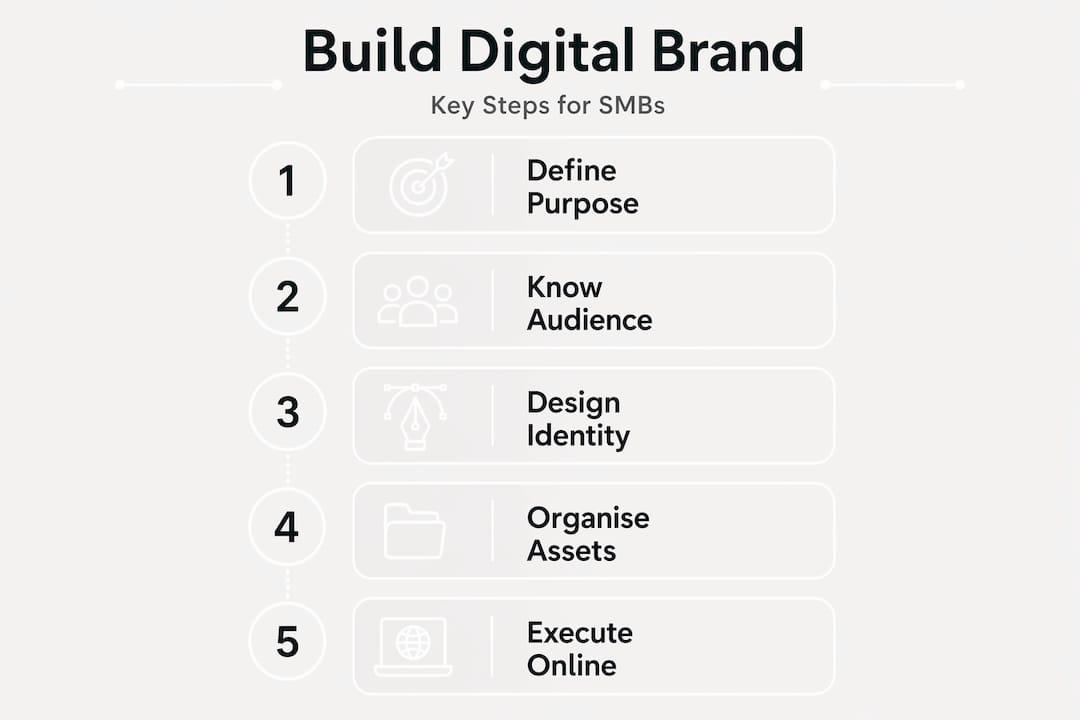
Before you design anything, you need to do the thinking that most SMBs skip. Skipping foundational brand strategy is one of the most common mistakes businesses make, and it leads directly to weak identity and poor online consistency. A logo without a strategy behind it is just a graphic.
Start by defining your brand purpose. Ask yourself: why does your business exist beyond making money? What problem do you solve, and why does it matter to the people you serve? Write this down in one or two sentences. This becomes the compass for every decision you make about your brand.
Next, build a clear picture of your audience. You need to know more than demographics. Understand what your customers worry about, what they value, how they talk about their problems, and where they spend time online. Interview a handful of existing customers if you can. The language they use is often the language that belongs in your brand messaging.
Once you know your audience, you can develop your unique value proposition (UVP). This is a direct, specific statement of what you offer, who it is for, and why it is better than alternatives. Generic claims like “quality service” and “competitive prices” do not qualify. Your UVP should be something a competitor could not honestly copy.
From there, build a step-by-step brand messaging framework covering:
- Your brand purpose and values
- Your UVP and key proof points
- Your tone of voice and communication style
- Core messages tailored to different audience segments
- What you stand for and, equally, what you do not
Pro Tip: Write your brand strategy in a short document and share it with everyone involved in your marketing. If your team cannot summarise your positioning in thirty seconds, your brand is not clear enough yet.
Creating and organising your brand identity assets
With strategy in place, you can build your visual and verbal identity. This is the step by step branding process where many businesses get excited, and rightly so. But it requires discipline to do well.
The core elements of a brand identity include:
- Logo and logomark (primary, secondary, and icon versions)
- Colour palette (primary, secondary, and neutral colours with hex codes)
- Typography (heading and body typefaces with usage rules)
- Brand voice and tone (how you write and speak across different contexts)
- Imagery style (photography, illustration, and graphic direction)
Once these elements exist, they need to be documented in a brand style guide. This is not optional. Without it, your brand will drift the moment a second person starts creating content. The style guide tells anyone working on your brand exactly how to use each element correctly.
The next challenge is managing those assets at scale. Digital asset management (DAM) improves brand consistency through approvals, versioning, and central asset control. It reduces brand drift and speeds up on-brand publishing, particularly when multiple contributors are involved. A shared Google Drive folder is not a DAM. It lacks the governance features needed to enforce your brand guidelines.

The table below shows the difference between managing assets in a basic file store versus a proper DAM system.
| Feature | Basic cloud storage | DAM system |
|---|---|---|
| Version control | Limited or none | Full version history |
| Approval workflows | None | Built-in review and sign-off |
| Usage permissions | Folder-level only | Asset-level control |
| Brand compliance | Manual checks | Automated enforcement |
| Search and filtering | Basic file names | Metadata and tagging |
Brand drift occurs first in templates and last-mile edits. A team member resizes the logo, another uses the wrong font on a social post, and gradually your brand looks fragmented. DAM governance features exist precisely to prevent this.
Pro Tip: Even if a full DAM system is out of budget, create a single locked PDF brand guide and a named folder of approved assets. Give every team member access before they create anything publicly visible.
Executing your brand across online channels
You have your strategy and your identity. Now you apply it everywhere your customers might encounter you. Creating an online brand that feels coherent takes deliberate effort across multiple touchpoints. Here is a practical sequence for doing it well.
-
Your website. This is your most important brand asset. The design, copy, and user experience all need to reflect your strategy. A well-built website communicates your UVP within seconds of a visitor arriving. If your site looks out of step with your brand guidelines, everything else you do will feel disconnected.
-
Search and SEO. Content is one of the most powerful tools for building brand awareness. Content marketing builds brand awareness for 87% of B2B marketers, and the same principle applies across the board. Publish useful, on-brand content consistently. Use your brand voice in every article, guide, and landing page.
-
Social media. Each platform has its own context, but your values and voice should remain constant. 46.8% of marketers focus on brand values across platforms to differentiate. Adapt the format to the channel, but keep the message anchored to your positioning.
-
Email marketing. Your email templates should use brand colours, fonts, and a consistent tone. This channel often gets treated as an afterthought, yet it reaches people who have already chosen to hear from you. Treat it as a flagship brand channel.
-
Digital listings and directories. Google Business Profile, industry directories, and review platforms all carry your brand name and description. Audit these regularly. Outdated logos, mismatched descriptions, or wrong contact details undermine the consistency you are working to build everywhere else.
Understanding digital marketing fundamentals helps you see how all these channels connect. No single touchpoint works in isolation. The cumulative effect of consistent branding across all of them is what builds recognition over time.
Measuring your digital brand’s impact
Building an effective brand presence means nothing if you cannot see whether it is working. Most SMBs track website traffic and call it brand measurement. That misses the point. You need to understand how many people are searching specifically for you, and whether that number is growing.
Start by setting up a Domain-level property in Google Search Console. This captures all traffic across your subdomains and both HTTP and HTTPS versions of your site, giving you a complete picture of your search performance.
The real insight comes from Google Search Console’s branded queries filter, which segments your data into brand and non-brand searches using AI. You can see impressions, clicks, and click-through rates for people actively searching for your business by name. This is a direct measure of brand demand, not just general traffic.
The table below shows how to interpret what you find.
| Metric | What it tells you | What to do |
|---|---|---|
| Branded impressions growing | Brand awareness is increasing | Maintain your current content and SEO approach |
| Branded clicks low vs impressions | People search your brand but do not click | Improve your meta descriptions and page titles |
| Non-branded traffic dominant | Brand demand is weak | Increase brand-building content and PR |
| Key pages not indexed | Brand presence is incomplete in Google | Fix crawl issues and submit URLs for indexing |
Treat your brand pages as key assets in SEO. Monitor their indexing and crawl status regularly to make sure your most important pages appear consistently in search. Separating branded from non-branded queries shifts your focus from capturing existing demand to growing the pool of people who know your name.
Pro Tip: Set a monthly reminder to check your branded query impressions in Search Console. A decline in branded searches often signals a brand visibility problem before it shows up in your revenue.
My honest take on digital brand building
I have worked with enough SMBs to know that the single most common mistake is building the brand backwards. Business owners get excited about logos, colours, and Instagram feeds. Then six months later they wonder why their brand feels flat. The answer is almost always that the strategy came after the assets, if it came at all.
Brand building is a long-term process requiring repeated positioning and information reinforcement. It is not a one-off promotion. The businesses I see grow strong digital brands are the ones who treat their positioning as a living document, revisit it regularly, and hold their teams accountable to it.
AI and automation tools are changing how brand content gets produced. AI-powered content creation is enabling faster, more consistent output at scale. But speed without strategy still produces noise. Use AI to accelerate on-brand content creation, not to replace the thinking that makes your brand distinctive.
My advice is straightforward. Lock down your strategy first. Build your assets to serve that strategy. Then focus relentlessly on consistency and measurement. The businesses that do this quietly chip away at their market’s attention and end up owning it. The ones who skip the groundwork spend years wondering why their marketing never quite lands.
— tibor
How Fyldedigital can help you build your brand
If you are ready to move from scattered online presence to a brand that earns real recognition, Fyldedigital works with SMBs across the Fylde Coast and beyond to do exactly that.
From professional web design built to reflect your brand identity, to targeted SEO for small businesses that grows your branded search presence, Fyldedigital offers a full-service approach tailored to businesses at every stage. The team also provides logos and brand identity work grounded in strategy, not just aesthetics. Whether you are starting from scratch or need to bring consistency to an existing brand, get in touch with Fyldedigital for a free website and SEO review and find out exactly where your brand stands today.
FAQ
What is the first step to build a digital brand?
Define your brand purpose, audience, and unique value proposition before creating any visual assets. Strategy guides every design and content decision that follows, so getting this right first prevents costly rework later.
How long does building an effective brand presence take?
Brand recognition builds over months and years, not weeks. Consistent positioning, content, and visibility across touchpoints compound over time, so starting with the right strategy from the beginning is what makes the effort worthwhile.
What is the branded queries filter in Google Search Console?
The branded queries filter separates your search data into brand-specific and non-brand searches, showing impressions, clicks, and CTR for each. It lets you measure genuine brand demand rather than just overall traffic.
How do I prevent brand drift as my team grows?
Use a documented brand style guide alongside a digital asset management system that includes approval workflows and versioning. This keeps every team member working from the same approved assets and guidelines, regardless of how quickly your output scales.
Why does brand consistency matter for SMBs?
Inconsistent branding erodes trust and makes your business look smaller and less established than it is. Consistent visual identity, messaging, and tone across all channels build recognition and confidence with potential customers.