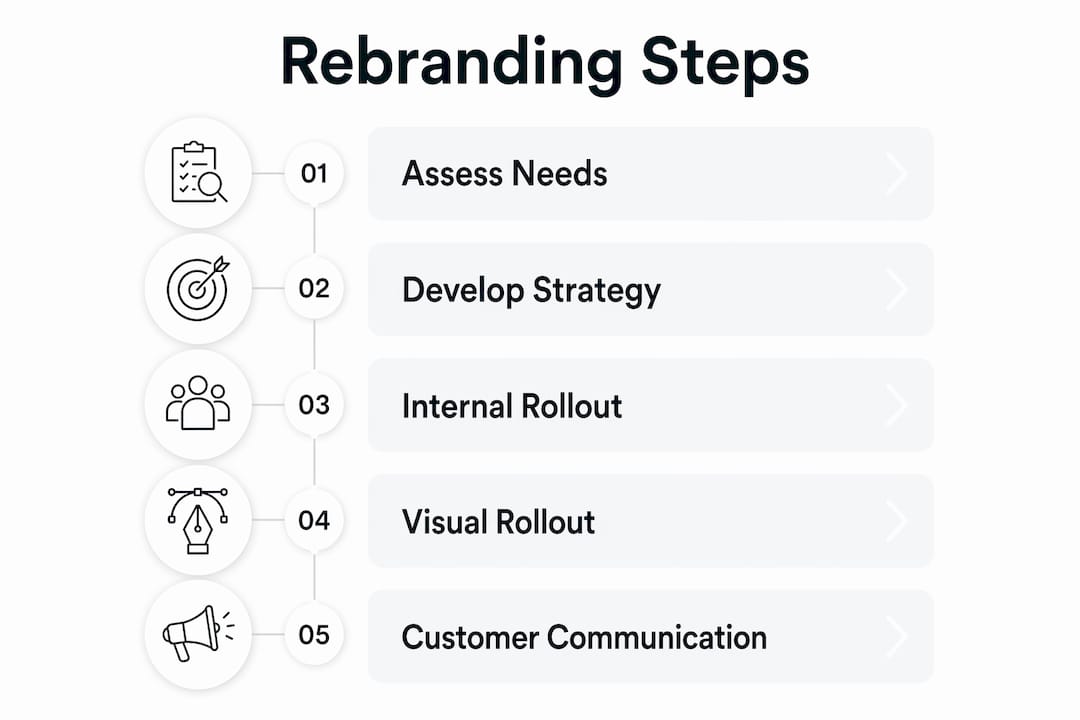
A rebranding campaign is a structured process of reshaping your business identity through coordinated changes to your name, visual style, messaging, and market positioning. Knowing how to launch a rebranding campaign correctly separates businesses that grow stronger from those that confuse their customers and lose search rankings in the process. The standard industry term for this process is brand repositioning, and it covers far more than a new logo. This guide walks you through every phase, from internal preparation to public rollout, with the technical and communication steps that most SMB guides skip entirely.
What do you need before launching a rebranding campaign?
The single biggest mistake SMBs make is treating a rebrand as a design project. Successful rebranding is a fundamental business transformation that requires cross-functional alignment across sales, marketing, product, and customer success teams. Each team shapes how your brand is experienced, so each team must understand the new direction before anyone outside the business does.
Your preparation phase needs four outputs before you move to execution. First, a written brand strategy that defines your new positioning, tone of voice, and target audience. Second, a complete visual identity pack covering logo, colour palette, typography, and imagery guidelines. Third, a brand guidelines document that every team member can reference. Fourth, a communication plan that maps out what gets said, to whom, and when.

| Readiness checkpoint | What to prepare |
|---|---|
| Brand strategy document | New positioning statement, tone of voice, audience definition |
| Visual identity pack | Logo files, colour codes, typography, imagery rules |
| Brand guidelines | Usage rules for all assets across print and digital |
| Internal comms plan | Messaging by audience: staff, customers, press |
| Technical migration plan | URL redirects, structured data, social handle changes |
| Asset library | Updated templates for email, presentations, social media |
Pro Tip: Involve your senior leadership team in brand strategy sign-off at least six weeks before launch. When leadership visibly champions the new brand, staff adoption follows far more quickly.
Read the essential branding elements guide for a practical breakdown of what your visual identity pack must include.
How should you handle the internal rollout first?
Your employees must hear about the rebrand from you before they see it anywhere else. Employees who first encounter new branding externally before leadership explains it often respond negatively, which damages morale and creates inconsistent external messaging. That reaction is entirely preventable with a structured internal rollout.
The timeline for internal enablement works as follows:
- Six to eight weeks before launch. Brief your leadership team and department heads. Share the brand strategy, the rationale for the change, and the rollout plan. Give them time to ask questions and prepare their own teams.
- Four weeks before launch. Run team-level briefings across all departments. Distribute updated brand guidelines, new email signature templates, presentation decks, and an FAQ document covering the questions staff are most likely to ask.
- Two weeks before launch. Confirm that all internal systems, templates, and tools reflect the new brand. Check email footers, internal documents, and any customer-facing materials your teams use daily.
- 48–72 hours before public launch. Hold a final all-staff briefing that covers the exact launch date, what will change publicly, and how staff should respond to customer questions. This window gives people enough time to prepare without the information leaking prematurely.
The emotional dimension of rebranding is real. Staff who have worked under your old brand for years may feel unsettled by the change. Acknowledge that openly. Explain the business rationale clearly and honestly. When people understand why the change is happening, they become advocates rather than sceptics.
Pro Tip: Run a live Q&A session with leadership during the four-week briefing stage. Written FAQs answer common questions, but a live session builds the trust that turns employees into genuine brand ambassadors.
What does the technical and visual rollout involve?
The public launch day is where most SMBs encounter problems they did not anticipate. A phased rollout that prioritises high-visibility touchpoints reduces customer confusion and keeps your brand consistent during the transition. Start with your website, social media profiles, and sales collateral. Secondary touchpoints such as printed materials, signage, and partner assets can follow in the weeks after.
The technical side of a rebrand carries the highest risk. Improper redirects and inconsistent structured data can erase years of SEO authority and cause ranking losses that are very difficult to recover from. Every old URL must redirect to its new equivalent using a 301 redirect. Your structured data, including schema markup and Google Business Profile, must be updated to reflect the new brand name and domain.
Critical touchpoints to synchronise on launch day:
- Website: new domain or updated branding live, all 301 redirects active
- Social media: profile names, handles, bios, and cover images updated
- Google Business Profile: name, website URL, and description updated
- Email signatures: all staff using new templates
- Sales collateral: updated pitch decks, brochures, and proposal templates
- Paid advertising: ad copy and landing pages reflecting new brand
| Technical task | Priority | Timing |
|---|---|---|
| 301 redirects from all old URLs | Critical | Before public launch |
| Structured data and schema updates | Critical | Before public launch |
| Google Business Profile update | High | Launch day |
| Social profile updates | High | Launch day |
| Old brand name used parenthetically in content | Medium | 3–6 months post-launch |
| Weekly SEO ranking checks | Medium | 90 days post-launch |
Maintain the old brand name parenthetically in your content for three to six months using the format “New Name (formerly Old Name).” This practice captures residual search queries from customers still searching for your previous brand. It also helps search engines and AI tools associate the new name with your existing authority.
Pro Tip: Monitor SEO rankings weekly for at least 90 days after launch. Early detection of a ranking drop gives you time to correct redirect errors or content gaps before the damage becomes permanent.
Review the common website redesign mistakes that overlap directly with rebrand rollout to avoid the most frequent technical pitfalls.
How do you communicate your rebrand to customers?
Your customer-facing announcement must explain the business rationale, not just the visual changes. Customers do not care that you have a new logo. They care about what the change means for them, whether their experience will improve, and whether the things they valued about your business remain intact. Lead with those answers.
Build anticipation before the launch date with pre-launch teasers. A short social media post hinting at “something new coming” or a brief email to your most loyal customers creates curiosity without revealing the full picture. This approach warms your audience and reduces the shock of a sudden change.
Your announcement materials should include:
- A clear statement of why the rebrand happened and what it means for customers
- Confirmation of what stays the same, such as your team, your service quality, and your values
- A visual preview of the new brand identity
- Direct links to your updated website and social profiles
- A contact point for customers with questions
Consistent messaging across all channels prevents confusion and reinforces the new positioning. Your website, email newsletter, social media posts, and any press release must carry the same core message. Inconsistency signals disorganisation, which is the opposite of the confidence a rebrand is meant to project.
One distinction worth making: a full strategic repositioning warrants earned media outreach to journalists and industry publications. A visual-only refresh such as a logo update does not attract journalistic interest and should be communicated through your own channels only. Know which type of rebrand you are running before you pitch to press.
What are the most common rebranding mistakes to avoid?
Most rebranding problems are predictable and preventable. The list below covers the mistakes that cause the most damage for SMBs.
- Rushing the internal rollout. Compressed internal communications produce negative staff sentiment and inconsistent external messaging. Give your team adequate time to absorb the change.
- Updating touchpoints asynchronously. When your website goes live with the new brand but your social profiles still show the old name, customers lose confidence. Coordinate all high-visibility updates to happen simultaneously.
- Neglecting 301 redirects. Missing or incorrect redirects cause search engines to treat your new pages as entirely new content. You lose the ranking authority your old pages had built over time.
- Treating the rebrand as a marketing project only. Cross-functional involvement from sales, product, and customer success is not optional. These teams interact with customers daily and must carry the new narrative consistently.
- Failing to monitor post-launch performance. Many businesses launch and move on. Ranking drops, broken redirects, and confused customers all appear in the weeks after launch, not on the day itself.
“A rebrand without internal alignment is just a new coat of paint on a confused organisation. The businesses that get rebranding right treat it as a company-wide evolution, not a marketing campaign.”
The most effective prevention tactic is a written launch checklist that assigns every task to a named owner with a deadline. Accountability prevents the gaps that cause asynchronous rollouts and missed technical steps.
Key takeaways
A successful rebranding campaign requires internal alignment, technical precision, and consistent customer communication delivered in a structured sequence.
| Point | Details |
|---|---|
| Prepare before you announce | Complete your brand strategy, visual identity, and technical migration plan before briefing anyone. |
| Prioritise internal rollout | Brief staff 4–8 weeks before launch so they become advocates, not bystanders. |
| Protect your SEO | Implement 301 redirects and update structured data before the public launch date. |
| Communicate the rationale | Tell customers why the change happened and what stays the same, not just what looks different. |
| Monitor for 90 days | Check SEO rankings weekly after launch to catch and fix problems before they compound. |
What I have learned from watching SMBs rebrand
The internal rollout is the part that most small business owners underestimate. They spend months on logo design and weeks on the website, then brief their staff three days before launch. That compressed timeline creates exactly the kind of confusion and low morale that a rebrand is supposed to leave behind.
The businesses I have seen handle rebranding well share one habit: they treat the internal launch as seriously as the public one. They run proper briefings, answer hard questions openly, and give staff the tools they need to represent the new brand confidently. That preparation shows up in customer interactions within days of the public launch.
The other thing that surprises SMBs is the technical complexity. A domain change or brand name update touches far more systems than most owners expect. Email platforms, CRM records, Google Business Profile, structured data, social handles, and printed materials all need updating. Missing even one high-visibility touchpoint creates a credibility gap that customers notice immediately.
My honest advice: treat your rebrand as a business evolution, not a marketing event. The branding impact on SME growth is real, but only when the rebrand is executed with the same rigour you would apply to a product launch or a market expansion. Plan for it accordingly.
— tibor
How Fyldedigital supports your rebrand from strategy to launch
Launching a rebrand touches every part of your digital presence, from your website and SEO to your social media profiles and printed materials. Fyldedigital works with SMBs across the Fylde Coast and beyond to make that transition clean, coordinated, and effective.
Whether you need a new website built to carry your new brand identity or SEO support to protect your search rankings through the technical transition, Fyldedigital offers the full range of services to back your rebrand. Request a free website or SEO review to see exactly where your current digital presence stands and what needs to change for your new brand to land well.
FAQ
What is a rebranding campaign?
A rebranding campaign is a coordinated effort to change how a business is perceived, covering its name, visual identity, messaging, and market positioning. It goes beyond design to include internal alignment, technical migration, and customer communication.
How long does a rebranding campaign take to plan?
Most SMBs need a minimum of three to four months from strategy development to public launch. The internal enablement phase alone requires four to eight weeks before the public announcement.
How do you protect SEO during a rebrand?
Implement 301 redirects from every old URL to its new equivalent before the public launch, update your structured data and Google Business Profile, and monitor rankings weekly for at least 90 days after launch.
Should you tell staff before customers about a rebrand?
Yes. Employees who discover a rebrand through external channels before leadership explains it respond negatively. An internal-first rollout builds staff advocacy and ensures consistent messaging from day one.
What is the difference between a rebrand and a brand refresh?
A rebrand involves a fundamental change to positioning, name, or identity and warrants earned media outreach. A brand refresh updates visual elements such as a logo or colour palette and should be communicated through owned channels only.