To win in 2026, build a unified, AI-ready marketing strategy that prioritises GEO/AEO visibility, authenticity, and a 90-day execution cadence. That is the single most important shift UK marketing leaders need to make right now. Gartner predicts that AI chatbots and virtual agents will significantly reduce traditional search engine query volume, which means your content must be discoverable by AI systems, not just Google’s blue links. Meanwhile, HubSpot’s 2026 State of Marketing reports that roughly half of consumers now use AI-powered search, and that updating SEO for AI search is a top priority for many marketers globally.
Your 72-hour action checklist:
- Audit your current website for structured data, schema markup, and mobile performance
- Identify your top three revenue-generating audience segments using Google Analytics 4 or HubSpot CRM data
- Document your current channel mix and note which channels have no measurement in place
- Run a quick AI visibility test: search your brand name and key product queries in ChatGPT, Perplexity, and Google’s AI Overviews
- Brief your team on GEO (Generative Engine Optimisation) and AEO (Answer Engine Optimisation) as priority workstreams
Initial KPIs to track from day one:
- Revenue attributed to marketing (pipeline contribution, not just leads)
- Organic visibility score across both traditional search and AI Overviews
- Branded mention frequency in AI-generated responses (tracked via Ahrefs or manual spot checks)
- Email list engagement rate (open rate and click-to-conversion)
- Cost per qualified lead by channel
Your 90-day priorities:
- Weeks 1–4: Complete the strategy audit, set documented SMART objectives, and publish your first GEO-optimised content cluster
- Weeks 5–8: Launch or refresh your paid channel mix, implement schema markup site-wide, and establish your measurement dashboard
- Weeks 9–12: Review early data, reallocate budget to top-performing channels, and begin building your composable team model
Key takeaways
A unified, AI-ready marketing strategy built on documented objectives, GEO/AEO visibility, and a 90-day execution cadence is the most reliable path to revenue growth for UK marketers in 2026.
| Point | Details |
|---|---|
| Start with a documented strategy | Teams with written SMART objectives and a quarterly review cadence consistently outperform those without one. |
| Prioritise GEO/AEO from day one | Roughly half of consumers now use AI-powered search; schema markup and entity optimisation are no longer optional. |
| Connect every KPI to revenue | Set primary KPIs tied to pipeline and CAC, not just traffic or follower counts. |
| Use the 90-day sprint model | Break strategy into three four-week sprints with named owners and weekly checkpoints to maintain momentum. |
| Keep owned channels central | Email and SEO deliver the highest long-term ROI; paid channels amplify what is already working, not the other way around. |
Table of Contents
- What does a complete marketing strategy guide 2026 actually look like?
- How do you research your market and audience fast in 2026?
- Which channels and content formats deliver results in 2026?
- How do you implement GEO, AEO and agentic AI readiness this quarter?
- How do you measure marketing ROI and prove it to leadership?
- What team structure and skills do you need for 2026?
- What does a 90-day marketing plan look like in practice?
- How Fyldedigital builds a 2026 marketing strategy for an SMB: a worked example
- What UK data privacy rules apply to your 2026 marketing?
- How does customer experience connect to your marketing strategy?
- Which emerging technologies beyond AI should you watch in 2026?
- How do you personalise marketing with AI without losing customer trust?
- How do you define objectives and KPIs that drive revenue?
- What most 2026 marketing guides get wrong
- Sources
What does a complete marketing strategy guide 2026 actually look like?
The most effective approach is an 8-step framework that moves from audit to operating model, with AI integration embedded throughout rather than added as an afterthought. StudioSynphos recommends a documented plan with SMART KPIs and a quarterly review cadence as the foundation for execution success. That advice holds up: teams with a written strategy consistently outperform those working from informal plans.
Step 1: Marketing audit (Days 1–5)
Deliverables: Channel performance report, content gap analysis, competitor positioning map.
Review your owned assets (website, email list, social profiles), earned coverage (backlinks, press, reviews), and paid activity. Note which channels have attribution data and which do not. A simple spreadsheet covering traffic sources, conversion rates, and revenue contribution per channel is enough to start.
Time estimate: 2–3 days for a focused team.
Step 2: Audience research and segmentation (Days 5–10)
Deliverables: Three validated personas with jobs-to-be-done, decision triggers, and preferred channels.
Pull behavioural data from Google Analytics 4, your CRM, and any social listening tool. Validate assumptions with five to ten customer interviews or a short survey. Segment by revenue potential, not just demographics.
Time estimate: 3–5 days including interviews.
Step 3: Define objectives and KPIs (Days 10–12)
Deliverables: One-page objectives document with SMART goals tied to revenue outcomes.
Every objective must connect to a business number: pipeline value, revenue, retention rate, or market share. Avoid vanity metrics at this stage. See the dedicated objectives section later in this guide for the full KPI framework.
Time estimate: 1–2 days with leadership sign-off.
Step 4: Channel selection and content mix (Days 12–18)
Deliverables: Channel priority matrix, initial content calendar, budget allocation draft.
Choose channels based on where your audience actually makes decisions, not where your team feels comfortable. For most UK SMBs in 2026, that means SEO/AEO, email, short-form video, and one paid channel. See the channel section below for benchmarks.
Time estimate: 2–3 days.
Step 5: Content strategy and production plan (Days 18–25)
Deliverables: Content pillar map, format mix, creator verification policy, publishing cadence.
Prioritise authoritative long-form content for AEO and short-form video for reach. Authenticity is the primary currency in 2026: verified creator identities and employee-led content carry outsized trust value as AI-generated content floods every channel.
Time estimate: 3–5 days to plan; ongoing production.
Step 6: AI integration and GEO/AEO readiness (Days 25–35)
Deliverables: Schema markup implementation, entity map, AI governance policy draft.
This is the step most UK teams skip or delay. Do not. Gartner advises CMOs to build AI-ready data, content, and governance now to maintain agility and trust as agentic AI reshapes marketing operations. Practical tasks include adding FAQ schema, building a brand entity page, and auditing your content for citation-worthiness.
Time estimate: 5–7 days for initial implementation.
Step 7: Measurement and attribution setup (Days 35–45)
Deliverables: KPI dashboard, attribution model decision, experiment backlog.
Set up your reporting cadence before you launch campaigns, not after. A weekly operational dashboard and a monthly leadership report are the minimum. Cover both traditional metrics and AI visibility signals.
Time estimate: 3–5 days.
Step 8: Operating model and team design (Days 45–60)
Deliverables: Team structure diagram, skills gap list, external partner brief.
Define who owns what. Assign clear accountability for GEO/AEO, content, paid, and measurement. If your team lacks capacity, identify which capabilities to buy from an agency partner versus build in-house.
Time estimate: 2–3 days for initial design.
Pro Tip: Document every step in a shared workspace (Notion, Confluence, or even a well-structured Google Drive folder). Teams that can point to a written strategy are far more likely to execute consistently, especially when priorities shift mid-quarter.
How do you research your market and audience fast in 2026?
Speed matters, but accuracy matters more. The good news is that AI tools have dramatically reduced the time needed to synthesise market data, provided you apply human verification at every stage.
Fast research techniques for 2026:
- Lightweight surveys: Use Typeform or Google Forms to run a five-question survey to your existing customers. Focus on jobs-to-be-done, not demographics.
- Behavioural analytics: Google Analytics 4’s exploration reports show you which content drives conversions, not just traffic. That distinction is worth more than any survey.
- Social listening: Tools like Brandwatch or Mention surface the language your audience uses organically. Feed those phrases directly into your content briefs.
- AI-assisted synthesis: Use ChatGPT or Claude to summarise interview transcripts, cluster survey responses, or draft initial persona hypotheses. Then verify every assumption against real data.
- AEO/GEO signals: Search your key product queries in AI Overviews and note which brands and sources are cited. Those citations tell you what content formats and authority signals the AI systems trust.
A concise persona template:
For each segment, document: the primary job-to-be-done (what they are trying to achieve), their top three information needs before making a decision, the trigger that moves them from passive interest to active search, and the channel where they spend time when researching. Keep it to one page per persona.
Prioritising segments by revenue potential:
Score each segment on two axes: estimated annual revenue if converted, and ease of reach given your current assets. Segments that score high on both get your first 60 days of attention. Do not spread budget across all segments in quarter one.
Pro Tip: AI tools can generate plausible-sounding personas from thin data. Always cross-reference AI-generated insights against at least five real customer conversations before treating them as validated. The ‘AI slop’ problem is real: confident-sounding output that reflects training data rather than your actual customers.
Which channels and content formats deliver results in 2026?
Channel selection is where most UK marketing plans go wrong. Teams chase the newest platform rather than doubling down on channels where their audience already makes decisions. According to 2POINT’s 2026 digital marketing guide, email and SEO continue to deliver high ROI and owned media should remain central to any strategy.
Channel roles and where GEO/AEO fits
Owned channels (your website, email list, blog) are your most durable assets. Earned channels (organic search, AI citations, press) build authority over time. Paid channels (PPC, paid social) deliver speed and targeting precision. In 2026, GEO and AEO sit across owned and earned: your content must be structured so that AI systems can extract, cite, and surface it in answer engines and AI Overviews.
Channel benchmarks and tactical plays
| Channel | Primary role | Key 2026 tactic | UK note |
|---|---|---|---|
| Retention and conversion | Behavioural segmentation and AI-personalised send times | High open rates persist; GDPR compliance non-negotiable | |
| SEO/AEO | Long-term organic visibility | Entity optimisation, FAQ schema, AI Overview targeting | Importance of SEO in 2026 is growing as AI reshapes discovery |
| Short-form video | Reach and brand awareness | TikTok, Instagram Reels, YouTube Shorts; creator-led content | UK audiences skew toward Instagram Reels and YouTube Shorts |
| Paid social | Audience building and retargeting | Meta Advantage+ campaigns, LinkedIn for B2B | LinkedIn delivers strong B2B pipeline for UK professional services |
| PPC (Google Ads) | Intent capture and fast testing | Performance Max with first-party audience signals | SEO vs PPC depends on your timeline and budget |
| Retail/affiliate media | Lower-funnel conversion | Product feed optimisation, affiliate partnerships | Growing fast for UK e-commerce brands |
Tactical plays by channel:
- Email: Start with a welcome sequence and a re-engagement campaign before building new automations. Fix the foundation first.
- SEO/AEO: Publish one authoritative long-form content cluster per month targeting a high-intent query. Add FAQ schema to every page.
- Short-form video: Commit to one format (Reels or Shorts) for 90 days before expanding. Consistency beats variety at this stage. For campaign ideas, the creative social media campaign ideas for 2026 resource is worth bookmarking.
- PPC: Run a small test budget (£500–£1,000) on your top three converting keywords before scaling. Use PPC landing pages built specifically for each ad group, not your homepage.
- Paid social: Use lookalike audiences built from your existing customer list, not broad interest targeting.
Content formats to prioritise in 2026:
Short-form video drives reach. Authoritative long-form content (1,500 words or more, well-structured with schema) drives AI citations and organic rankings. Employee-led and creator-verified content drives trust. You need all three, but if you are starting from scratch, begin with long-form SEO content because it compounds over time.
How do you implement GEO, AEO and agentic AI readiness this quarter?
The shift from traditional SEO to GEO (Generative Engine Optimisation) and AEO (Answer Engine Optimisation) is the most significant tactical change UK marketers face in 2026. Ahrefs reports rapid growth in search interest for GEO and agentic marketing terms, and notes that branded mentions correlate strongly with AI Overview visibility. Tracking those mentions is now as important as tracking keyword rankings.
GEO/AEO readiness checklist:
- Add FAQ schema markup to your top 20 pages using JSON-LD format
- Create a dedicated brand entity page (an “About” page structured as a knowledge panel source) with consistent NAP data, founder details, and service descriptions
- Build a content entity map: list the key topics, people, products, and places your brand should be associated with in AI systems
- Earn citations from authoritative UK sources (trade press, industry directories, government-linked resources)
- Audit your content for direct-answer formatting: does each page answer a specific question in the first 100 words?
Agentic discovery readiness:
AI agents browse and interact with websites differently from human users. They look for structured, machine-readable content. Practical steps include ensuring your sitemap is current and submitted to Google Search Console, adding Open Graph and structured data to all key pages, and reviewing your site’s web design for 2026 standards to confirm agent-friendly navigation and page structure.
For deeper implementation guidance on embedding AI into customer engagement workflows, Monobot’s AI-driven customer engagement strategy covers practical approaches worth reviewing alongside your own governance policy.
Governance and transparency checklist:
- Document which content is AI-assisted and establish a human review step before publication
- Add a brief AI usage disclosure to your content policy (a single sentence on your About or Editorial Standards page is sufficient)
- Verify creator identities on all branded content: bylines, author bios, and LinkedIn profiles should be consistent and current
- Review your data processing practices against UK GDPR before deploying any AI personalisation tool that handles personal data
Pro Tip: Schema markup is not a one-time task. Every time you publish a new service page, FAQ, or article, check that the correct schema type is applied. A quarterly schema audit takes less than two hours and keeps your AEO signals current.
How do you measure marketing ROI and prove it to leadership?
Measurement is where good strategies either earn continued investment or get cut. The goal is a dashboard that connects marketing activity to revenue, not just traffic.
Core metric categories and KPI definitions:
| KPI | How it is calculated | Business question it answers |
|---|---|---|
| Marketing-attributed revenue | Pipeline deals closed where marketing touched the account | Are we generating revenue, not just leads? |
| Customer acquisition cost (CAC) | Total marketing spend ÷ new customers acquired | Are we acquiring customers efficiently? |
| Customer lifetime value (LTV) | Average order value × purchase frequency × average customer lifespan | Are we targeting the right customers? |
| AI visibility score | Frequency of brand mentions in AI-generated responses (manual or tool-tracked) | Are we discoverable in AI search? |
| Email engagement rate | (Opens + clicks) ÷ delivered emails | Is our owned channel healthy? |
| Organic share of voice | Your organic impressions ÷ total category impressions | Are we growing relative to competitors? |
Attribution in 2026:
No single attribution model tells the full story. The most reliable approach combines three signals: Marketing Mix Modelling (MMM) for strategic budget decisions, incrementality testing for channel-level proof, and event-level data (GA4, CRM) for day-to-day optimisation. Use MMM outputs to inform quarterly budget reviews, not daily decisions.
Experiment template:
- Hypothesis: “If we add FAQ schema to our top 10 service pages, AI Overview impressions will increase within 60 days.”
- Variant: Pages with FAQ schema vs. control pages without.
- Measurement window: 60 days post-implementation.
- Success metric: AI Overview impressions in Google Search Console for treated pages vs. control.
- Sample size guidance: At least 10 pages per group for statistical reliability.
Dashboard cadence:
- Weekly: channel spend, leads, conversion rates, and any anomalies
- Monthly: revenue attribution, CAC, LTV trends, and AI visibility score
- Quarterly: full MMM review, budget reallocation decisions, and strategy checkpoint
What team structure and skills do you need for 2026?
The composable marketing team model replaces the traditional siloed department. Instead of fixed headcount organised by channel, you build a small core team with clear outcome ownership and flex capacity through agency partners or freelancers.
Core team roles for 2026:
- Content engineer: Writes and structures content for both human readers and AI systems. Owns schema markup, entity optimisation, and content quality standards.
- AI ops lead: Manages AI tool selection, prompt libraries, governance policies, and integration with existing martech. Bridges marketing and IT.
- GEO/AEO specialist: Owns AI visibility strategy, tracks branded mentions in AI systems, and manages citation-building campaigns.
- Measurement analyst: Builds and maintains the attribution model, runs incrementality experiments, and owns the leadership dashboard.
- Paid media manager: Runs PPC and paid social with a first-party data focus. Works closely with the measurement analyst on incrementality.
For smaller UK businesses, one person may cover two of these roles. The important thing is that each function has a named owner, not that each function has a dedicated headcount.
Training priorities for existing staff:
- Prompt engineering and AI tool literacy (practical, not theoretical)
- Schema markup and structured data basics
- GA4 advanced reporting and attribution
- Short-form video production (even basic smartphone-shot content outperforms no video)
Agency vs. in-house decisions:
Keep strategy, customer insight, and measurement in-house. These are your competitive advantages. Buy execution capacity (content production, paid media management, web development) from agency partners when you lack the headcount. For AI strategy alignment and governance, Silk Data’s guide to AI strategy for corporate leaders provides a useful framework for structuring that conversation internally.
Pro Tip: Rapid transformation burns out good people. Set a clear 90-day scope for each team member’s new responsibilities and build in a fortnightly check-in specifically about workload, not just progress. The teams that sustain change are the ones that pace it.
What does a 90-day marketing plan look like in practice?
Budget and timeline decisions are where strategy becomes real. The following framework is designed for UK SMBs with a modest but meaningful marketing budget, and it scales up or down depending on your resources.
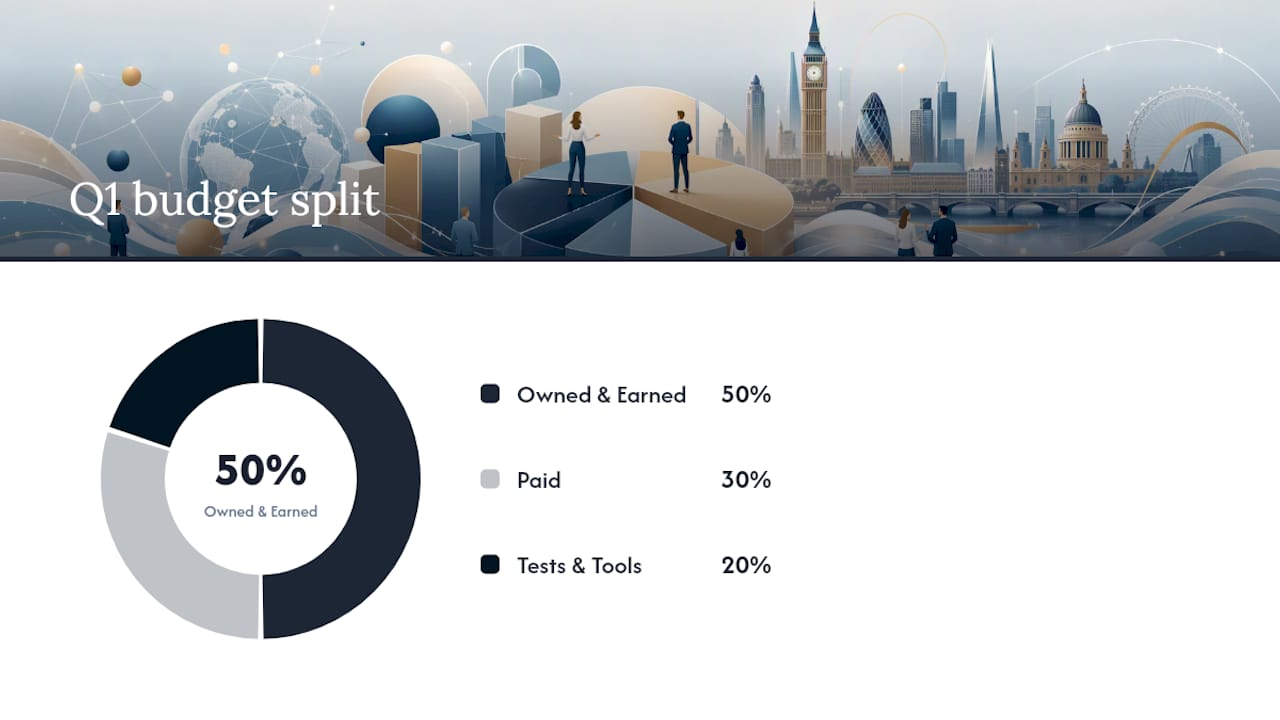
Sample budget split for quarter one:
- 50% owned and earned: Content production, SEO/AEO work, email programme, schema implementation
- 30% paid: PPC and paid social test budgets, with performance-based scaling from week six
- 20% experimentation: New channel tests, creative variants, and tool subscriptions
A useful rule of thumb: do not scale paid spend until you have at least four weeks of conversion data from your owned channels. Paid amplifies what is already working; it does not fix a broken funnel.
90-day weekly sprint plan:
- Week 1: Strategy audit complete; objectives and KPIs documented and signed off
- Week 2: Audience research underway; persona drafts shared with leadership
- Week 3: Channel priority matrix finalised; content calendar for weeks 5–12 drafted
- Week 4: GEO/AEO audit complete; schema markup implementation begun
- Week 5: First content cluster published; email welcome sequence live
- Week 6: Paid channel tests launched; measurement dashboard live
- Week 7: First weekly performance review; early signals reviewed
- Week 8: Schema audit complete; AI visibility baseline established
- Week 9: Mid-quarter review; budget reallocation based on early data
- Week 10: Second content cluster published; social video series begins
- Week 11: Incrementality experiment results reviewed; attribution model refined
- Week 12: Full quarter review; 90-day plan for Q2 drafted
Three quick wins that move KPIs fastest in quarter one:
- Fix your website’s technical SEO and schema: This costs relatively little and improves both traditional rankings and AI visibility within weeks.
- Launch a behavioural email sequence: A three-email welcome or re-engagement sequence typically delivers the highest conversion rate of any channel for the effort invested.
- Run a small PPC test on your top three converting keywords: Even a modest budget generates real conversion data that informs your broader channel strategy. Review how to plan PPC budgets before committing spend.
Reassessing spend at checkpoints:
At weeks four, eight, and twelve, review your cost per qualified lead by channel against your initial benchmarks. Do not wait until the end of the quarter to make that call.
How Fyldedigital builds a 2026 marketing strategy for an SMB: a worked example
This is a hypothetical but realistic example of how Fyldedigital approaches a 2026 strategy build for a UK-based SMB. It illustrates the framework in practice.
The scenario: A professional services firm based in Lancashire with a dated website, no active SEO programme, and a social media presence that has not been updated consistently for 18 months. Monthly marketing budget: £2,500.
Objectives set in week one:
- Increase organic search visibility by targeting 15 high-intent service queries
- Generate 25 qualified enquiries per month from digital channels within 90 days
- Establish a measurable email list of 500 engaged contacts within the quarter
Steps taken in the first 90 days:
- Web design and technical foundation: Fyldedigital rebuilt the firm’s website with a mobile-first, conversion-focused layout and added full schema markup across all service pages. The web design services covered both the visual redesign and the technical SEO groundwork simultaneously.
- SEO and AEO content: Three long-form service pages were published targeting specific local and sector queries, each structured with FAQ schema and direct-answer formatting for AI Overviews.
- Social media management: A consistent posting schedule was established across LinkedIn and Instagram, with employee-led content and short-form video clips from the firm’s team. Social media management was handled as a managed service, freeing the client’s team to focus on client work.
- PPC test: A small Google Ads campaign targeting the firm’s three highest-value service queries ran from week five, generating initial conversion data within a fortnight.
Example outcomes at 90 days (illustrative):
- Organic impressions increased significantly as new pages indexed and schema was recognised
- Enquiry volume from digital channels grew, with email and organic search as the top two sources
- The firm’s brand name began appearing in Google AI Overviews for two target queries
Pro Tip: Request a free website and SEO review before committing to a full strategy build. Knowing your baseline takes less than 48 hours and changes which steps you prioritise in the first 30 days.
If you want Fyldedigital to build or review your 2026 marketing strategy, start with a free website and SEO review or explore the full range of digital marketing services available to UK businesses.
What UK data privacy rules apply to your 2026 marketing?
UK GDPR and the Data Protection Act 2018 govern how you collect, store, and use personal data in marketing. The UK Information Commissioner’s Office (ICO) is the regulatory authority, and its guidance is the primary reference for any marketing team processing personal data in the UK.
The key rules that affect day-to-day marketing practice are straightforward. You need a lawful basis for processing personal data: for most marketing activities, that means either consent (for email marketing to individuals) or legitimate interests (for some B2B communications, subject to a balancing test). Pre-ticked boxes and bundled consent are not valid under UK GDPR. Every email list must be built on confirmed opt-in, and unsubscribe mechanisms must work immediately.
For AI-powered personalisation tools, the compliance question is more complex. If your AI tool processes personal data to make automated decisions about individuals (such as dynamic pricing or personalised content targeting), you may need to conduct a Data Protection Impact Assessment (DPIA) before deployment. The ICO’s guidance on AI and data protection is the right starting point.
Cookie consent remains a live issue. UK rules require informed, specific consent for non-essential cookies, including analytics and advertising cookies. Consent Management Platforms (CMPs) such as OneTrust or Cookiebot help manage this at scale. Audit your cookie implementation annually, not just at launch.
Ethical marketing practice goes beyond legal compliance. In 2026, audiences are increasingly alert to manipulative design patterns, misleading claims, and opaque data use. Brands that communicate clearly about how they use data, and that make opting out genuinely easy, build the kind of trust that converts and retains customers over time.
How does customer experience connect to your marketing strategy?
Marketing and customer experience (CX) are not separate disciplines in 2026. Every touchpoint a customer has with your brand, from the first Google search to the post-purchase email, is both a CX moment and a marketing signal. Treating them as separate functions creates gaps that customers notice immediately.
The most practical way to integrate CX into your marketing strategy is to map the full customer journey before you plan any campaign. Identify the moments where customers form opinions about your brand: the first website visit, the enquiry response time, the onboarding experience, and the follow-up after purchase. Each of these is a marketing opportunity as much as a service one.
Net Promoter Score (NPS) and Customer Satisfaction Score (CSAT) are the standard CX metrics, but they only tell you what happened after the fact. More useful for marketing planning are behavioural signals: which pages do customers visit before converting, where do they drop off, and what questions do they ask before buying? Those signals should feed directly into your content strategy and channel mix.
Personalisation is the bridge between marketing and CX. When your email programme sends content relevant to where a customer is in their journey, rather than a generic newsletter, it feels like good service rather than marketing. That distinction matters to UK consumers, who are increasingly sceptical of mass-broadcast messaging.
Which emerging technologies beyond AI should you watch in 2026?
Augmented reality (AR) and virtual reality (VR) are moving from novelty to practical marketing tools for specific sectors. UK retail brands are using AR try-on features (virtual fitting rooms, furniture placement tools) to reduce return rates and increase purchase confidence. If you sell a product where visualisation matters, AR is worth a small test budget in 2026.

Spatial computing, driven by devices like Apple Vision Pro, is still early-stage for most UK marketers. The audience is small and the production costs are high. Watch it, but do not allocate significant budget until the installed base grows.
Voice search remains relevant, particularly for local queries. UK consumers use voice assistants (Google Assistant, Amazon Alexa, Apple Siri) for local business searches, directions, and quick information queries. Optimising for conversational, question-based queries and ensuring your Google Business Profile is complete and accurate covers most of the voice search opportunity without specialist investment.
Connected TV (CTV) advertising is growing fast in the UK as streaming platforms introduce ad-supported tiers. For brands with video creative, CTV offers precise audience targeting at a lower cost per thousand than traditional broadcast. Sky AdSmart and Channel 4’s addressable TV products are the most accessible entry points for UK SMBs.
Web3 and blockchain-based marketing tools (NFTs, token-gated communities) have not delivered the mainstream marketing utility that was predicted in earlier years. They remain niche and technically complex. Unless your audience is specifically engaged with these technologies, they are not a priority for 2026 planning.
How do you personalise marketing with AI without losing customer trust?
AI-powered personalisation delivers better results than broadcast messaging, but it carries a real trust risk if implemented without transparency. The line between “this brand understands me” and “this brand is watching me” is thinner than most marketers assume.
The most effective personalisation in 2026 uses first-party data: purchase history, browsing behaviour on your own site, and declared preferences from your CRM. This data is both more accurate and more ethically sound than third-party data, which is increasingly restricted under UK GDPR and browser privacy changes.
Practical personalisation techniques that work without eroding trust:
- Behavioural email segmentation: Send different content to customers based on what they have browsed or purchased, not just their demographic profile. A customer who viewed your pricing page three times in a week needs a different email than one who has not visited in six months.
- Dynamic website content: Tools like HubSpot’s smart content or similar platforms can show different page content to returning visitors versus new ones, or to visitors from specific industries. Keep the personalisation relevant and obvious rather than covert.
- Predictive lead scoring: Use your CRM’s AI features (Salesforce Einstein, HubSpot’s predictive scoring) to prioritise follow-up on the leads most likely to convert. This improves sales efficiency without any customer-facing data use.
- AI-assisted content recommendations: Recommend related articles, products, or services based on what a visitor has already engaged with. This feels helpful rather than intrusive when the recommendations are genuinely relevant.
Transparency is not just a legal requirement; it is a competitive advantage. Brands that tell customers clearly what data they collect and why, and that give customers genuine control over their preferences, consistently outperform those that obscure data practices. A clear, plain-English privacy notice and a preference centre in your email programme are the minimum standard.
How do you define objectives and KPIs that drive revenue?
Objectives without revenue connections are decorative. Every marketing goal in your 2026 plan should trace directly to a business outcome: revenue generated, customers acquired, retention improved, or market share gained.
The SMART framework (Specific, Measurable, Achievable, Relevant, Time-bound) is the standard, and it works when applied honestly. The failure mode is writing SMART-sounding objectives that are actually activity targets dressed up as outcomes. “Publish 12 blog posts per quarter” is an activity. “Generate 50 qualified leads per month from organic search by the end of Q2” is an objective.
Revenue-focused objective examples:
- Increase marketing-attributed pipeline by £150,000 within 90 days
- Reduce customer acquisition cost from £120 to £85 within two quarters
- Grow email list to 2,000 engaged subscribers with a 25% open rate by end of Q2
- Achieve first-page organic rankings for five high-intent service queries within 60 days
KPI hierarchy:
Set primary KPIs (revenue, pipeline, CAC) that leadership cares about, secondary KPIs (leads, conversion rates, organic traffic) that your team manages daily, and diagnostic metrics (click-through rates, bounce rates, AI visibility score) that explain why primary KPIs are moving. Never let diagnostic metrics become the focus of leadership reporting.
Think with Google’s 2026 marketing predictions highlight that 2026 marks the shift from experimental tactics to integrated, agent-ready marketing where AI is embedded into workflows. That shift makes revenue-focused objectives more important, not less, because AI tools make it easier to generate activity and harder to distinguish genuine results from noise.
What most 2026 marketing guides get wrong
Most marketing strategy guides for 2026 make the same mistake: they list trends without telling you which ones to act on first, or they bury the practical steps under so much context that the reader finishes the article no clearer on what to do Monday morning.
The research behind this guide points to a more uncomfortable truth. The biggest risk for UK marketing leaders in 2026 is not missing a trend. It is continuing to run a strategy built for 2022 while the discovery environment shifts underneath them. Gartner’s prediction about declining traditional search volume is not a distant forecast; it is already visible in zero-click search rates and the growing share of queries answered directly in AI Overviews. Teams that treat GEO and AEO as “something to look at later” are already behind.
The conventional advice to “test and learn” is sound in principle but often used as cover for avoiding commitment. The teams that will outperform in 2026 are the ones that commit to a documented strategy, assign clear ownership, and review it on a fixed cadence. The 90-day sprint model in this guide is not a suggestion. It is the minimum viable execution structure for a market moving this fast.
One more thing that gets underplayed: authenticity is not a content trend. It is a structural shift in how trust is built online. As AI-generated content floods every channel, the brands that win will be the ones whose content is visibly human, verifiably expert, and consistently honest. That means investing in real people (employee content, verified creators, genuine case studies) rather than scaling AI output for its own sake.
If you take one thing from this guide, make it this: write your strategy down, assign every objective an owner, and review it in 90 days. The rest is execution.
Sources
These are the primary sources used to build this guide. Each one is worth bookmarking for ongoing reference.
- 2026 state of marketing: Data from 1,500+ global marketers
- 9 Marketing Trends I’m Seeing Firsthand in 2026 (With Data)