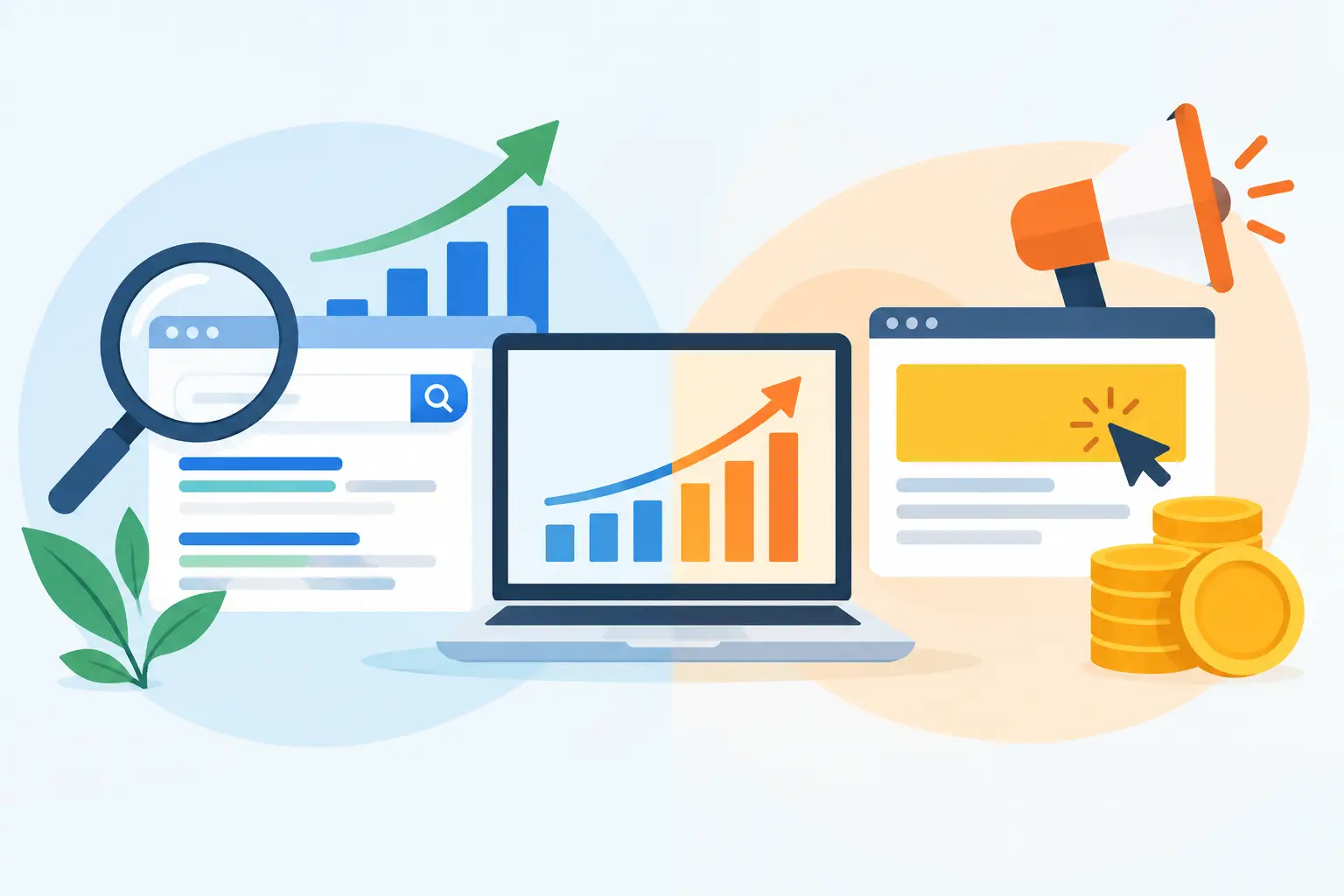
A lot of businesses ask the same question when leads slow down or growth stalls: SEO vs PPC – which one is actually worth the budget? The honest answer is that both can work brilliantly, but they do very different jobs. If you treat them as interchangeable, you can waste time, money, or both.
For most SMEs, the real decision is not about picking a winner in some marketing contest. It is about choosing the right route to visibility, enquiries and sales based on your goals, your market and how quickly you need results.
SEO vs PPC: the core difference
SEO is about improving your visibility in organic search results. You invest in your website, content, technical performance and authority so that Google sees your business as a strong answer to relevant searches. Done properly, it builds momentum over time.
PPC is paid advertising, usually through platforms such as Google Ads. You bid to appear for selected searches and pay when someone clicks. It can generate traffic quickly, but the visibility stops when the budget stops.
That is the simplest way to frame SEO vs PPC. One builds long-term equity in your online presence. The other buys immediate access to attention.
Neither is automatically better. It depends on what your business needs right now.
When SEO makes the most commercial sense
SEO is usually the stronger choice when you want sustainable growth rather than a short burst of traffic. If your customers actively search for your services, and you want to reduce reliance on paid channels over time, SEO deserves serious attention.
A well-optimised website can keep attracting relevant visitors month after month. That matters if you are a local service provider, a trades business, a clinic, a retailer or any company that wants consistent visibility without paying for every single click.
There is also a trust factor. Many users skip ads and head straight to organic results because they see them as more credible. If your business appears naturally for high-intent searches, it can strengthen brand confidence before a prospect even lands on your site.
The catch is speed. SEO takes time. In a competitive market, it may take months to move the needle in a meaningful way. If your website is weak, your content is thin, or your competitors are already investing heavily, results will not happen overnight.
That does not make SEO slow in a bad way. It makes it cumulative. Good work compounds.
SEO is strongest when:
You have patience, want to build a valuable marketing asset, and need a channel that can support growth over the long term. It is especially useful when your cost per lead from paid ads is becoming too high, or when you want your website to do more heavy lifting for the business.
When PPC is the smarter move
PPC comes into its own when speed matters. If you need leads this month rather than next quarter, paid search can put your business in front of ready-to-buy users quickly.
That makes it useful for new website launches, seasonal campaigns, product promotions, event-driven demand, or businesses entering a new market. It is also valuable when you want tighter control over who sees your offer, when they see it and what message they get.
PPC gives you more immediate data as well. You can test keywords, landing pages and offers at pace. That kind of visibility is helpful when you are trying to work out what converts before investing in a larger long-term strategy.
But there is a trade-off. PPC can become expensive, particularly in competitive sectors such as legal, home improvements, finance or specialist health services. If campaigns are poorly managed, budget disappears fast. Clicks alone mean nothing if the traffic does not convert.
That is why PPC should never be treated as a switch you flick and forget. It needs strategy, strong creative, persuasive landing pages and constant optimisation.
PPC is strongest when:
You need immediate visibility, have a clear offer, and can support the spend with a website or landing page built to convert. It works best when commercial intent is high and tracking is in place from day one.
Cost: where businesses often get this wrong
A lot of decision-makers assume SEO is free because you are not paying for each click. It is not. Proper SEO takes investment in technical improvements, on-page optimisation, content, local search work and ongoing analysis.
PPC, on the other hand, looks straightforward because you can set a daily budget and start quickly. But the visible ad spend is only part of the cost. You also need campaign management, ad copy, testing and conversion-focused pages if you want a proper return.
So the real question is not which is cheaper. It is which is more cost-effective for your current stage of growth.
If your business needs leads now, PPC may justify a higher short-term cost because it creates immediate opportunity. If you want to lower acquisition costs over the next 12 months, SEO may produce better value over time.
The strongest commercial decisions usually come from looking at lead quality, conversion rate and customer lifetime value, not just headline traffic costs.
SEO vs PPC for local businesses
For many businesses across Blackpool, Lancashire and the wider Fylde Coast, local intent changes the picture. If people are searching for services near them, local SEO can be a powerful driver of enquiries. Appearing in local search results and map listings can put your business in front of customers who are already close to making a decision.
That said, PPC can still play a valuable role in local markets, especially if you want to dominate a high-value service area or target specific postcodes. It can also help if organic rankings are weak and you do not want to wait for SEO improvements to gain traction.
For local firms, the smartest approach is often practical rather than ideological. Use SEO to build long-term local visibility and use PPC to fill gaps, support promotions or target priority services.
What SEO and PPC can learn from each other
This is where the conversation gets more useful. SEO and PPC are often treated like rival services, but in reality they can strengthen each other.
PPC data can reveal which keywords convert best, which messages attract clicks and which landing pages generate enquiries. That insight can shape your SEO strategy so you focus on terms with genuine commercial value instead of chasing vanity rankings.
SEO can support PPC too. A fast, well-structured website with strong content and clear service pages can improve ad performance and help turn paid clicks into real leads. If your site experience is poor, PPC becomes more expensive than it needs to be.
Used together, the two channels can give your business both short-term traction and long-term resilience.
So which should you choose?
If you need a simple answer, here it is.
Choose SEO if you want to build sustainable visibility, strengthen your website as a business asset and reduce reliance on paid traffic over time.
Choose PPC if you need fast results, want immediate visibility for a clear offer, or need a controlled way to test and scale demand.
Choose both if your business is serious about growth and has the budget to invest sensibly. That combined approach often works best because it balances immediate lead generation with long-term performance.
The wrong move is choosing based on assumptions. A business with a poor website and no conversion tracking will struggle with both. A business with strong service pages, clear offers and a joined-up strategy can make either channel work far harder.
At Fylde Digital, we often see businesses come to us thinking they need more traffic, when what they actually need is a better plan. More visibility only matters if it turns into enquiries, sales and measurable return.
The better question than SEO vs PPC
Instead of asking which channel is best in general, ask which channel is best for your next stage of growth.
If your pipeline is quiet and you need demand quickly, paid search may be the right move. If your business is too dependent on paid leads and wants stronger long-term foundations, SEO may be the smarter investment. If your market is competitive and your ambitions are bigger than one quick fix, combining the two may give you the balance you need.
Marketing works best when it is aligned to commercial reality. Budget, timescale, competition, website quality and customer behaviour all matter. The businesses that grow consistently are usually the ones that stop looking for silver bullets and start building joined-up systems.
That is the useful way to think about SEO vs PPC. Not as a battle, but as a choice about timing, intent and return. Pick the channel that fits where your business is now, and make sure it is backed by a website and strategy strong enough to convert attention into action.