Branding is the strategic process of shaping how customers perceive, recognise, and connect with your business, and it is the single most consistent driver of trust, differentiation, and long-term revenue growth. The American Marketing Association defines branding as a strategic infrastructure that shapes perceptions over time, influencing every marketing and sales decision you make. For small and medium-sized businesses, this matters enormously. You are competing against larger budgets and more established names, so your brand is often the deciding factor when a customer chooses you over a rival. This guide explains how branding builds trust, what the data says about its measurable impact, and exactly what you can do to strengthen yours.
What is the role of branding in business?
Branding is not simply a logo or a colour palette. It is the sum of every impression your business makes, from your website copy and social media tone to how your team answers the phone. The role of brand identity in an SME context is to create a consistent, recognisable presence that customers can trust before they have even spoken to you.
The core branding benefits for companies fall into four categories: recognition, trust, differentiation, and loyalty. Recognition means customers can identify you instantly across channels. Trust means they believe you will deliver on your promises. Differentiation means they understand why you are the better choice. Loyalty means they return, refer others, and resist switching to competitors. Each of these outcomes compounds over time, which is why branding is an investment rather than an expense.

The importance of branding also extends inward. A clearly defined brand gives your team a shared language for decision-making. It tells your staff what you stand for, how to communicate, and what standards to uphold. Without that internal clarity, your external messaging drifts, and customers notice.
How does branding build trust and evolve with business growth?
Trust is not built in a single interaction. Research into brand trust in SMEs shows that founder-led businesses build early credibility through symbolic cues, things like the language you use, the expertise you signal, and the confidence of your positioning. This is what researchers describe as the Sage archetype: a brand that leads with knowledge and authority.
As your business matures, those symbolic cues are no longer enough on their own. Customers expect tangible proof artifacts, such as case studies, diagnostic tools, published frameworks, and client results. This shift reflects the Creator archetype: a brand that demonstrates capability through evidence rather than assertion. The transition from Sage to Creator is one of the most important and most overlooked stages in SME brand development.
There is a specific risk worth knowing about here. Brands that lean heavily on the Innocent archetype, projecting simplicity and approachability above all else, can undermine their own authority as they grow. What reads as friendly and accessible at launch can read as lightweight and unproven two years later. Planning your brand’s maturation in advance prevents this credibility gap.
Pro Tip: Map out your brand trust signals by business stage. Ask yourself: what proof does a new customer need to trust us at year one, year three, and year five? Build your content, case studies, and credentials to match each stage.
Key trust-building considerations for SMEs include:
- Use expertise-led content early to establish your Sage positioning.
- Introduce case studies and client results as soon as you have them.
- Avoid over-relying on approachability messaging once your business has a track record.
- Assign a named person or team to maintain brand consistency as the business grows.
What are the measurable impacts of consistent branding on business performance?
The data on brand consistency is striking. Businesses that maintain consistent brand presentation across all channels see revenue lifts of between 23% and 33%. That is not a marginal gain. It is the difference between a business that grows steadily and one that stalls despite strong products or services.
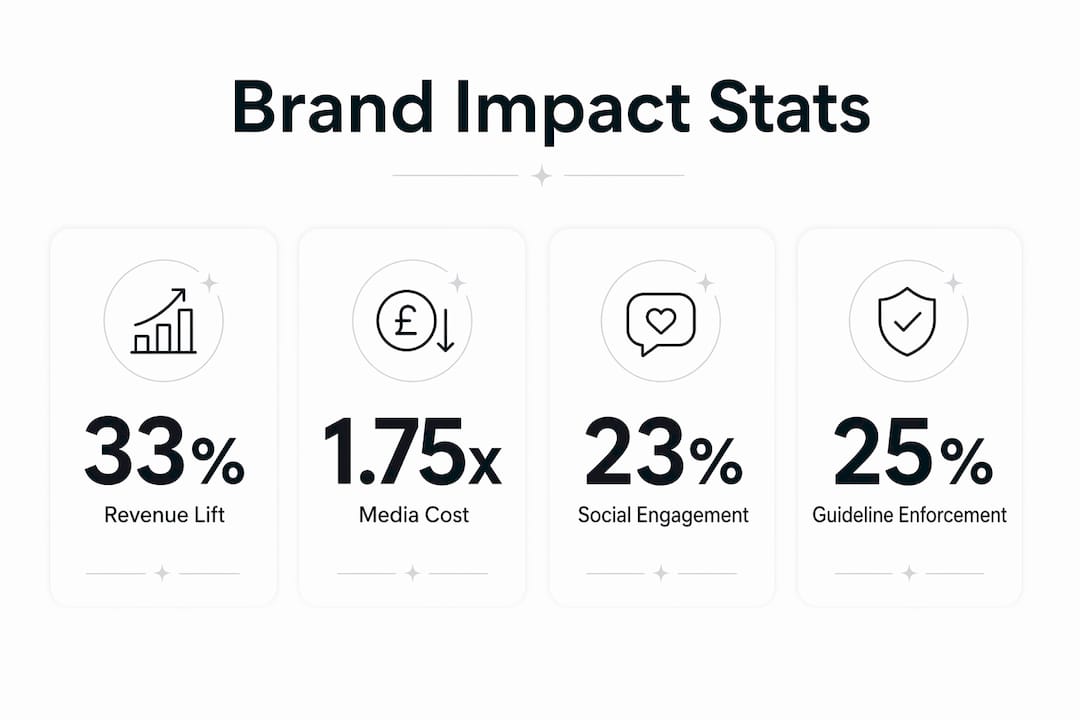
The cost of inconsistency is equally significant. Brands that present themselves unevenly across channels spend 1.75 times more on media to achieve the same growth as consistent competitors. That wasted spend compounds every quarter, quietly draining your marketing budget without producing proportional results.
The engagement figures are just as compelling. Consistent omnichannel brand messaging produces 23% higher social media engagement and a 306% higher customer lifetime value. Businesses that maintain consistent branding across five or more channels outperform single-channel brands by 400%. These numbers make the case for treating brand consistency as a commercial priority, not a design preference.
| Branding factor | Measured impact |
|---|---|
| Consistent brand presentation | Revenue lift of 23% to 33% |
| Inconsistent brand presentation | 1.75x higher media spend required |
| Omnichannel consistency | 23% higher social media engagement |
| Customer lifetime value | 306% higher with consistent messaging |
| Five or more channels mastered | 400% better performance vs single-channel |
Despite this evidence, only 25 to 30% of companies with brand guidelines actually enforce them. That gap between having a brand plan and operating one is where most SMEs lose their return on investment.
Pro Tip: Treat your brand guidelines as a live operational document, not a PDF that sits in a shared drive. Assign clear ownership, integrate guidelines into your content workflows, and review them quarterly.
How do brand awareness, association, and resonance foster customer loyalty?
Understanding how branding impacts sales requires looking at three connected mechanisms: brand awareness, brand association, and brand resonance. Each plays a distinct role in moving a customer from first contact to long-term loyalty.
Brand awareness is the degree to which customers recognise and recall your business. It is the foundation. Without awareness, no other branding investment delivers its full return. Brand association is what customers connect to your name: quality, reliability, value, expertise, or any other attribute you have worked to establish. Brand resonance is the deepest level. It describes the emotional and psychological bond a customer has with your brand, the sense that your business genuinely fits their values and needs.
Research from a survey of 481 food-and-beverage SMEs found that brand resonance mediates the relationship between awareness and loyalty. In plain terms: awareness and association create the conditions for loyalty, but resonance is the mechanism that converts them. Without resonance, customers know you and may even like you, but they will still switch when a competitor offers a better deal.
For SMEs, measuring resonance does not require expensive research. Practical proxies include repeat purchase intent and brand-fit sentiment gathered through simple post-purchase surveys. Ask customers whether your brand feels right for them, not just whether they were satisfied. The distinction matters.
Strategies to build resonance include:
- Align your brand values explicitly with the values of your customer base.
- Create brand experiences that go beyond the transaction, such as follow-up content, community events, or personalised communications.
- Use consistent visual and verbal identity so every touchpoint reinforces the same emotional impression.
- Highlight shared values in your messaging rather than leading only with product features.
What practical steps can SMEs take to build and maintain effective branding?
Building a strong brand is a process, not a project. The following steps give you a structured path from positioning to governance.
-
Clarify your brand narrative. Define what your business stands for, who it serves, and why it is the right choice. This narrative should be specific enough to differentiate you and simple enough for every team member to repeat accurately. A vague positioning statement produces vague customer perceptions.
-
Develop your visual and verbal identity. Your logo, colour palette, typography, and tone of voice are the surface layer of your brand. They need to be consistent, documented, and applied without exception. A clear visual identity is often the first thing a potential customer judges you on, and first impressions are difficult to reverse.
-
Embed your brand internally. Employees are your most consistent brand ambassadors, and embedding brand values through recruitment, onboarding, and leadership training is what keeps your external messaging coherent. If your team does not understand or believe in the brand, customers will sense the disconnect.
-
Govern your brand actively. Operationalising brand governance means assigning ownership, integrating guidelines into daily workflows, and auditing your output regularly. Without enforcement, brand guidelines are decorative. The businesses that see the strongest branding ROI are the ones that treat consistency as a non-negotiable operational standard.
-
Plan your brand evolution. As your business grows, your brand signals need to mature with it. Add case studies, publish thought leadership, and introduce diagnostic tools or frameworks that demonstrate your expertise in concrete terms. The World Economic Forum notes that in an environment of information overload, a clear and consistent brand acts as a protective asset, cutting through noise and anchoring customer trust.
Pro Tip: Schedule a brand audit every six months. Review your website, social media profiles, sales collateral, and email templates against your brand guidelines. Inconsistencies accumulate quietly and erode the trust you have worked to build.
Key takeaways
Strong branding requires consistent signals, active governance, and planned evolution from symbolic trust cues to tangible proof as your business grows.
| Point | Details |
|---|---|
| Branding drives measurable revenue | Consistent brand presentation produces revenue lifts of 23% to 33% across channels. |
| Trust signals must evolve | Early symbolic cues must give way to case studies and proof artifacts as your business matures. |
| Resonance converts awareness to loyalty | Brand resonance is the mechanism that turns recognition into repeat purchase and long-term loyalty. |
| Governance closes the ROI gap | Only 25 to 30% of businesses enforce their brand guidelines; enforcement is where returns are realised. |
| Employees carry the brand | Internal brand embedding through training and onboarding keeps external messaging coherent and credible. |
Why I think most SMEs are solving the wrong branding problem
Most small business owners I speak with treat branding as a design problem. They invest in a logo refresh or a new website and expect the results to follow. The research tells a different story. The gap is almost never in the visual assets. It is in the governance, the internal alignment, and the failure to plan how the brand should mature.
The insight from brand archetype research is one I find genuinely useful in practice. A friendly, approachable brand works brilliantly at launch. It lowers the barrier to first contact and makes you feel accessible. But that same positioning, left unchanged, starts to work against you once you have a track record. Customers who have grown with you expect more authority, more evidence, more proof. If your brand still reads as a startup when you are three years in, you are leaving credibility on the table.
The businesses I see getting this right are the ones that treat their brand as a living system. They review it regularly, they train their teams on it, and they add proof points deliberately over time. They also understand that branding for business growth is not a one-time decision. It is a discipline. The SMEs that commit to that discipline consistently outperform those that treat branding as a task to be completed and filed away.
— tibor
How Fyldedigital can help you build a consistent, credible brand
Fyldedigital works with small and medium-sized businesses across the Fylde Coast and beyond to create digital presences that reflect their brand accurately and consistently. From professional web design that puts your brand identity front and centre, to SEO and social media management that amplifies your message across channels, the team at Fyldedigital builds the infrastructure your brand needs to perform. If your website no longer reflects where your business is today, or if your online presence feels inconsistent, a free website and SEO review is a practical first step. Get in touch to find out what is holding your brand back.
FAQ
What is the role of branding in business growth?
Branding shapes how customers perceive and trust your business, directly influencing their decision to buy and return. Consistent brand presentation is linked to revenue lifts of 23% to 33%, making it one of the highest-return investments an SME can make.
Why does brand consistency matter so much?
Inconsistent branding forces businesses to spend 1.75 times more on media to achieve the same growth as consistent competitors. Consistency reduces wasted spend and compounds the value of every marketing activity you run.
How can SMEs measure whether their branding is working?
Track repeat purchase intent and brand-fit sentiment through post-purchase surveys, alongside social media engagement rates and customer lifetime value. These proxies measure brand resonance, which research identifies as the key mechanism linking awareness to loyalty.
What is brand resonance and why does it matter?
Brand resonance is the emotional and psychological connection a customer has with your brand. Research from a survey of 481 food-and-beverage SMEs found it mediates the relationship between brand awareness and customer loyalty, making it the critical outcome to build towards.
How often should an SME review its branding?
A brand audit every six months is a practical standard. Review all customer-facing materials against your brand guidelines and check whether your trust signals still match your current stage of business growth.