Keywords are defined as the words and phrases that signal to search engines what your content is about and who it is for. The role of keywords in SEO is to connect your pages with the right searches at the right moment, directly shaping your visibility, traffic, and conversions. Without a deliberate keyword approach, even well-written content sits invisible in search results. This guide covers how keywords function in modern SEO, how to research and prioritise them, the mistakes that cost rankings, and the practical steps to build a keyword strategy that delivers real business results.
How do keywords function within modern SEO frameworks?
Keywords help search engines categorise content by topic and user intent, not just by matching exact words. Google shifted from exact word matching to evaluating intent and context years ago. That shift means a page about “affordable web design for small businesses” can rank for “cheap website builder” without using that phrase once, provided the content genuinely addresses the underlying need.

Semantic search is the engine behind this change. Algorithms now read the relationships between words, the structure of your content, and the signals of user satisfaction. Keywords remain the starting point for discovery, but content relevance and quality decide which pages actually rise to the top.
Placement still matters enormously. Keywords in titles, headings, and meta descriptions tell search engines and readers what a page covers before they click. A title tag without a clear keyword is a missed opportunity to rank and to earn the click in the first place.
AI-powered search tools, including AI overviews in Google Search, add another layer. These systems pull answers from pages with strong topical coverage and clear keyword signals. Consistent use of related terms across a page, what SEO professionals call a keyword cluster, improves your chances of appearing in both traditional results and AI-generated citations.
Key functions of keywords in modern SEO:
- Topic signalling: Keywords tell search engines which subject your page covers.
- Intent matching: The right keywords attract visitors at the right stage of their buying journey.
- Content structure: Keywords placed in title tags, H1 and H2 headings, and meta descriptions reinforce topical focus.
- Topical authority: Covering a cluster of related terms builds credibility with search algorithms.
- AI discoverability: Clear keyword signals improve inclusion in AI-generated search summaries.
Pro Tip: Place your primary keyword within the first 100 words of your page and in the H1 heading. This gives search engines an immediate, unambiguous signal about your content’s focus.
What is involved in effective keyword research and prioritisation?
Keyword research is the process of identifying the exact words and phrases your audience uses when searching for what you offer. Knowing these terms guides your content towards actual demand and revenue generation, rather than topics you assume people care about.
Three metrics determine whether a keyword is worth targeting:
- Search volume: How many people search for this term each month. High volume sounds attractive, but volume without relevance wastes your effort.
- Keyword difficulty: How competitive the term is. A brand-new site targeting a difficulty score of 80+ will wait years for results. Lower-difficulty terms with decent volume offer faster wins.
- Business potential: How directly the keyword connects to what you sell. A term like “what is SEO” has enormous volume but low purchase intent. “SEO agency Blackpool” has lower volume but far higher conversion potential.
High-intent, bottom-of-funnel keywords often convert better than high-volume general queries. This is the most important insight in keyword prioritisation. A business generating ten enquiries from 200 targeted visitors outperforms one generating two enquiries from 2,000 untargeted visitors.
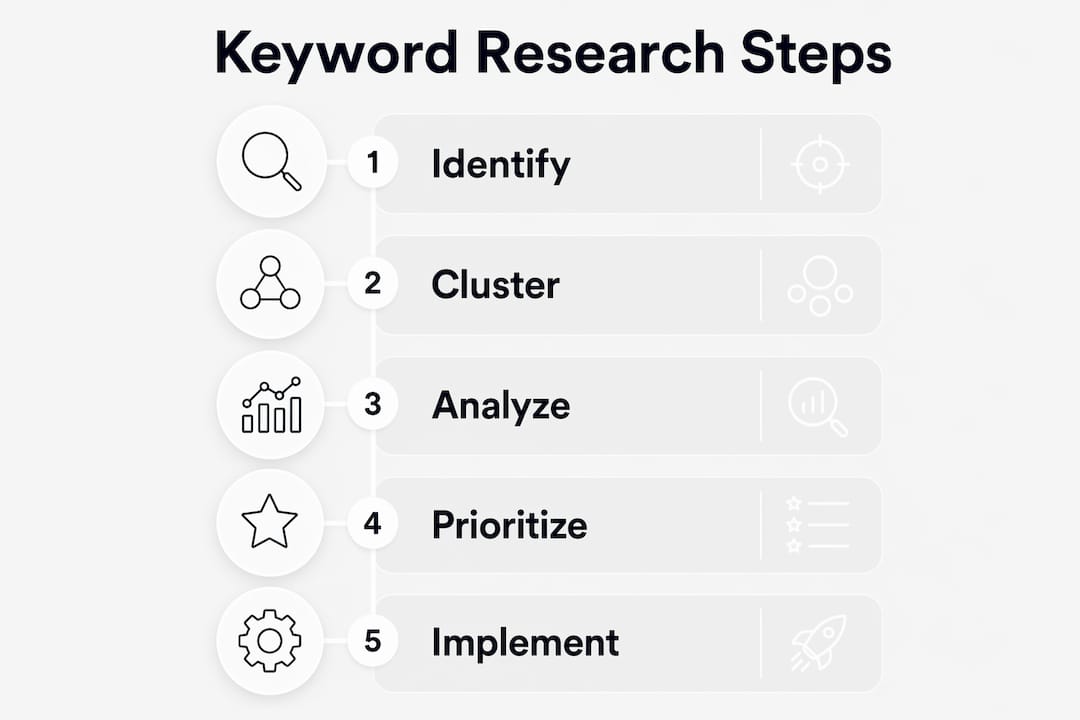
Clustering is the method that ties research together. Grouping keywords by intent and theme allows you to target multiple related queries with a single, well-structured page rather than creating dozens of thin pages that compete with each other.
| Keyword type | Search volume | Difficulty | Business potential | Priority |
|---|---|---|---|---|
| Informational (“what is SEO”) | High | Medium | Low | Content marketing |
| Navigational (“Fyldedigital services”) | Low | Low | High | Brand pages |
| Commercial (“best SEO agency”) | Medium | High | High | Service pages |
| Transactional (“hire SEO consultant”) | Low | Medium | Very high | Conversion pages |
AI tools and multi-platform research add depth to this process. Searching on YouTube, Reddit, and Google’s “People Also Ask” boxes reveals the language your audience actually uses, which often differs from industry jargon. Combining these sources with a dedicated keyword research tool gives you a fuller picture of real demand.
Pro Tip: Start your keyword research by listing the problems your business solves, not the services you offer. Your audience searches for solutions, not product names.
What challenges and common mistakes impact keyword effectiveness?
The most damaging mistake in keyword strategy is targeting high-volume terms that have no connection to your business. Over-focusing on high-volume but irrelevant keywords reduces SEO effectiveness even when you rank for them, because visitors who land on your page leave immediately. High bounce rates signal to search engines that your content did not satisfy the query.
Keyword stuffing is the other classic error. Repeating a keyword unnaturally throughout a page was a tactic that worked in 2005. Today, it triggers algorithmic penalties and makes your content unreadable. Search engines are sophisticated enough to understand synonyms and related terms, so natural language always outperforms forced repetition.
Common mistakes that undermine keyword performance:
- Ignoring user intent: Targeting “running shoes” when your audience searches “best trail running shoes for wide feet” misses the actual need.
- Neglecting business alignment: Ranking for terms unrelated to your services brings traffic that never converts.
- Skipping topical depth: A single page on a broad topic rarely outranks a site with ten interconnected pages covering the subject thoroughly.
- Failing to update: Keywords that drove traffic in 2023 may be irrelevant or over-competitive in 2026. Keyword strategy requires regular review.
- Underestimating AI search: AI-driven query expansion means users receive answers to questions they did not explicitly type. Pages with shallow coverage get skipped.
Pro Tip: Review your top-ranking pages every quarter. Check whether the keywords driving traffic still align with your current services and business goals. Drift between keyword focus and business offer is one of the quietest causes of declining conversions.
Understanding the evolving SEO landscape helps you stay ahead of these shifts rather than reacting to them after rankings drop.
How can you implement a successful keyword strategy?
A keyword strategy defines which queries to rank for, in what order, and through what content. Aligning SEO efforts with business goals and resources is what separates a strategy from a list of keywords.
Follow these steps to build and execute yours:
- Audit your current position. Identify which keywords your site already ranks for and which pages drive the most traffic. This reveals gaps and quick-win opportunities before you create anything new.
- Build a keyword map. Assign keyword clusters to specific pages. Each page should target one primary keyword and a handful of closely related secondary terms. Avoid two pages competing for the same keyword.
- Optimise on-page elements. Place your primary keyword in the title tag, H1 heading, the first paragraph, and at least one subheading. Use related terms naturally throughout the body. Write a meta description that includes the keyword and gives a clear reason to click.
- Create content with topical depth. A single page rarely outranks a cluster of interlinked pages on a subject. Build supporting articles that address related questions and link back to your main page.
- Measure and adjust. Track keyword rankings, organic traffic, and conversion rates monthly. Key digital marketing metrics tell you whether your keyword choices are delivering business results, not just traffic.
- Adapt for AI and semantic search. Write content that answers specific questions clearly. Use structured headings that match the way people phrase searches. Pages that directly answer questions earn featured snippets and AI citations.
On-page keyword placement compared by impact:
| Page element | Keyword placement impact | Notes |
|---|---|---|
| Title tag | Very high | Primary keyword as close to the start as possible |
| H1 heading | Very high | Must match or closely mirror the title tag |
| First 100 words | High | Sets topical context immediately |
| H2 and H3 subheadings | Medium-high | Use related terms and question formats |
| Meta description | Medium | Influences click-through rate, not ranking directly |
| Body text | Medium | Natural usage; avoid repetition |
| Image alt text | Low-medium | Useful for image search and accessibility |
Effective keyword strategies in 2026 prioritise balancing search volume, ranking difficulty, and search intent to drive higher conversion rates. That balance is the difference between a keyword list and a keyword strategy. Fyldedigital applies this framework when building SEO campaigns for clients across the Fylde Coast and beyond, ensuring every keyword choice connects to a measurable business outcome.
For a deeper grounding in the terminology behind these techniques, the SEO glossary for small businesses covers the core concepts without unnecessary complexity.
Key takeaways
Keywords work best when they align search volume, user intent, and business relevance within a structured, regularly reviewed strategy.
| Point | Details |
|---|---|
| Keywords signal intent | They tell search engines what your page covers and who it serves. |
| Intent beats volume | High-intent keywords convert better than high-volume general terms. |
| Placement drives rankings | Title tags, H1 headings, and the first paragraph carry the most weight. |
| Clustering builds authority | Grouping related keywords across linked pages outperforms single-page targeting. |
| Strategy needs regular review | Keyword relevance shifts with algorithms, competition, and business changes. |
Keywords in 2026: what I have learned from watching strategies succeed and fail
The businesses I see struggle most with SEO share one pattern. They chose keywords based on what sounded impressive rather than what their customers actually type. A regional accountancy firm targeting “financial services” instead of “accountant for small businesses in Lancashire” is a real example of this. The broad term brought traffic. None of it converted.
The shift to AI-powered search has made intent alignment even more critical. AI systems do not just match keywords. They evaluate whether a page genuinely answers the question behind the search. Pages built around keyword clusters with real topical depth are the ones earning AI citations and featured snippets. Thin pages optimised for a single phrase are disappearing from results.
My honest view is that keyword volume is the most overrated metric in SEO. Marketers chase it because it is easy to measure and easy to present in a report. But a keyword with 200 monthly searches that converts at 10% is worth more than one with 20,000 searches that converts at 0.1%. The maths is simple. The discipline to act on it is harder.
The best keyword strategies I have seen share three qualities. They are built around customer language, not industry language. They are reviewed and updated at least quarterly. And they are connected directly to revenue goals, not vanity metrics like raw traffic or average position.
If you are building your keyword strategy from scratch, start with the questions your best customers ask before they buy. Those questions are your keywords.
— tibor
How Fyldedigital approaches keyword strategy for real results
Fyldedigital works with content creators, digital marketers, and business owners who want keyword strategies built around conversion, not just traffic. The team researches search volume, ranking difficulty, and business intent together, then maps keywords to the right pages and content types.

Whether you need a full SEO campaign built from the ground up or a review of your existing keyword targeting, Fyldedigital offers practical support grounded in measurable outcomes. The agency also provides a free SEO review for small businesses to identify where your current keyword strategy is leaving traffic and revenue on the table. If your site is not ranking for the terms your customers use, that is the starting point.
FAQ
What is the role of keywords in SEO?
Keywords signal to search engines what your content covers and which user queries it should appear for. They influence ranking, visibility, and the quality of traffic your site attracts.
Do keywords still matter for SEO in 2026?
Keywords remain vital for topic signalling, but intent and content quality now determine rankings more than exact keyword matching. Using relevant terms naturally within high-quality content is the current standard.
How many keywords should a single page target?
Each page should target one primary keyword and a cluster of closely related secondary terms. Targeting too many unrelated keywords on one page dilutes focus and confuses search engines about the page’s core topic.
What is keyword stuffing and why does it hurt rankings?
Keyword stuffing is the practice of repeating a keyword unnaturally throughout a page to manipulate rankings. Search engines penalise this behaviour because it degrades content quality and fails to satisfy user intent.
How do I choose the best keywords for my business?
High-priority keywords combine strong traffic potential, manageable ranking difficulty, and direct relevance to what you sell. Start with the problems your customers search for, then filter by competition and conversion potential.