An agency portfolio is a strategic business document that proves measurable impact, not a gallery of pretty work. In 2026, the role of portfolio in agency marketing has shifted decisively: prospects no longer accept a list of past clients as evidence of competence. They want documented outcomes, specific KPIs, and case studies that answer one question above all others. What changed for the client? Platforms like Clutch, portfolio websites, and analytics integrations have made it easier than ever to present verifiable results, and agencies that fail to do so are losing ground to those that do.
How portfolios demonstrate agency expertise and influence client decisions
A portfolio is the most revealing indicator of agency quality because it functions as a business document showing competence and results, not just creative output. When a prospect reviews your portfolio, they are not admiring your design sense. They are asking whether you can solve their specific problem and prove it with numbers.
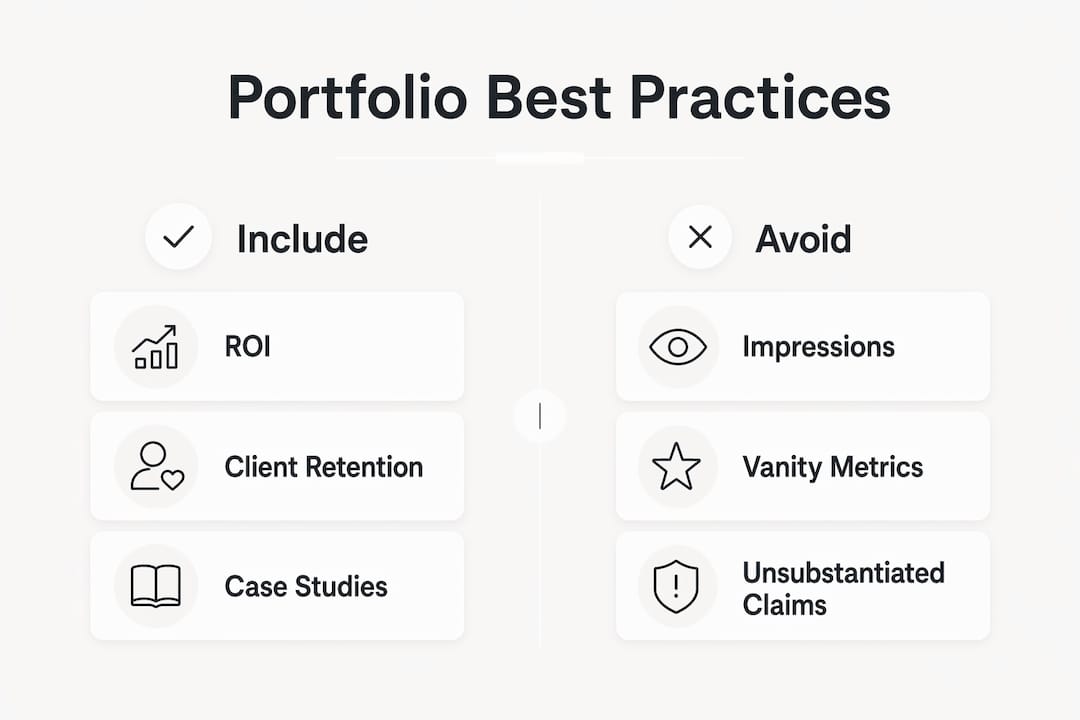
The metrics that matter most to decision-makers are KPIs tied directly to business performance: return on investment, cost per acquisition, revenue growth, and conversion rate improvements. Vanity metrics such as impressions and likes without financial linkage slow deal velocity, particularly when CFOs or procurement teams are involved in the buying decision. This means your portfolio must connect campaign activity to revenue, customer lifetime value, or another financial outcome that a non-marketer can understand and trust.
The most persuasive portfolios are structured around a clear narrative:
- Problem: What specific challenge did the client face before engaging your agency?
- Strategy: What approach did you choose, and why?
- Execution: What did you actually do, and which tools or channels did you use?
- Result: What changed, expressed in specific, verifiable numbers?
This Problem > Strategy > Execution > Result structure improves both clarity and persuasiveness. A case study that reads “we ran a PPC campaign and improved performance” tells a prospect nothing. A case study that reads “we reduced cost per acquisition by 34% over 90 days while maintaining lead volume” tells them everything they need to know about your capability.
Industry relevance also matters. A prospect in the professional services sector is far more likely to trust an agency that has solved problems for similar businesses. Where possible, group your case studies by sector or service type so prospects can self-select the evidence most relevant to their situation.

Pro Tip: Include client retention indicators where you have permission to share them. Long-term client relationships signal consistent delivery, not just a single successful campaign.
Best practices for curating and structuring an effective agency portfolio
Selecting the right projects is as important as presenting them well. Curate your portfolio with three to five strong, recent projects that demonstrate measurable range rather than filling a page with every piece of work you have ever produced. Each project should represent the type of work you want to keep doing, because your portfolio signals to prospects what they can expect from you.
Follow this process when building or refreshing your portfolio:
- Audit your existing work. List every project completed in the last 12 to 18 months and identify which ones produced the strongest, most documented results.
- Prioritise business impact. Select projects where you can show a clear before-and-after story with specific numbers, not just attractive visuals.
- Write a structured case study for each project. Use the Problem, Strategy, Execution, Result framework. Keep each section concise and data-led.
- Gather verifiable supporting evidence. Screenshots of analytics dashboards, client testimonials, and third-party review profiles like Clutch all add credibility that self-reported claims cannot.
- Update every six to twelve months. Agencies should refresh portfolios regularly with new projects to demonstrate market relevance and capability evolution.
The table below summarises what to include and what to avoid in each case study:
| Element | Include | Avoid |
|---|---|---|
| Metrics | ROI, CPA, conversion rates, revenue | Impressions, follower counts, likes |
| Narrative | Problem, strategy, execution, result | Vague descriptions of activity |
| Evidence | Analytics screenshots, client quotes | Unverifiable claims |
| Recency | Projects from last 12 to 18 months | Work older than two years |
| Tone | Business outcome focused | Creative-led without context |
Visual presentation still matters, but it must support substance rather than replace it. A well-designed portfolio page that loads quickly on mobile and presents data clearly will outperform a visually complex site that buries the results. Fyldedigital sees this pattern consistently: agencies with clean, outcome-focused portfolio pages generate more qualified enquiries than those leading with aesthetics alone.
Pro Tip: Ask clients for a short written testimonial immediately after a successful campaign, while the results are fresh. Testimonials gathered weeks later are harder to obtain and often less specific.
What are the emerging trends in agency portfolio strategy for 2026?
The most significant shift in portfolio strategy for 2026 is the move from opaque to transparent. Clients increasingly want to understand how an agency works, not just what it has produced. This is sometimes described as the difference between a “black book” and a “black box” approach.
A modular “black book” portfolio emphasises transparency and flexibility, showing how an agency deploys data, tools, and workflows. Clients favour understanding agency systems over opaque solutions, particularly when those systems need to integrate with their existing technology stacks. This is a meaningful shift from the traditional approach of presenting finished work without context.
Key trends shaping portfolio strategy right now include:
- Workflow and tool transparency. Showing which platforms, AI tools, and reporting systems you use builds confidence that your processes are repeatable and scalable, not dependent on individual talent alone.
- AI integration documentation. Agencies that can demonstrate how they use AI tools responsibly within campaigns are differentiating themselves from those that either ignore AI or use it without disclosure.
- Always-on digital accessibility. Online portfolios function as 24/7 sales tools that prospects can access and share without any agency involvement. A PDF sent by email cannot compete with a well-structured portfolio website that ranks in search results.
- Integration with client reporting. Forward-thinking agencies are embedding live data visualisations or anonymised dashboard screenshots directly into case studies, making results tangible rather than theoretical.
“Clients increasingly demand modular, client-adaptable portfolio elements showing workflows and technology integration.” — AdExchanger
Staying current with digital marketing trends in 2026 is not optional for agencies that want their portfolios to feel relevant. A portfolio that references outdated platforms or ignores current channel mix signals to prospects that the agency may not be keeping pace with the market.
Practical steps to build and leverage your portfolio in sales and marketing
A portfolio that sits on your website and does nothing else is a missed opportunity. The most effective agencies treat their portfolio as an active sales asset, deploying it across multiple touchpoints in the client acquisition process.
Here is how to put your portfolio to work:
- Align projects with your target client profile. If you want to attract e-commerce clients, lead with e-commerce case studies. If your growth ambition is in professional services, restructure your portfolio to reflect that sector. The best portfolios demonstrate how agency choices align with client goals through clear rationale, not just final outcomes.
- Use portfolio case studies in proposals. When responding to a brief, reference the specific case study most relevant to the prospect’s challenge. Paste a summary directly into the proposal document rather than asking the prospect to visit your website separately.
- Reference portfolio results in sales conversations. Specific numbers are far more persuasive than general claims. “We increased a B2B client’s qualified lead volume by 47% in four months” is a conversation starter. “We do great B2B work” is not.
- Identify gaps as development opportunities. If your portfolio lacks a particular service type or sector, that is useful intelligence. It tells you where to focus your next client relationships or internal capability building.
- Complement your portfolio with personal branding. LinkedIn profiles, speaking engagements, and published thought leadership all reinforce the credibility your portfolio establishes. Prospects rarely make a decision based on a portfolio alone. They look for consistent signals across multiple channels.
For agencies working to convert social media prospects into clients, portfolio case studies shared as social content can generate inbound enquiries without any outbound effort. A single well-documented result, presented as a short LinkedIn post with a link to the full case study, can reach hundreds of relevant prospects organically.
Quantitative proof of impact drives stronger client confidence. A case study showing three deals closed in 60 days adding £24,000 in monthly recurring revenue is the kind of specific, verifiable result that makes a prospect think “I want that for my business.” That is the standard to aim for.
Key takeaways
A well-structured agency portfolio is the single most effective tool for converting prospects into clients because it replaces claims with documented, verifiable proof of business impact.
| Point | Details |
|---|---|
| Portfolios are business documents | Lead with KPIs, revenue outcomes, and conversion data rather than visual work alone. |
| Curate, do not accumulate | Three to five strong, recent case studies outperform a long list of undocumented projects. |
| Structure drives persuasion | Use Problem, Strategy, Execution, Result in every case study to maximise clarity. |
| Transparency builds trust | Show your tools, workflows, and AI use to differentiate from opaque competitors. |
| Portfolios are active sales assets | Deploy case studies in proposals, social content, and sales conversations, not just on your website. |
Why most agency portfolios are still getting this wrong
I have reviewed hundreds of agency portfolios over the years, and the same mistake appears again and again. Agencies treat their portfolio as a record of what they have done rather than a sales argument for what they can do. The distinction sounds subtle, but it changes everything about how a prospect responds.
The agencies I see winning new business consistently are those that lead with measurable outcomes and treat every case study as a piece of evidence in a legal argument. They are not trying to impress. They are trying to prove. That shift in intent produces portfolios that are shorter, sharper, and far more effective at generating enquiries.
The other pattern I see is agencies leaving their portfolios to go stale. Work from three or four years ago, even if it was excellent, signals to a prospect that the agency may not be active or evolving. Refreshing your portfolio every six to twelve months is not a cosmetic exercise. It is a signal that your agency is growing and that your capabilities are current.
My honest view is that most agencies underinvest in their portfolio relative to its impact on revenue. A well-built portfolio website with strong SEO, clear case studies, and verifiable results is one of the highest-return marketing investments an agency can make. If you are spending time and budget on outbound prospecting but your portfolio cannot close the deal when a prospect arrives, you are working harder than you need to.
— tibor
How Fyldedigital can help you build a portfolio that wins clients
Fyldedigital builds portfolio websites and digital marketing assets that do more than look good. From conversion-focused layouts and SEO-optimised case study pages to integrated analytics and mobile-first design, Fyldedigital’s web design services in Blackpool are built specifically to help agencies and businesses present their work in a way that generates real enquiries. If your current portfolio is not converting visitors into conversations, it is time to change that. Get in touch with Fyldedigital for a free website review and find out exactly what your portfolio is costing you in lost business.
FAQ
What is a marketing portfolio for an agency?
A marketing agency portfolio is a curated collection of case studies and documented client outcomes that demonstrates the agency’s capability to deliver measurable business results. It functions as a strategic sales document, not simply a visual showcase.
How many case studies should an agency portfolio include?
Three to five strong, recent case studies are the recommended number for an effective agency portfolio. Each should represent work completed within the last 12 to 18 months and include specific, verifiable results.
What metrics should appear in an agency portfolio?
Portfolios should feature KPIs directly tied to business performance, including ROI, cost per acquisition, revenue growth, and conversion rates. Engagement metrics like impressions or follower counts carry little weight without a clear link to financial outcomes.
How often should an agency update its portfolio?
Agencies should refresh their portfolio every six to twelve months to maintain market relevance and demonstrate that their capabilities are current. Outdated work signals stagnation to prospective clients.
Why does portfolio transparency matter to clients in 2026?
Clients now expect to understand how an agency works, not just what it has produced. Showing tools, workflows, and AI use builds confidence that results are repeatable and that the agency can integrate with the client’s existing systems.