A brand strategy is the long-term plan that defines who your business is, what it stands for, and how it consistently connects with customers to build loyalty and competitive advantage. In marketing, the recognised industry term is “brand strategy,” and it covers far more than a logo or a colour palette. It shapes every decision your business makes, from pricing to the tone of your social media posts. Fyldedigital works with businesses across the UK to build brand strategies that drive real growth, not just good-looking assets.
What is a brand strategy and why does it matter?
A brand strategy is a documented framework that defines your business’s purpose, positioning, values, and the way you communicate with your audience. Think of it as the operating system behind every piece of marketing you produce. Without it, your campaigns may look polished but feel disconnected. With it, every touchpoint reinforces the same message and builds cumulative trust.
Consumers seek brands that authentically express identity and values, not just flashy marketing. That means emotional connection is not a nice-to-have. It is the mechanism by which customers choose you over a competitor with a similar product at a similar price. A brand strategy gives you the tools to create that connection deliberately and consistently.

The importance of brand strategy also shows up in internal clarity. When your team understands the brand’s purpose and boundaries, they make better decisions faster. They know which campaigns to pursue and which to decline. That clarity reduces wasted budget and keeps your growth focused.
What are the essential elements of a brand strategy?
A brand strategy is built from several interlocking components. Each one shapes how your audience perceives you and how your business makes decisions day to day. Understanding the key branding elements helps you build a strategy that holds together under pressure.
The core elements include:
- Brand purpose. The reason your business exists beyond making money. It answers the question “why do we do this?”
- Brand positioning. Where you sit in the market relative to competitors and what makes you the better choice for your specific audience.
- Brand messaging. The language, tone, and key messages you use consistently across all channels.
- Visual identity. Your logo, colour palette, typography, and imagery style. These create instant recognition.
- Emotional connection. The feeling customers associate with your brand after every interaction.
- Customer loyalty framework. How you retain customers and turn them into advocates through consistent experience.
A great brand strategy influences product assortment, pricing architecture, distribution choices, and marketing campaigns. That means your strategy is not just a communications document. It is a commercial filter that shapes what you sell, how you price it, and where you sell it.
Pro Tip: Treat your brand strategy as a living document you reference weekly, not a PDF filed away after a workshop. Pin your purpose statement somewhere visible and ask “does this decision fit our brand?” before every major campaign or product launch.
Why is brand strategy more important than ever?
Brand strategy acts as the competitive moat in the AI-saturated 2026 market by providing trust and unique emotional resonance that AI cannot replicate. That is a significant claim, and it holds up. AI tools can produce blog posts, social captions, and ad copy at scale. What they cannot produce is the genuine story behind your business, the values your team lives by, or the specific reason a loyal customer keeps coming back.
The risk of ignoring brand strategy is concrete. Without a clear brand strategy, companies risk “positioning drift,” where messaging becomes incoherent and customer interest fades. Expanding into adjacent markets or chasing trends without strategic grounding dilutes the brand and reduces relevance over time.
Brand strategy and performance marketing are not rivals. Performance marketing captures near-term demand while brand strategy builds trust and long-term authority. Both are necessary for sustained growth. The table below shows how they differ and where each delivers value.
| Dimension | Brand strategy | Performance marketing |
|---|---|---|
| Time horizon | Long term (years) | Short term (days to weeks) |
| Primary goal | Build trust and recognition | Generate clicks and conversions |
| Measurability | Qualitative and lagging | Quantitative and immediate |
| Risk without the other | Weak conversion rates | No lasting brand equity |
| Best used for | Positioning and loyalty | Demand capture and testing |
Pro Tip: If your paid ads are getting clicks but not converting, check your brand strategy first. Weak positioning means customers arrive but cannot quickly understand why you are the right choice. Fix the strategy before increasing the ad spend.
How do you create a brand strategy?
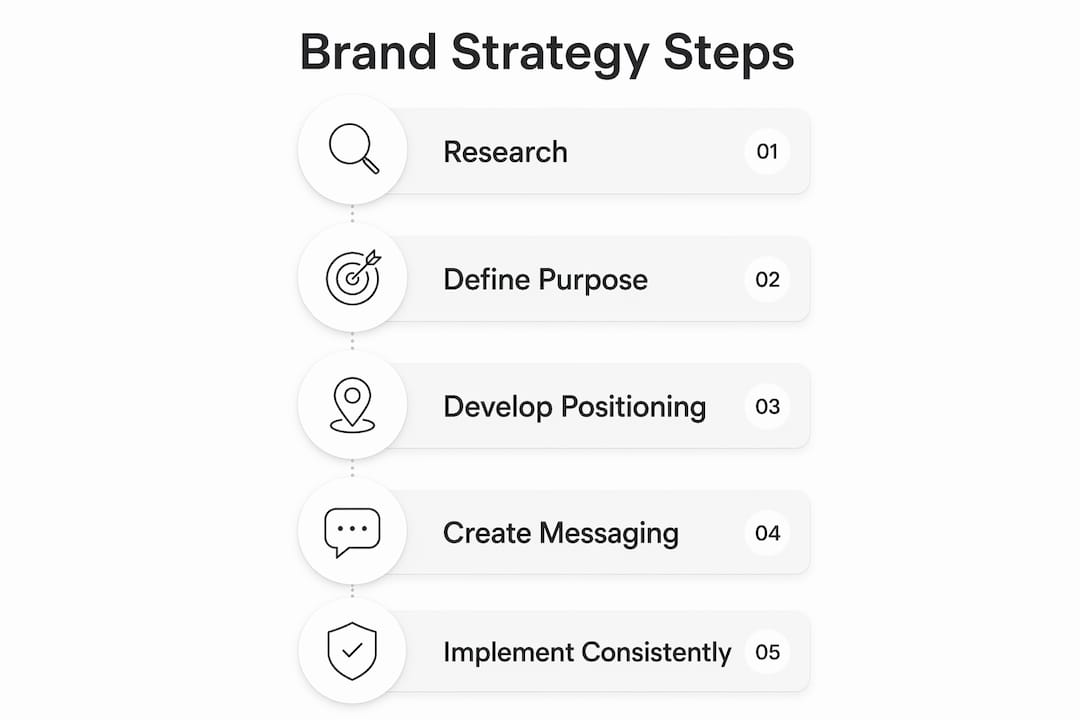
Creating a brand strategy follows a clear sequence. Skipping steps produces a strategy that looks complete on paper but collapses under real business pressure. Brand strategy must be embedded as an operating system within a company to guide every decision and interaction, not stored as a static mission statement.
- Research your customers and competitors. Conduct interviews, surveys, and competitor audits. Understand what your best customers value most and where competitors fall short.
- Define your purpose and values. Write a clear purpose statement that explains why your business exists. Identify three to five values that guide behaviour and decision-making.
- Develop your positioning. Articulate who you serve, what you offer, and why you are the better choice. Keep it specific. “We help small retailers increase repeat purchases through loyalty-focused web design” beats “we help businesses grow.”
- Build your messaging framework. Write your brand story, key messages for each audience segment, and a consistent tone of voice guide.
- Design your visual identity. Commission a logo, colour palette, and typography system that reflects your positioning. Consistency across your website, social media, and print materials builds recognition fast.
- Create brand guidelines. Document every element above in a single reference guide. Share it with every team member, agency, and supplier who creates content on your behalf.
- Conduct regular brand audits. Ongoing brand audits focusing on clarity of purpose, consistency in customer targeting, and clear decision-making rules are critical to maintaining brand health. Schedule a review every six to twelve months.
Pro Tip: A strong brand strategy acts as a filter for saying “no” to profitable but dilutive opportunities. If a campaign, partnership, or product idea does not fit your brand purpose, decline it. Short-term revenue from off-brand activity costs more in long-term confusion than it earns.
What do effective brand strategy examples look like in practice?
Real-world brand strategy examples show how the principles above translate into commercial decisions. Betts, the Australian footwear retailer, built its strategy around the idea that “Shoes Change Everything.” That single strategic idea directly affected product range and communication style across every channel. Every campaign, every window display, and every product decision was filtered through that lens.
Frank Body, the Australian skincare brand, built its strategy around a bold, irreverent tone of voice and a clear positioning around natural ingredients and body confidence. That strategy shaped its social media content, its packaging copy, and its influencer partnerships. Customers recognised the brand instantly because every touchpoint felt coherent and true to the same identity.
The contrast with brands that lack strategy is instructive. When campaigns vary wildly in tone or values, customer confusion arises and brand strength erodes. A business that runs a premium-feel campaign one month and a discount-led promotion the next sends conflicting signals about who it is and who it serves.
Key lessons from these examples:
- A single, clear strategic idea can guide years of consistent marketing activity.
- Pricing and product decisions are brand decisions, not just commercial ones.
- Tone of voice is as important as visual identity in building recognition.
- Inconsistency is more damaging than imperfection.
For more real-world context, Fyldedigital’s guide to branding strategies for growth covers how businesses of different sizes apply these principles to stand out in competitive markets.
Key takeaways
A brand strategy is the single most important framework a business can build, because it determines whether every pound spent on marketing compounds into lasting equity or disappears into noise.
| Point | Details |
|---|---|
| Brand strategy defined | It is the long-term plan covering purpose, positioning, messaging, and visual identity. |
| Core elements | Purpose, positioning, messaging, visual identity, emotional connection, and loyalty all work together. |
| 2026 relevance | AI cannot replicate genuine trust or emotional resonance, making brand strategy the key differentiator. |
| Creation process | Research, define, position, message, design, document, and audit on a regular cycle. |
| Strategy as filter | Use your brand strategy to decline off-brand opportunities and maintain long-term coherence. |
Brand strategy is an operating system, not a document
Every business I have worked with that struggled with inconsistent marketing had the same root problem. They had a brand identity of sorts, usually a logo and some colours, but no strategy behind it. The creative work looked fine in isolation. It just never added up to anything.
The shift that changes everything is treating brand strategy the way you treat your accounting system. You do not consult your accounts once a year and then ignore them. You use them to make decisions every week. Brand strategy deserves the same discipline. When it is embedded that way, something interesting happens. Creative briefs get easier to write. Campaigns get faster to approve. New team members understand the brand within days rather than months.
The other thing I have seen consistently is that strong brand strategy actually sharpens creativity rather than limiting it. Constraints force better thinking. When you know exactly who you are and who you are not, you stop producing average work that tries to appeal to everyone. You produce specific, resonant work that the right customers genuinely connect with. That is where the real commercial value lives.
If you are working on your digital strategy alongside your brand strategy, treat them as two sides of the same coin. Your digital presence is where your brand strategy meets your customer in real time.
— tibor
How Fyldedigital can help you build a brand that lasts
Your brand strategy needs a digital presence that brings it to life consistently, from your website to your search rankings to your social channels.
Fyldedigital works with small and medium-sized businesses across the UK to translate brand strategy into websites, SEO campaigns, and social media that build real visibility and trust. Whether you are starting from scratch or refreshing an existing brand, the team at Fyldedigital can help you define your positioning and build the digital infrastructure to support it. A well-designed website is often the first place a customer tests whether your brand delivers on its promise. Explore Fyldedigital’s web design services in Blackpool to see how your brand strategy can come to life online.
FAQ
What does a brand strategy include?
A brand strategy includes your brand purpose, positioning, messaging framework, visual identity, tone of voice, and customer loyalty approach. These elements work together to shape how customers perceive and connect with your business.
How do you create a brand strategy step by step?
Start by researching your customers and competitors, then define your purpose and values, develop your positioning, build a messaging framework, design your visual identity, and document everything in brand guidelines. Review the strategy every six to twelve months through a brand audit.
Why is brand strategy important for small businesses?
Brand strategy gives small businesses a clear filter for every marketing and product decision, preventing wasted budget on off-brand activity. It builds the consistent trust that turns first-time buyers into loyal customers.
How is brand strategy different from marketing strategy?
Brand strategy defines who you are and what you stand for. Marketing strategy defines how you reach and convert your audience. Brand strategy informs and constrains marketing strategy, not the other way around.
Can brand strategy help with SEO and digital marketing?
Yes. A clear brand strategy improves SEO by ensuring consistent messaging, targeted content, and a defined audience across all digital channels. It also makes paid campaigns more effective because customers who land on your site immediately understand your value.