Your brand voice online is the consistent personality your business expresses across every digital touchpoint, from your website copy and email newsletters to social media captions and customer support replies. Think of it as your brand’s character in written form. Just as a person’s character stays the same whether they are chatting informally or presenting in a boardroom, your brand voice remains fixed regardless of channel or context.
Brand voice is built from a combination of elements that work together to make your communications instantly recognisable:
- Personality traits: typically three to five core descriptors such as “confident,” “approachable,” or “direct” that define how your brand comes across
- Language style: the vocabulary you choose, the formality of your sentences, and the phrases you favour or avoid
- Tone: the situational variation of your voice (more on this distinction shortly)
- Rhythm and structure: how your sentences are constructed, whether short and punchy or measured and detailed
- Values: the beliefs and principles that underpin every message you send
Defining your brand voice is not about inventing a new personality. It is about capturing who your business genuinely is and expressing that consistently online.
Why brand voice matters for your online marketing
A clearly defined brand voice builds trust, and trust drives purchasing decisions. When customers encounter the same personality across your website, your social media, and your emails, they develop a sense of familiarity with your business. That familiarity translates into confidence, and confidence converts browsers into buyers.

Consistency also sharpens your market position. Trying to appeal to everyone with a shifting, undefined voice dilutes your message and weakens your brand’s distinctiveness. As branding professionals note, a distinct point of view is what separates memorable brands from forgettable ones. The businesses that stand out online are those that sound like themselves, every single time.
Consistent brand language increases customer engagement and strengthens recognition across channels. The practical benefits for your business are real:
- Stronger brand recognition: audiences learn to identify your brand by how it sounds, not just how it looks
- Improved customer loyalty: predictability and coherence create psychological comfort, encouraging repeat business
- Clearer internal guidelines: your marketing team, copywriters, and social media managers all work from the same framework, reducing inconsistency
- Better differentiation: a defined voice sets you apart in a crowded digital market
- Higher conversion rates: customers who trust your brand are more likely to act on your calls to action
A well-defined voice also carries an internal benefit that is easy to overlook. When every person writing for your brand understands the voice, your content output becomes coherent without requiring constant editorial oversight.

Brand voice vs brand tone: what is the difference?
Brand voice and brand tone are closely related but serve distinct purposes, and confusing the two leads to inconsistent communications. Your brand voice is fixed. It is the underlying personality of your business and does not change based on the situation, the platform, or the audience. Your brand tone, by contrast, is the situational dial you adjust within that fixed voice depending on context.
A practical way to picture this: imagine a business with a voice that is warm, direct, and reassuring. On social media, the tone might be light and conversational. In a billing error email, the tone shifts to calm and apologetic. In a product launch announcement, it becomes energised and enthusiastic. The voice, warm, direct, and reassuring, never changes. Only the tone moves.
Here is how the two concepts differ in practice:
- Voice: fixed, consistent, reflects core brand personality and values
- Tone: variable, adapts to the channel, message type, and audience mood
- Voice example: a brand that is always “expert but approachable” in every piece of content it produces
- Tone example: that same brand using a lighter, more playful register in an Instagram caption than in a technical support reply
- The rule: if your voice changes, your brand feels inconsistent; if your tone never changes, your content feels robotic
Mapping your tone variants to specific contexts, such as marketing, customer support, and transactional emails, keeps your voice coherent without making every piece of content sound identical.
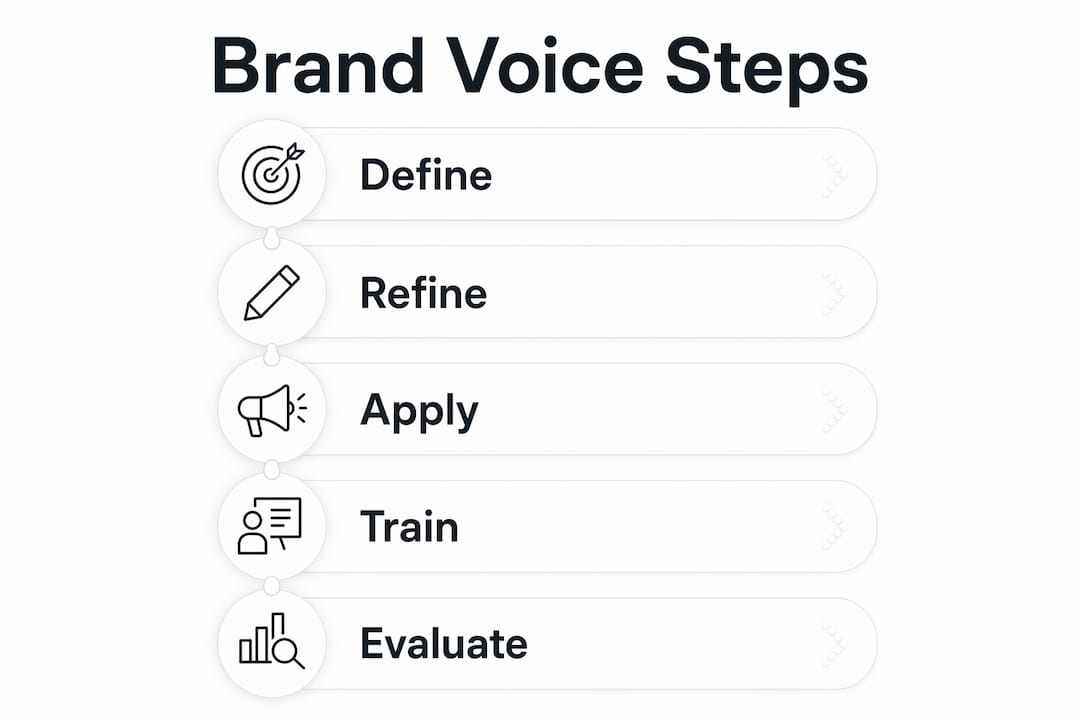
How to create a strong brand voice online: a step-by-step guide
Building a brand voice that works online takes deliberate effort, but the process is straightforward when you follow a clear sequence. The goal is to codify what your brand already is, not to manufacture something artificial.
-
Audit your existing content. Gather your best-performing emails, social posts, and web pages. Look for patterns in language, tone, and style. What words appear repeatedly? What personality comes through? This audit surfaces the authentic voice you may already have without realising it.
-
Research your audience. Understand how your customers communicate. What language do they use? What register resonates with them? Social listening and customer interviews both reveal the vocabulary and tone that feel natural to your audience.
-
Define your core values. Your brand voice should reflect your business’s genuine beliefs. List three to five values that drive your decisions and let those inform your personality traits.
-
Choose three to five personality traits. Be specific. “Friendly” is vague. “Warm but never sycophantic” is useful. Concrete descriptors give your writers something to work with and reduce subjective interpretation.
-
Write a brand voice guide. Document your traits, your preferred vocabulary, your sentence style, and your tone variants. A brand voice guide should include real examples of on-brand and off-brand writing so that anyone producing content for your business can apply it without guessing.
-
Use “this, not that” examples. For each trait, show what it looks like in practice versus what it does not. “We say ‘get in touch,’ not ‘utilise our contact portal’” is far more useful than a vague adjective. This technique prevents the kind of jargon-heavy, impersonal writing that undermines trust and engagement.
-
Distribute and train. Share the guide with everyone who writes for your brand, including freelancers and agency partners. A voice guide only works if the people producing content have actually read it.
-
Iterate based on feedback. Your brand voice should evolve as your business grows and your audience changes. Review it regularly, gather feedback from your team, and refine the guide rather than treating it as a fixed document.
Pro Tip: When defining your personality traits, test each one against a piece of real content you have already published. If the trait does not show up clearly in that content, either the trait is wrong or the content needs rewriting. This simple check keeps your voice grounded in reality rather than aspiration.
Practical examples of brand voice online
Seeing brand voice in action across different channels makes the concept concrete. The following examples illustrate how distinct personalities translate into real communications.
-
The expert voice: a professional services firm uses measured, precise language across its website and LinkedIn content. Its emails open with clear context, avoid jargon, and close with a specific next step. The personality is confident and knowledgeable, and that consistency means clients trust the firm’s advice before they have even spoken to anyone.
-
The friendly challenger: a direct-to-consumer brand uses short sentences, occasional humour, and a conversational register across Instagram, email, and its website. Its customer support replies carry the same warmth as its marketing copy. The voice feels like a person, not a corporation, which builds loyalty among its audience.
-
The reassuring guide: a financial services business writes in plain English, avoids technical terms where possible, and always explains the “why” behind its recommendations. On social media, the tone is encouraging. In transactional emails, it is calm and clear. The underlying voice, reassuring and transparent, never wavers.
-
The bold disruptor: a technology brand uses punchy headlines, active verbs, and a direct second-person register across all channels. Its social captions are brief and confident. Its website copy makes bold claims and backs them up immediately. The voice signals ambition and authority without resorting to empty superlatives.
-
The community-first brand: a lifestyle business writes as though it is speaking to a group of like-minded people rather than broadcasting to a mass audience. Its newsletters feel personal, its social posts invite conversation, and its website copy uses “we” and “you” in equal measure. The voice creates a sense of belonging that keeps customers engaged long after the first purchase.
What these examples share is consistency. The voice does not shift between channels or content types. The tone adapts, but the personality stays the same.
Developing brand voice in the UK market: insights from Fyldedigital
UK audiences have particular expectations when it comes to brand communications. Directness is valued, but so is a degree of warmth and wit. Overly corporate or American-inflected language can feel out of place, and UK consumers tend to respond well to brands that sound genuinely human rather than polished to the point of feeling distant.
Consistency across all channels is the single most important factor in building loyalty through psychological comfort and predictability. UK consumers notice when a brand sounds different on its website than it does on social media, and that disconnect erodes confidence quickly. Getting your voice right across every platform is not a cosmetic concern; it directly affects whether customers come back.
At Fyldedigital, the approach to brand voice starts with understanding what a business genuinely stands for before a single word of copy is written. That means working through brand identity before moving to messaging, so that the voice reflects something real rather than something manufactured. The result is content that feels authentic because it is.
With AI-generated content now widespread, maintaining a human-driven brand voice has become more important than ever. Audiences are increasingly adept at recognising generic, machine-produced copy, and they respond better to brands that sound like real people with real opinions. Owning your voice and applying it consistently is one of the clearest ways to stand out in 2026.
Practical recommendations for UK businesses developing their brand voice:
- Audit for Americanisms and corporate jargon. UK audiences notice language that feels imported or overly formal. Strip it out and replace it with plain, direct English.
- Define tone variants for your key channels. Your LinkedIn content, your email newsletters, and your social media posts can all carry different tones while sharing the same underlying voice.
- Involve your whole team. Brand voice breaks down when only the marketing department knows about it. Share the guide with sales, customer service, and any external partners who write for you.
- Test your voice with real customers. Share draft content with a small group of existing customers and ask whether it sounds like the business they know. Their feedback is more useful than any internal review.
- Review your voice guide at least once a year. Your business changes, and your voice should keep pace. An annual audit keeps the guide relevant and prevents it from becoming a document nobody reads.
Pro Tip: For UK businesses serving multiple customer segments, such as both trade and retail buyers, create a brief tone variant for each audience rather than trying to write one voice that serves everyone. The core personality stays the same; only the register shifts. This approach, documented clearly in your brand voice guidelines, prevents the confusion that comes from trying to be everything to everyone.
Key takeaways
A consistent, well-defined brand voice online builds trust, drives recognition, and gives your entire team a clear framework for every piece of content they produce.
| Point | Details |
|---|---|
| Brand voice is fixed | Your core personality traits stay constant across every channel and content type. |
| Tone adapts within voice | Adjust your register for context, such as social media vs. support emails, without changing your underlying character. |
| Documentation is essential | A brand voice guide with “this, not that” examples prevents inconsistency across your team. |
| Consistency builds loyalty | UK consumers respond to brands that sound the same everywhere, creating trust and encouraging repeat business. |
| Human voice wins in 2026 | As AI content grows, a genuinely human and authentic brand voice is your clearest point of differentiation. |