Creative direction in marketing is the strategic leadership process that transforms business goals into a unified brand experience through visual identity, narrative choices, and campaign cohesion. It sits above execution. Where a graphic designer produces assets and a copywriter crafts words, a creative director shapes the overarching vision that makes every element feel intentional and connected. Research shows that companies with strong creative leadership achieve 1.5 times higher revenue growth than less aligned peers. That figure alone tells you creative direction is not a luxury reserved for large agencies. It is a commercial discipline that directly affects your bottom line.
What is creative direction in marketing, and how does it work?
Creative direction in marketing is the practice of connecting brand vision to creative execution across every customer touchpoint, from your website and social media to print materials and advertising campaigns. It is the function that decides not just what something looks like, but why it looks that way and what it communicates to your audience.
A creative director does not sit at a desk producing designs. They set the visual and conceptual standards that every piece of creative work must meet. They define the mood, the colour palette, the tone of voice, and the storytelling approach that makes a brand recognisable. Nike’s “Just Do It” campaigns, Apple’s minimalist product launches, and Innocent Drinks’ conversational packaging are all products of strong creative direction. The aesthetic choices are deliberate, consistent, and tied to a clear commercial purpose.

For marketing professionals and business owners, understanding this distinction matters. Creative direction is the strategic layer that prevents your brand from looking like a patchwork of disconnected decisions. Without it, your Instagram posts, your website, and your printed brochures can feel like they belong to three different companies.
How does creative direction differ from creative strategy?
Creative direction and creative strategy are related but distinct disciplines, and confusing them leads to poorly structured campaigns.
Creative strategy is the blueprint. It defines the campaign’s objectives, the audience it targets, the single key message it must communicate, and the channels through which it will run. A structured creative strategy prevents “design by instinct” and connects objectives to measurable outcomes. It answers the question: what are we trying to achieve, and for whom?
Creative direction takes that blueprint and translates it into a visual and narrative reality. It answers: how will this look, feel, and sound across every format?
The table below shows how the roles stack up in practice:
| Role | Primary focus | Typical output |
|---|---|---|
| Creative director | Vision, brand cohesion, leadership | Creative briefs, brand guidelines, campaign concepts |
| Art director | Visual execution within a campaign | Layouts, photography direction, visual assets |
| Graphic designer | Production of individual assets | Logos, social graphics, print materials |
| Strategist | Audience insight, objectives, messaging | Creative briefs, audience research, channel plans |
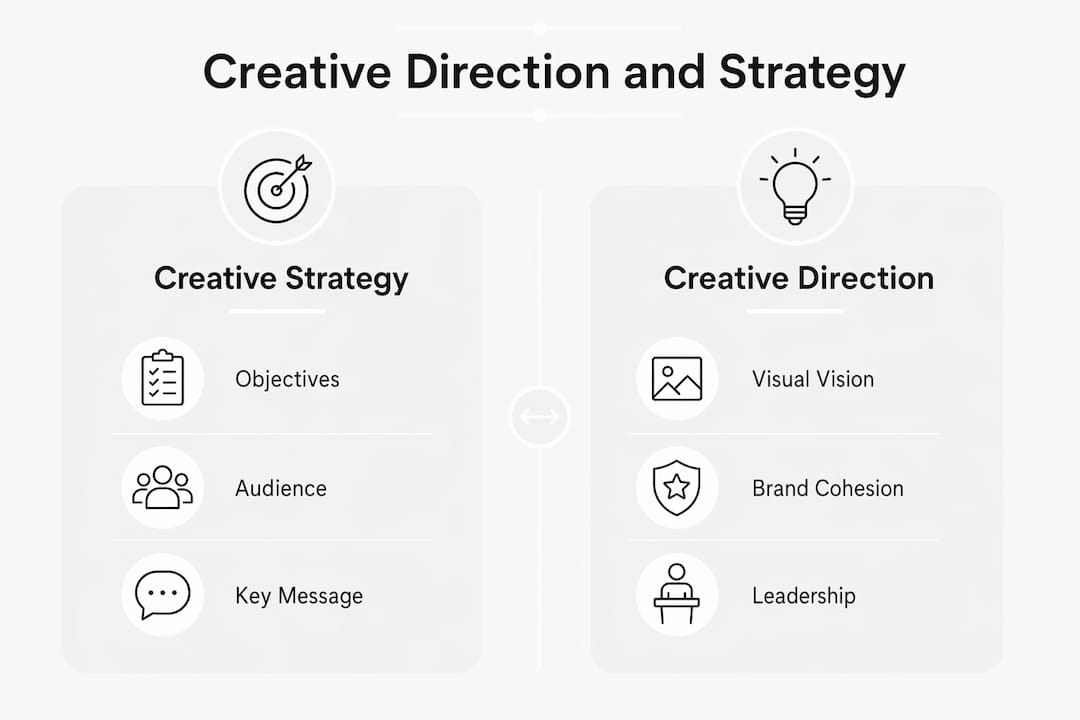
The creative director sits above the art director and graphic designer in the creative hierarchy. They are responsible for the whole, not the parts. Critically, they also work alongside strategists to make sure the creative vision serves the business objective, not just the creative team’s preferences.
Few campaigns fail because of execution. Failures most often stem from unclear strategic intent. This is why the relationship between creative strategy and creative direction is so important. One without the other produces either beautiful work that misses the point, or clear objectives that never come to life.
What does a creative director do in a marketing team?
The role of a creative director spans vision setting, team leadership, brand consistency, and campaign guidance. In practical terms, this breaks down into several core responsibilities:
- Vision setting. The creative director defines the aesthetic and conceptual direction for the brand or campaign. This includes establishing mood boards, tone of voice documents, and visual identity standards.
- Team leadership. They manage and inspire creative teams, including copywriters, designers, photographers, and video producers, ensuring every contributor understands and works within the agreed creative framework.
- Brand consistency. They review all outgoing creative work to confirm it aligns with brand guidelines and the campaign’s strategic intent.
- Stakeholder communication. They translate creative decisions into business language for clients, senior leadership, and marketing directors who may not have a creative background.
- Campaign guidance. They oversee the creative development of campaigns from concept through to final production, making judgement calls on quality, relevance, and brand fit.
The skills required go beyond aesthetic judgement. A strong creative director combines strategic thinking, market awareness, and cultural sensitivity. They understand what resonates with an audience and why. They also need to manage people effectively, because creative teams produce their best work in environments where direction is clear and feedback is constructive.
Modern creative directors face an additional challenge. AI and automation now influence how creative teams work, from AI-generated imagery to automated copywriting tools. The creative director’s role is to blend these data-driven capabilities with genuine human creativity, ensuring technology serves the brand rather than diluting it.
Pro Tip: When briefing your creative team, always state the single business outcome the campaign must achieve before discussing aesthetics. This keeps every creative decision anchored to a measurable goal rather than personal preference.
Why does creative direction matter for brand consistency and growth?
Brand consistency driven by creative direction builds trust, recognition, and customer loyalty, all of which improve marketing ROI over time. When your audience sees the same visual language and tone across your website, your social media, and your advertising, they build a mental model of your brand. That familiarity reduces the cognitive effort required to trust you, which directly affects conversion rates.
The commercial evidence is clear. Companies with strong creative leadership achieve 1.5 times higher revenue growth than competitors with weaker creative alignment. This is not a marginal difference. It reflects the compounding effect of consistent brand communication across every customer interaction.
Weak creative direction produces the opposite outcome. Consider what happens when a business redesigns its website without updating its social media templates, or launches a campaign with a tone of voice that contradicts its brand guidelines. The audience receives mixed signals. Trust erodes. Conversion drops. The cost of fixing inconsistent brand expression is almost always higher than the cost of getting it right from the start.
Strong creative direction also supports your digital marketing metrics by giving every channel a coherent identity to measure against. When your creative output is consistent, you can attribute performance changes to specific decisions rather than guessing which variable caused a shift in results.
The importance of creative direction extends to competitive differentiation. Good creative leadership enables innovation while maintaining brand consistency, which is what separates brands that feel fresh from those that feel erratic.
How to implement effective creative direction in your campaigns
Establishing strong creative direction does not require a large in-house team. It requires a clear process. Here is a practical framework for marketing professionals and business owners:
- Define your brand’s creative vision. Before any campaign begins, document your visual identity standards, tone of voice, and the emotional response you want your brand to evoke. This becomes your creative north star.
- Align creative vision with business objectives. Every creative decision should trace back to a measurable goal, whether that is increasing enquiries, improving brand recall, or driving website traffic. Effective creative direction balances artistic vision with commercial pragmatism.
- Integrate audience insight. Use customer research, analytics, and behavioural data to inform your creative choices. Knowing your audience’s preferences and pain points prevents creative work from being self-indulgent.
- Consider channel constraints early. Media context shapes message execution. A campaign concept that works brilliantly as a full-page print advertisement may need significant adaptation for a 15-second social media video. Build this into your creative planning from the outset.
- Establish a review and approval process. Creative direction only works if there is a consistent standard applied to all outgoing work. Define who has final sign-off and what criteria they use to evaluate creative output.
- Measure and adjust. Creative direction is not a one-time exercise. Review campaign performance regularly and use the findings to refine your creative approach. The role of external creative expertise can be valuable here, bringing fresh perspective without losing brand continuity.
Pro Tip: Create a one-page creative brief template that forces every campaign to state its audience, single key message, desired emotional response, and success metric before any design work begins. This single document prevents weeks of misaligned effort.
What pitfalls should you avoid in creative direction?
The most common failure in creative direction is the absence of a structured creative strategy. When campaigns are built on personal taste rather than audience insight and business objectives, the results are unpredictable. A clear single takeaway in every campaign prevents message dilution and produces stronger audience response.
Other pitfalls to watch for include:
- Inconsistent brand expression. Allowing individual team members or external suppliers to interpret brand guidelines differently creates visual and tonal fragmentation across channels.
- Prioritising novelty over clarity. Creative teams sometimes chase originality at the expense of communicating clearly. The audience’s understanding always takes precedence over the team’s desire to be different.
- Ignoring performance data. Creative direction informed only by instinct misses the signals that analytics provide. Tracking engagement, click-through rates, and conversion data tells you what is actually resonating with your audience.
- Failing to adapt to channel context. A brand identity that works in print does not automatically translate to digital. Brand revitalisation strategies that succeed always account for how creative assets perform across different media environments.
The solution to most of these pitfalls is the same: a documented creative strategy that precedes every campaign, combined with a creative director who has both the authority and the accountability to maintain standards.
Key takeaways
Creative direction in marketing succeeds when it connects a clearly defined brand vision to every creative output, backed by audience insight, measurable objectives, and consistent leadership.
| Point | Details |
|---|---|
| Creative direction vs strategy | Creative strategy sets objectives; creative direction translates them into visual and narrative reality. |
| Revenue impact | Companies with strong creative leadership achieve 1.5 times higher revenue growth than less aligned peers. |
| Core responsibilities | Creative directors set vision, lead teams, maintain brand consistency, and guide campaigns from concept to production. |
| Brand consistency | Consistent creative direction builds audience trust and improves conversion rates across all marketing channels. |
| Common pitfall | Campaigns built on personal taste without a structured strategy produce inconsistent, measurable results. |
Why creative direction deserves more respect in small business marketing
Most small and medium-sized businesses treat creative direction as something that happens automatically when they hire a designer or brief an agency. In my experience, that assumption is where most marketing budgets quietly go to waste.
I have seen businesses invest significantly in paid advertising, SEO, and social media management, only to see mediocre returns because every channel looked and sounded slightly different. The website used one colour palette, the social media posts used another, and the printed materials felt like they came from a third company entirely. No single campaign failure was obvious. The damage was cumulative and slow, eroding the brand’s credibility with every inconsistent touchpoint.
What changed the outcome in each case was not a bigger budget. It was the introduction of a clear creative vision, documented and applied consistently. Once a business knows exactly what it stands for visually and verbally, every marketing decision becomes faster and more confident. The creative brief gets shorter. The approval process gets cleaner. The results get more predictable.
The businesses I have seen grow most consistently are those that treat creative direction as a strategic function, not a finishing touch. They invest in professional web design that reflects their brand properly, they maintain brand guidelines across every channel, and they measure creative performance with the same rigour they apply to their sales data.
If you are a marketing professional or business owner reading this, the question is not whether you can afford to invest in creative direction. It is whether you can afford the compounding cost of not doing so.
— tibor
How Fyldedigital helps you build a stronger creative foundation
Fyldedigital works with businesses across the Fylde Coast and beyond to create marketing that looks and performs consistently across every channel. From professional web design in Blackpool to social media management and SEO, every service is built around a clear creative and commercial brief. If your current marketing feels fragmented or your brand identity is not translating consistently online, Fyldedigital can help you establish the creative foundation your campaigns need. Request a free website review at Fyldedigital and find out exactly where your brand’s creative direction can be strengthened.
FAQ
What is the difference between a creative director and an art director?
A creative director sets the overall vision and strategic direction for a brand or campaign, while an art director executes that vision through specific visual decisions. The creative director leads the team; the art director leads the visual output within that framework.
How does creative strategy support creative direction?
Creative strategy defines the campaign’s objectives, audience, and single key message before any creative work begins. Creative direction then translates that strategy into a consistent visual and narrative identity across all channels.
Can a small business benefit from creative direction?
Yes. Creative direction is not exclusive to large agencies or enterprise brands. Any business that produces marketing across more than one channel benefits from a documented creative vision that keeps all output consistent and purposeful.
What skills does a creative director need in marketing?
A creative director needs strategic thinking, aesthetic judgement, team leadership, and market awareness. Increasingly, they also need the ability to integrate data insights and AI tools into the creative process without losing brand authenticity.
How do you measure the effectiveness of creative direction?
Track brand consistency across channels, monitor engagement and conversion rates by campaign, and compare performance before and after implementing a structured creative vision. Consistent improvement in these metrics indicates that creative direction is working.