Local SEO is the process of optimising a business’s online presence to appear in location-based search results on platforms like Google Search and Google Maps. It connects you with nearby customers who are actively searching for what you sell. 46% of all Google searches have local intent. That single figure tells you how much opportunity sits in your own postcode. For small businesses on the Fylde Coast or anywhere across the UK, understanding local search optimisation is not optional. It is the foundation of getting found by the right people at the right moment.
What are the main benefits of local SEO for small businesses?
Local SEO delivers measurable results that general SEO and paid advertising often cannot match at the same cost. The core reason is intent. When someone searches “plumber near me” or “best café in Blackpool,” they are ready to act, not just browse.
The numbers back this up clearly:
- Businesses appearing in the Google Local Pack receive 126% more traffic compared to lower-ranked listings.
- Those same businesses see 93% more calls, clicks, and direction requests than competitors sitting outside the top three map results.
- 28% of local searches result in a purchase on the same day. That is a conversion rate most paid campaigns would envy.
- Businesses typically start seeing an impact on leads within 4–12 weeks of consistent local SEO effort.
The ROI case is strong. Local SEO is one of the highest-ROI marketing channels for small businesses because it filters out distant, unqualified traffic. You are not paying to reach someone in Manchester when your shop is in Lytham. Every visitor you attract already has geographic relevance.
Compared to Google Ads, local SEO builds compounding visibility over time. Paid clicks stop the moment your budget runs out. Organic local rankings keep working. For businesses weighing up their options, the SEO vs Google Ads comparison is worth reading before committing budget.
How does local SEO differ from traditional SEO?
Traditional SEO and local SEO share the same technical roots, but they serve different goals. Understanding the distinction helps you allocate effort correctly.

| Factor | Local SEO | Traditional SEO |
|---|---|---|
| Geographic focus | Specific town, city, or region | National or global audience |
| Primary platform | Google Business Profile, Maps, Local Pack | Organic search results |
| Ranking signals | Proximity, reviews, citations, GBP signals | Backlinks, content, domain authority |
| Customer intent | Find and visit a local business | Research, compare, or purchase online |
| Result type | Map pack, local listings | Standard blue-link organic results |
Local SEO targets a specific geographic area, focusing on proximity and location-based intent. Traditional SEO targets broader audiences with no geographic filter. A national e-commerce brand needs traditional SEO. A Blackpool restaurant needs local SEO first.
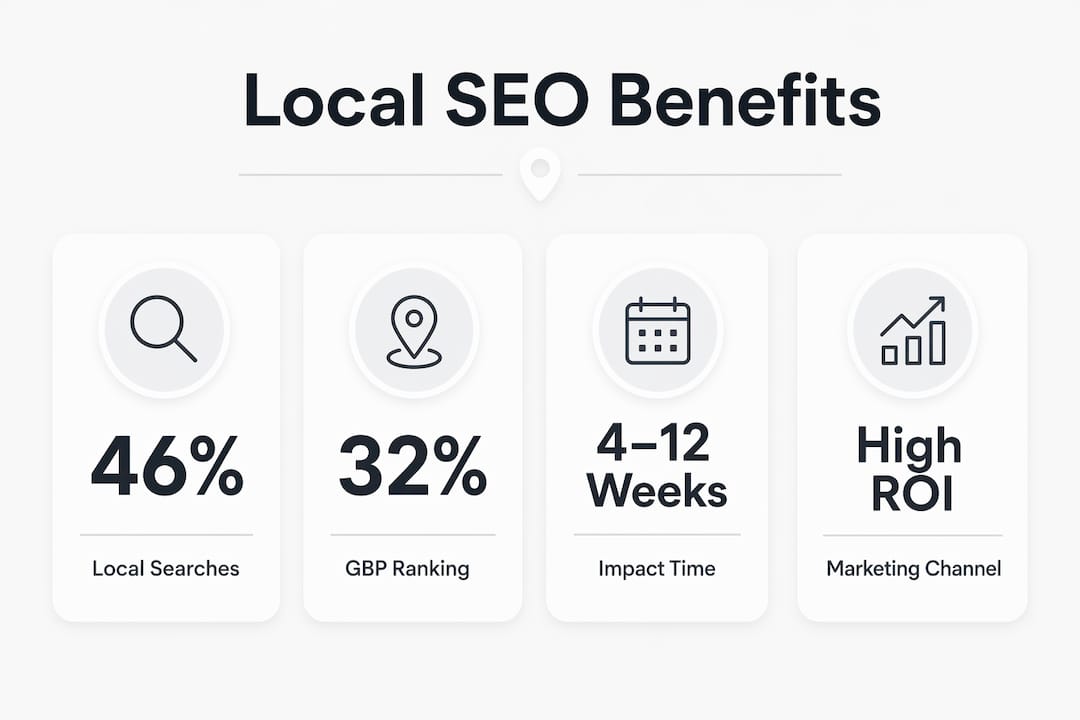
The ranking signals also differ significantly. Google Business Profile signals account for roughly 32% of local ranking weight. That is a larger share than most business owners realise. Your GBP listing can outperform a well-optimised website if it is managed correctly.
Pro Tip: Set up and fully complete your Google Business Profile before touching anything else. Category selection, opening hours, photos, and a business description all feed directly into how Google ranks you locally.
Local SEO and traditional SEO are not competitors. They work together. A well-structured website with locally relevant content supports your GBP performance. Think of traditional SEO as the foundation and local SEO as the targeted layer on top.
What are the top local SEO tactics small businesses should use?
Effective local search optimisation comes down to a focused set of repeatable actions. Here are the tactics that deliver the most consistent results.
-
Optimise your Google Business Profile fully. Complete every field: business name, address, phone number, website, categories, opening hours, and photos. An incomplete profile signals low trust to Google. Add posts regularly to show the listing is active.
-
Keep your NAP consistent across all directories. NAP stands for Name, Address, Phone number. Every listing on Yell, Yelp, Thomson Local, and other directories must match exactly. Inconsistencies confuse Google and suppress your rankings.
-
Acquire and manage customer reviews actively. Businesses with 50 or more reviews are 266% more likely to appear in the Local Pack. Every 10 new reviews can boost your Google Business Profile conversion rate by 2.8%. Ask every satisfied customer to leave a review. Respond to every review, positive or negative. For a practical approach to this, the guide on managing online reputation covers the process step by step.
-
Create locally relevant website content. Write service pages and blog posts that mention your town, region, and nearby areas. A roofing company in Preston should have a page titled “Roof repairs in Preston” rather than a generic “Our services” page.
-
Target local keywords throughout your site. Targeting local keywords increases your relevance and your chance of ranking in local search results. Use tools like Google Keyword Planner or Semrush to find phrases people actually search in your area.
-
Build local backlinks. Get listed in local business directories, sponsor community events, and earn mentions from local news sites or blogs. A link from a Blackpool Chamber of Commerce page carries more local authority than a generic directory link.
-
Monitor behavioural signals. Google tracks calls, clicks, and direction requests from your listing. The more people interact with your profile, the stronger the signal that your business is relevant and trusted.
Pro Tip: Add at least five photos to your Google Business Profile when you set it up. Listings with photos receive significantly more direction requests and website clicks than those without.
Consistency matters as much as the initial setup. Update your GBP when hours change, add new photos monthly, and respond to reviews within 48 hours. Local SEO rewards businesses that treat their online presence as a living asset, not a one-time task.
How can you measure the ROI of your local SEO efforts?
Tracking local SEO performance requires looking beyond website traffic. The metrics that matter most are the ones tied to real business outcomes.
- Local Pack rankings. Track where your business appears for your key search terms in Google Maps and the local results. Tools like BrightLocal and Semrush offer rank tracking specific to local search.
- Google Business Profile insights. GBP shows you how many people searched for your business, how many clicked through to your website, and how many requested directions or called you directly. Review these figures weekly.
- Website traffic from local sources. Google Analytics 4 lets you segment traffic by location. Monitor whether visitors from your target towns and cities are increasing month on month.
- Conversion metrics. Track phone calls, contact form submissions, and bookings that originate from local search. These are the numbers that connect SEO activity to actual revenue.
- Review volume and quality. Good reviews positively influence local SEO because they are among the main ranking factors for local search. Track your total review count and your average rating across Google, Yelp, and other relevant platforms.
Pro Tip: Use UTM parameters on your GBP website link so Google Analytics 4 records GBP traffic as a distinct source. Without this, visits from your listing get lumped into “direct” traffic and you lose visibility on what local SEO is actually generating.
Tying metrics to business outcomes is the step most businesses skip. Rankings and traffic are useful indicators, but the real measure is whether local SEO is generating more enquiries and sales. Review your numbers monthly and adjust your tactics based on what the data shows. For a deeper look at how to improve local SEO and track what works, Fyldedigital has a practical guide worth bookmarking.
Key takeaways
Local SEO is the single most cost-effective channel for small businesses to attract nearby customers with high purchase intent, and Google Business Profile optimisation is its most impactful lever.
| Point | Details |
|---|---|
| Local search volume is significant | 46% of all Google searches have local intent, making local SEO a priority for any business with a physical presence. |
| Local Pack visibility drives results | Appearing in the top three map results delivers 126% more traffic and 93% more calls than lower-ranked listings. |
| Reviews are a ranking factor | Businesses with 50 or more reviews are 266% more likely to appear in the Local Pack. |
| Results arrive faster than most expect | Consistent local SEO effort typically produces lead impact within 4–12 weeks. |
| GBP outweighs website SEO locally | Google Business Profile signals carry roughly 32% of local ranking weight, often more than on-site content alone. |
Why local SEO is the smartest investment most small businesses are not making
I have worked with dozens of small businesses across the North West, and the pattern is almost always the same. The business has a decent website, maybe some social media activity, and a Google Business Profile that was set up years ago and never touched since. The listing has three reviews, no photos, and the opening hours are wrong.
That is not a niche problem. It is the norm. And it represents a genuine opportunity for any business willing to put in consistent effort.
What surprises most business owners is how quickly local SEO moves the needle compared to broader SEO campaigns. You are not trying to outrank national brands. You are trying to appear in front of people in your town who are ready to spend money. That is a much more achievable target, and the benefits for local businesses are well documented.
The other thing I would push back on is the idea that reviews are passive. Waiting for customers to leave reviews is a losing strategy. The businesses that dominate local search actively ask for reviews after every positive interaction. They respond to every review. They treat reputation management as a core part of their marketing, not an afterthought.
Local SEO also compounds in a way that paid advertising does not. Every review you earn, every citation you build, every piece of locally relevant content you publish adds to a growing foundation. Six months of consistent effort creates an asset that keeps generating enquiries without ongoing spend. That is the kind of return that makes local SEO indispensable for small businesses with limited marketing budgets.
— tibor
How Fyldedigital can help your business get found locally
Getting local SEO right takes time, consistency, and a clear plan. Fyldedigital works with small businesses across the Fylde Coast and beyond to build that foundation properly, from Google Business Profile setup to locally targeted content and citation building.
A well-designed website is also part of the equation. Your GBP listing drives traffic to your site, and if that site is slow, hard to navigate, or not built for conversions, you lose the lead at the final step. Fyldedigital’s web design services in Blackpool are built with local SEO performance in mind from the start. For businesses ready to put a proper strategy in place, the SEO best practices guide is a strong starting point. Get in touch with Fyldedigital for a free SEO review and find out exactly where your local visibility stands.
FAQ
What is local SEO in simple terms?
Local SEO is the process of making your business appear in Google search results and Google Maps when nearby customers search for your products or services. It focuses on geographic relevance rather than broad national rankings.
How long does local SEO take to show results?
Businesses typically see an impact on leads within 4–12 weeks of consistent local SEO effort. Results build over time as reviews, citations, and content accumulate.
Does my business need a website for local SEO?
A website strengthens local SEO but is not strictly required. A fully optimised Google Business Profile alone can generate calls and direction requests, though a website significantly improves your overall visibility and conversion rate.
What is the most important local SEO ranking factor?
Google ranks local results using relevance, distance, and prominence. Google Business Profile signals account for roughly 32% of local ranking weight, making GBP optimisation the single most impactful action you can take.
How do reviews affect local SEO?
Reviews are a direct ranking factor in local search. Businesses with 50 or more reviews are 266% more likely to appear in the Local Pack, and every 10 new reviews can increase Google Business Profile conversion rates by 2.8%.