Most business owners assume web design is primarily about making a site look attractive. That assumption is understandable, but it misses the bigger picture entirely. Your website is often the first salesperson your customers encounter, and its job goes far beyond visual appeal. Effective web design combines usability, performance, accessibility, and conversion strategy into a single, cohesive experience. This guide breaks down what web design truly involves, why it matters for your bottom line, and how you can use it to generate more enquiries, build trust, and grow your business sustainably.
Table of Contents
- Defining web design: Beyond just looks
- Key elements of modern web design
- Why accessibility and edge cases are business-critical
- From design to business growth: How web design drives success
- Why ‘pixel-perfect’ design is overrated for SMEs
- Get expert help with your business website
- Frequently asked questions
Key Takeaways
| Point | Details |
|---|---|
| Design is not just visual | Web design combines form, function, and business goals for real-world results. |
| Performance outranks perfection | Fluid, accessible, and mobile-ready sites deliver better ROI than overdesigned layouts. |
| Inclusivity drives growth | Accessible design expands your audience and futureproofs your brand. |
| Design impacts business | Every design choice affects conversions, SEO, and how customers perceive your business. |
Defining web design: Beyond just looks
When most people hear “web design,” they picture colour palettes, fonts, and logo placement. Those elements matter, but they represent only a fraction of what professional web design actually covers. True web design is a discipline that brings together visual presentation, information architecture, usability, content strategy, and technical structure. Each of these components works together to create a site that not only looks credible but also performs and converts.
Think of it this way. A beautifully designed shop front that is impossible to navigate inside will still lose customers. The same principle applies online. If your website looks polished but loads slowly, confuses visitors, or buries your contact details, it will fail to deliver results regardless of how much you spent on the visuals.
The role of web design in winning business is far more strategic than many SME owners realise. A well-designed site communicates your brand values instantly, guides visitors towards the actions you want them to take, and reassures them that you are a credible, trustworthy operation. These outcomes depend on decisions made during the design process, not just the final coat of visual polish.
Here is what modern web design actually encompasses:
- Visual design: Colour, typography, imagery, spacing, and brand consistency
- User experience (UX): How intuitive and enjoyable it is to navigate your site
- Information architecture: How content is organised and structured so users find what they need
- Responsive design: Ensuring the site works correctly on all screen sizes and devices
- Performance optimisation: Fast load times and efficient code
- Accessibility: Making the site usable for people with disabilities
- Conversion design: Strategically placing calls to action (CTAs) to drive enquiries and sales
This is why working with specialists who understand both graphic design services and digital strategy gives you a significant advantage over using a basic template and hoping for the best.
“Modern expert consensus favours flexible systems, component reusability, and data-driven iteration over exact pixel replication.”
That shift in thinking is important. The old model of web design focused on matching a static mockup pixel by pixel. Today, the focus is on building flexible, adaptable systems that perform consistently across devices, browsers, and user contexts. For SMEs, this means your investment goes further when it is directed at outcomes rather than aesthetics alone.
Pro Tip: Before briefing a web designer, write down the three main actions you want visitors to take on your site. Every design decision should support those goals.
Key elements of modern web design
Now that you know what web design covers, let us break down its most important modern components and why each one directly affects your business results.
Mobile-first design
More than half of all web traffic now comes from smartphones. A mobile-first approach means designing for smaller screens first and then scaling up, rather than the other way around. This ensures your site is genuinely usable on a phone, not just technically viewable. Buttons are large enough to tap, text is readable without zooming, and navigation is simple and intuitive.

SMB owners should prioritise mobile-first responsive design, Core Web Vitals compliance, and conversion-focused CTAs over pixel-perfect visuals. If your current site is difficult to use on a phone, you are almost certainly losing enquiries every single day.
Core Web Vitals and performance
Core Web Vitals are a set of performance metrics defined by Google. They measure how quickly your page loads, how stable the layout is as it loads, and how quickly it responds to user input. These metrics directly influence your position in Google’s search results. A slow site does not just frustrate visitors. It actively harms your visibility online.
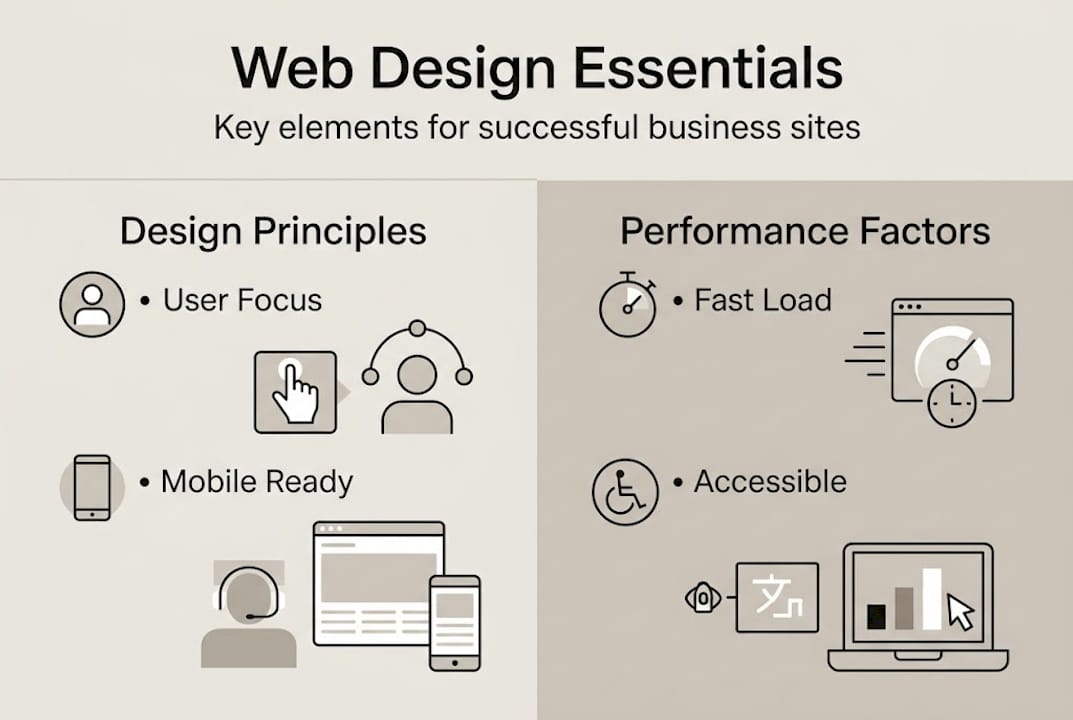
Here is a quick comparison of what strong versus weak performance looks like in practice:
| Performance factor | Strong performance | Weak performance |
|---|---|---|
| Page load time | Under 2.5 seconds | Over 4 seconds |
| Layout stability | No unexpected shifts | Elements jump as page loads |
| Input responsiveness | Under 100ms | Delayed responses to clicks |
| Mobile usability | Fully responsive | Requires pinching or zooming |
| SEO impact | Higher search rankings | Lower visibility |
Improving your site’s performance is one of the highest-return investments you can make. It supports your SEO best practices and directly improves how many visitors convert into customers.
Accessibility
Accessibility means designing so that people with visual, auditory, motor, or cognitive impairments can use your site effectively. This includes sufficient colour contrast, descriptive alt text for images, keyboard navigation, and screen reader compatibility. Edge cases like accessibility must be designed for early; ignoring them excludes users and risks fragility across the entire site.
Conversion-focused design
Every page on your site should have a clear purpose and a clear next step for the visitor. Strong calls to action, logical page layouts, and trust signals such as testimonials, accreditations, and case studies all contribute to turning visitors into leads. This is where improving website user experience pays direct dividends for your business.
Pro Tip: Run your site through Google’s free PageSpeed Insights tool to get an immediate snapshot of your Core Web Vitals performance. It takes two minutes and gives you clear, actionable data.
Why accessibility and edge cases are business-critical
With the basics clear, it is vital to address what many business owners overlook entirely: accessibility and designing for all users. This is not a niche concern. It is a business-critical decision that affects your reach, your reputation, and potentially your legal standing.
Approximately one in five people in the UK lives with some form of disability. That represents a significant portion of your potential customer base. If your website cannot be used by someone who relies on a screen reader, navigates by keyboard only, or struggles with low-contrast text, you are actively excluding those customers. That is not just an ethical issue. It is a commercial one.
Edge cases like accessibility, slow networks, and disabilities must be accounted for early to avoid excluding users. The term “edge case” is often used to dismiss these scenarios as rare or unimportant. In reality, they affect millions of people and, when ignored, create fragile websites that break under real-world conditions.
Here is a summary of the business impact of accessibility decisions:
| Accessibility factor | Business impact |
|---|---|
| Poor colour contrast | Excludes users with visual impairments; reduces readability for all |
| Missing alt text | Harms SEO and excludes screen reader users |
| No keyboard navigation | Blocks access for motor-impaired users |
| Inaccessible forms | Reduces enquiries and conversions |
| Non-responsive design | Alienates mobile users and damages search rankings |
The steps to improve accessibility are often straightforward. Here is where to start:
- Check colour contrast. Use a free tool like the WebAIM Contrast Checker to ensure your text is readable against its background.
- Add descriptive alt text. Every image on your site should have a written description that conveys its meaning to someone who cannot see it.
- Test keyboard navigation. Press the Tab key on your site and see if you can navigate every link, button, and form without a mouse.
- Use clear, descriptive link text. Avoid “click here.” Instead, use phrases that describe where the link goes.
- Ensure forms are labelled correctly. Every input field should have a visible label so users know exactly what information is required.
These changes cost relatively little to implement, especially when addressed during the initial design phase. Retrofitting accessibility onto an existing site is significantly more expensive and time-consuming. This is why a website redesign for growth presents an ideal opportunity to get these fundamentals right from the start.
“Designing for edge cases is not charity. It is good engineering and good business practice.”
Accessibility compliance also reduces your legal exposure. In the UK, the Equality Act 2010 requires that service providers make reasonable adjustments to ensure disabled people can access services. A website that actively excludes disabled users could be considered a breach of this legislation. Getting accessibility right protects your business as well as your customers.
From design to business growth: How web design drives success
With accessibility and performance in focus, let us see how these design choices translate into real, measurable business results.
Web design and business growth are not separate conversations. Every design decision you make has a downstream effect on your visibility, your credibility, and your revenue. The connection is direct and consistent.
Performance drives both SEO and conversions. A faster site ranks higher in search results, which means more visitors. Those visitors then encounter a site that loads quickly and is easy to use, which means more of them convert into enquiries or sales. Fluid, performant sites outperform rigid aesthetics in real-world metrics. The compounding effect of better performance is one of the strongest arguments for investing in quality web design from the outset.
Here is a practical framework for connecting design decisions to business outcomes:
- Start with your goals. Define what success looks like. Is it phone calls, contact form submissions, online bookings, or product sales? Every design element should support those goals.
- Map the customer journey. Think about how a first-time visitor finds your site, what they look at first, and what would make them take action. Design your pages to guide that journey logically.
- Build in trust signals. Customer testimonials, case studies, accreditations, and clear contact information all reassure visitors that you are a legitimate, reliable business.
- Review and improve regularly. Web design is not a one-time project. Use tools like Google Analytics to understand how visitors behave on your site and make incremental improvements over time.
Brand consistency reinforces credibility. When your website, social media profiles, and printed materials all share the same visual identity, customers trust you more. Consistency signals professionalism and attention to detail. Working with specialists who offer professional graphic design alongside web design ensures your brand is coherent across every touchpoint.
Web design is integral to your digital marketing, not separate from it. Your SEO strategy, your paid advertising, your social media content, and your email campaigns all drive traffic back to your website. If the site itself is not designed to convert that traffic, every other marketing investment is partially wasted. A well-designed site acts as the hub that makes all your other marketing work harder.
- Clear landing pages aligned to specific campaigns improve PPC (pay-per-click) performance
- Fast, mobile-friendly pages reduce bounce rates from organic search traffic
- Trust-building design elements increase the return on investment from social media activity
- Strong CTAs ensure email campaign traffic results in actual enquiries
Pro Tip: Treat your website as a living business asset, not a finished product. Schedule a quarterly review to check performance metrics, update content, and test key pages for conversion rate improvements.
Why ‘pixel-perfect’ design is overrated for SMEs
Here is an opinion that might surprise you. Chasing pixel-perfect visual accuracy is one of the most common ways SMEs waste their web design budget. It sounds counterintuitive. Surely a more precise, polished design is better? In practice, the obsession with matching a static mockup exactly creates more problems than it solves.
Traditional pixel-perfect matching to static mockups creates technical debt and ignores web fluidity. The web is not a printed brochure. It is a dynamic environment viewed on hundreds of different screen sizes, browsers, and devices. A design that looks perfect on one screen will look different on another, and that is entirely normal. Spending hours adjusting spacing by two pixels on a specific browser version is time and money that could be directed at improving load speed, refining your CTAs, or creating better content.
What actually moves the needle for SMEs is adaptability, clarity, and performance. A site that loads in under two seconds, communicates your value proposition clearly, and makes it effortless for visitors to contact you will outperform a visually stunning but slow and confusing site every time. The businesses that see the strongest digital results are those that invest in continual improvement rather than a single moment of visual perfection. That is the mindset behind web design that wins business for the long term.
Get expert help with your business website
If this article has shifted how you think about web design, you are already ahead of many of your competitors. Understanding that performance, accessibility, and conversion strategy matter more than visual perfection is the first step. The next step is working with a team that can put those principles into practice for your business.
At Fylde Digital, we build expert web design services that are grounded in measurable outcomes, not just aesthetics. Whether you need a new site built from scratch, want to explore SEO-driven redesign tips to improve your current site’s performance, or are looking to strengthen your brand through branding and graphic design, we can help. Get in touch today for a free website review and find out exactly where your site is leaving opportunities on the table.
Frequently asked questions
What is the main difference between web design and web development?
Web design focuses on the appearance, usability, and user experience of a website, while web development handles the technical coding and functionality that makes the site operate correctly.
Why is accessibility so important in web design?
Accessible web design ensures everyone, including people with disabilities, can use your site effectively, expanding your potential audience and reducing the risk of legal issues under UK equality legislation. Designing for accessibility early prevents costly retrofitting and protects your business from excluding a significant portion of users.
How does good web design help my business grow?
Effective web design improves user experience, boosts conversions, and supports all your digital marketing activity, making every channel work harder and delivering better overall business results. Fluid, performant sites consistently outperform visually rigid ones in real-world business metrics.
What are Core Web Vitals and why do they matter?
Core Web Vitals are Google’s key website performance metrics covering load speed, visual stability, and responsiveness; optimising them improves user experience and directly influences your search engine ranking. Prioritising Core Web Vitals compliance is one of the most practical steps an SME can take to improve both visibility and conversions.