Your website is often the first salesperson your business has. Before a potential customer picks up the phone or walks through your door, they have already formed an opinion based on what they see on screen. Research shows that 85% of first impressions are made through a business’s website, and that 75% of people judge a company’s credibility purely by its design. If your site looks generic, loads slowly, or fails to reflect your brand, you are losing customers before the conversation even starts. This guide explains why custom website design is worth the investment, how it compares to templates, and what it means for your long-term growth.
Table of Contents
- How website design influences trust and engagement
- Custom vs template: What’s the real difference?
- Return on investment: Costs and long-term benefits
- Design for SEO and digital visibility
- Our take: What most guides miss about custom website design
- Ready to transform your website?
- Frequently asked questions
Key Takeaways
| Point | Details |
|---|---|
| Custom design builds trust | A custom website signals credibility and professionalism better than any template. |
| Templates limit growth | Template sites are fast and cheap but can restrict scalability and digital marketing effectiveness. |
| ROI favours custom | Although custom websites cost more upfront, their long-term returns can far outweigh the initial investment. |
| SEO advantages | Custom sites are optimised for search engines, improving online visibility and attracting new customers. |
How website design influences trust and engagement
Building on those statistics, it becomes clear that design is not simply a cosmetic concern. It is a business-critical decision that shapes whether visitors stay, enquire, or leave within seconds.
Consider this: 94% of first impressions are determined by design alone. That is not a small margin. It means that the visual quality of your website carries more weight than your product descriptions, your pricing, or even your customer reviews on that very first visit. If your design fails to inspire confidence, nothing else on the page will get the chance to do its job.
Custom website design gives you full control over the visual and functional elements that shape those first impressions. You are not constrained by a template’s colour palette or a rigid layout that dozens of other businesses are using. Instead, every element, from your typography and imagery to your navigation structure and calls to action, is designed specifically around your brand and your audience.
Here is why that matters practically:
- Consistent branding builds recognition. When your website reflects your brand identity accurately, visitors begin to associate your visual style with professionalism and reliability. Understanding branding’s effect on trust helps explain why a bespoke design always outperforms a borrowed one.
- Navigation clarity reduces bounce rates. Custom sites are built with your specific user journey in mind. Logical, intuitive navigation keeps visitors moving through your site rather than clicking away in frustration.
- Images and layout communicate authority. High-quality, contextually relevant images placed within a well-considered layout signal professionalism. Generic stock photos on a template say the opposite.
- Conversion-focused layouts guide decisions. Every page can be structured to lead visitors towards a specific action, whether that is filling in an enquiry form, making a purchase, or calling your team.
“Design is not what it looks like and feels like. Design is how it works.” This principle applies directly to your website. A site that looks good but functions poorly will still cost you business.
The practical takeaway here is straightforward. When visitors land on a site that feels polished, purposeful, and clearly designed for them, their trust increases. When trust increases, engagement increases. And when engagement increases, your conversion rate follows. That is the chain of events a well-executed custom design sets in motion, and it is a chain that generic templates consistently fail to build.
Custom vs template: What’s the real difference?
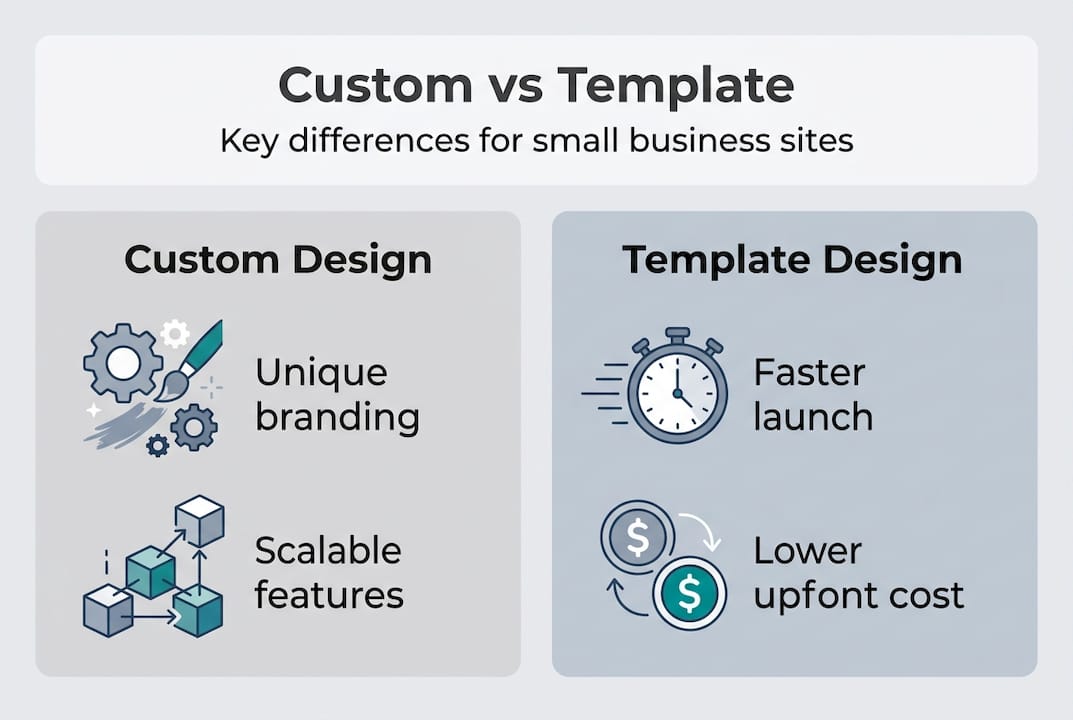
With trust and engagement at stake, the choice between a custom-built site and a ready-made template is one that deserves careful thought. Both options have their place, but they are not interchangeable, especially for a business that relies on its digital presence to generate leads.
Custom sites are built from scratch using modern frameworks that produce clean, performance-first code. They are structured with semantic HTML, optimised for Core Web Vitals, and designed with your specific goals in mind from day one. Templates, on the other hand, are pre-built solutions that often carry excess code, limited flexibility, and shared design patterns that make it difficult to stand out.
Here is a direct comparison to help you assess both options:
| Factor | Custom design | Template design |
|---|---|---|
| Upfront cost | Higher (£10,000+) | Lower (£500 to £3,000) |
| Time to launch | Weeks to months | Days to weeks |
| Unique branding | Fully bespoke | Limited by theme constraints |
| Scalability | Designed to grow with you | Often requires rebuild to scale |
| SEO performance | Optimised from the ground up | Dependent on template quality |
| Long-term cost | Lower total cost of ownership | Ongoing plugin and rebuild costs |
The distinction matters beyond aesthetics. 83% of SMBs now have websites, and 40% report that organic search is their primary source of leads. If your site is built on a bloated template that struggles to rank, you are effectively invisible to a large portion of your potential market.
Templates are a reasonable starting point for very early-stage businesses with minimal digital requirements. But for an SMB that depends on its website to generate consistent enquiries and sales, the limitations of a template become a ceiling rather than a foundation.
Pro Tip: Do not make your decision based solely on upfront cost. Consider what it will cost you in lost leads, rebuilds, and redesigns over three to five years. When you factor in the full picture, a custom site frequently works out to be the more economical choice. Explore website design services that are built with your long-term goals in mind, not just your immediate budget.
A few additional differences that are easy to overlook:
- Plugin dependency. Template sites often rely on multiple third-party plugins for basic functionality. Each plugin is a potential security risk and a source of compatibility problems when updates roll out.
- Brand ownership. With a custom site, you own the design outright. With many templates, you are operating within the licence terms of the theme provider.
- Performance under pressure. As your business grows and traffic increases, a custom site built on clean architecture handles the load far better than a template-based solution that was never designed for scale.
Return on investment: Costs and long-term benefits
Beyond design quality, there is a clear financial case for custom website design that too many business owners overlook. The conversation usually starts with the upfront cost, but that is only one part of the picture.
Custom websites typically require an initial investment of £10,000 or more, depending on the scope, functionality, and complexity involved. That figure can feel significant, particularly for smaller businesses. But the real question is not “how much does it cost?” but rather “how much does it return?”

The long-term ROI of custom design is substantial. In documented cases, businesses have recorded returns of 5,160% over 18 months following a move to a well-designed custom site. That is not a theoretical figure. It reflects increased lead volume, higher conversion rates, improved search visibility, and lower ongoing maintenance costs all working together.
Here is a practical framework for measuring the return on your own investment:
- Track enquiry volume. Measure how many leads your website generates before and after launch. Even a 20% increase in monthly enquiries from a site that previously generated 10 leads per month means two additional customers every single month.
- Monitor conversion rate. What percentage of visitors take a desired action? A custom site built around your audience and their journey will consistently outperform a generic template in this area.
- Assess search visibility. Where do you rank for your core search terms? SEO-driven growth is one of the most direct financial benefits of investing in a custom site built for performance.
- Calculate total cost of ownership. Factor in hosting, maintenance, plugin costs, and the cost of eventual rebuilds on a template versus the lower ongoing costs of a well-built custom site.
Pro Tip: If your website currently generates, say, five new clients per month at an average value of £1,000 each, improving your conversion rate by just 30% adds £1,500 in monthly revenue. Over a year, that is £18,000. Suddenly, a £10,000 to £15,000 investment in a custom site looks very different.
The total cost of ownership argument is particularly compelling. Template sites often require more frequent rebuilds, ongoing plugin subscriptions, and performance fixes that gradually erode the initial cost saving. A custom site, maintained properly, tends to remain viable and effective for longer, meaning the cost is spread over more years of productive use.
Design for SEO and digital visibility
Understanding the ROI of custom design also requires understanding how it connects to your search engine visibility. A site that does not rank well is a site that cannot generate leads, regardless of how good it looks.
Custom sites are built with performance-first code and semantic HTML, which are two of the most important technical foundations for strong SEO. Semantic HTML means your content is structured in a way that search engines can read and interpret accurately. Performance-first code means your pages load quickly, a factor that Google treats as a direct ranking signal through its Core Web Vitals framework.
Core Web Vitals measure three things: how fast your largest content element loads (Largest Contentful Paint), how quickly your page responds to user interaction (Interaction to Next Paint), and how stable your layout is during loading (Cumulative Layout Shift). Template sites frequently struggle with all three because of excess code, bulky scripts, and plugins that were never designed to work together efficiently.
Organic search drives 40% of leads for SMBs with an online presence. That is an enormous proportion of your potential business pipeline to leave to chance. If your site’s technical foundations are not built for SEO from the start, you are already behind.
Here are the key actions to take when building for visibility:
- Prioritise mobile-first design. Google indexes the mobile version of your site first. If your mobile experience is poor, your rankings will reflect that regardless of how good your desktop site looks.
- Optimise page speed from day one. Choose compressed images, minimal scripts, and a clean code base rather than retrofitting performance later.
- Structure content with clear headings. Proper use of H1, H2, and H3 tags helps search engines understand your page hierarchy and identify your most important content.
- Build for user experience. Search engines increasingly use behavioural signals, such as how long visitors stay and how many pages they visit, as indicators of content quality. Good UX supports good rankings.
Pro Tip: Before commissioning any website, ask your design partner directly how they approach SEO best practices during the build process, not as an afterthought once the site is live. A developer who treats SEO as a bolt-on is likely to deliver a site that underperforms in search. Also consider improving website UX as a continuous process, not a one-time task.
The relationship between design and SEO is not incidental. A custom site, built correctly, does not just look better. It performs better in search, attracts more traffic, and converts that traffic more effectively. Those three outcomes together are what generate lasting business results.
Our take: What most guides miss about custom website design
Most discussions about custom versus template design focus almost entirely on aesthetics and upfront cost. That misses the most important point. The real value of a custom website is adaptability.
Your business will change. Your audience will evolve. The services you offer, the markets you target, and the way customers search for you will all shift over the coming years. A template site is built for a fixed moment in time. A custom site is built to grow with you.
We have worked with businesses on the Fylde Coast and beyond who initially chose templates to save money, only to find themselves rebuilding from scratch two years later because their site could not accommodate growth. That rebuild cost more than a custom site would have in the first instance. The lesson is not that templates are always wrong. It is that business needs rarely stay still, and a design solution that cannot flex will eventually become a barrier.
Visit our page on winning web design strategies to see how we approach this differently: every project starts with a conversation about where your business is going, not just where it is today.
Custom design is a long-term commitment to your brand and your audience. Done well, it pays for itself many times over.
Ready to transform your website?
If this article has clarified why custom design delivers more than a template ever can, the logical next step is to see what a purpose-built solution looks like for your business.
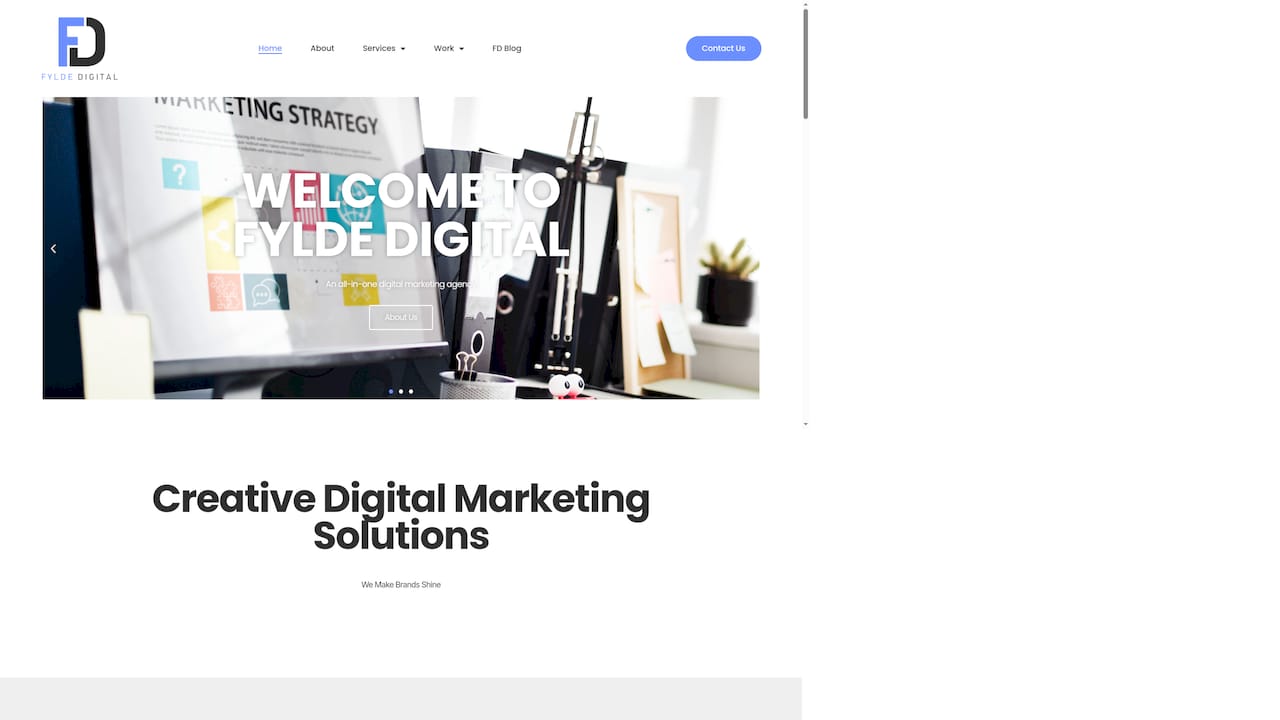
At Fylde Digital, we design and build custom web design services that are grounded in your brand, optimised for search engines, and structured to convert visitors into enquiries. We do not apply generic templates and call it done. We build sites that reflect who you are, perform where it matters, and grow alongside your ambitions. If you want to understand exactly how a new site could change your results, explore how we approach winning business online and request a free website review today.
Frequently asked questions
How much does custom website design typically cost for an SMB?
Custom website costs typically start from around £10,000 for an SMB, but the return on that investment through increased leads and revenue consistently justifies the spend over time.
Is custom website design better for SEO than a template site?
Yes. Custom sites use clean code and semantic HTML that meet modern SEO standards, while many templates carry excess code that slows performance and limits your ability to rank effectively.
How quickly can a custom website be launched?
Custom sites take longer to build than template solutions, usually several weeks to a few months, because they require thorough design, development, and testing. Templates suit faster timelines but sacrifice long-term capability for short-term speed.
What’s the main advantage of custom design for small businesses?
Custom design gives your business a unique identity that builds genuine trust. 94% of first impressions are design-based, so standing out with a purposeful, brand-led site gives you a real competitive edge over businesses using the same generic templates.