Most business owners have heard the term, but very few can explain what is digital strategy in a way that actually holds up under scrutiny. It gets lumped in with social media campaigns, website redesigns, or whichever technology platform is being considered that quarter. The reality is quite different. A digital strategy is a structured plan that connects your use of digital technologies directly to your business goals. Get it right, and well-defined digital strategies increase growth likelihood by 2.5 times compared to businesses operating without one.
Table of Contents
- Key takeaways
- What is digital strategy and its core components
- Common misconceptions: strategy vs marketing vs transformation
- How to build a digital strategy that delivers results
- Measuring success: choosing the right metrics
- My honest take on why digital strategies fail
- Ready to put your digital strategy into action?
- FAQ
Key takeaways
| Point | Details |
|---|---|
| Digital strategy definition | A structured plan linking digital technologies, data, and capabilities to specific business objectives. |
| Not just marketing | Digital strategy is broader than campaigns or channels. It sets the direction for how your whole business uses digital. |
| Start with outcomes | Effective digital strategy begins with business problems, not technology or channel selection. |
| Measure what matters | Focus on 5 to 7 core KPIs tied to business impact, reviewed regularly, to avoid spreading attention too thin. |
| Governance is critical | Clear ownership and reporting structures significantly increase the likelihood of achieving expected results. |
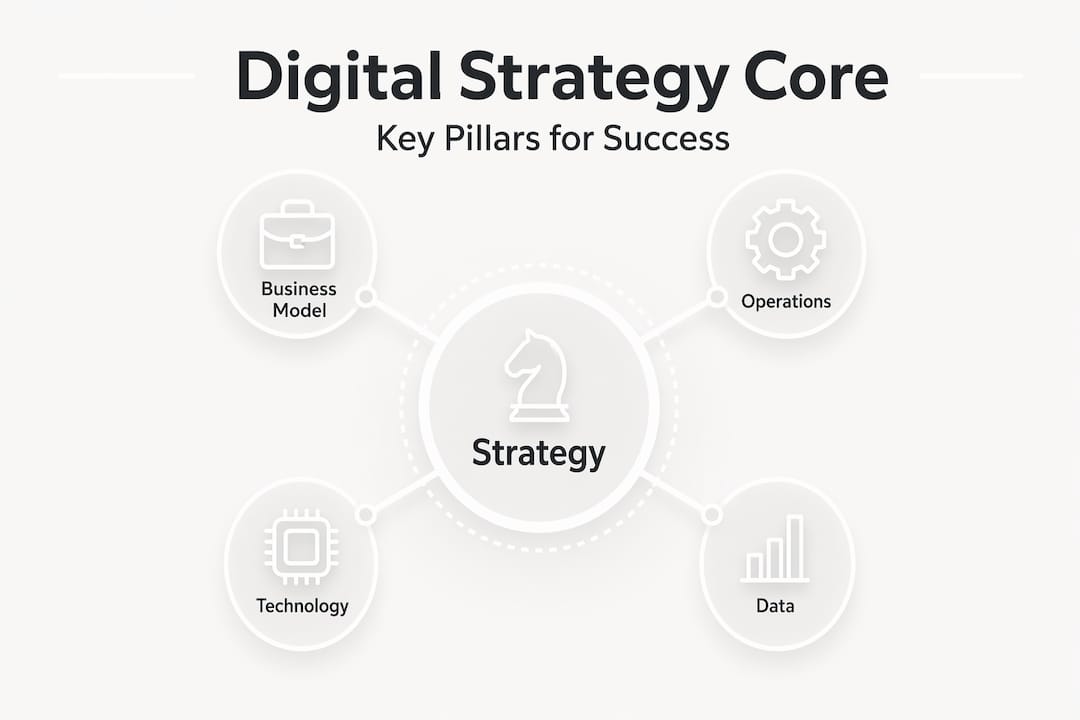
What is digital strategy and its core components
A solid digital strategy definition goes beyond marketing or software. It is a structured plan for deploying digital technologies to meet specific business objectives, addressing both how your business operates and how it creates value for customers. Think of it as the blueprint that sits above your individual digital activities, connecting them to the outcomes that actually matter to your business.
Every effective digital strategy is built around five core components:
- Digital vision aligned to business goals. This is not a mission statement. It is a clear articulation of what your business needs digital to achieve, whether that is growing revenue, reducing operating costs, or reaching new markets.
- Competitive landscape assessment. Understanding where your competitors are digitally and where gaps exist in your market gives your strategy direction and focus.
- Prioritised use cases. Not every digital initiative deserves equal attention. Prioritising by value potential means your resources go where they will generate the most return.
- Capability requirements. This covers the technology, skills, data infrastructure, and processes your business needs to execute the strategy.
- Measurable KPIs. Objectives without measurement are wishes. Your strategy must define how success will be tracked, tied directly to commercial outcomes.
It is worth distinguishing digital strategy from two related terms that often cause confusion. A digital marketing strategy focuses on marketing channels and campaigns. Digital transformation is the broader organisational change that a well-executed digital strategy can enable. Neither is the same thing, and understanding the difference shapes how you invest your time and budget.
Effective strategies address both business model innovation and operational efficiency at the same time. That dual focus is what separates a genuine digital strategy from a list of projects with a “digital” label attached.
Common misconceptions: strategy vs marketing vs transformation
This is where most businesses go wrong. The three terms get used interchangeably, but they describe different things operating at different levels of your organisation.
| Term | What it focuses on | Scope |
|---|---|---|
| Digital strategy | Business goals, direction, and how digital creates value | Organisation-wide |
| Digital marketing strategy | Campaigns, channels, and customer acquisition or engagement | Marketing function |
| Digital transformation | Reshaping operations, culture, and business models using digital | Enterprise-wide change |
A digital marketing strategy is essentially a subset of your broader digital strategy. It answers questions like: which channels should we use, what content should we produce, and how do we convert prospects into customers. It is tactical and campaign-focused. That is genuinely useful work, but it is not a substitute for the strategic layer above it.
Digital transformation is something else entirely. It involves integrating digital technology across your entire business, changing how it operates and delivers value. It requires a top-down reimagining of business models and customer relationships, not just a new CRM system or a better website.

Confusing digital strategy with transformation leads to misaligned efforts and wasted resources. A business that treats its digital strategy as purely a technology deployment project risks spending significant budget on tools that digitise existing inefficiencies rather than addressing the underlying business problems. That is a real and common failure mode.
The practical implication for you as a business owner or marketing professional is this: your digital strategy sets the direction. Your digital marketing strategy executes part of it. And if your digital strategy succeeds over time, transformation becomes the natural result. Treat them as three separate conversations and you will make much better decisions about where to invest.
How to build a digital strategy that delivers results
The most common mistake in building a digital strategy is starting with technology. A business hears about AI tools, a new social platform, or an automation system and builds backwards from the technology to justify why it should be used. That approach rarely works.
The right sequence looks like this:
- Define the business outcome you are trying to achieve. Be specific. “Grow revenue” is not an outcome. “Increase qualified leads from the North West by 30% over 12 months” is. Starting here keeps the entire strategy grounded in commercial reality.
- Identify the problem standing between you and that outcome. Is it low awareness? Poor conversion on your website? High customer churn? The problem shapes everything that follows, including which digital capabilities you actually need.
- Prioritise the initiatives that address that problem with the highest value potential. You will have more ideas than budget. Ruthless prioritisation based on estimated return and feasibility is what separates good strategy from a wish list.
- Define the capabilities required. This means technology, yes, but also the people, processes, and data needed to execute. Many digital strategies stall because the capability gap was never honestly assessed.
- Establish governance structures. Clear digital ownership and reporting structures are established in 69% of organisations that achieve expected digital results. Someone must own the strategy. Without accountability, even well-designed plans drift.
- Connect every initiative to a measurable KPI tied to the business outcome. Channel metrics like clicks and impressions are secondary. Your primary KPIs should reflect revenue impact, cost reduction, or efficiency gains.
Pro Tip: Revisit your digital strategy at least quarterly. Markets shift, competitors move, and customer behaviour evolves. A digital strategy is not a document you file away. Treat it as a living framework, and build in structured reviews from the start.
Following a defined digital strategy methodology means your channel selection becomes a consequence of your strategy, not the starting point. That shift in sequence makes your entire digital investment more coherent and more likely to deliver results. You can also explore overcoming digital marketing challenges that arise during implementation, which helps you anticipate common obstacles before they derail progress.
Measuring success: choosing the right metrics
Measurement is where many otherwise decent digital strategies fall apart. The problem is not a lack of data. It is an excess of it. When you track 30 different metrics across multiple channels, you lose the ability to act decisively on any of them.
Strategy fatigue is a genuine risk, and it can be mitigated by focusing on 5 to 7 core KPIs, reviewed quarterly. That discipline forces clarity about what actually matters.
Here is how to think about your metrics in two tiers:
- Primary KPIs tied to business outcomes. These sit at the top of your measurement framework. Examples include revenue generated from digital channels, customer retention rate, cost per acquisition, and operational cost savings enabled by digital processes.
- Secondary channel metrics. These help you diagnose performance within specific channels. Organic traffic, email open rates, paid search conversion rates, and social engagement all fall here. They are useful indicators, but they should never replace business outcome metrics at the top of your reporting.
80% of digital marketing leaders struggle to define consistent metrics for multichannel impact due to siloed approaches. The fix is building your measurement framework from the top down, starting with business outcomes and working backwards to identify which channel metrics are genuinely predictive of those outcomes.
For ongoing reporting, a simple monthly dashboard reviewed by whoever owns the strategy is far more effective than complex quarterly reports no one reads. Track your 5 to 7 core KPIs, flag significant changes, and connect every anomaly back to a business decision. You can build on this further by understanding key digital marketing metrics and how they connect to wider strategic goals.
My honest take on why digital strategies fail
I have worked with a fair number of businesses on their digital strategy, and the pattern I see most often is the same. The strategy gets written, the deck gets presented, and then reality takes over. Within three months, the team is back to doing what they always did, just with more expensive tools.
In my experience, the failure is almost never about the strategy document itself. It is about three things: no clear owner, too many metrics, and a fundamental confusion between deploying technology and solving a business problem. When digital strategy is treated as tech deployment, businesses risk digitising their inefficiencies rather than addressing the underlying problems. I have seen this happen with CRM implementations, e-commerce builds, and marketing automation platforms.
What I have found actually works is starting every strategy conversation with a blunt question: “What business problem are we trying to solve?” Not which technology to use, not which channels to prioritise. The problem first. That single shift changes everything about how the strategy gets built and, more importantly, how it gets executed.
The other thing I would push back on is the idea that a digital strategy is a one-off exercise. It is not. Digital transformation is the broader outcome a good strategy enables over time. Your strategy should evolve as your business does. Build in the review cadence from day one and treat your KPIs as a living conversation, not a scorecard you dust off at year end.
— tibor
Ready to put your digital strategy into action?
Understanding what digital strategy means is the first step. The second is making sure your digital foundations are strong enough to support it.

At Fyldedigital, we work with businesses across the Fylde Coast and beyond to build the kind of online presence that supports real strategic goals. Whether that starts with professional web design built around your business objectives, or with improving your search visibility through effective SEO practices, we can help you connect the dots between your digital activity and the results that matter. Get in touch with Fyldedigital today for a free website or SEO review and find out where your biggest opportunities lie.
FAQ
What is digital strategy in simple terms?
A digital strategy is a structured plan that outlines how your business will use digital technologies to achieve specific goals, such as growing revenue, reducing costs, or reaching new customers. It connects your digital activity directly to business outcomes rather than treating digital as a series of isolated projects.
How does digital strategy differ from digital marketing strategy?
Digital marketing strategy focuses on campaigns, channels, and customer acquisition tactics within the marketing function. A digital strategy operates at a higher level, setting the overall direction for how your entire business uses digital technology to create value.
Why is digital strategy important for businesses?
Businesses with a well-defined digital strategy are 2.5 times more likely to achieve strong growth than those without one. It provides clarity, ensures resources are invested where they matter most, and gives everyone in the business a shared direction.
How many KPIs should a digital strategy include?
Most experts recommend focusing on 5 to 7 core KPIs reviewed on a quarterly basis. Tracking too many metrics spreads attention too thinly and makes it harder to take decisive action when performance changes.
What is the first step in creating a digital strategy?
The first step is defining a specific business outcome you want to achieve, not selecting a technology or channel. Starting with a clear commercial problem ensures that every digital decision that follows is grounded in what your business actually needs.