Most business owners assume that having a website and posting regularly on social media is enough to generate leads online. It is not. Effective online marketing demands more than waiting for customers to stumble across your content. Digital outreach is the proactive approach that closes the gap between your business and the people who need it most. This article explains exactly what digital outreach is, why it matters for small and medium-sized businesses, and how to apply proven strategies to generate real, measurable results.
Table of Contents
- Defining digital outreach: What it really is (and isn’t)
- Key strategies and channels for digital outreach
- Personalisation and success factors: What makes outreach campaigns work?
- Integrating outreach with inbound: The compounding effect for small businesses
- Why most outreach fails and what actually works for smaller businesses
- Next steps: Elevate your outreach with expert local support
- Frequently asked questions
Key Takeaways
| Point | Details |
|---|---|
| Digital outreach is proactive | It means initiating contact with new people, not just waiting for them to find you. |
| Smaller lists perform best | Outreach to fewer, well-matched contacts gets far better results than bulk sending. |
| Hybrid strategy wins | Combining outbound outreach and inbound marketing gives the best long-term success. |
| Personalisation is crucial | Campaigns that feel researched and human achieve higher reply rates and credibility. |
Defining digital outreach: What it really is (and isn’t)
Now that we’ve exposed the limits of passive content, let’s clarify exactly what counts as digital outreach and what does not.
Outreach marketing is the proactive process of initiating personalised contact with relevant individuals or organisations outside your existing network to build relationships, generate leads, secure partnerships, earn backlinks, or increase visibility. The word proactive is key here. You are not waiting for enquiries. You are going out and starting conversations.

This is different from publishing blog posts, running adverts, or even doing social media management on your own channels. Those are all forms of inbound or owned-media marketing. They attract people who are already searching. Digital outreach targets people who may not even know your business exists yet.
The immediate benefits are tangible:
- Lead generation: Reaching out to prospective clients directly, rather than hoping they find you.
- Partnerships: Forming relationships with complementary businesses or industry influencers.
- Backlinks: Earning links from reputable websites, which strengthens your SEO performance.
- Visibility: Getting your name in front of new audiences through collaborations or features.
A common misconception is that digital outreach is the same as spam or mass email blasting. It is not. Genuine outreach is targeted, personalised, and respectful of the recipient’s time and interests. The goal is always to initiate a meaningful conversation, not to overwhelm an inbox with irrelevant offers. When done correctly, it is one of the most cost-effective strategies available to small businesses.
“Digital outreach is not a numbers game. It is a relevance game. The more relevant your message, the greater your chance of a response.”
For small businesses especially, the primary goals are to build new relationships and achieve measurable outcomes. Whether that means securing three new B2B partnerships this quarter or acquiring ten high-quality backlinks, outreach gives you a direct route to growth rather than leaving it to chance.
Key strategies and channels for digital outreach
With a solid definition in place, it is time to explore the actual tools and techniques that make digital outreach work for real businesses.
There are several channels you can use, each with distinct strengths. Understanding where to invest your time makes a significant difference to your results. Studies show that outreach response rates vary considerably by channel: cold email typically achieves reply rates of 1 to 5 percent, while LinkedIn outreach can reach 15 to 25 percent due to higher levels of trust, though LinkedIn imposes connection and messaging limits.
Here is a breakdown of the key channels available:
| Channel | Best for | Average reply rate | Key limitation |
|---|---|---|---|
| Cold email | Scalable lead generation | 1 to 5% | Low trust, easy to ignore |
| B2B relationships, partnerships | 15 to 25% | Connection/messaging limits | |
| Social media (other) | Brand visibility, influencer outreach | Varies | High noise, lower conversion |
| Partnership outreach | Referrals, collaborations | Varies | Time-intensive to develop |
| Backlink outreach | SEO, authority building | 5 to 10% | Requires strong content asset |
A hybrid approach, combining two or more channels, consistently delivers better ROI than relying on a single method. For most small and medium-sized businesses, starting with cold email combined with LinkedIn tends to be the most practical route. Email gives you scale, and LinkedIn builds trust.
Here is how to approach each channel effectively:
- Cold email: Research your prospect first. Understand their business, identify a specific problem you can solve, and write a short, focused message. Keep it under 150 words where possible. One clear call to action, such as booking a 15-minute call, performs better than multiple requests.
- LinkedIn: Send a personalised connection request with a brief note explaining why you want to connect. Follow up with a value-led message after the connection is accepted. Avoid immediately pitching; lead with genuine interest or a useful observation.
- Partnership outreach: Identify businesses serving the same target audience without competing directly. Propose a specific collaboration, such as a co-authored blog post or a referral arrangement, and explain what is in it for them.
- Backlink outreach: Create a genuinely useful piece of content first. Then approach relevant websites or bloggers with a personalised pitch explaining why your content adds value to their audience. Successful backlink campaigns also improve your getting management clients results when combined with social proof.
Pro Tip: To avoid being flagged as spam, always send from a properly configured business email address, include a genuine unsubscribe option in cold emails, and never use deceptive subject lines. Complying with the UK’s Privacy and Electronic Communications Regulations (PECR) is not optional; it protects both you and the people you contact.
The compounding advantage of a hybrid approach is this: each channel reinforces the other. A prospect who receives a thoughtful email is more likely to accept your LinkedIn request. A connection who sees your social content regularly is more likely to respond positively when you follow up. Together, the channels multiply your impact.
Personalisation and success factors: What makes outreach campaigns work?
Now that you know the channels, let us reveal the details that often separate effective outreach from the silence and lost time so many businesses experience.
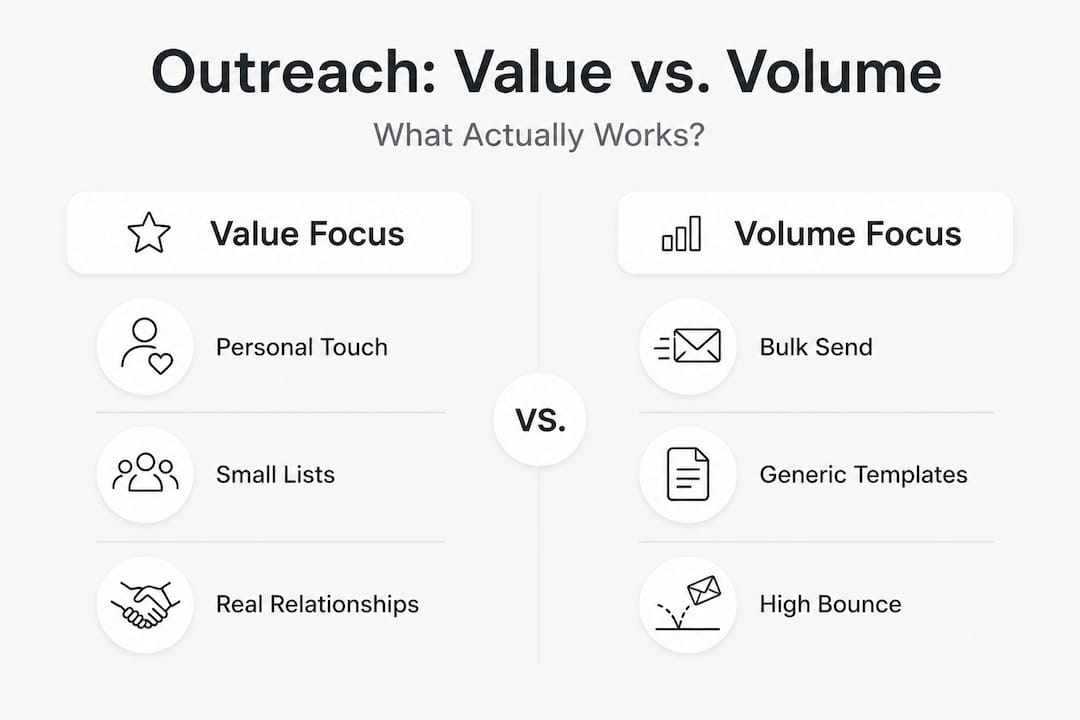
The single biggest factor in outreach performance is personalisation. Research consistently shows that small lists under 50 contacts yield up to three times higher reply rates than bulk lists. This may feel counterintuitive if you are used to thinking “more emails equals more results.” The reality is the opposite.
Here is a data comparison that illustrates this clearly:
| List size | Average reply rate | Bounce rate | Time investment |
|---|---|---|---|
| Under 50 (highly researched) | Up to 15% | Under 3.8% | High per contact |
| 50 to 200 (semi-targeted) | 5 to 8% | Around 8% | Moderate |
| 500 plus (bulk/generic) | Under 2% | Up to 18% | Low per contact |
The reason smaller lists perform better is straightforward: more time per contact means more personalised messages, which means higher relevance, which earns more responses. With bulk lists, your message is generic, your bounce rate climbs, and your sender reputation suffers. A damaged sender reputation makes future emails more likely to land in spam.
Data quality matters enormously. Before sending any outreach, verify your contact data using tools such as Hunter.io or ZeroBounce. Verified data reduces bounces from as high as 18 percent to under 3.8 percent, protecting your email domain’s credibility and ensuring your messages actually arrive.
Practical personalisation tactics include:
- Reference a specific piece of content they published or a recent achievement.
- Mention a mutual connection or shared professional interest.
- Address a concrete pain point relevant to their industry or business size.
- Use their first name naturally, not mechanically repeated throughout.
One area worth addressing separately is AI-assisted outreach. Tools like ChatGPT can speed up template creation, but AI-generated messages often carry a recognisable, robotic tone that recipients spot instantly. Always review and rewrite AI templates in your own voice before sending.
Pro Tip: Read your outreach message aloud before sending it. If it sounds stiff or formulaic, rewrite it. If it sounds like something you would genuinely say to a person at a networking event, it is ready.
There is also a time pressure that applies specifically to small businesses. Around 60 percent of SMB owners work more than 50 hours per week. That means your outreach strategy must deliver proof of value quickly. Focus your efforts on social media strategies and outreach methods that show tangible results within four to six weeks, rather than campaigns that promise vague long-term gains.
Integrating outreach with inbound: The compounding effect for small businesses
With the mechanics in place for outreach success, it is critical to see how it fits seamlessly alongside your other marketing efforts.
Pure outbound outreach, done in isolation, rarely sustains business growth. Equally, relying entirely on inbound content without any proactive outreach means you are dependent on search algorithms and social feeds delivering your message. The most effective approach for small business digital marketing combines both, and the results compound over time.
Here is how integration works in practice:
- Use outreach to amplify content: Write a helpful blog post or case study, then reach out to relevant contacts sharing it as a resource. The content gives you a reason to make contact without immediately asking for business.
- Build social proof before outreaching: A prospect who receives your outreach message is very likely to check your website and social media immediately after reading it. Make sure what they find reinforces your credibility.
- Follow up with inbound touchpoints: After sending an outreach message, connect on LinkedIn and engage with their content. When they see your name appearing positively across multiple channels, trust builds naturally.
- Use content to warm up cold audiences: Running a sequence where prospects receive educational content before a direct pitch consistently outperforms cold pitching alone.
“Success hinges on relevance. Showing that you have done your research turns a cold message into a warm conversation. Integrating outreach with inbound creates a compounding effect that pure outbound campaigns can never replicate.”
Compliance and trust are not afterthoughts. Under PECR and the UK GDPR, you must have a lawful basis for contacting individuals. For business-to-business outreach this is typically legitimate interest, but you must still give recipients a straightforward way to opt out and you must honour those requests promptly. Businesses that operate with transparency in their outreach build lasting reputations. Those that cut corners face deliverability problems, complaints, and regulatory risk.
The relationship-first mindset is the foundation of everything. Outreach that leads with genuine value, whether that is a useful resource, a relevant introduction, or a thoughtful observation, will always outperform outreach that begins with a sales pitch.
Why most outreach fails and what actually works for smaller businesses
Here is an honest look at what most guides miss and what truly gives smaller businesses an edge in digital outreach.
The most common reason outreach campaigns fail is simple: they are built around volume rather than value. Business owners invest in tools that send hundreds of emails per day and then wonder why reply rates hover at 1 percent. The issue is not the tool. It is the mindset. When you treat outreach as a numbers game, the numbers will always disappoint.
The real differentiator is meaningful personalisation integrated into broader marketing activity. We have seen smaller businesses outperform much larger competitors by focusing on fifty highly targeted contacts a month, each approached with a personalised, relevant message, backed by strong effective digital channels and credible social profiles. Fifty well-chosen contacts at a 15 percent response rate gives you seven or eight genuine conversations. Seven hundred bulk emails at 1 percent gives you the same number, but with a damaged sender reputation and hours of wasted effort.
Automation has its place. Using tools to manage follow-up sequences or track open rates is entirely sensible. But automating the thinking behind your outreach is where businesses lose. No tool can substitute for the moment a prospect opens a message and thinks, “This person actually understands my situation.”
The hard lesson that often takes businesses time to learn is this: outreach is not a shortcut to leads. It is an investment in relationships. Some of the most valuable business partnerships we encounter started with a single well-crafted message that did not ask for anything, it simply offered something useful. That opening generosity creates goodwill that turns into referrals, collaborations, and long-term revenue.
Focus on human connection. Measure your outreach not only by immediate replies, but by the relationships that develop over three, six, and twelve months. That is where the real return lives.
Next steps: Elevate your outreach with expert local support
Ready to turn insight into lasting business growth? Here is how you can put these ideas into practice with support that matches your ambition.
Running effective digital outreach campaigns alongside everything else your business demands is no small task. Getting the strategy right from the start saves you considerable time, budget, and frustration further down the line.
At Fylde Digital, we work with small and medium-sized businesses to build the kind of online presence that makes outreach land. Our web design services ensure that every prospect who looks up your business after receiving your message finds a professional, credible, and conversion-focused website. Our social media management advice helps you maintain an active, trustworthy presence across the channels that matter most. And our guidance on SEO best practices means your inbound and outbound efforts reinforce each other for compounding results. Get in touch today for a free review and find out how we can help your business grow with purpose.
Frequently asked questions
How does digital outreach differ from inbound marketing?
Digital outreach means proactively reaching out to relevant people, while inbound marketing draws them in with content and resources. Outreach is targeted and proactive; inbound is passive and attraction-based.
What are the best channels for small businesses to start digital outreach?
Cold email and LinkedIn are the most effective starting points. Cold email scales but typically achieves only 1 to 5 percent reply rates, while LinkedIn offers higher trust and reply rates of 15 to 25 percent.
How big should my outreach list be?
Keep your list small and well-researched. Lists under 50 contacts generate up to three times more replies than bulk lists because each message can be genuinely personalised.
What is the biggest mistake to avoid in digital outreach?
Sending generic, impersonal messages is the most common failure. Outreach succeeds on relevance and compliance; always show that you have researched the recipient and make it easy for them to opt out if they wish.