Most businesses understand that their logo should look the same on a business card as it does on their website. What integrated branding actually demands goes far deeper than that. It is the practice of coordinating every message, every channel, and every customer interaction so that your brand speaks with one consistent voice, regardless of where someone encounters it. Get this right, and your brand builds recognition and trust at pace. Get it wrong, and you risk confusing the very customers you are trying to win.
Table of Contents
- Key takeaways
- What integrated branding really means
- The strategic foundations of integrated branding
- The real benefits of integrated branding
- How to implement integrated branding
- Integrated branding vs related concepts
- My perspective on why integrated branding so often falls short
- How Fyldedigital can help you build a coherent brand
- FAQ
Key takeaways
| Point | Details |
|---|---|
| More than visual identity | Integrated branding covers messaging, tone, and customer experience, not just logos and colours. |
| Coordination is non-negotiable | Marketing, sales, PR, and customer service must all work from the same brand narrative. |
| Consistency drives performance | Consistent brands outperform inconsistent ones, gaining 27% more large brand effects and double the profit gains. |
| Governance makes it stick | Brand guidelines, approval workflows, and cross-team meetings are what keep integration from slipping. |
| Adapt by channel, not by brand | Use a single core message expressed differently per channel to stay fresh without losing coherence. |
What integrated branding really means
Integrated branding is the deliberate coordination of a brand’s messaging, visual identity, tone, and values across every channel and touchpoint, so that customers receive a consistent, unified identity regardless of where they interact with the business. That might be a social media post, a paid advertisement, a PR article, a customer service call, or a page on your website. Each one should feel like it belongs to the same brand.
This is where many businesses trip up. They treat branding as a design task and marketing as a separate communications task, never properly connecting the two. The result is a brand that looks polished in one place and generic in another.
Integrated branding sits within the broader concept of Integrated Marketing Communications (IMC). The integrated marketing definition, at its core, is about aligning touchpoints so customers receive coherent communication regardless of platform. Integrated branding takes that principle further by anchoring every communication in a shared brand identity, not just a shared campaign message.
The touchpoints that integrated branding must account for include:
- Your website and landing pages
- Social media profiles and content
- Paid advertising copy and creative
- PR coverage and press releases
- Email marketing and newsletters
- Customer service language and responses
- Print materials and packaging
Each of these is a moment where a customer forms an impression of your brand. Integrated branding is what builds brand cohesion across all of them. It is not cosmetic. It is about coherent meaning that aligns every brand interaction to build a strong mental brand image in the mind of your customer.
The strategic foundations of integrated branding
Understanding what integrated branding is only gets you so far. Achieving it in practice requires the right organisational conditions. The businesses that do this well treat brand integration as a strategic priority, not a creative afterthought.
Effective integrated branding requires coordination among marketing, sales, customer service, and leadership to uphold a unified brand narrative. That is harder than it sounds. Most organisations run these functions in separate teams with separate priorities. Without deliberate effort, messaging fragments and the brand drifts.
Senior leadership plays a defining role here. When the people at the top of a business understand and articulate the brand vision clearly, it filters down into every team’s decisions. Leadership must enforce brand consistency without sacrificing personalisation, ensuring the brand stays meaningful rather than mechanical.
Governance tools are what make this consistent in practice:
- Brand guidelines: A documented reference covering tone of voice, visual standards, messaging pillars, and channel-specific rules.
- Approval workflows: A process for reviewing content before it goes live, catching off-brand material before it reaches customers.
- Cross-functional meetings: Regular touchpoints between teams to align on messaging and upcoming campaigns.
- Reporting dashboards: Shared metrics that show how brand consistency is performing across channels.
Pro Tip: Don’t let your brand guidelines sit in a folder nobody reads. Embed them into onboarding, brief templates, and campaign planning documents so they become part of how work actually gets done.
Data is the final pillar. Embedding integration into workflow prevents message drift over time, but you need measurable signals to know when drift is happening. Tracking brand sentiment, message recall, and consistency audits across channels gives you the evidence to adapt your integrated branding strategy before small inconsistencies become serious problems.
The real benefits of integrated branding
The case for investing in integrated branding is not difficult to make. The returns show up in recognition, customer loyalty, and commercial performance. Here is why it matters in practical terms.

Consistent brands outperform inconsistent ones, gaining 27% more very large brand effects and double the profit gains. Inconsistency does not just weaken aesthetics. It erodes trust and recognition, which directly affects revenue.
The benefits of integrated branding extend across the business:
- Brand recognition: When every touchpoint reinforces the same identity, customers remember you faster and more reliably.
- Customer trust: All communications reflecting shared values and tone leads to a more trustworthy customer experience.
- Loyalty: Familiarity is one of the strongest predictors of brand preference. Consistency creates familiarity.
- Marketing efficiency: Coordinated campaigns reinforce each other rather than working in isolation, which stretches your budget further.
- Reduced confusion: Fragmented messaging makes customers uncertain about what your business actually stands for. Integrated branding removes that uncertainty.
For small and medium-sized businesses, these benefits are especially significant. You are working with limited budgets and competing for attention in crowded markets. A well-executed integrated branding strategy means every pound you spend on marketing reinforces the same clear message rather than pulling in different directions. Understanding why branding matters for growth is the first step towards getting real commercial value from your brand investment.
How to implement integrated branding
Knowing the theory is one thing. Actually putting an integrated branding strategy in place requires a structured approach. Here is how to do it without getting overwhelmed.
-
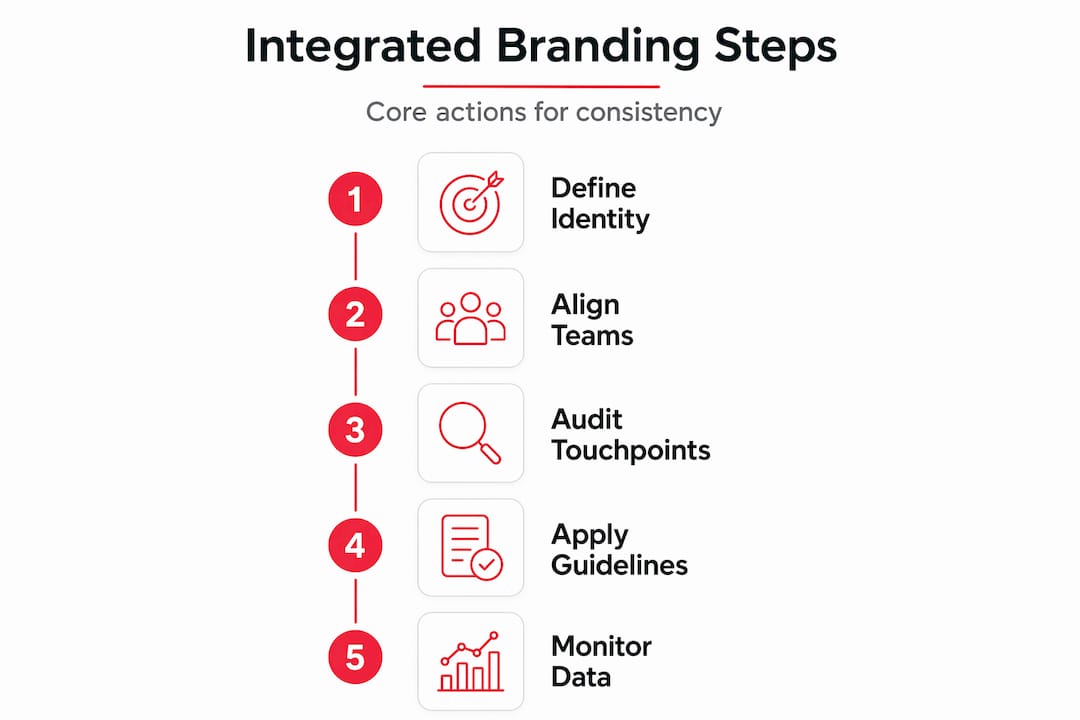
Define your core brand message. Before you can integrate anything, you need clarity on what your brand stands for, who it serves, and what makes it different. This becomes the anchor for everything else.
-
Document your tone of voice. Decide how your brand speaks. Formal or conversational? Bold or measured? Write it down with real examples of on-brand and off-brand language so every team member can apply it consistently.
-
Audit your existing touchpoints. Review your website, social media, email campaigns, and any printed materials side by side. Identify where the messaging diverges, where the visual identity weakens, and where the tone shifts unexpectedly.
-
Build a brand playbook. Consolidate your visual guidelines, messaging pillars, tone of voice rules, and channel-specific guidance into a single reference document. Make it accessible to everyone who creates or approves content.
-
Plan coordinated campaigns. When you run a campaign, plan how it will appear across every relevant channel from the start rather than adapting it channel by channel after the fact. Channel-specific creative adaptations built around a shared narrative prevent content fatigue without sacrificing coherence.
-
Assign brand ownership. Designate someone responsible for maintaining brand standards. In smaller businesses, this is often the marketing lead. In larger ones, it may be a brand manager or creative director.
-
Review and adapt regularly. Set a quarterly review to audit brand consistency across channels and assess whether your messaging still resonates. Use data from customer feedback, engagement metrics, and campaign performance to guide updates.
Pro Tip: When adapting your core message for different channels, think of it like a photograph printed at different sizes. The image stays the same. Only the format changes. Your Instagram caption and your press release should feel like siblings, not strangers.
The importance of brand consistency throughout this process cannot be overstated. Even small deviations, an off-tone email here, an inconsistent visual on a paid ad there, compound over time and chip away at the recognition you are trying to build.
Integrated branding vs related concepts
A common source of confusion is how integrated branding relates to similar concepts. Getting clear on the distinctions helps you apply each concept where it actually belongs.
| Concept | Primary focus | Key goal |
|---|---|---|
| Integrated branding | Unified identity across every brand touchpoint | Coherent brand meaning and recognition |
| Integrated Marketing Communications (IMC) | Consistent messaging across paid, earned, and owned channels | Aligned campaign communication |
| Omnichannel marketing | Seamless customer experience across channels | Frictionless customer journey |
IMC focuses on unified messaging while omnichannel focuses more broadly on customer experience coordination. Integrated branding sits above both. It is the strategic framework that gives your messaging and your customer experience a shared identity to draw from.
The most common myths about integrated branding are worth addressing directly. It is not simply about using the same logo everywhere. It is not a one-off project completed when a rebrand launches. And it is not exclusively the concern of large businesses with dedicated brand teams. Fragmentation risks brand equity at any scale, and a consistent brand built carefully over time is one of the most durable competitive advantages a business can develop.
My perspective on why integrated branding so often falls short
I’ve worked with enough businesses to see a clear pattern. Integrated branding breaks down not at the strategy stage, but at the execution stage. A brand workshop produces excellent guidelines that then sit in a shared folder, never consulted, never enforced. Teams revert to doing what is quick rather than what is consistent, and within six months the brand has quietly fragmented again.
The tension I find most interesting is between consistency and personalisation. Some businesses overcorrect and apply their brand so rigidly that every piece of communication feels identical and lifeless. Others personalise so freely that coherence disappears entirely. The answer is the core message with channel-specific adaptation approach, but that requires genuine discipline and regular review, not just a set of rules written once.
What I’ve seen work is treating brand governance as an ongoing operational commitment rather than a creative project. The brands that stay coherent are the ones where leadership talks about brand standards in the same breath as they talk about sales targets. They measure it. They hold people accountable for it. They use data to catch drift early. That is what a data-driven culture actually looks like in practice.
If you are a business owner reading this, the most practical thing you can do today is pull up three or four of your recent customer touchpoints and ask honestly whether they feel like they come from the same brand. If the answer is uncertain, that is where to start.
— tibor
How Fyldedigital can help you build a coherent brand
Building an integrated brand presence across every digital touchpoint takes more than good intentions. It takes professional web design, consistent visual identity, and a coordinated approach to every channel your customers use.
At Fyldedigital, we work with small and medium-sized businesses across the Fylde Coast and beyond to create branding that works together across every platform. From your website to your social media, every element is designed to reinforce the same brand identity. Our web design in Blackpool service is built with brand consistency at its core, not added as an afterthought. We also offer graphic design, SEO, and social media management to help your brand stay coherent wherever your customers find you. Get in touch with Fyldedigital to find out how we can put an integrated branding strategy to work for your business.
FAQ
What is integrated branding in simple terms?
Integrated branding is the practice of making sure your business communicates a consistent identity, message, and tone across every channel and customer touchpoint, from your website and social media to your customer service and print materials.
How does integrated branding differ from IMC?
Integrated Marketing Communications focuses on aligning campaign messages across paid, earned, and owned media channels. Integrated branding goes further by anchoring all communication in a shared brand identity, making it a broader strategic framework than IMC alone.
What are the main benefits of integrated branding?
The primary benefits include stronger brand recognition, greater customer trust, improved marketing efficiency, and reduced consumer confusion. Research shows consistent brands achieve significantly higher profit gains than those with fragmented messaging.
How do I start implementing an integrated branding strategy?
Begin by defining your core brand message and tone of voice, then audit your existing touchpoints to identify inconsistencies. Build a brand playbook, assign clear ownership, and plan campaigns that express the same narrative across every relevant channel.
Is integrated branding only relevant for large businesses?
No. Fragmentation damages brand equity at any scale. Small and medium-sized businesses benefit significantly from integrated branding because it maximises the impact of limited marketing budgets by ensuring every channel reinforces the same clear message.