Digital marketing goals are measurable outcomes that direct your marketing activity and prove whether your investment is working. Without them, you are spending budget on channels and campaigns with no clear way to judge success or failure. The SMART framework, used by brands from Coca-Cola to early-stage start-ups, gives you a structured method to define goals that are Specific, Measurable, Achievable, Relevant, and Time-bound. Understanding digital marketing fundamentals first makes the goal-setting process far more grounded and effective for any small or medium-sized business.
How to set digital marketing goals using the SMART framework
The SMART framework is the most widely used method for setting digital marketing objectives because it removes ambiguity and forces clarity at every stage of planning. A vague goal like “get more website traffic” tells your team nothing useful. A SMART goal tells them exactly what to do, by when, and how to know if it worked.
Here is what each element means in practice:
- Specific: Name the channel, metric, and audience. “Increase organic search sessions from UK visitors” is specific. “Improve our online presence” is not.
- Measurable: Attach a number. Increase organic sessions by 20% in six months gives you a clear benchmark to track against.
- Achievable: Base your target on historical data or industry benchmarks. If your site currently grows at 5% per month, a 20% uplift over six months is realistic. A 200% uplift is not.
- Relevant: The goal must connect to a business priority. If your business needs more local enquiries, a goal around national brand awareness is misaligned.
- Time-bound: Set a firm deadline. Open-ended goals drift. A six-month window creates urgency and a natural review point.
The most common pitfall is setting goals that are measurable but not specific, or specific but not time-bound. Both errors produce the same result: a goal that nobody owns and nobody reviews. Digital marketing goal examples that work in practice include “generate 50 qualified leads per month through paid search by Q3” or “reduce cost per acquisition on Facebook Ads from £45 to £30 within 90 days.”
Pro Tip: Write your SMART goal in a single sentence and read it aloud. If it sounds vague or you cannot picture how you would measure it, rewrite it before moving forward.
How do you align marketing goals with business objectives?
Marketing goals must support company priorities directly. If they do not, you risk spending budget on activity that looks productive but contributes nothing to the business outcomes that actually matter.
The right starting point is your business objectives, not your marketing channels. Many SME owners make the mistake of starting with tactics (“we should do more social media”) rather than outcomes (“we need to increase revenue from new customers by 15% this year”). Tactics without objectives are just activity.
Here is a practical process for aligning the two:
- Write down your top three business objectives for the year. Examples: grow revenue by 20%, enter a new geographic market, reduce customer churn by 10%.
- Identify which marketing activities directly support each objective. Revenue growth might require more leads. A new market might require brand awareness in that region. Churn reduction might require better email retention campaigns.
- Translate each business objective into a corresponding marketing goal. “Grow revenue by 20%” becomes “increase qualified leads from SEO by 30% in six months.” “Enter a new market” becomes “achieve 5,000 monthly impressions from Manchester-based search queries by Q4.”
- Remove any marketing goal that does not map to a business objective. If you cannot draw a straight line from the marketing goal to a business outcome, cut it or deprioritise it.
This approach also helps you communicate the value of marketing to stakeholders who are not close to the day-to-day activity. When your goals are expressed in business language, such as revenue, leads, and market share, rather than marketing language like impressions and followers, the conversation becomes far more productive. Your digital strategy should act as the connective tissue between business ambition and marketing execution.
What KPIs should you track for digital marketing goals?
Selecting the right KPIs is where many SMEs lose their way. Effectiveness KPIs measure business contribution, such as revenue generated or leads closed. Efficiency KPIs measure funnel performance, such as click-through rate or cost per click. You need both, but they serve different purposes.
A practical structure for each goal looks like this:
| KPI type | What it measures | Example |
|---|---|---|
| Primary (lagging) | Business outcome | Qualified leads generated per month |
| Supporting (leading) | Funnel performance | Organic sessions, conversion rate |
| Efficiency | Channel performance | Cost per click, email open rate |
Assign one primary KPI per goal and a single owner responsible for tracking it. Multi-metric dashboards without a clear owner cause confusion and missed targets. Supporting KPIs act as early warning signals. If your organic sessions are falling three months before your lead target is due, you know to act now rather than at the deadline.
Reporting cadence matters as much as the KPIs themselves. Weekly checks should cover leading indicators such as click-through rates and conversion rates. Monthly reviews should assess pipeline and revenue impact. Quarterly sessions are for reassessing the strategy and resetting goals where needed. Tools like ClickUp Dashboards centralise your campaign data and KPIs, reducing the time your team spends gathering numbers and improving communication across the business. For a deeper look at which metrics to prioritise, the Fyldedigital guide to key marketing metrics is a useful reference.
Pro Tip: Avoid tracking more than five KPIs per goal. Data overload leads to paralysis. Pick the metrics that will genuinely change your decisions and ignore the rest.
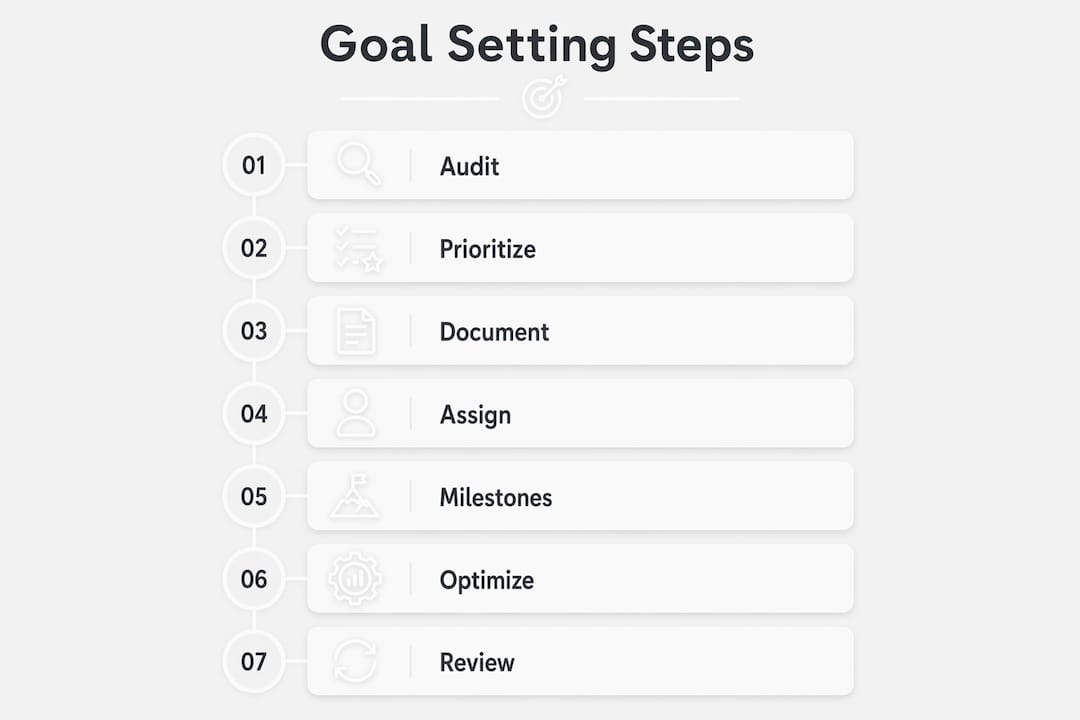
Step-by-step process to set, implement, and review your goals
Knowing the theory is one thing. Putting it into practice across a real business with limited time and budget is another. Here is a process that works for SMEs without a dedicated marketing department.

Step 1: Audit your current position. Before setting targets, know your baseline. Pull three to six months of data from Google Analytics 4, Google Search Console, or your CRM. You cannot set a meaningful growth target without knowing where you are starting from.
Step 2: Brainstorm and prioritise. Generate a list of potential marketing goals, then cut it down. Set no more than three to five core goals per period. Taking on too many objectives spreads your budget thin and reduces the likelihood of achieving any of them.
Step 3: Document and share. Write each goal in SMART format and share it with everyone involved in delivery. A goal that lives only in the marketing manager’s head is not a goal. It is a wish.
Step 4: Assign ownership and resources. Every goal needs a named owner and a budget allocation. Without both, accountability disappears. If your SEO goal has no owner, nobody will chase the rankings.
Step 5: Break goals into monthly milestones. A six-month goal feels distant. Monthly milestones make it manageable. If your goal is to increase organic traffic by 20% in six months, your month-one milestone might be publishing four optimised blog posts and fixing three technical SEO issues.
Step 6: Run experiments and optimise. SMART goals are necessary but not sufficient. Success comes from disciplined execution, regular testing, and adjusting based on what the data tells you. Test one variable at a time, whether that is a landing page headline, an ad audience, or an email subject line, and record what you learn.
Step 7: Review and reset. At the end of each quarter, review every goal honestly. Did you hit it? If not, why not? Longer sales cycles require longer measurement windows, so avoid declaring a campaign a failure before the conversion cycle has had time to play out. Adjust targets based on evidence, not optimism.
The businesses that get the most from their marketing are not the ones with the biggest budgets. They are the ones that set clear goals, track them honestly, and adapt quickly. Reviewing your 2026 digital marketing approach alongside your goal-setting process keeps your strategy current and grounded in what is actually working.
Key takeaways
Effective digital marketing goal setting requires the SMART framework, clear KPI ownership, and a disciplined review cadence to convert marketing activity into measurable business results.
| Point | Details |
|---|---|
| Use the SMART framework | Goals must be Specific, Measurable, Achievable, Relevant, and Time-bound to drive real results. |
| Align goals to business outcomes | Map every marketing goal to a company-level objective before committing budget or resource. |
| Assign one primary KPI per goal | A single owner and one primary KPI per goal prevents confusion and maintains accountability. |
| Limit goals to three to five per period | Fewer goals mean sharper focus and a higher likelihood of achieving each one. |
| Review on a structured cadence | Weekly, monthly, and quarterly reviews keep goals on track and allow timely course corrections. |
Why most SMEs get goal setting wrong, and how to fix it
From working with small and medium-sized businesses across the Fylde Coast and beyond, the pattern I see most often is not a lack of ambition. It is a lack of specificity. Business owners set goals that sound reasonable, “grow our social media presence” or “get more traffic,” but they have no number attached, no deadline, and no owner. Six months later, nobody can say whether they succeeded or not.
The second most common mistake is setting too many goals at once. I have seen marketing plans with twelve objectives for a team of two. The result is always the same: everything gets a little attention and nothing gets enough. Three focused goals, pursued with real commitment, will outperform twelve scattered ones every time.
What actually works is keeping goals visible. Write them on a whiteboard, pin them to a shared document, or use a dashboard that the whole team can see. When goals are visible, they get discussed. When they get discussed, they get done. The digital marketing KPI setting process is not a one-off exercise. It is a habit you build into the rhythm of your business.
The mindset shift that makes the biggest difference is treating goals as learning tools, not just performance targets. When you miss a goal, the question is not “who failed?” It is “what did we learn, and what do we change?” That approach turns every missed target into a better strategy for the next quarter.
— tibor
How Fyldedigital helps you set and achieve your marketing goals

Setting clear marketing goals is only the start. You also need the right website, the right SEO foundations, and the right team behind you to turn those goals into results. At Fyldedigital, we work with SMEs across the Fylde Coast and beyond to build conversion-focused web design and targeted digital marketing strategies that are built around your specific business objectives. Whether you need help defining your goals, tracking your KPIs, or building a website that actually generates enquiries, our team is ready to help. Get in touch today for a free website and SEO review, and find out exactly where your biggest opportunities lie.
FAQ
What are digital marketing goals?
Digital marketing goals are measurable outcomes that guide your marketing activity and allow you to assess whether campaigns are delivering value. They differ from tactics in that they define the destination, not the route.
What is a SMART goal in digital marketing?
A SMART goal is Specific, Measurable, Achievable, Relevant, and Time-bound. A practical example is “increase organic website sessions by 20% within six months,” which gives your team a clear target, a metric, and a deadline.
How many digital marketing goals should a small business set?
Set no more than three to five goals per period. Spreading effort across too many objectives reduces focus and makes it harder to allocate budget effectively.
How do you measure digital marketing success?
Measuring success requires selecting the right KPIs for each goal, assigning a single owner, and reviewing performance on a weekly, monthly, and quarterly basis. Tools like ClickUp Dashboards and Google Analytics 4 centralise this data and simplify reporting.
How often should you review your digital marketing goals?
Review leading indicators such as click-through rates weekly, assess pipeline and revenue impact monthly, and conduct a full strategy reassessment quarterly. This cadence keeps goals relevant and allows you to course-correct before deadlines arrive.