Social media marketing is the practice of using platforms like Instagram, LinkedIn, TikTok, Facebook, YouTube, and X to build brand visibility, engage audiences, and drive measurable sales through content, paid advertising, and community interaction. The role of social media in marketing has shifted from optional extra to core business function. By 2026, it sits at the centre of how small and medium-sized businesses attract customers, build trust, and compete with larger brands on a fraction of the budget. This guide breaks down the benefits, platform differences, and practical strategies you need to make it work.
What are the primary benefits of social media in marketing?
Social media marketing delivers three things most small businesses struggle to buy cheaply elsewhere: exposure, trust, and direct customer access. The numbers back this up clearly.
Key benefits reported by marketers in 2026 include:
- Increased brand exposure: 83% of marketers identify increased exposure as a top benefit of social media marketing. That figure spans industries, which means the advantage is not limited to consumer brands.
- Sales growth: Social media marketing accounts for 46.8% of variance in online sales growth, with influencer marketing and quality content particularly effective among Gen Z and millennial buyers.
- Revenue contribution: Social media drives revenue for 56% of marketing leaders, supporting the full customer journey from awareness through to purchase.
- Brand accountability: 81% of consumers believe social media increases brand accountability, and 71% say they are more likely to recommend a brand after a positive social experience.
“Social media uniquely interrupts, discovers, and deepens business relationships in one channel.” — Neal Schaffer, 2026 Practitioner’s Guide
Global social media ad spending is forecast to exceed $480 billion by 2030, following 200% growth since 2019. That level of investment reflects where purchasing decisions are now being made. For small and medium-sized businesses, the opportunity is not to match that spend but to use the platforms more intelligently than competitors who simply throw money at them.
How do social media platforms differ in their marketing roles?
Not every platform serves the same purpose, and choosing the wrong one wastes time and budget. The table below maps the major platforms to their primary marketing function and best-fit audience.

| Platform | Primary Marketing Role | Best For |
|---|---|---|
| Lead generation and thought leadership | B2B businesses, professional services | |
| Visual brand building and product discovery | Retail, hospitality, lifestyle brands | |
| TikTok | Organic reach and brand awareness | Consumer brands targeting under-35s |
| Community building and paid advertising | Local businesses, broad demographics | |
| YouTube | Long-form content and search discovery | Education, tutorials, product reviews |
| X (formerly Twitter) | Real-time conversation and PR | News, tech, B2B commentary |
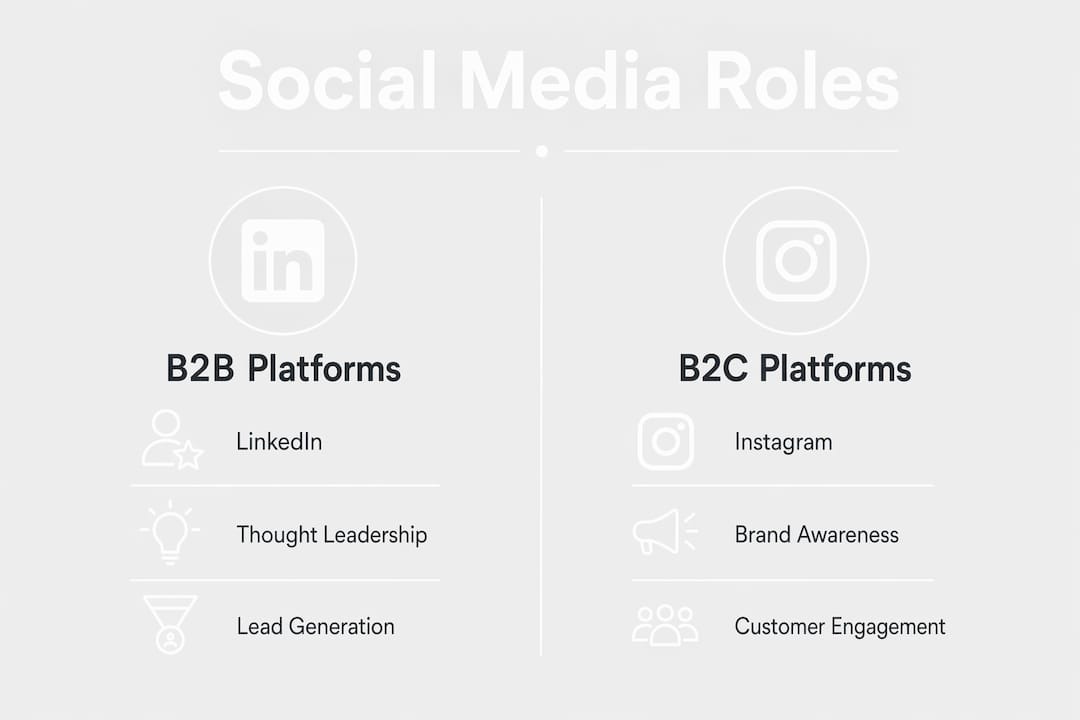
B2B businesses primarily use LinkedIn for lead generation and thought leadership, with secondary investment in X, YouTube, and Reddit. That platform hierarchy matters because spreading effort equally across six channels produces mediocre results on all of them.
Social platforms are increasingly used as search engines, which changes how you should think about content. A well-optimised Instagram post or LinkedIn article can surface in platform search results just as a web page ranks on Google. This means your captions, hashtags, and profile copy deserve the same attention as your website’s SEO.
Pro Tip: Start with two platforms where your audience is most active. Master the content format native to each one before expanding. A business that posts consistently on LinkedIn and Instagram will outperform one that posts sporadically across five channels.
Multi-account distribution also plays a role for businesses with distinct product lines or audience segments. A single brand can run separate accounts for different markets without diluting its core identity, provided each account has a clear purpose and consistent posting schedule.
What strategic approaches maximise social media marketing effectiveness?
The most effective social media strategies in 2026 are built around engagement signals, not follower counts. Here is how to structure your approach.
-
Prioritise engagement over reach. Modern algorithms prioritise engagement over follower count, distributing content based on shares, comments, and saves rather than audience size. A post that generates genuine conversation will outperform a polished broadcast with no interaction.
-
Use social listening actively. Social listening tools enable you to track conversations, spot emerging trends, and uncover customer insights that sharpen your campaigns. Tools like Sprout Social, Brandwatch, and Mention give you real-time feedback that no survey can match. Check out Fyldedigital’s guide to social media management for practical steps on building this into your workflow.
-
Integrate paid advertising with organic content. Organic reach alone rarely scales for small businesses. Paid social on Facebook, Instagram, and LinkedIn lets you target by job title, location, interest, and behaviour. Combine paid promotion with strong organic content to build credibility alongside visibility.
-
Work with micro-influencers. Influencer marketing does not require celebrity budgets. Micro-influencers with 5,000–50,000 followers in a specific niche typically deliver higher engagement rates and more trusted recommendations than accounts with millions of followers.
-
Balance AI tools with human creativity. Between 33% and 38% of marketers report efficiency and creativity gains from generative AI in social media marketing. Yet 43% cite maintaining authenticity as their biggest challenge when using AI-generated content. Use AI to draft, schedule, and repurpose content, but keep a human voice at the centre of every post.
Pro Tip: Review your 2026 digital marketing trends to understand which platform features are gaining algorithm favour right now. TikTok’s search tab and LinkedIn’s newsletter feature, for example, are both rewarding consistent creators with significant organic reach.
A successful social media strategy integrates content, paid ads, influencers, and social listening under unified business goals. Without that unifying framework, each tactic operates in isolation and produces results that are difficult to attribute or repeat.
How can small businesses measure social media marketing ROI?
Measuring return on investment from social media requires tracking the right metrics at each stage of the customer journey. Vanity metrics like follower count tell you very little about business performance.
The metrics that actually matter fall into four categories:
- Awareness: Reach, impressions, and share of voice tell you how many people are seeing your brand.
- Engagement: Likes, comments, shares, and saves indicate whether your content resonates.
- Traffic: Click-through rate and referral traffic from social platforms to your website show whether social is feeding your sales funnel.
- Conversions: Lead form completions, enquiries, and purchases directly attributed to social channels confirm revenue impact.
| Metric | What It Measures | Tool to Track It |
|---|---|---|
| Engagement rate | Content resonance with audience | Native platform analytics |
| Referral traffic | Social-to-website visits | Google Analytics 4 |
| Cost per lead | Paid social efficiency | Facebook Ads Manager |
| Conversion rate | Social-driven purchases or enquiries | CRM or landing page analytics |
Social listening data adds another layer. When customers mention your brand, ask questions, or compare you to competitors in public posts, that feedback informs both your marketing and your product decisions. Fyldedigital’s overview of the best management platforms covers tools that consolidate these metrics into a single dashboard, saving you significant time each week.
The importance of social media marketing becomes clearest when you connect platform activity to actual revenue. Set up UTM parameters on every link you share, and use a CRM like HubSpot or Zoho to track leads from first social touch through to closed sale. Without that attribution chain, you are guessing at what works.
Key takeaways
Social media marketing works because it builds awareness, generates leads, and deepens customer relationships within a single, measurable channel.
| Point | Details |
|---|---|
| Exposure is the top benefit | 83% of marketers cite increased exposure, making visibility the clearest immediate return. |
| Platform choice determines results | Match your platform to your audience: LinkedIn for B2B, TikTok and Instagram for consumer brands. |
| Engagement beats follower count | Algorithms reward shares and comments, so prioritise content that sparks genuine interaction. |
| AI needs a human check | 43% of marketers struggle with authenticity in AI content; keep a human voice in every post. |
| Measure the full funnel | Track awareness, engagement, traffic, and conversions to connect social activity to real revenue. |
Why social media is your business’s most underused asset
Most small business owners I speak with treat social media as a broadcast channel. They post an offer, wait for enquiries, and conclude it does not work when nothing happens. That framing misses the point entirely.
Social media is not a megaphone. It is the closest thing most businesses have to a permanent, open shop floor where customers can browse, ask questions, and form opinions before they ever contact you. The businesses I have seen grow consistently through social media are the ones that treat it as a relationship tool first and a sales channel second.
The shift that makes the biggest difference is moving from scheduled posts to genuine participation. Responding to comments, joining relevant conversations, and sharing content that reflects real expertise builds the kind of trust that paid advertising cannot replicate. Consumers spend an average of 143 minutes daily on social platforms. That is not time they are spending passively. They are researching, comparing, and deciding.
The other thing worth saying plainly: algorithm changes are not a threat if your content earns engagement on its own merits. Businesses that chase reach through tricks tend to lose ground every time a platform updates its rules. Businesses that focus on genuinely useful, interesting content tend to grow steadily regardless of what the algorithm does next.
— tibor
How Fyldedigital can help you get more from social media
If you are ready to move beyond posting and hoping, Fyldedigital offers social media management services built specifically for small and medium-sized businesses on the Fylde Coast and beyond.
From strategy and content creation through to paid social campaigns and performance reporting, the team handles the day-to-day work so you can focus on running your business. Every campaign is tied to measurable outcomes, whether that is leads, website traffic, or direct enquiries. If you want to understand how social fits into your broader digital presence, Fyldedigital’s social media management guide is a strong starting point. Get in touch for a free review of your current social media activity and find out exactly where the gaps are.
FAQ
What is the role of social media in marketing?
Social media marketing is the use of platforms like Instagram, LinkedIn, TikTok, Facebook, and YouTube to build brand awareness, engage customers, and drive sales through content and paid advertising. It functions as both a discovery channel and a relationship tool within the broader marketing mix.
Which social media platform is best for small businesses?
The best platform depends on your audience and business type. LinkedIn suits B2B businesses focused on lead generation, while Instagram and TikTok work well for consumer brands targeting younger buyers. Facebook remains effective for local businesses using paid advertising.
How do you measure social media marketing ROI?
Track engagement rate, referral traffic to your website, cost per lead from paid campaigns, and conversion rate from social-driven enquiries. Use Google Analytics 4 alongside native platform analytics and UTM parameters to connect social activity to actual revenue.
How does social media influence purchasing decisions?
71% of consumers say they are more likely to recommend a brand after a positive social experience, and 81% believe social media increases brand accountability. These figures show that social presence directly shapes buying behaviour before a customer ever visits your website.
How much should a small business spend on social media marketing?
There is no fixed figure, but starting with a modest paid social budget alongside consistent organic content is more effective than spending heavily without a strategy. Focus budget on the one or two platforms where your audience is most active, and scale spending once you have identified what converts.