Marketing consulting is defined as a professional service where experienced specialists analyse, plan, and improve a business’s marketing activities to achieve measurable growth. For small and medium-sized business owners, it answers a question that keeps many up at night: why is marketing not delivering results? A marketing consultant brings external expertise and fresh perspective that in-house teams often cannot provide, combining customer insight, data-driven planning, and brand positioning to turn marketing into a genuine growth engine. Fyldedigital works with businesses across the Fylde Coast who face exactly this challenge every day.
What is marketing consulting and what does it involve?
Marketing consulting is the practice of engaging a specialist to audit, plan, and guide a business’s marketing efforts. The industry term is “marketing strategy consulting,” and it covers everything from a focused two-week audit to a full annual planning cycle. The consultant’s role combines high-level strategic advice with practical guidance, measuring results and adjusting strategy continuously rather than delivering a plan and disappearing.

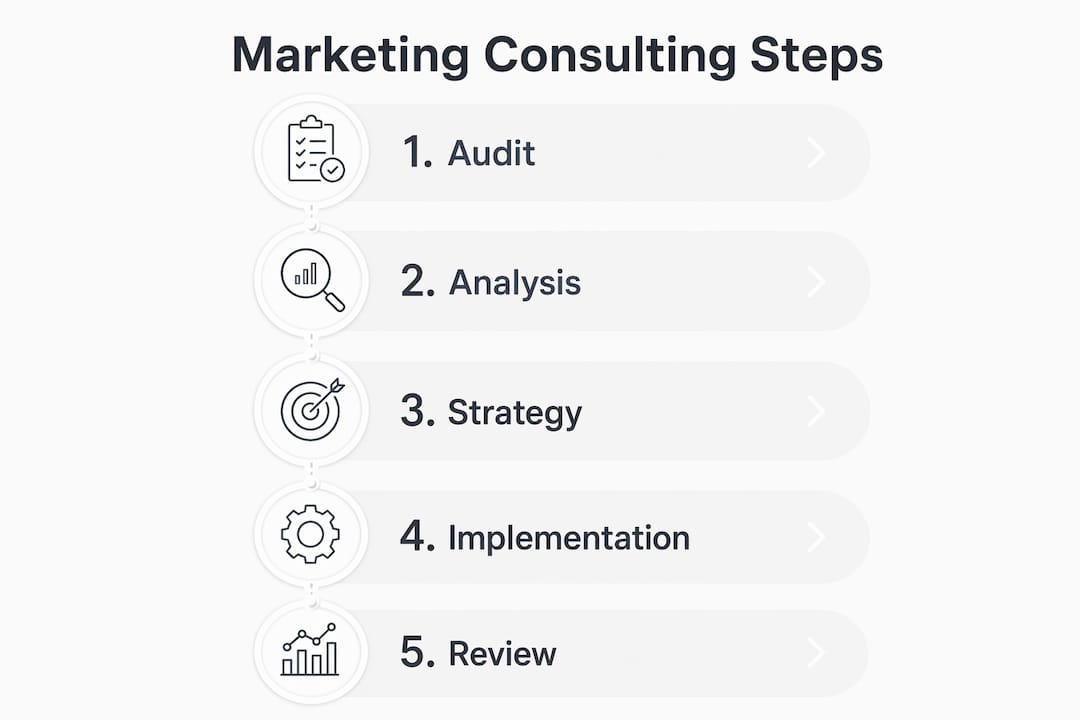
A typical engagement follows a clear sequence. The consultant first audits your current marketing activities, identifying what works, what wastes budget, and where gaps exist. You can see how this process maps to a digital marketing audit for a practical sense of the steps involved. Next, the consultant defines your target audience and positioning, then builds a prioritised plan with specific channels, budgets, and timelines.
Common deliverables from a consulting engagement include:
- Channel-mix models showing which platforms and tactics deserve your budget
- Strategic roadmaps with phased priorities and milestones
- KPI frameworks so you can measure progress objectively
- Go-to-market strategies for new products, services, or market entry
These outputs are designed for board-level decisions and give your marketing team a clear brief to execute against. That distinction matters: a consultant tells you what to do and why; an agency does the doing.
Pro Tip: Ask any consultant you consider to show you a sample deliverable before you sign. If they cannot produce a clear, readable document, their thinking is probably just as unclear.
What are the main benefits of marketing consulting for SMEs?
The most direct benefit is clarity. Many business owners spread budget across SEO, social media, paid advertising, and print without knowing which channel actually drives enquiries. A consultant cuts through that noise and tells you where to focus. That clarity alone can save thousands of pounds per year in wasted spend.
Stopping ineffective tactics often saves more than adding new marketing channels. This is the insight most business owners miss. They assume more activity means more results. A good consultant identifies the two or three things that genuinely move the needle and advises you to stop everything else.
The benefits for SMEs are concrete and repeatable:
- Reduced wasted spend by eliminating tactics that do not convert
- Improved lead quality through sharper audience targeting and positioning
- Better ROI from existing budget, without increasing total spend
- Alignment between marketing and business goals, so every campaign serves a commercial purpose
- Access to specialist knowledge your in-house team may not have
Marketing consultants bring breadth from working across multiple industries and business types. That breadth allows them to spot patterns and overlooked opportunities that someone embedded in your business simply cannot see.
“The most valuable thing a marketing consultant does is tell you what to stop doing. Eliminating wasted activity frees up budget, focus, and energy for the things that actually grow your business.”
Understanding how consulting compares to agency work helps you decide which model fits your current stage of growth.
How do marketing consulting engagements typically work?
Marketing consultancy services are structured around defined formats, each with a clear scope, timeline, and fee. Fixed-fee, time-boxed engagements protect both parties from scope creep and guarantee measurable outputs rather than open-ended billing hours. This model is now the professional standard for SME consulting work.
The three most common engagement types are:
- Focused audit (2–4 weeks, approximately £5,000–£10,000): Reviews your current marketing activities, identifies inefficiencies, and produces a prioritised list of recommendations.
- Channel-mix planning (4–8 weeks, approximately £15,000–£30,000): Builds a full channel strategy with budget allocation, audience targeting, and performance benchmarks.
- Full annual planning (8–12 weeks, approximately £40,000–£75,000): Delivers a complete marketing strategy aligned to your business plan, including go-to-market planning and KPI frameworks.
| Engagement type | Typical duration | Approximate cost |
|---|---|---|
| Focused audit | 2–4 weeks | £5,000–£10,000 |
| Channel-mix planning | 4–8 weeks | £15,000–£30,000 |
| Full annual planning | 8–12 weeks | £40,000–£75,000 |
| Ongoing advisory retainer | Monthly | £5,000–£15,000/month |
Ongoing advisory retainers sit alongside these project formats. A retainer gives you access to a consultant on a monthly basis, typically for a set number of days. This suits businesses that need continuous strategic input without hiring a full-time marketing director. It is sometimes called fractional marketing leadership.
Pro Tip: If your business turns over less than £1 million annually, start with a focused audit rather than a full annual plan. You will learn more in four weeks than you would from a twelve-week engagement that outpaces your capacity to act.
For context on how pricing works across related services, the social media management pricing guide shows how consultants and agencies structure fees differently.
How to choose and get the most from a marketing consultant
Choosing the right consultant is as important as deciding to hire one. The wrong fit wastes time and budget just as surely as bad marketing does. Before you engage anyone, be clear on what you need: a one-off audit, an ongoing adviser, or a specialist in a specific channel such as SEO or paid search.
Use these criteria when evaluating candidates:
- Relevant sector experience: Have they worked with businesses of your size and type?
- Demonstrable results: Can they show specific outcomes from previous engagements, not just testimonials?
- Clear methodology: Do they explain their process in plain language, or rely on jargon?
- Cultural fit: Will they communicate directly and honestly, even when the news is uncomfortable?
- References: Are they willing to connect you with past clients?
Before signing any agreement, ask these questions directly:
- What does a typical engagement look like from week one to final delivery?
- How do you measure success, and what KPIs will we track?
- What do you need from me and my team to make this work?
- What happens if the scope changes mid-engagement?
Once you have hired a consultant, your job is to be an active participant, not a passive recipient. Share your sales data, customer feedback, and previous campaign results honestly. Consultants work best when they have the full picture. Set clear objectives before the engagement starts, agree on KPIs, and schedule regular check-ins to review progress.
A common pitfall is treating the consultant’s plan as a finished product. A strategy is only useful when it is acted upon and adjusted based on real results. Build a simple measurement process into your business from day one of the engagement. If you are unsure where to start with digital marketing basics, getting that foundation right makes consulting engagements far more productive.
Key takeaways
Marketing consulting delivers the most value when it combines clear objectives, fixed-fee engagements, and a willingness to stop ineffective tactics rather than simply adding more activity.
| Point | Details |
|---|---|
| Clear definition matters | Marketing consulting means strategic advice to improve marketing effectiveness, not just execution. |
| Stopping waste is the priority | Eliminating ineffective tactics often saves more than launching new marketing channels. |
| Fixed-fee engagements protect you | Time-boxed sprints from 2–12 weeks prevent scope creep and guarantee measurable outputs. |
| Choose by fit, not price | Sector experience, clear methodology, and honest communication matter more than the lowest fee. |
| Active participation drives results | Share your data, agree KPIs upfront, and treat the strategy as a living document to adjust. |
Why I think most SMEs misunderstand what a consultant actually does
Most business owners I speak to assume a marketing consultant will arrive with a bag of tactics: run these ads, post on this platform, write these blogs. That is not what good consulting looks like. The most valuable work happens before any tactic is chosen, in the audit phase where a consultant identifies what is already broken and what is being ignored.
The shift I have noticed in 2026 is that the best consultants are becoming more data-driven and more direct. They are willing to tell a client that their website is the problem, not their ad spend, or that their pricing undercuts the value they actually deliver. That kind of external judgement is uncomfortable but genuinely useful.
SMEs often underestimate how much they lose by not having this external view. An in-house team, no matter how talented, becomes blind to the business’s own assumptions over time. A consultant sees your business the way a new customer does. That perspective is worth paying for.
My honest advice: treat consulting as an investment with a defined return, not a cost. Set a clear objective, agree a fixed-fee engagement, and measure the outcome against your original goal. If the consultant cannot articulate what success looks like before the work starts, find someone who can.
— tibor
How Fyldedigital supports SMEs with marketing and digital strategy
Fyldedigital works with small and medium-sized businesses across the Fylde Coast and beyond, providing the kind of practical marketing support that moves the needle on visibility, leads, and revenue.
Whether you need a professionally designed website that converts visitors into enquiries, an SEO campaign that builds long-term organic traffic, or a clear view of your SEO best practices to rank higher in search results, Fyldedigital brings the same structured, results-focused approach described in this article. You can request a free website or SEO review directly from the Fyldedigital team to see exactly where your marketing stands today and what to prioritise next.
FAQ
What is the marketing consulting definition?
Marketing consulting is a professional service where specialists analyse a business’s marketing activities and provide strategic advice to improve effectiveness and drive growth. It combines audience research, channel planning, and performance measurement into a structured engagement.
How does marketing consulting work in practice?
A consultant audits your current marketing, defines your audience and positioning, then builds a prioritised plan with specific channels, budgets, and KPIs. Engagements typically run as fixed-fee sprints lasting 2–12 weeks.
What do marketing consultants do differently from agencies?
Consultants provide strategic direction and judgement, while agencies primarily supply execution and labour. A consultant tells you what to do and why; an agency carries out the work.
What are the main benefits of marketing consulting for small businesses?
The key benefits include reduced wasted spend, sharper audience targeting, better alignment between marketing and business goals, and access to specialist expertise that in-house teams typically lack.
How much does marketing consulting cost for an SME?
Focused audits typically cost £5,000–£10,000 over 2–4 weeks. Channel-mix planning runs £15,000–£30,000 over 4–8 weeks. Ongoing advisory retainers cost £5,000–£15,000 per month, depending on scope and consultant experience.