A digital audit is a staged evaluation of your business’s digital channels, technology and controls that ends with a prioritised, implementable action plan. It moves through four core stages: discovery and scoping, data collection, analysis and benchmarking, then prioritised reporting. For a UK SMB, the immediate outputs are a ranked list of quick wins, a longer remediation roadmap, and confirmation that your data handling meets GDPR requirements. Tools such as GA4 and Google Search Console sit at the heart of the data collection stage, and agencies like Fyldedigital run the full process on behalf of small and medium-sized businesses that want an independent view.
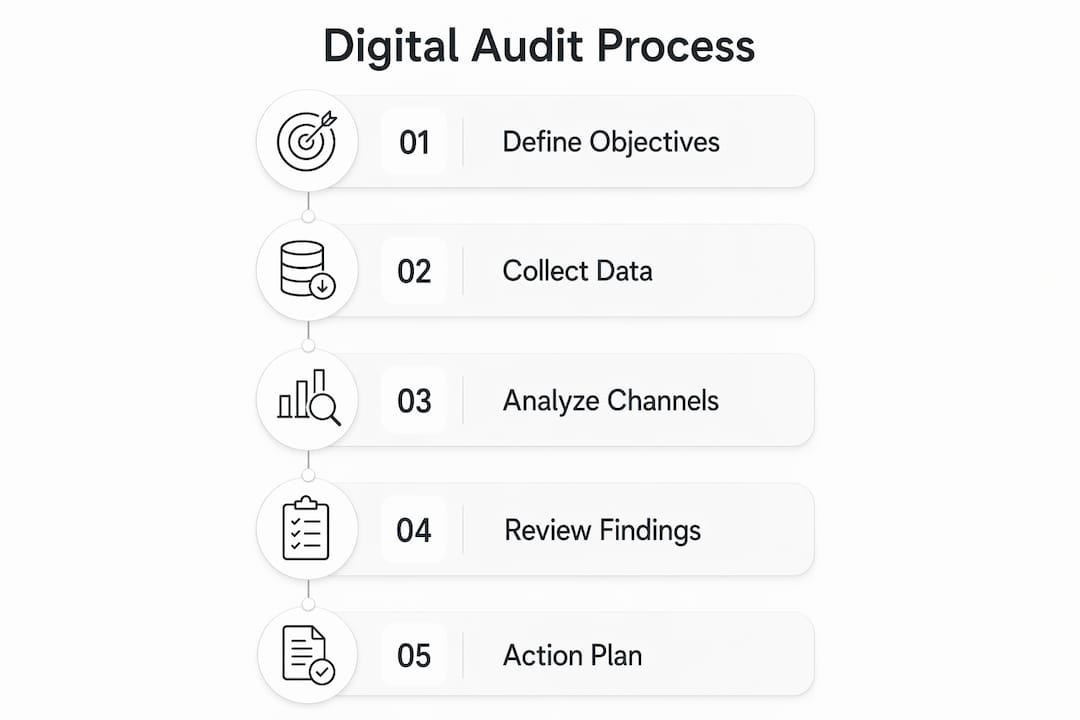
- Discovery and scoping: agree objectives, stakeholders, channels in scope and access credentials.
- Data collection: pull data from GA4, Google Search Console, ad platforms and your CRM.
- Analysis and benchmarking: identify gaps, wasted spend and compliance risks against market peers.
- Prioritised reporting: deliver a ranked action plan with quick wins separated from longer projects.
Pro Tip: Before you brief any auditor, write down the three business questions you most need answered. Scoping an audit around specific revenue-driving channels keeps costs down and keeps the findings usable.
Table of Contents
- Why should a UK SMB commission a digital audit now?
- How does a digital audit process work, step by step?
- What do professional audit deliverables look like?
- What do digital audits cost and how long do they take?
- Manual auditing versus automated digital auditing: which approach fits your business?
- How do you choose the right digital audit provider?
- Key takeaways
- Why the mid-project review is the most underrated part of any audit
- Get a structured digital audit from Fyldedigital
- Useful sources for further reading
Why should a UK SMB commission a digital audit now?
Most small and medium-sized businesses reach a point where marketing spend is rising but results are not. A digital audit gives you the evidence to understand why. The importance of digital audits is clearest at four specific business moments: when you are validating campaign ROI, when you suspect gaps in your digital tools, when you are preparing for growth, or when a compliance review is overdue.
From a UK perspective, GDPR and the UK Data Protection Act 2018 make governance checks a practical necessity, not an optional extra. A digital audit verifies that your consent mechanisms, data retention policies and third-party tracking tags are operating correctly, as digital audits confirm that documented controls are working across cloud services and automated systems.
- Validate ROI: find out which channels are actually generating leads and which are consuming budget without return.
- Identify gaps: spot missing tracking, broken conversion funnels or underperforming content before they cost more.
- Support growth plans: give investors or lenders evidence-based data rather than assumptions.
- Compliance readiness: confirm GDPR-compliant data handling ahead of a regulatory review or website rebuild.
Whether to run an audit internally or hire external help depends on your team’s capacity and objectivity. Internal teams know the business context but often lack the tools or the distance to spot what is broken. An external auditor brings both.
Pro Tip: For an affordable first audit, focus only on the channels that directly drive revenue. Auditing your Google Ads account and your top five landing pages will surface more actionable findings than a broad sweep of every social profile.

How does a digital audit process work, step by step?
A data-driven auditing workflow typically expands into seven or more stages because of the emphasis on data ingestion and structured analysis. Here is what a thorough engagement looks like in practice.
- Pre-engagement and onboarding: confirm objectives, agree scope, identify stakeholders and collect access credentials for GA4, Google Ads, your CMS and any CRM in use.
- Discovery and scoping: conduct stakeholder interviews, review existing documentation and align on KPIs. Decide whether you need a full audit or a focused one covering specific channels.
- Data collection: pull data from GA4 (user journeys and conversions), Google Search Console (search queries and coverage errors), ad platforms, CRM exports and server logs where available.
- Technical website audit: run Lighthouse for performance and Core Web Vitals, Screaming Frog for crawlability and indexation issues, and manual checks for mobile usability and accessibility.
- Content and SEO review: identify keyword gaps, on-page issues, thin content and conversion funnel drop-off points. A website SEO audit checklist covers the key on-page and technical checks.
- Paid media analysis: review campaign structure, tracking integrity, attribution settings and wasted spend indicators across Google Ads and any other active paid channels.
- Competitive benchmarking: compare your search visibility, ad presence and social footprint against two or three market peers using publicly available signals.
- Analysis, risk assessment and prioritisation: rank every finding by impact, effort and urgency. Produce a remediation roadmap that separates quick wins from longer projects.
- Mid-project review: present preliminary findings to your leadership team. This step, highlighted in anatomy-of-a-digital-audit research, validates assumptions and prevents the final report from missing critical business context.
- Final reporting and knowledge transfer: deliver the formal report, present the prioritised action plan and run a handover session so your internal team can own implementation.
Core data sources and what they reveal
| Data source | Evidence supplied |
|---|---|
| GA4 | User journeys, conversion paths, channel attribution |
| Google Search Console | Search queries, coverage errors, Core Web Vitals |
| Google Ads / paid platforms | Campaign spend, click quality, wasted budget |
| Screaming Frog | Crawl errors, broken links, redirect chains |
| Lighthouse | Page speed, accessibility, best-practice scores |
| CRM / sales data | Lead quality, pipeline contribution by channel |
Pro Tip: Schedule the mid-project review at the halfway point, not at the end. Presenting preliminary findings early lets you course-correct before the final report is written, saving time and avoiding surprises for your leadership team.
What do professional audit deliverables look like?
A well-structured audit produces more than a PDF. The HBS digital marketing audit framework emphasises measurable objectives and KPI prioritisation, and the deliverables should reflect that rigour.
- Executive summary: two pages maximum, written for a non-technical audience, covering the top five findings and the single most urgent action.
- Findings dashboard: a spreadsheet or BI view that scores each finding by impact and effort, so you can see the prioritised roadmap at a glance.
- Technical checklist: a line-by-line record of every technical issue found, with severity ratings and suggested fixes.
- Content gap matrix: a table mapping keyword opportunities against existing content, showing where new pages or updates would have the most impact.
- Ad-spend remediation list: a prioritised list of wasted spend items in your paid campaigns with specific recommended changes.
Knowledge transfer is where many audits fall short. Assign an internal owner to each action item, and ask your auditor to run at least one working session with the people who will implement the changes. Without that handover, recommended changes often stall.
| Deliverable | Minimum evidence it should contain |
|---|---|
| Executive summary | Top findings, urgency rating, one clear next step |
| Prioritised roadmap | Impact score, effort score, owner, target date |
| Technical checklist | Issue, page URL, severity, recommended fix |
| Content gap matrix | Keyword, search volume band, existing content, gap action |
| Ad-spend report | Campaign, wasted spend indicator, recommended change |
What do digital audits cost and how long do they take?
Timelines and costs vary with scope, but UK SMBs can use these bands as a realistic starting point.
- Focused audit (2–3 weeks): covers one or two channels, such as SEO and Google Ads. Suited to businesses with a specific question to answer or a limited budget.
- Standard full audit (4–6 weeks): covers website technical health, SEO, paid media and basic competitive benchmarking. The most common scope for a growing SMB.
- Comprehensive or ongoing audit retainer (6–8 weeks initial, then quarterly): adds deeper competitive analysis, governance checks, CRM integration review and recurring health checks.
Key cost drivers include the number of channels in scope, the depth of technical testing required, and whether the engagement includes workshops or training sessions. The IT digital audit guide from DMS Group notes that security checks such as vulnerability assessments add time and specialist resource.
Watch out for scope creep: missing account access, incomplete tracking setup and fragmented data across multiple platforms are the three factors most likely to extend a project beyond its original timeline. Resolve access issues before the engagement starts.
Manual auditing versus automated digital auditing: which approach fits your business?
The ICAEW distinguishes between two complementary approaches: auditing digital means examining your client’s systems and marketing channels using human expertise; digital auditing means using analytics and automation to run the audit itself more efficiently. High-value engagements combine both.
- Automated tasks: bulk URL crawls, tracking tag validation, ad spend anomaly detection and Core Web Vitals scoring. Fast, repeatable and consistent.
- Human judgement tasks: strategy alignment, stakeholder interviews, interpreting ambiguous data and deciding which findings actually matter to your business goals.
| Approach | Speed | Depth of insight | Repeatability | Best for |
|---|---|---|---|---|
| Automated scans | Fast | Surface-level | High | Technical checks, tracking validation |
| Analyst review | Slower | Strategic | Medium | Context, prioritisation, compliance |
| Hybrid workflow | Balanced | Comprehensive | High | Full SMB audits |
For most UK SMBs, a hybrid workflow delivers the best return. Automation handles the volume work; an experienced analyst interprets what the data means for your specific market position.
How do you choose the right digital audit provider?
Picking the wrong auditor wastes both money and time. Use this checklist when evaluating proposals.
- Ask to see a sample report or redacted deliverable from a comparable SMB engagement.
- Confirm which tools they use and how findings are scored (impact versus effort is the standard method).
- Ask whether a mid-project review is included, and at what point it occurs.
- Clarify who owns the deliverables after the engagement ends.
- Check their UK compliance experience, specifically GDPR and UK data handling requirements.
- Ask how knowledge transfer is handled and whether implementation support is available.
Red flags to watch for:
- No mid-project review offered.
- The only deliverable is a PDF with no operational handover or scoring.
- The auditor cannot show sample outputs or explain their prioritisation method.
- No mention of GDPR or UK-specific compliance checks.
- Vague timelines with no milestone structure.
Key takeaways
A digital audit process is only as useful as the prioritised action plan it produces, so insist on scored findings, a knowledge transfer session and a mid-project review before you sign any proposal.
| Point | Details |
|---|---|
| Define objectives first | Agree the three business questions you need answered before scoping begins. |
| Insist on prioritised actions | Every finding should carry an impact score and an effort score, not just a list of issues. |
| Confirm knowledge transfer | Ask for a working handover session so your team can own implementation from day one. |
| Expect a mid-project review | A preliminary findings presentation catches wrong assumptions before the final report is written. |
| Fyldedigital for UK SMBs | Fyldedigital runs structured digital audits for UK small and medium-sized businesses, covering SEO, paid media, technical health and GDPR compliance. |
Why the mid-project review is the most underrated part of any audit
Most SMB owners focus on the final report. The deliverable that actually determines whether an audit succeeds is the mid-project review, and most providers either skip it or treat it as optional.
Here is why that matters. An audit surfaces data, but data without business context produces recommendations that look correct on paper and fail in practice. A mid-project presentation forces the auditor to test their assumptions against the people who run the business every day. It is the point where “your Google Ads account has significant wasted spend” becomes “your Google Ads account is wasting budget on search terms your sales team already told you never convert.” That specificity is the difference between a report that sits in a drawer and one that drives real change.
The same logic applies to knowledge transfer. Assigning an internal owner to each action item, with a clear deadline and a brief training session, is what separates audits that deliver results from audits that deliver documents. If your auditor does not offer this as a standard part of the engagement, ask for it explicitly.
Get a structured digital audit from Fyldedigital
If you have read this far, you already know what a well-run audit should include. Fyldedigital delivers structured digital audits for UK small and medium-sized businesses that want an independent evaluation of their SEO, paid media, technical website health and GDPR compliance, with a prioritised roadmap they can actually act on.

Before you get in touch, gather three things: access to your GA4 account, your Google Ads login, and a short list of the business objectives you want the audit to address. That preparation cuts the onboarding stage significantly and means findings arrive faster. After your initial conversation, Fyldedigital will confirm scope, agree a timeline and schedule the mid-project review before work begins. Explore the full range of digital marketing services or go straight to the SEO best practices page to see how post-audit SEO work is structured. Ready to get started? Contact Fyldedigital today for a no-obligation scoping conversation.
Useful sources for further reading
- Harvard Business School Online: How to conduct a digital marketing audit — methodology and KPI framework; start here for audit structure.
- ICAEW: Digital auditing and auditing digital — authoritative explanation of the two audit approaches and how to combine them.
- Wolters Kluwer: Audit engagement checklist — step-by-step checklist covering pre-engagement through to follow-up.
- Chief Digital Officer: An anatomy of a digital audit — detailed 30-point assessment methodology with guidance on mid-project presentations.
- DMS Group: Running IT digital audits — practical guide covering IT security checks, vulnerability assessments and access controls.
- Vero AI: What is a digital audit? — governance and compliance focus, including ISO 27001 and data handling controls.
- Fyldedigital: Digital marketing audit guide for SMEs — service-specific walkthrough of how audits validate campaign success for UK SMBs.
- Fyldedigital: Website SEO audit checklist — practical on-page and technical SEO checklist to use alongside an audit engagement.