Drip marketing is an automated communication strategy that delivers a pre-written sequence of messages to prospects or customers at set intervals or when triggered by specific behaviours. The core benefit: it keeps your brand consistently present throughout a buyer’s journey without requiring manual effort at every touchpoint. Done well, with proper segmentation, it lifts engagement, shortens sales cycles, and converts more leads into paying customers.
This guide covers:
- How drip sequences are built and how automation flows work
- Which channels and campaign types suit different goals
- A step-by-step setup checklist and best practices
- UK GDPR and PECR compliance requirements
- How to measure ROI and which tools to use
Table of Contents
- How drip sequences actually work
- Which channels and campaign types should you use?
- Drip marketing examples that show real-world results
- Why drip marketing works and when to choose it
- Step-by-step setup checklist for your first drip campaign
- Which metrics tell you whether your drip campaign is working?
- Which tools should UK businesses use for drip campaigns?
- UK GDPR and PECR: what you must get right before you send
- Practical drip sequence templates you can adapt
- Research evidence: what the data says about drip campaign effectiveness
- Key takeaways
- When to run drip campaigns in-house versus hiring an agency
- Fyldedigital can set up your drip campaigns
- Useful sources and further reading
- Why the “set it and forget it” mindset is drip marketing’s biggest enemy
How drip sequences actually work
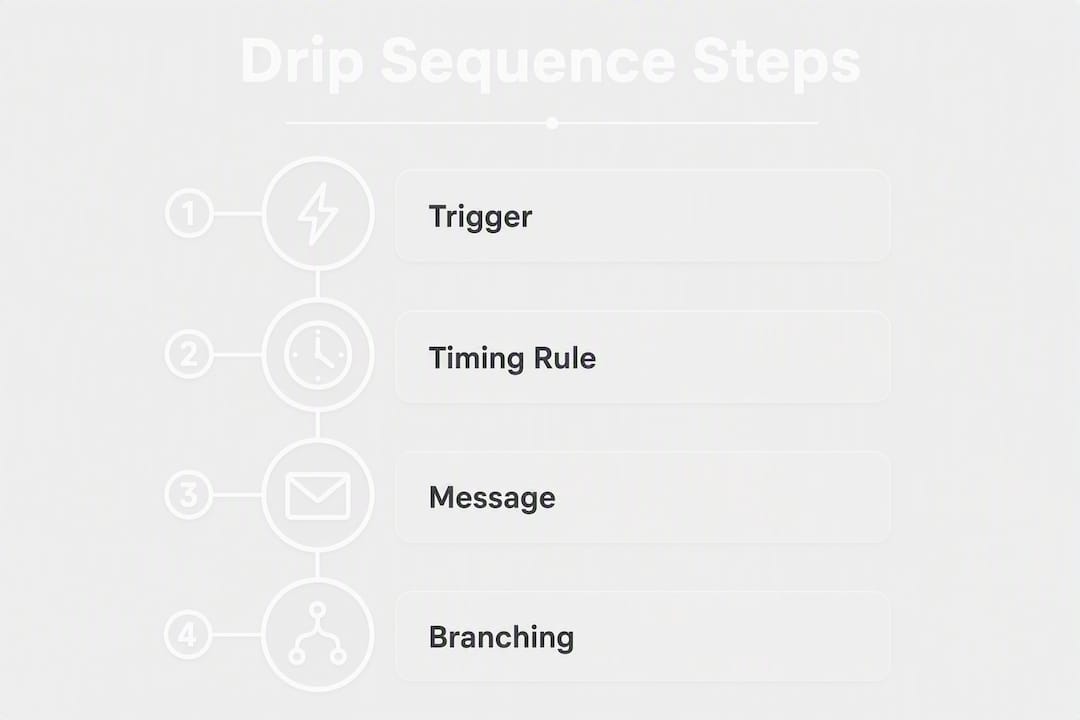
At its core, a drip sequence has four building blocks: a trigger, a timing rule, a message, and a branching condition. The trigger is what starts the sequence, whether that is a form submission, a content download, a free trial signup, or a product purchase. The timing rule determines when each subsequent message goes out. The message is the content itself. Branching conditions decide what happens next based on whether the recipient opened, clicked, or ignored the previous message.
Wikipedia notes that drip marketing is distinct from other database marketing because timing follows a predetermined course and messages are grouped according to a recipient’s status or behaviour. That distinction matters when you are deciding which type of sequence to build.
There are two main approaches:
- Time-based drips: messages go out on a fixed schedule regardless of recipient behaviour (Day 1, Day 3, Day 7). Simple to set up; best for welcome sequences and post-purchase follow-ups.
- Behaviour-triggered nurture flows: messages fire when a recipient takes a specific action, such as clicking a pricing page or abandoning a cart. More complex, but far more relevant to the recipient.
HubSpot’s guidance recommends combining both approaches for best results, particularly in B2B contexts where buyers move at different speeds through the funnel.
Pro Tip: Before writing a single word of copy, map your entire sequence in a flowchart. Sketch every entry point, wait rule, branch condition, and goal. Salesforce recommends this approach specifically to reduce errors and improve coherence across messages.
Which channels and campaign types should you use?
Email remains the most widely used channel for drip campaigns, largely because of the low cost of sending multiple messages over time, as the Cambridge Dictionary’s definition of drip marketing acknowledges. But it is not the only option.

| Channel | Strengths | Constraints |
|---|---|---|
| Low cost, rich content, easy automation | Inbox competition, deliverability risk | |
| SMS | High open rates, immediate delivery | Character limits, opt-in requirements, cost per message |
| Push notifications | Real-time, app-native | Requires app install, easy to disable |
| In-app messages | Contextual, high relevance | Only reaches active users |
| Paid retargeting | Reaches non-email contacts | Higher cost, limited personalisation |
Campaign types map to specific outcomes:
- Welcome series: introduces your brand immediately after signup, when engagement is highest
- Onboarding sequence: guides new users or customers through key features or next steps
- Trial-to-paid: educates trial users on value and nudges them toward a purchase decision
- Re-engagement: targets dormant contacts with a reason to return or a clear unsubscribe option
- Post-purchase cross-sell: follows up buyers with complementary products or loyalty incentives
For most UK SMBs, email is the right starting point. Add SMS for time-sensitive messages only, and layer in retargeting once your email sequences are performing consistently.
Drip marketing examples that show real-world results
B2B use cases:
- A software company sends a five-email sequence after a whitepaper download: Day 1 delivers the content, Day 3 shares a case study, Day 7 offers a demo. Prospects who engage with the case study are moved into a faster-cadence sales sequence.
- A professional services firm running a long sales cycle sends a monthly nurture email to prospects who attended a webinar but did not book a consultation. Over six months, this keeps the firm visible without aggressive outreach.
- A SaaS business triggers a demo follow-up sequence when a trial user visits the pricing page but does not upgrade, sending three targeted emails over five days.
B2C use cases:
- An e-commerce retailer sends a three-email welcome series: a brand introduction, a bestseller showcase, and a first-purchase discount. Klaviyo notes that subscribers are often most engaged immediately after signup, making this the single best window to establish brand value.
- A cart abandonment sequence fires 30 minutes after abandonment, then again at 24 hours, then at 72 hours with a small incentive. Recovery rates on three-touch sequences consistently outperform single-email reminders.
- A subscription box sends a post-purchase cross-sell sequence three days after delivery, recommending add-ons based on the items purchased.
A common sequencing error to avoid: sending every message in a sequence to every subscriber regardless of engagement. If a contact has not opened your first three emails, sending them a fourth identical-format message will not help. Branch your sequence so unengaged contacts receive a re-engagement message or are suppressed, protecting your sender reputation.
Why drip marketing works and when to choose it
Salesforce describes drip marketing as a sequence of targeted, automated messages that nurture leads and build relationships over time. The relationship-building framing is deliberate: the primary purpose is consistent, value-led contact, not a single conversion push.
Drip campaigns are particularly effective when:
- Your sales cycle is longer than a week and prospects need multiple touchpoints before deciding
- You have a high volume of inbound leads that cannot be followed up manually at scale
- You are onboarding new customers and want to reduce churn through education
- You need lifecycle communications (renewals, anniversaries, re-engagement) to run without manual intervention
Segmentation lifts results significantly. HubSpot’s research found that segmented email strategies drive significantly higher clickthroughs and opens than unsegmented, one-off blasts.
One-off email blasts have their place for announcements and promotions. But for sustained lead nurturing, drips win on consistency, relevance, and scale. You build the sequence once and it works continuously, whether you have 50 leads or 5,000.
Step-by-step setup checklist for your first drip campaign
Follow this sequence to build a drip campaign that is ready to launch:
- Define your objective. Are you nurturing leads, onboarding customers, or re-engaging dormant contacts? One campaign, one goal.
- Identify and segment your audience. Group contacts by behaviour, source, or lifecycle stage. Segmented campaigns consistently outperform generic ones.
- Map the content journey. Decide how many messages, what each one covers, and what action you want the recipient to take at each step.
- Set timing and cadence. Welcome sequences work well at Day 0, Day 2, and Day 5. Nurture sequences for long sales cycles can run weekly or fortnightly.
- Build your automation flow. Set entry triggers, wait rules, and branching conditions in your chosen platform before writing copy.
- Write and design your messages. Keep each email able to stand alone; Salesforce’s implementation guidance specifically recommends designing every message so it provides context and value even if the recipient missed earlier ones.
- QA and test. Send test emails to yourself, check links, preview on mobile, and verify that branching logic fires correctly.
- Launch and monitor. Watch open rates, click-through rates, and unsubscribes in the first 48 hours.
A/B testing priorities: start with subject lines, then test your primary CTA, then experiment with send cadence. Change one variable at a time and run tests for at least two weeks before drawing conclusions.
Pro Tip: Protect your sender reputation from day one. Authenticate your sending domain with SPF, DKIM, and DMARC records. Clean your list before importing it, removing invalid addresses and hard bounces. A damaged sender reputation can take months to recover.

Which metrics tell you whether your drip campaign is working?
| Metric | What it measures | Action when it moves |
|---|---|---|
| Open rate | Subject line and sender reputation | Low opens: test subject lines, check authentication |
| Click-through rate (CTR) | Relevance of content and CTA | Low CTR: revise CTA copy, simplify message, improve targeting |
| Conversion rate | How many recipients complete the desired action | Low conversion: review landing page, check offer clarity |
| Unsubscribe rate | Audience fit and message frequency | High unsubscribes: reduce cadence, improve segmentation |
| Revenue attributed | Direct commercial return from the sequence | Low revenue: review offer, test incentives, check attribution model |
For attribution, use UTM parameters on every link so you can track which emails drive traffic and conversions in Google Analytics 4. For longer sales cycles, use a multi-touch attribution model rather than last-click, so early nurture emails receive credit for their role in the conversion.
ROI calculation is straightforward: divide the revenue attributed to the campaign by the total cost of running it (platform fees, copywriting, design, and time). A well-segmented drip sequence typically pays back its setup cost within the first full campaign cycle.
Which tools should UK businesses use for drip campaigns?
The right platform depends on your business size, technical resource, and how sophisticated your sequences need to be.
Entry-level email platforms suit small businesses running straightforward welcome and newsletter sequences. Mailchimp sits in this category: it offers basic automation, audience segmentation, and a free tier for smaller lists, making it a practical starting point for businesses new to drip email campaigns.
Mid-market marketing automation platforms are the right step up when you need behaviour-triggered flows, CRM integration, and more granular reporting. ActiveCampaign is widely used in this space, offering conditional logic, lead scoring, and SMS alongside email, with pricing that remains accessible for growing SMBs. HubSpot’s Marketing Hub covers similar ground and adds a native CRM, which simplifies attribution and contact management for teams that want everything in one place.
Enterprise suites such as Salesforce Marketing Cloud are built for organisations running complex, multi-channel programmes at scale. The depth of segmentation, journey building, and analytics is considerable, but so is the implementation investment. For most UK SMBs, this tier is more than needed until volume and complexity justify it.
Pro Tip: When evaluating any platform as a UK business, check these before signing up: built-in GDPR consent management and unsubscribe handling; list segmentation by behaviour and source; deliverability support and dedicated IP options; and reporting that shows revenue attribution, not just open rates. Many platforms offer these features only on higher-tier plans, so read the feature matrix carefully.
Pairing your email platform with a well-structured lead generation website ensures your entry points capture the right data to power segmentation from the start.
UK GDPR and PECR: what you must get right before you send
Running drip campaigns in the UK means operating under two overlapping frameworks: UK GDPR and the Privacy and Electronic Communications Regulations (PECR). Getting this wrong carries real regulatory risk, so treat compliance as part of your setup checklist, not an afterthought.
Core obligations for email and SMS drips:
- Lawful basis: for direct marketing to individuals, consent is the required lawful basis under PECR. Legitimate interest may apply in limited B2B contexts, but it requires a documented balancing test.
- Consent capture: consent must be freely given, specific, informed, and unambiguous. Pre-ticked boxes do not meet the standard. Record the date, source, and wording of consent for every contact.
- Unsubscribe handling: every message must include a clear, working unsubscribe mechanism. Honour opt-outs promptly and suppress those contacts from all future marketing sequences.
- Data minimisation: only collect and store the contact data you actually need to run the sequence. Avoid profiling contacts beyond what your legitimate purpose requires.
- Periodic audits: review your contact lists and consent records at least annually. Remove contacts whose consent is stale or whose data you can no longer verify.
The Information Commissioner’s Office (ICO) publishes detailed guidance on direct marketing and PECR compliance, and it is the primary reference for UK businesses.
Pro Tip: Build your consent audit trail into your automation platform from day one. Store the consent timestamp, source URL, and consent wording as custom fields on each contact record. When automated flows add new contacts, log the entry trigger and source. This documentation is what regulators ask for first.
Practical drip sequence templates you can adapt
1. Welcome series (e-commerce or SaaS, 3 emails)
- Day 0: “Welcome to [Brand] — here’s what to do first” (brand intro, one clear next step)
- Day 2: “The [Product] features our customers use most” (education, social proof)
- Day 5: “Your first [discount/free resource] is waiting” (incentive to convert)
2. Trial-to-paid sequence (SaaS, 4 emails)
- Day 1: “Your trial starts now — here’s how to get the most from it” (onboarding)
- Day 4: “How [Company] used [Feature] to [outcome]” (case study)
- Day 9: “You have 48 hours left in your trial” (urgency, objection handling)
- Day 11: “Ready to continue? Here’s what’s included” (upgrade CTA with pricing clarity)
3. Re-engagement sequence (any sector, 3 emails)
- Week 1: “We miss you — here’s what’s new” (value update)
- Week 2: “Is this still useful to you?” (direct question, low-pressure)
- Week 3: “Last chance to stay on our list” (clear opt-out or re-subscribe option)
Personalisation tokens to use safely: {{first_name}}, {{company_name}}, {{product_interest}}. Always set a fallback value (e.g. “there” if first name is missing) so messages do not send with blank fields.
Each email in a sequence should make sense on its own. Assume some recipients will miss earlier messages and write every email so it provides context without relying on what came before.
Research evidence: what the data says about drip campaign effectiveness
The empirical case for drip marketing rests on a clear finding about segmentation. HubSpot’s email marketing research shows:
That gap is the practical argument for building sequences around audience segments rather than sending the same message to your entire list.
Additional evidence supports specific tactical choices:
- The high-engagement window immediately after signup is the best opportunity to establish brand value and reduce churn for trial users. Klaviyo’s research on welcome sequences consistently points to this window as the highest-performing period in any drip programme.
- The principle of repeated, value-adding touchpoints is well established in B2B marketing. The exact number of contacts needed before a decision varies by sector and deal size, but the consistent finding is that a single outreach rarely converts a cold prospect.
- HubSpot’s sales blog describes drip email campaigns as automated series sent on a set schedule, used to educate subscribers and move them toward conversion — a framing that underlines why education-first sequencing outperforms promotional-first approaches.
For UK businesses, these findings translate directly: build your sequences around segments, lead with value, and treat the post-signup window as your highest-priority touchpoint.
Key takeaways
Drip marketing delivers consistent, scalable lead nurturing through automated sequences, and segmentation is the single factor that most reliably determines whether those sequences convert.
| Point | Details |
|---|---|
| Definition | Drip marketing is an automated sequence of timed or triggered messages designed to nurture leads and customers toward conversion. |
| Segmentation drives results | Segmented email strategies generate 50% more clickthroughs and 30% more opens than unsegmented blasts, per HubSpot’s research. |
| Compliance is non-negotiable | UK businesses must capture explicit consent, honour unsubscribes promptly, and maintain consent records under UK GDPR and PECR. |
| Start simple, then layer | Begin with a time-based welcome sequence on an entry-level platform; add behaviour-triggered flows as your audience and data mature. |
| Fyldedigital can implement for you | Fyldedigital sets up drip campaign infrastructure, copy, and GDPR-compliant automation for UK SMBs who prefer agency support. |
When to run drip campaigns in-house versus hiring an agency
The honest answer is that most businesses can set up a basic welcome sequence in-house using Mailchimp or ActiveCampaign within a day or two. The question is whether that is the right use of your time, and whether the sequence you build will actually perform.
In-house execution makes sense when you have a dedicated marketing resource who understands segmentation, someone who can write copy that converts, and the time to monitor and iterate on performance. If those three conditions are met, the platform costs are modest and the learning curve is manageable.
Agency support becomes the stronger choice when any of those conditions are missing. Deliverability expertise alone is worth the investment: a poorly authenticated domain or an unclean list can damage your sender reputation in ways that take months to fix. Add GDPR compliance requirements, multi-channel sequencing, and the need for professional copy and design, and the case for bringing in experienced help strengthens considerably.
The decision checklist:
- Do you have in-house copywriting and design capability?
- Does your team understand SPF, DKIM, DMARC, and list hygiene?
- Can you build and maintain branching automation logic without errors?
- Do you have the resource to run A/B tests and act on the results?
- Are you confident your consent capture and record-keeping meet ICO standards?
If you answered no to two or more of those, an agency partnership is likely to deliver faster results and fewer compliance risks than a DIY approach.
Fyldedigital can set up your drip campaigns
Fyldedigital works with UK small and medium-sized businesses to plan, build, and manage drip campaign programmes from the ground up. That covers automation setup across the platforms that suit your business size, sequence copywriting, GDPR-compliant consent and unsubscribe handling, and reporting that ties campaign activity to actual revenue.
The practical difference from a DIY approach: you get a working, tested sequence with proper authentication and segmentation in place, rather than spending weeks troubleshooting deliverability or rebuilding a sequence that was not converting. For businesses that also need a stronger entry point for their drip funnel, Fyldedigital’s web design and lead generation services ensure your landing pages and forms capture the right data from the start.
To discuss your drip campaign requirements, visit the Fyldedigital services page or get in touch directly for a free review of your current marketing setup.
Useful sources and further reading
- Drip marketing — Wikipedia: historical context and definition of drip marketing as a distinct database marketing approach
- Drip marketing — Cambridge Dictionary: formal definition and distinction from marketing blitz approaches
- ICO direct marketing guidance — ico.org.uk: authoritative UK source for GDPR and PECR compliance in email and SMS marketing
This article provides general information about drip marketing practices and UK data protection principles. It is not legal advice. Confirm your specific compliance obligations with the ICO or a qualified legal professional.
Why the “set it and forget it” mindset is drip marketing’s biggest enemy
Most businesses that struggle with drip campaigns share one trait: they built the sequence, launched it, and moved on. The automation runs, the metrics sit in a dashboard nobody checks, and the sequence that worked reasonably well in its first month quietly degrades as the audience changes and the content ages.
Drip marketing is not passive once it is live. The automation handles delivery, but the strategy still needs a human eye on it. Subject lines that performed well six months ago may be losing ground to inbox competition. A re-engagement sequence that was converting at a healthy rate may now be hitting a segment that has genuinely moved on, dragging down your sender reputation with every send.
The businesses that get the most from drip campaigns treat them like a product: they review performance quarterly, retire sequences that are no longer converting, and test new approaches against the control. That discipline is harder to maintain in-house than it sounds, particularly for small teams where marketing is one of several responsibilities. It is also precisely where an agency relationship earns its keep, because the review and iteration work gets done on a schedule rather than whenever someone has a spare afternoon.