Three moves matter more than the rest: own a specific topic, prove you can back it up, and get other people saying so on your behalf. Everything else, from schema markup to Reddit threads, exists to support one of those three pillars. Backlinko’s research on topical authority frames this as a pyramid: foundation, point of view, and proof, and it holds up whether you’re briefing an in-house marketer or an agency.
Here’s the priority order for the next 30 days, ranked by impact against effort:
- Pick one narrow topic to own rather than spreading content across ten loosely related themes. A plumber who owns “emergency boiler repair advice” will outrank one who writes generically about “home services.”
- Fix your on-site foundation — hub pages, author bios, working internal links — before you spend a penny on outreach. Google and AI systems both need to verify you before they’ll cite you.
- Claim your unlinked mentions and turn existing goodwill (press quotes, supplier directories, event listings) into actual backlinks. This is usually the fastest visible win because the trust already exists; you’re just formalising it.
Everything past these three is compounding work: guest posts, reviews, community engagement, and consistent publishing. Quick wins get you noticed. Compounding work is what keeps you cited eighteen months later, and Semrush’s guidance on building website authority makes the same point, linkable assets and earned mentions do more long-term work than any single tactic in isolation.
Key takeaways
Online authority comes from owning a specific topic, building on-site proof that supports it, and earning third-party validation you can’t manufacture yourself.
| Point | Details |
|---|---|
| Audit before building | Check off-site mentions, reviews, and on-site structure before creating anything new. |
| Own one narrow topic | Choose a defensible angle rather than competing broadly across your whole category. |
| Build the hub first | Publish a genuine pillar page with supporting cluster pages before pursuing outreach. |
| Claim unlinked mentions | This converts existing goodwill into ranking signal faster than any new content. |
| Fylde Digital builds the foundation | We structure the hub pages, schema, and technical base that authority work needs to hold. |
Table of Contents
- Quick audit: where you currently stand online
- How do you choose a topic to own?
- Build the on-site foundation that proves you belong
- Create content that earns trust and links
- How do you earn third-party proof?
- Using social platforms and communities to build authority
- What KPIs and timeline should you expect?
- A concrete 30, 60, 90-day checklist
- How does Fylde Digital approach authority building for clients
- What SMEs consistently get wrong about building authority
- If you’d like help building your online authority
- Sources
Quick audit: where you currently stand online
Before adding anything, find out what already exists. Search your brand name plus common qualifiers, “[brand] reviews,” “[brand] scam,” “[brand] vs,” and read what comes back. You’ll often find old directory listings with wrong phone numbers, unlinked press mentions, or a Companies House entry doing more SEO work than your homepage.
Run this off-site checklist in an afternoon:
- Google your brand name and note every result on page one, then page two.
- Check whether your business appears in ChatGPT or Perplexity when someone asks for recommendations in your category. If it doesn’t, you have no AI visibility yet.
- Search for unlinked brand mentions using quotation marks around your business name minus your own domain.
- Look at your review profile coverage: Google Business Profile, Trustpilot, and any industry-specific platform.
- Check forums and Reddit threads in your niche for mentions, questions you could answer, or misinformation about your category.
On-site, the checklist is shorter but more technical: do you have a genuine hub page for your core topic, does every article link back to it, do author bios exist and say something specific, and does Google’s crawler actually reach your key pages without hitting JavaScript walls? Google’s own guidance on duplicate content is worth reading here, because duplicate or near-duplicate pages dilute the authority signal you’re trying to concentrate.
Pro Tip: The single fastest fix is consistency, not creation. Before writing a word of new content, make sure your business name, address, phone number, and core service description read identically across your website, Google Business Profile, and every directory listing. Search engines treat inconsistency as a trust signal working against you.
How do you choose a topic to own?
Pick a topic where buyer intent is high, no single competitor has locked it down, and you can defend it with something they can’t easily copy, whether that’s data, experience, or geography.
- Audit the head term. Search your main category term in Google and in an AI assistant. Note who ranks and who gets cited. If three large national brands dominate every result, that head term isn’t winnable in year one.
- Test the “best” query. Search “best [category] for [use case]” and see whether any SMB-sized competitor appears. If it’s all big-box brands and review aggregators, look for a narrower angle.
- Check your brand query. Search your own business name. If nothing distinctive comes up beyond your homepage, that’s a sign you haven’t built a recognisable point of view yet.
- Find the specific angle no one’s claimed. Look for a sub-topic, a regional variant, or a customer segment that’s underserved. This is usually where SMBs win.
- Score the opportunity. Weigh buyer intent (do people searching this actually convert?), existing competition (can you realistically outrank incumbents?), and defensibility (do you have data, case studies, or credentials competitors lack?).
A useful template for step five: “We are the [specific service] for [specific audience] who need [specific outcome], backed by [specific proof].” A commercial cleaning firm might write: “We are the after-hours office cleaning specialist for medical practices who need infection-control compliance, backed by our NHS supplier accreditation.” That sentence is narrow enough to own and specific enough to defend.
Build the on-site foundation that proves you belong
Search engines and AI systems both need somewhere to point when they cite you. That means a real hub page, not a thin category description, sitting at the centre of your topic with supporting pages linking back to it. Search Engine Land’s analysis of topical authority describes this as structured coverage: depth across a topic, internal linking that forms a pillar and cluster shape, and consistent references to related entities so a crawler can map what you actually know.

Build in this order. First, your pillar page, the single most comprehensive resource on your chosen topic. Second, three to five cluster pages that each answer one specific question feeding into that pillar. Third, at least one case study with real numbers. Fourth, an editorial or about page that reads like it was written by a person, not a template.
Author and contributor bios matter more than most SMBs realise. A bio that says “Jane has ten years’ experience in commercial flooring, specialising in warehouse and industrial installations across the North West” tells both readers and search engines something verifiable. A bio that says “Jane loves helping customers” tells them nothing.
On the technical side: use schema markup so structured data describes your business, services, and reviews explicitly rather than leaving search engines to infer them. Keep canonical tags clean so you’re not accidentally competing with yourself across near-duplicate pages, a problem Google’s developer documentation has warned about for years. And check that your key pages don’t rely on heavy JavaScript rendering that crawlers struggle to process. Our guide to SEO best practices for higher rankings covers the technical detail in more depth if you want to brief a developer directly.
Pro Tip: Internal linking isn’t just good practice. Search Engine Land’s research found that a proper pillar-and-cluster structure makes it measurably easier for AI systems to excerpt accurate summaries of your content, which increases your odds of being the source cited in an AI-generated answer rather than a competitor’s.
Create content that earns trust and links
Think of proof as a ladder. At the bottom rung, you’re simply making claims about yourself. Higher up, you’re consistent across every channel. Higher still, someone else vouches for you. Near the top, you have verifiable results. At the very top, independent sources cite you without being asked. Instant Press’s proof ladder framework argues that credibility compounds as you climb, and most SMBs get stuck on the bottom two rungs because self-claims are easy and third-party validation is hard. That’s exactly why the top rungs matter more.
The content formats that actually climb this ladder share a common trait: they invite verification rather than asking for trust on faith.
- Original data. Even a small survey of forty customers, published with methodology, outperforms generic advice content because it’s citable.
- Case studies with real numbers. “We reduced call-out time significantly” is far more linkable than “we improved efficiency.”
- Tools and calculators. A simple cost estimator or quiz on your site becomes a natural link target for other publishers writing about your category.
- Comparison and longform pieces. Detailed, well-researched comparisons of approaches (not competitor bashing) tend to attract organic backlinks because they save other writers research time.
The businesses that win the proof ladder fastest are rarely the ones publishing the most content. They’re the ones publishing the one piece of original data or the one named case study that gets picked up and repeated elsewhere, because a single strong proof point distributed widely beats a dozen generic posts nobody references.
Brief your writers, or your agency, with specificity rules baked in: name the client (with permission), name the number, name the date range. Vague claims like “many clients have seen improvements” invite scepticism, not links. Shopify’s research on brand credibility backs this up directly, small businesses build credibility fastest through authentic, specific proof, video testimonials, named case studies, and third-party certification, rather than polished but vague marketing copy.
How do you earn third-party proof?
Third-party proof is anything you can’t manufacture yourself, a link from another site, a mention in a trade publication, a review you didn’t write. It’s the hardest rung to climb and the one that compounds the most.
- Run broken link outreach. Find dead links on relevant industry pages pointing to resources that no longer exist, and pitch your equivalent (better, updated) content as a replacement.
- Claim unlinked mentions. Search your brand name, find every text mention that isn’t hyperlinked, and email the site owner asking for a link. This converts existing goodwill into ranking signal at almost no cost.
- Pitch guest contributions to niche outlets, not high-volume general blogs. A single article on a respected trade publication in your sector outweighs ten guest posts on unrelated sites.
- Publish a small data release and pitch it to journalists. Local news outlets and trade press regularly need data-backed stories; original survey results or usage statistics from your own customer base are genuinely useful to them.
- Use HARO-style journalist request platforms to respond quickly to relevant queries with specific, quotable answers rather than generic commentary.
A workable outreach template: “Hi [name], I noticed your article on [topic] links to [dead resource]. We’ve published an updated version covering [specific angle] that might be a useful replacement. No obligation either way, happy to share the link if it’s helpful.” Short, specific, no hard sell.
Prioritise targets by relevance first, domain size second. A small, genuinely relevant trade site beats a huge, irrelevant one almost every time Backlinko’s topical authority research points out that relevance to your specific topic matters more for authority-building than raw domain size. Practical link acquisition tactics like these, outlined in detail by developer community writers, consistently rank broken link replacement and unlinked mention claims among the highest-return activities for smaller sites.
Pro Tip: A mention without a link still helps brand recognition, but it does almost nothing for search authority. Always follow up on unlinked mentions specifically, they’re the lowest-effort, highest-conversion outreach you’ll ever do, because the writer already trusts you enough to name you.
Using social platforms and communities to build authority
Distribution doesn’t create authority by itself, but it accelerates every other tactic on this list by putting your proof in front of the people who might link to it, quote it, or review it.
LinkedIn works well for B2B service businesses, particularly when founders or senior staff post specific, opinionated commentary rather than generic updates. Niche forums and subreddits work when you answer questions genuinely, without linking your own site in every reply. Industry Slack or Discord communities work best for relationship building that eventually turns into partnerships or guest opportunities. Podcasts, whether you appear as a guest or start your own, work particularly well for service businesses because they generate quotable soundbites and a natural backlink from the show notes.
- Answer questions in forums and communities without dropping a link every time; earn the credibility first.
- Post original opinions on LinkedIn rather than reshared industry news with no added comment.
- Never mass-post identical content across five communities in the same day, moderators notice and it reads as spam.
- Repurpose your best case study into a short data summary for social, a forum answer, and a guest post excerpt, so one piece of proof does three jobs.
- Contribute something useful before asking for anything, a genuinely helpful forum answer is worth more long-term than ten self-promotional posts.
Our guide on how to do social media management well goes deeper into channel-specific tactics if you want to build this into a standing process rather than a one-off push.
What KPIs and timeline should you expect?
Authority-building doesn’t move overnight, and anyone promising page-one rankings in two weeks is either misunderstanding the work or overselling it. Track five metrics: unlinked and linked brand mentions, referring domains (not total backlinks, quality over volume), SERP visibility for your target queries, whether AI assistants cite you when asked relevant questions, and review volume alongside conversion proxies like enquiry form completions.
| Timeframe | What to expect | Primary focus |
|---|---|---|
| 30 days | Audit complete, hub page live, unlinked mentions claimed | Foundation and quick wins |
| 60 days | First guest placements live, review volume rising, early outreach replies | Proof and distribution |
| 90 days | Referring domains increasing, early SERP movement on target terms, first AI citations appearing | Compounding signals |
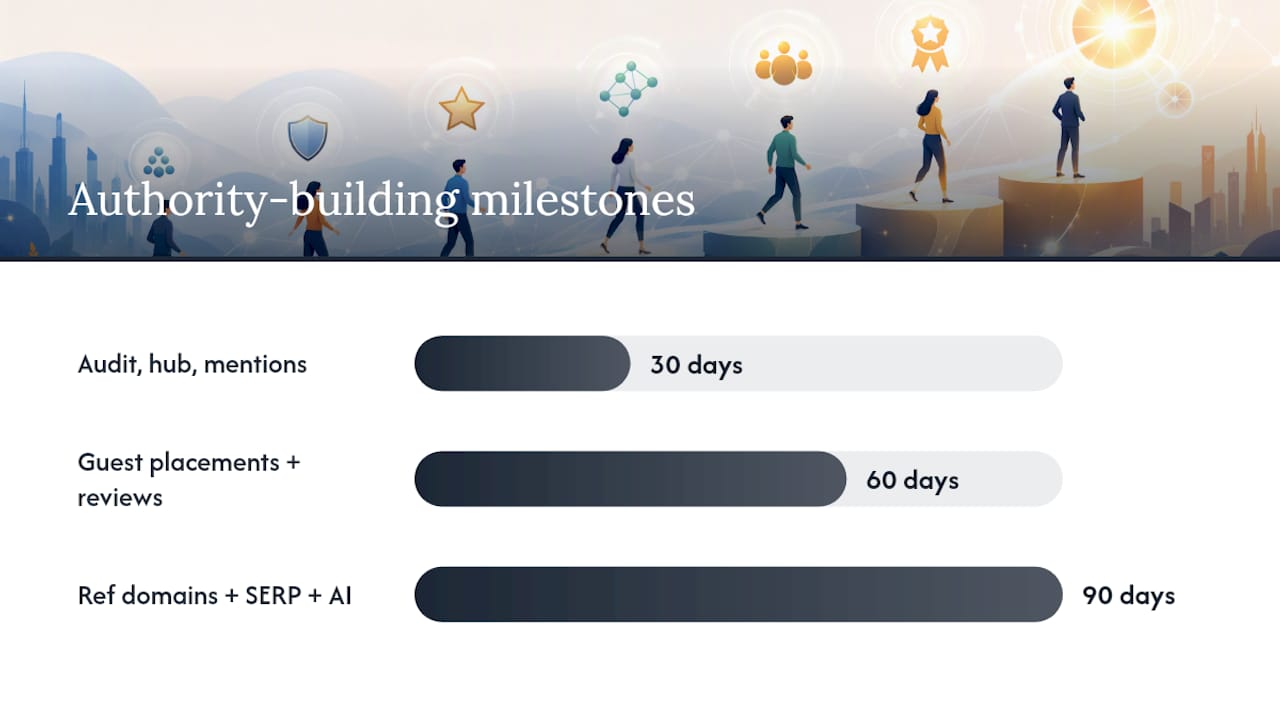
Cost expectations vary by how much you can do in-house versus outsource. A founder spending a few hours a week on outreach and content will move slower but spend less. A retained agency arrangement moves faster because outreach, content production, and technical fixes happen in parallel rather than sequentially, but it costs more upfront. Neither approach is wrong, the right choice depends on whether your bottleneck is time or expertise. Our breakdown of SEO strategy step by step for 2026 sets out typical resourcing patterns in more detail.
A concrete 30, 60, 90-day checklist
Break the work into three phases: discovery, build, and amplify. Each phase has measurable outputs, not vague intentions.
- Weeks 1 to 2 (Discovery): Complete the off-site and on-site audit. Identify your chosen topic and write the one-sentence POV statement.
- Weeks 3 to 4 (Discovery to Build): Draft the hub page outline and identify five unlinked mentions to claim.
- Weeks 5 to 6 (Build): Publish the hub page and two supporting cluster pages. Send outreach emails claiming unlinked mentions (aim for at least ten).
- Weeks 7 to 8 (Build): Publish one detailed case study with real figures. Add or update author bios sitewide.
- Weeks 9 to 10 (Amplify): Pitch three guest contributions to relevant niche outlets. Begin regular LinkedIn or forum engagement.
- Weeks 11 to 12 (Amplify): Review early results, referring domains, review volume, any AI citations, and adjust which topic clusters get priority for the next quarter.
Ownership matters here. A founder is usually best placed to write the POV statement and approve case studies, because only they can vouch for the specifics. A marketer or agency should own outreach volume, technical implementation, and content production, since those tasks benefit from consistent, dedicated time that founders rarely have.
How does Fylde Digital approach authority building for clients
Our process for clients follows the same structure laid out above, because it’s the one that actually produces measurable results rather than vanity metrics. We start with an audit of existing off-site presence and on-site technical health, move to selecting a defensible point of view for the client’s specific market, then build the hub and cluster pages that give search engines and AI systems something concrete to reference.
- We assess current site structure, internal linking, and technical crawlability before recommending new content.
- We help clients identify a topic angle that’s realistic to win rather than aspirational.
- We build the on-site foundation, hub pages, schema, author information, that supports long-term authority rather than short-term traffic spikes.
- We support outreach and proof-gathering, including review generation and case study development, once the foundation is solid.
You can see the range of services this covers, from web design through to ongoing SEO support, across our services overview. If you’re weighing up a broader technology partner for the AI-visibility side specifically, tools like ecentic focus on making content more legible to AI systems, which complements the structural work described here.
What SMEs consistently get wrong about building authority
The most common mistake is sequencing. Businesses jump straight to outreach and guest posting before the on-site foundation exists, so even when a journalist or blogger agrees to link to them, there’s no hub page worth linking to, just a thin homepage or a blog post with no supporting structure around it. The link lands on a page that can’t hold the authority it’s being handed.
The second mistake is chasing volume over specificity. A business that publishes twelve generic blog posts a month will almost always underperform one that publishes three posts a quarter built around original data or a genuinely detailed case study. Instant Press’s research on trust-building makes a similar point: small businesses often get more traction from owning one narrow topic and one signature proof point than from spreading effort thin across many loosely related themes. I’ve seen this pattern repeat across sectors, the businesses that pick one thing to be known for and prove it relentlessly tend to overtake competitors reliant on generic content.
The third mistake is treating reviews and testimonials as an afterthought rather than infrastructure. A business with many specific, detailed Google reviews will out-convert one with a larger number of generic five-star ratings that all say “great service,” because specificity signals authenticity to both readers and algorithms.
If you’d like help building your online authority
There are ways to run this plan entirely in-house, and plenty of the tactics above cost nothing but time. But if your bottleneck is a website that can’t actually hold the hub pages, schema, and case studies this plan requires, that’s the exact gap Fylde Digital fills. We build the on-site foundation first, properly structured, fast to crawl, and ready to support the authority work, rather than bolting content onto a site that was never built to carry it.
If you’re not sure whether your current site is holding you back, our free website and SEO review will tell you exactly where the gaps are, technical, structural, or content, before you spend a penny on outreach or content production. It’s a concrete first step: get the review, see the specific issues, then decide what to tackle first.
Sources
- Topical authority framework and pyramid
- How topical authority works and why it matters
- 5 ways to increase your website authority in 2026
- What brand credibility means and strategies for small businesses