A brand messaging framework is the single document that defines what your business says, to whom, and why it matters, so every team member and channel repeats the same story instead of improvising one. Start today by drafting a 10-second core message: one sentence that says what you do, for whom, and what changes because of it. Everything below builds outward from that sentence.
TL;DR:
- A messaging framework should include clear positioning, pillars, proof points, audience variants, and voice guidelines to ensure consistent and effective communication across channels.
- It must be built through customer research, tested with validation exercises, and stored in an accessible, ownership-assigned document to prevent drift.
- Using a messaging matrix and hierarchy improves how pillars are adapted for each audience and medium, ensuring key messages remain focused under space constraints.
- Regular audits, KPIs, and updates after major changes protect the framework’s relevance and enforce team adherence.
- External agencies can enhance this process by conducting validation, creating message cards, and integrating the framework into your website and workflows.
Table of Contents
- What is a brand messaging framework and why does it matter?
- Core components: the layers every usable framework contains
- How do you actually build the framework, step by step?
- Activation: building a messaging matrix and a messaging hierarchy
- Validation and testing: proving the framework works before rollout
- How do you roll the framework out across an SMB marketing team?
- Where do you use the framework, and what do the templates look like?
- Measure and maintain: KPIs, audits, and update cadence
- What does an agency actually add to this process?
- Sources
What is a brand messaging framework and why does it matter?
Messaging, positioning, and a tagline get confused constantly, and that confusion is exactly why so many businesses drift. Positioning is where you sit against competitors in the customer’s mind. A tagline is the polished, external-facing line you might put on a billboard. A brand messaging framework sits between the two: the internal working document that generates both, plus everything your sales team, social media manager, and web copywriter say day to day.
The payoff for building one is practical, not decorative. Teams with a documented framework write content faster because nobody reinvents the value proposition every time a new page goes live. Conversions improve because your website, adverts, and sales calls reinforce a single argument instead of three competing ones. Trust builds faster too, and with Gartner reporting that trust scarcity is now central to brand growth, consistency has become a competitive advantage rather than a nice-to-have.
Without a framework, three failure modes show up repeatedly:
- New hires and freelancers each interpret “what we stand for” differently, so tone shifts page by page.
- Sales promises things marketing never mentions, and customers notice the gap.
- Every new campaign starts from a blank page, because there’s no shared source of truth to draw from.
Core components: the layers every usable framework contains
A messaging framework only works if it has structure. Without layers, you end up with a pile of adjectives and no way to apply them. The components that a practical framework needs break down into seven parts, each doing a distinct job.
- Positioning foundation: where you sit in the market and against whom, stated in one paragraph.
- Core message: the 10-second version. If a stranger asks what you do, this is the answer.
- Value proposition: the specific benefit a customer gets and why it beats the alternative.
- Messaging pillars: three to five recurring themes that support the core message.
- Proof points: the evidence, data, or credentials that back each pillar.
- Audience variants: how the same pillar gets phrased differently for a buyer versus an operations manager.
- Voice and tone guardrails: the rules that keep every writer sounding like the same brand.
The pillar layer trips up most first attempts. A pillar should describe an outcome the customer gets, not a feature you built. “We reply within two hours” is a feature. “You’re never left guessing what happens next” is the pillar; the two-hour reply time is the proof underneath it. Get this the wrong way round and your pillars read like a spec sheet, not a story. Proof always sits below its pillar, never floating on its own, because a claim without evidence attached is just an assertion nobody has to believe.
Pro Tip: Write each pillar as a sentence a customer would actually say out loud about you, not a sentence your marketing team would write about itself. If it sounds like internal jargon, it’s a feature, not a pillar.
For voice and tone specifically, a documented brand voice guide prevents the slow drift that happens when three different people write your social captions over six months.
How do you actually build the framework, step by step?
Building a framework in the wrong order is the most common reason SMBs abandon the exercise halfway through. Follow this sequence and you avoid rewriting pillars after you’ve already drafted the copy that depends on them.
- Gather voice-of-customer research first. Pull language straight from sales call recordings, customer reviews, and support tickets. The phrases customers use unprompted are worth more than anything your team invents in a workshop, because they’re already proven to resonate.
- Draft your positioning and core message. Write the one-paragraph positioning statement, then compress it into a single sentence: your 10-second core message. Test it on someone outside your industry. If they can’t repeat it back in their own words within a few seconds, it’s not there yet.
- Cluster themes into three to five pillars. Go back through your research and group recurring ideas. Name each pillar as a customer outcome, then attach the proof (data, case studies, credentials) that supports it.
- Build audience variants. For each buyer type, rewrite the same pillar in language that fits their priorities. A pillar about reliability might lean on uptime data for an IT buyer and on peace of mind for a small business owner.
- Create message cards. One card per pillar, with the pillar statement, proof, and a sample sentence for at least two channels. These become the physical artefact your team actually uses.
- Document and assign ownership. Put everything into one accessible document, name who owns it, and set a review date. A framework nobody owns is a framework nobody updates.
This order matters because each step depends on the one before it. Skip the research and your pillars sound like guesses. Skip the audience variants and your sales team keeps writing their own version anyway.
Activation: building a messaging matrix and a messaging hierarchy
Pillars on their own are a list. A messaging matrix is what turns that list into something your team can actually copy and paste into a brief. Guides that go beyond the basics stress that a messaging matrix and hierarchy are what make pillars usable across different audiences and channels, rather than staying theoretical.
Structure the matrix with pillars as rows and audience segments as columns. Each cell contains a short, ready-to-use sentence: not the abstract pillar statement, but the actual line a copywriter would drop into an email subject or a social ad. A cell for “reliability” against “time-poor small business owner” might read: “One less thing to chase up.” The same pillar for an enterprise buyer might read: “99.9% uptime, audited quarterly.”
The hierarchy matters when space runs out, which it always does in a 30-character ad headline or a six-word push notification. Rank your pillars by how strongly they drive the decision for your primary audience, and know which one survives when everything else gets cut. Losing the second or third pillar under space pressure is fine; losing the top one changes what you’re saying entirely.
A few rules keep this from sprawling into an unmanageable spreadsheet:
- Never adapt proof without adapting the claim it supports; swapping in a stat that doesn’t match the audience’s concern undermines both.
- Keep each matrix cell to one sentence. If it needs two, the pillar is probably too broad.
- Review the matrix whenever you enter a new channel, since a format like short-form video needs a different cell than a landing page.
Validation and testing: proving the framework works before rollout
Messaging that sounds convincing in a meeting room often falls flat with actual customers. That gap is why validating with both customers and internal stakeholders before full rollout matters more than any amount of internal debate about wording.
Run these three checks before you commit the framework to your website or ad accounts:
- The clarity test. Show your core message to five people outside your business with no context. Ask them to repeat back what you do and who it’s for. If two or more get it wrong, the sentence needs work, not the audience.
- A/B the headline or value proposition. Run your candidate core message against your current one on a landing page or ad set. Watch click-through rate and, further down funnel, demo or enquiry rate rather than impressions alone.
- Map every claim to its evidence. For each pillar, list the exact proof point and set a bar for what counts as acceptable: a client quote, a measurable result, a certification. If a pillar has no evidence you can point to, either find the proof or drop the pillar.
Forrester’s research on AI-assisted marketing operations is a useful reminder here: as more messaging gets drafted with AI assistance, measuring actual creative effectiveness, not just output speed, becomes the control that keeps quality from slipping.
How do you roll the framework out across an SMB marketing team?
A framework that lives in one person’s head or a forgotten Google Doc dies within a quarter. Assign clear ownership, usually marketing lead or founder in an SMB, with final approval resting on one person to prevent messaging created by committee.
Store the document somewhere every writer, freelancer, and agency partner checks before starting work, whether that’s a shared drive, Notion, or a documented brand guidelines page. Then embed it into the actual workflow: add a line to every content brief template asking “which pillar does this support?” and check it during copy QA before anything ships.
Training doesn’t need to be elaborate. A single workshop to walk the team through the pillars, followed by laminated or PDF message cards at each desk, covers most of what’s needed. New hires get the same cards as part of onboarding rather than a verbal explanation that changes slightly with every telling.
- Set a quarterly cadence for reviewing the framework against new customer feedback.
- Flag drift early: if three pieces of content in a row ignore the hierarchy, that’s a training gap, not a one-off mistake.
- Revisit the whole document after any major product change, rebrand, or new market entry.
Pro Tip: Put the core message and top pillar on a sticky note near your team’s screen for the first month after rollout. It sounds basic, but repetition is what actually changes writing habits, not a single training session.
Where do you use the framework, and what do the templates look like?
Every channel needs the same pillars phrased for its format and its moment in the customer’s attention. A practical guide to brand messaging recommends keeping a short template for each recurring use case, so nobody starts from scratch.
- Website hero line: your core message, trimmed to under 12 words, with the strongest proof point directly below it.
- Product page opener: lead with the pillar most relevant to that specific product, not the general core message.
- Sales opening line: a spoken version of the core message, informal enough to say out loud without sounding scripted.
- Social ad headline: the sharpest single pillar, adapted for the platform’s character limit, with proof implied rather than spelled out.
- Customer email opener: a warmer, second-person version of the value proposition, written as if continuing a conversation.
Short-form contexts (ads, push notifications, social captions) need the pillar stripped to its sharpest phrase with proof implied. Long-form contexts (landing pages, case studies, sales decks) can carry the full pillar plus its proof point explicitly, and often benefit from an example of a branding strategy to anchor the abstract claim in something concrete.
Measure and maintain: KPIs, audits, and update cadence
A framework earns its place with numbers, not just team enthusiasm. Track adoption rate (the percentage of new content that visibly maps to a pillar), click-through rate shifts after a messaging change, and win rate by customer persona if your sales team logs it.
Run a lightweight audit quarterly: sample ten recent pieces of content, score each against the framework on a simple scale, and flag anything that’s drifted. Documenting the framework in an accessible, portable format such as a one-page cheat sheet makes this audit faster because reviewers aren’t hunting through a 40-page brand book to check compliance.
- Review formally every quarter, or immediately after a rebrand, new product launch, or shift in target market.
- Treat repeated qualitative feedback (customers misunderstanding what you do) as a trigger for rework, not just a training reminder.
- Update audience variants whenever a new buyer segment becomes a meaningful share of revenue.
What does an agency actually add to this process?
Most SMBs don’t fail at messaging because the concept is hard. They fail because nobody protects the framework once the initial workshop energy fades. Keep it simple, map every claim to real proof, and strip out internal jargon before it reaches a customer; those three disciplines matter more than any clever pillar wording.
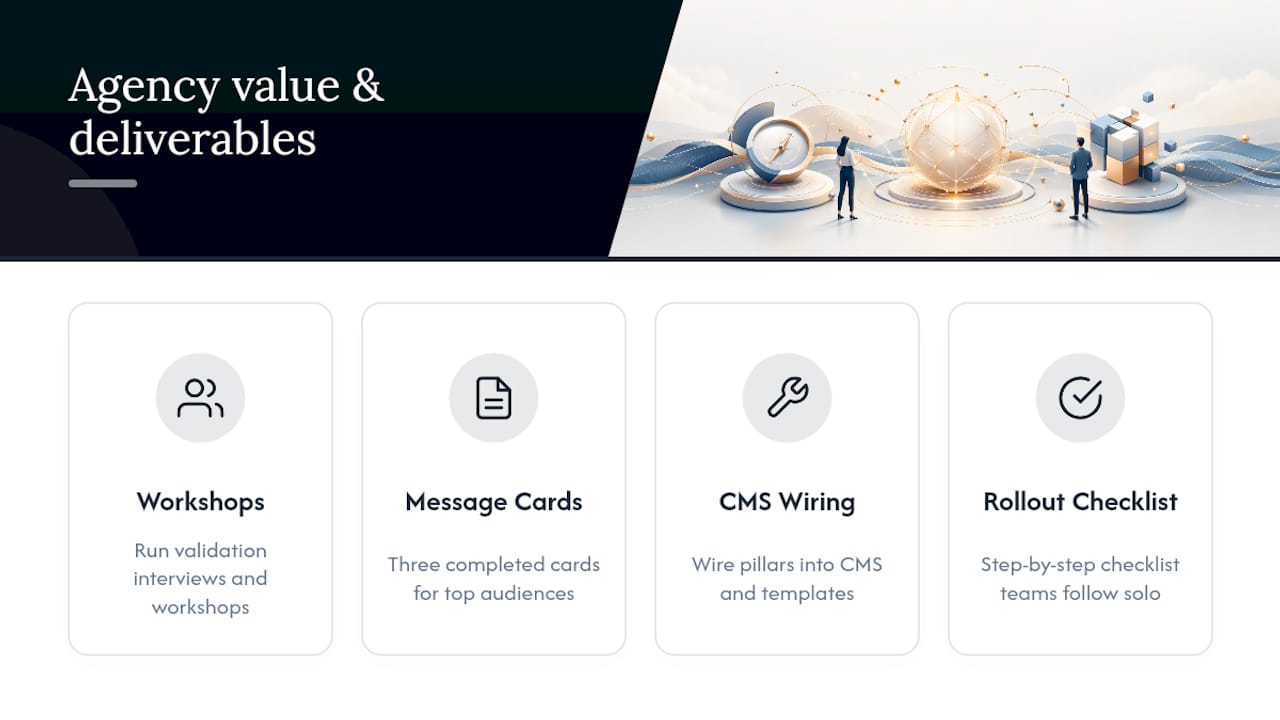
Where an outside partner earns its fee is in the parts founders rarely have time for: running the validation interviews properly, building message cards that survive contact with a busy sales team, and wiring the finished pillars into your CMS and templates so consistency isn’t a matter of memory. Fyldedigital runs this as a structured engagement covering workshops, message card production, and training, because a framework filed away after one meeting delivers nothing.
At minimum, insist on three deliverables from any framework project: a one-page framework document, three completed message cards for your top audiences, and a rollout checklist your team can follow without supervision. Anything less isn’t finished.
— tibor
Fyldedigital builds messaging frameworks directly into the websites it designs, so your core message, pillars, and proof points show up correctly from the homepage down. If your current site was built before your messaging was, that mismatch is usually the first thing worth fixing. Start with a free website review to see where your existing pages already contradict the story you’re trying to tell.
Sources
- Brand messaging framework: Components + 6-step guide
- Brand Messaging Framework: The Full Structure and Matrix (2026)
- Brand Messaging Framework: Aligning What You Say with Who You Serve
- What is brand messaging? A framework for teams of any size