Social media ROI equals value generated minus total costs, divided by total costs, then multiplied by 100. Collect two numbers before anything else: the revenue or value your social activity produced, and every cost that made it happen, including staff time and tools, not just ad spend. Pick a reporting period, usually a campaign window or a full quarter, and plug both figures into that formula. Everything else in this guide simply helps you find those two numbers accurately.
TL;DR:
- Calculating true social media ROI requires including all costs such as labor, content creation, and tools, not just ad spend, for an accurate measure.
- Attribution challenges mean consistent UTM tagging, pixel verification, and CRM data stitching are essential to reliably link sales to social touchpoints.
- Organic social value is best estimated using customer lifetime value or media equivalence, but these proxies depend heavily on honest assumptions and sensitivity analysis.
- Both ROAS and full-cost True ROI should be reported side by side, as each serves different decision-making needs for campaign managers and business owners.
- Common mistakes include incomplete cost tracking, double-counting conversions, and neglecting multi-touch attribution, which distort the real return figures.
Table of Contents
- Quick calculator approach and required inputs
- How do you calculate social media ROI step by step?
- How do you put a value on brand awareness and engagement?
- Why does attribution make social media ROI so hard to pin down?
- Should you measure paid and organic social differently?
- Which tools and templates actually work for social media ROI analysis?
- Worked examples: campaign and annual social media ROI calculation
- What mistakes commonly distort a social media ROI calculation?
- How Fyldedigital approaches social media ROI for clients
- Why most social ROI reporting undersells the real picture
- Get your social media ROI calculated properly
- Sources
Quick calculator approach and required inputs
Before you touch a formula, gather the raw numbers. A social media ROI calculation is only as good as the inputs behind it, and most small businesses underestimate what actually belongs in the cost column.
You need two categories of data: what you spent and what you got back. On the spend side, that means ad budgets, content production (photography, video editing, design), the hours your team or an agency retainer actually spent, and any software subscriptions for scheduling or analytics. On the return side, you need conversions and the revenue those conversions generated.
Start pulling this from:
- GA4 acquisition reports for traffic and conversion paths from social referrals
- Ad platform billing dashboards (Meta Ads Manager, LinkedIn Campaign Manager) for exact spend
- CRM records for lead value and closed deals traced back to social
- Invoices for freelancer fees, agency costs and content production
There is a critical fork here. ROAS (return on ad spend) only counts paid media cost against the revenue that spend drove, useful for quick campaign-level tuning. True ROI counts everything, including the labour that built the creative and managed the account. A study on Calculover makes the point plainly: leaving out labour and production costs inflates your apparent efficiency and can lead you to double down on channels that are not actually paying for themselves.
How do you calculate social media ROI step by step?
Follow this sequence in order. Skipping steps, especially the cost audit, is where most calculations go wrong.
- Choose your objective and primary KPI. Sales, leads, or customer lifetime value; each demands different tracking.
- Map that objective to concrete metrics and data sources. A lead-generation goal needs form-fill tracking in your CRM; a sales goal needs GA4 e-commerce reporting or platform-attributed purchases.
- Total your investment. Add ad spend, staff hours (at a realistic hourly rate), production costs, agency fees and tool subscriptions for the same period.
- Calculate attributable value. Count direct conversions first, then add assisted value only where you can justify it, such as a documented influence from a social touchpoint earlier in the buyer journey.
- Apply the formula and report two figures. Run ROAS for campaign managers optimising day to day, and True ROI for anyone deciding whether the whole channel deserves its budget next year.
This structure mirrors the process recommended by the Digital Marketing Institute, which treats goal definition and cost mapping as the two steps businesses most often shortcut.
Pro Tip: Keep a running spreadsheet tab logging every social-related invoice as it arrives, rather than reconstructing costs at quarter-end. Retroactive cost-hunting is how labour and small subscriptions quietly vanish from the calculation.
How do you put a value on brand awareness and engagement?
Not every social win shows up as a sale in the same month. Awareness, engagement and follower growth still carry value, but only if you assign that value with discipline rather than guesswork.
The most defensible method uses customer lifetime value (CLV) as a proxy. If your average customer is worth £400 over their lifetime and social historically converts 2% of new followers into customers within a year, each new follower carries an implied value of roughly £8. Multiply that by your follower growth for the period and you have a conservative, defensible number.
Earned media value (EMV), which multiplies impressions by an equivalent CPM, is the other common proxy. It is quick to calculate but easy to inflate, since it assumes every impression carries advertising-equivalent value, which it rarely does.
- Always state your CLV and conversion-rate assumptions alongside the final figure
- Run the calculation twice with a conservative and optimistic assumption to show a sensitivity range
- Treat EMV as a directional indicator, never as a hard revenue number in board reporting
Why does attribution make social media ROI so hard to pin down?
Attribution is where most social media ROI analysis breaks down, not the arithmetic — mastering how to track QR code scans for smarter campaigns can significantly improve your offline-to-online attribution accuracy. If you cannot reliably trace a sale back to a social touchpoint, the formula is only ever as accurate as your tagging.

UTM parameters are the starting point. Every social post that links off-platform needs consistent source, medium and campaign tags, or GA4 will lump your Instagram and Facebook traffic into an unhelpful “social” bucket with no campaign detail. Consistent UTM discipline alongside CRM stitching resolves most of the attribution headaches small businesses face, according to Brandwatch’s analysis of measurement practices.
A practical tracking checklist:
- Standardise your UTM naming convention across every team member and tool before launching a single post
- Install and verify platform pixels (Meta Pixel, LinkedIn Insight Tag) and check they are firing correctly using each platform’s own debugging tool
- Stitch CRM data to ad-platform lead IDs so a closed sale can be traced back to its originating campaign
- Audit tag health monthly, not annually. Broken tags fail silently and quietly corrupt months of reporting
Last-click attribution is simple but routinely gives all the credit to whichever channel closed the sale, often organic search or direct traffic, even when a social touchpoint started the journey. Gartner recommends analytics-driven, multi-touch measurement for organisations that can support it, alongside incrementality testing as the strongest available proof of causal impact. Multi-touch requires more setup than most SMBs will justify immediately, so start with clean UTMs and assisted-conversion reporting in GA4, then graduate to incrementality testing only once you have enough volume to make it statistically meaningful.
Should you measure paid and organic social differently?
Yes, and treating them the same is a common source of misleading conclusions. Paid social gives you a defined campaign window, direct conversions, and a clean ROAS figure within days. Organic social is a slower, compounding asset that rarely converts on the same timeline.
- Paid social: measure within the campaign window; ROAS and direct conversions are your primary signals
- Organic social: measure over quarters, not weeks; look for brand-search volume lift and direct traffic growth as leading indicators
- Comparing the two: never judge organic against a paid-style short window. Sprinklr’s analysis treats organic as a longer-term investment that compounds, which is a fair basis for allocating budget between the two channels rather than expecting parity on the same clock.
Which tools and templates actually work for social media ROI analysis?
A spreadsheet handles most of this perfectly well. Build two columns, one for ROAS (ad spend against directly attributed revenue) and one for True ROI (full cost stack against total value, including assigned proxies).
- Use a simple spreadsheet with input cells for ad spend, labour hours, production costs, tool fees and conversion value
- Upgrade to a dashboard tool once you are running multiple campaigns simultaneously and manual reconciliation eats too much time; these still need clean UTMs and CRM linkage to be worth the investment
- Treat vendor calculators, including free ones like Sprout Social’s ROI calculator, as a starting sanity check only. They typically ask for impressions, CPM and post frequency, but the output is only meaningful once you swap in your own CPM and CLV figures rather than the tool’s defaults
Our guide to key digital marketing metrics breaks down CPL, CAC and CLV in more depth if you need to build these assumptions from scratch.
Worked examples: campaign and annual social media ROI calculation
Numbers make this concrete. Here is a paid campaign and an organic annual view, run side by side.
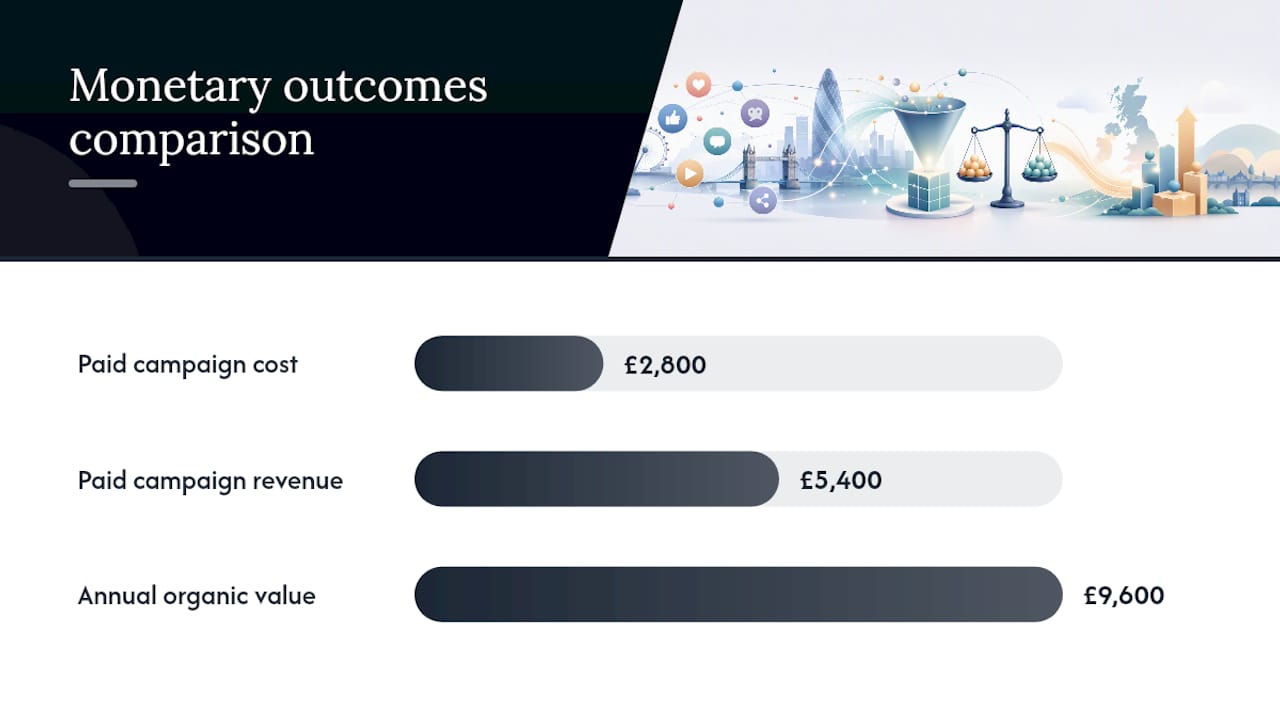
A four-week paid campaign spends £2,000 on ads, £500 on creative production and £300 of staff time (15 hours at £20), for a total cost of £2,800. It generates 40 leads at a 15% close rate, six sales averaging £900 each, for £5,400 in revenue. ROAS (revenue ÷ ad spend) is 2.7. True ROI, using the full £2,800 cost stack, is ((£5,400 − £2,800) ÷ £2,800) × 100, which comes to 92.9%.
An organic annual view: 1,200 new followers gained over the year, valued at £8 each using the CLV proxy described earlier, gives £9,600 in assigned value.
| Scenario | Assumption A | Assumption B | Resulting True ROI |
|---|---|---|---|
| Campaign, higher CLV close rate | 15% close rate | 20% close rate | 92.9% → — |
| Annual organic, lower follower value | £8 per follower | £5 per follower | — → — |
That second row matters. It shows how sensitive an organic ROI figure is to your CLV assumption, which is exactly why disclosing assumptions alongside the headline number is not optional.
What mistakes commonly distort a social media ROI calculation?
Most inflated ROI figures share the same root cause: an incomplete cost stack. Excluding labour, treating a single conversion as both a direct and an assisted sale, or applying last-click attribution to a multi-touch buyer journey are the three errors that appear most often in reports Fyldedigital reviews.
- Excluding staff time or agency fees from the cost side
- Double-counting a conversion in both direct and assisted totals
- Reporting only ROAS to stakeholders who need the full-cost True ROI figure
- A sudden spike in “assisted conversions” with no matching rise in direct sales, which usually signals an attribution setup problem rather than genuine growth
Pro Tip: If your True ROI and ROAS figures move in wildly different directions month to month, check your cost inputs before your attribution model. It is almost always a missing invoice, not a broken pixel.
How Fyldedigital approaches social media ROI for clients
Fyldedigital’s social media management work always separates ROAS from True ROI in client reporting, because campaign managers and business owners need different numbers. The most common corrective action across client reviews is adding overlooked labour and tool costs back into the calculation before presenting figures to ownership. A free review can surface these gaps in your own reporting within a day.

Why most social ROI reporting undersells the real picture
The conventional advice treats social media ROI as a single number to chase, but that framing misses what actually drives better decisions. The genuinely useful version is two numbers, ROAS and True ROI, presented side by side, because they answer different questions for different people. An ad manager optimising a campaign this week needs ROAS. A business owner deciding whether social deserves next year’s budget needs True ROI, full cost stack included.
Where conventional advice falls short is in treating attribution as a solved problem once UTMs are in place. Tagging fixes visibility, not causation. A social touchpoint that appears in an assisted-conversion path did not necessarily cause that sale, and pretending otherwise inflates confidence in a channel that might be riding on the coat-tails of paid search or word of mouth.
Prioritise cost completeness first. Get every labour hour and subscription fee into your total before worrying about which attribution model is more sophisticated. A precise formula applied to incomplete costs is still a wrong answer.
— tibor
Get your social media ROI calculated properly
Building your own spreadsheet is a solid start, but most small businesses lose accuracy at the tagging and cost-tracking stage, not the maths. Fyldedigital sets up the tracking infrastructure first: clean UTM structures, CRM linkage and platform pixel audits, so the numbers feeding your calculation are trustworthy before anyone applies a formula to them.
Our social media management service includes ongoing ROAS and True ROI reporting as standard, alongside the cost audits that most in-house teams skip under time pressure. If you want a second opinion on your current reporting or help deciding which metrics actually matter for your business, request a free social media and analytics review and we will walk through your existing setup with you, gap by gap.
Sources
- Social media ROI: measure, prove, and improve at scale — Hootsuite
- Prove marketing ROI with analytics — Gartner
- How to Measure Social Media ROI — Digital Marketing Institute