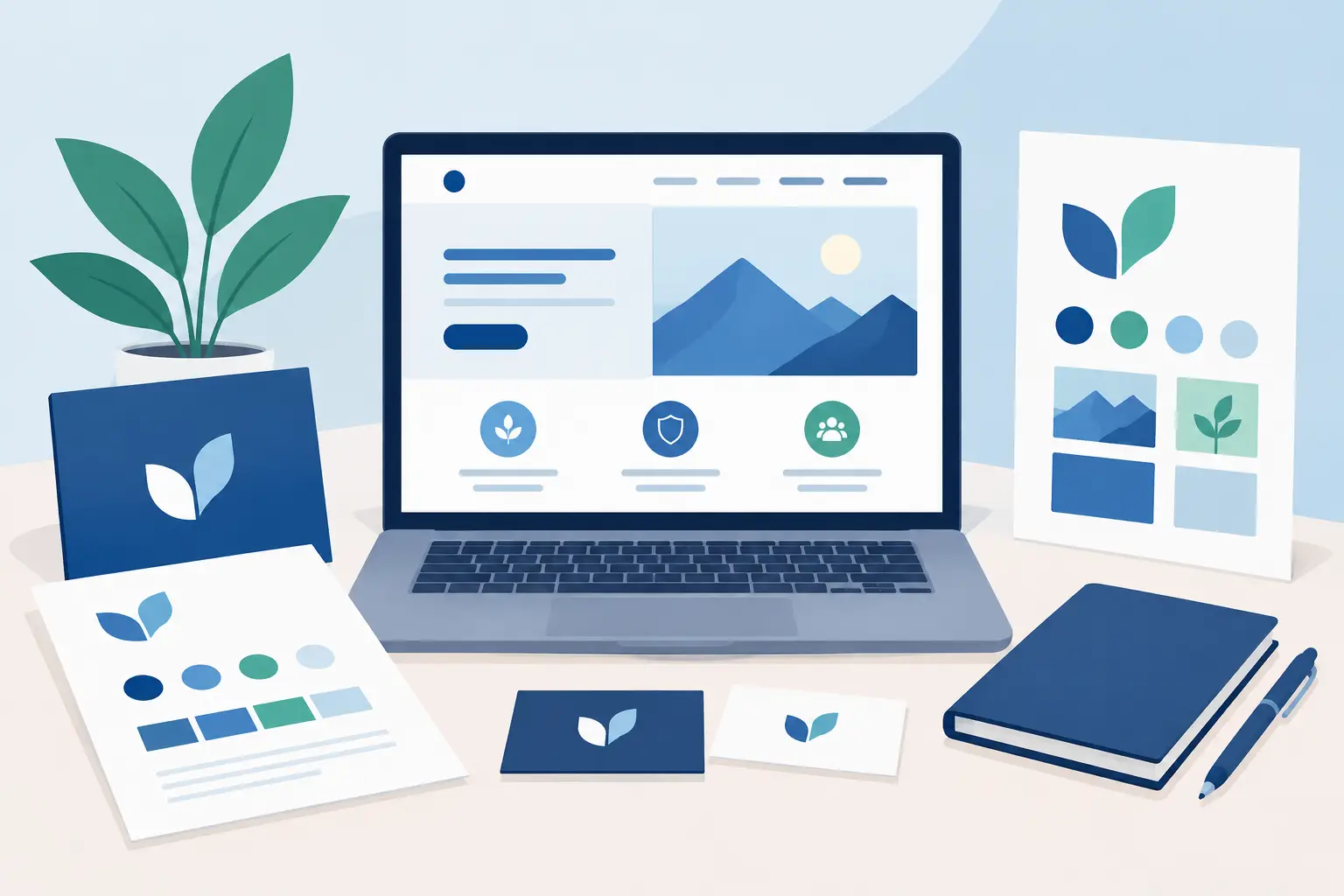
Promotional materials are physical, printed, or digital branded items used to raise awareness, generate leads, and keep your business front of mind. The most common examples of promotional materials span a wide range of formats, from everyday carry items to high-impact print collateral. Here is a quick-reference list of core types you can use as a starting checklist:
- Branded pens and pencils
- Tote bags
- Mugs and reusable water bottles
- Business cards
- Brochures and tri-fold leaflets
- Flyers and postcards
- Posters and pull-up banners
- Stickers and magnets
- Branded notebooks
- T-shirts, hoodies, and caps
- Lanyards and badge holders
- Seed paper cards
- Presentation folders
- Branded USB drives and tech accessories
Tools such as Canva, Adobe Express, and Vistaprint UK make it straightforward to design and order most of these items without a dedicated in-house studio.
Key takeaways
Promotional materials deliver measurable brand impressions only when the item, the audience, and the distribution channel are matched deliberately, not chosen by default.
| Point | Details |
|---|---|
| Match item to touchpoint | Choose materials based on how and where they will be received, not on unit cost alone. |
| Prioritise repeat use | Reusable items (bottles, notebooks, tote bags) generate daily impressions and lower cost-per-impression over time. |
| Prepare files correctly | Supply CMYK PDFs at 300 DPI with 3mm bleed to avoid costly reprints and colour shifts. |
| Measure every campaign | Assign a unique QR code or URL to each physical item so you can attribute responses accurately. |
| Fyldedigital for integrated campaigns | Fyldedigital manages design, print procurement, and campaign integration for UK SMEs from a single brief. |
Table of Contents
- Why physical promotional materials still deliver results
- Categorised examples of promotional materials by campaign role
- Creative and niche promotional ideas that start conversations
- Professional and B2B promotional materials that support sales
- How to turn artwork into finished items: file specs and finishes
- Typical costs and production timelines for UK promotional items
- How to choose the right promotional material for your campaign
- How Fyldedigital integrated print with a digital campaign
- Sustainable and ethical options for promotional materials
- Distribution strategies that get your materials in front of the right people
- Measuring the ROI of your promotional materials
- Legal considerations when creating promotional materials
- Three rules that separate effective promotional campaigns from expensive clutter
- Fyldedigital’s print and promotional design service
- Sources
Why physical promotional materials still deliver results
Physical items create a tactile impression that a digital ad simply cannot replicate. When someone picks up a branded pen or carries a tote bag, your logo travels with them, generating repeat impressions over days, weeks, or months. Adobe’s Creative Cloud research notes that brand consistency can increase average revenue by a notable percentage, underlining why coherent, well-produced materials matter across every touchpoint.
The situations where physical and printed materials outperform purely digital tactics include:
- Trade shows and exhibitions: a well-designed pull-up banner and a branded giveaway bag do the work of a salesperson before you even open your mouth.
- Direct mail campaigns: a postcard or brochure landing on a desk cuts through inbox noise.
- In-store and retail: point-of-sale posters and shelf-edge cards drive impulse decisions.
- High-value B2B leave-behinds: a premium notebook or presentation folder reinforces credibility after a pitch meeting.
- Employee onboarding packs: branded merchandise builds team culture from day one.
PaperTrue’s guidance on marketing materials makes the point clearly: brochures suit complex service explanations, postcards work for quick scannable offers, and short videos drive social sharing. Choosing the right format for the right moment is the skill that separates effective campaigns from wasted print runs.
Categorised examples of promotional materials by campaign role
Steel City’s definition of promotional materials frames them as physical branded items (swag and merch) alongside print and digital collateral, all working together to raise awareness and create memorable interactions. The categories below follow that logic, pairing each item with its primary campaign role.
Branded merchandise and lifestyle items
- Tote bags: high-visibility, reusable, and popular at events; strong for B2C brands targeting eco-conscious audiences.
- Mugs and reusable bottles: desk and kitchen staples that generate daily impressions; ideal for corporate gifting and trade-show giveaways.
- Branded pens: the highest-volume giveaway item; cost-effective for mass events where budget per unit is tight.
- Notebooks: perceived as higher value than pens; suited to professional and B2B audiences.
Apparel
- T-shirts and hoodies: walking billboards when worn in public; best for brand-culture campaigns and staff uniforms.
- Caps and beanies: seasonal relevance makes them memorable; popular at outdoor events and festivals.
- Lanyards: ubiquitous at conferences; low cost, high visibility for the duration of an event.
Print collateral
- Business cards: the original leave-behind; still the fastest way to share contact details in a face-to-face meeting.
- Brochures and tri-fold leaflets: suited to services that need explanation; leave them at reception desks or include in welcome packs.
- Flyers and postcards: quick, scannable, and cheap to produce in volume; effective for promotions, events, and direct mail.
- Posters: in-store and venue promotion; large format commands attention in high-footfall locations.
Signage and display
- Pull-up (roller) banners: portable, reusable, and quick to set up; the standard for trade-show stands.
- Outdoor banners and PVC signs: durable for long-term external display; useful for building frontage and event perimeters.
- Table throws and branded tablecloths: professional finish for exhibition stands; often overlooked but visually impactful.
Packaging and stickers
- Custom stickers and labels: low cost, high versatility; used on product packaging, laptops, and as event freebies.
- Branded packaging: turns every delivery into a brand moment; particularly powerful for e-commerce businesses.
PromotionalProductInc’s 25-idea guide organises items by category and cost-per-impression, which is a useful lens when you are matching items to campaign goals rather than simply ordering what looks good.
Pro Tip: Design your poster artwork at A2 or A1 size first, then export scaled-down versions for A5 postcards and 1080×1080px Instagram graphics. One design session, three formats, and a consistent visual across print and social.
Creative and niche promotional ideas that start conversations
The most memorable campaigns often use items people have not seen before. These niche formats tend to generate social sharing and word-of-mouth that standard giveaways rarely achieve:
- Seed paper cards: plantable paper embedded with wildflower or herb seeds; perfect for eco brands, garden centres, and sustainability-led campaigns.
- Customised playing cards: a premium novelty that sits on desks and gets used repeatedly; strong for hospitality, gaming, and creative agencies.
- Recipe cards: food brands and restaurants use these to extend the brand experience into the home kitchen.
- Mini potted plants or seed kits: memorable at wellness events and corporate gifting; aligns with green brand values.
- Novelty socks: surprisingly popular at tech and creative industry events; high perceived value relative to cost.
- Iron-on patches: resurgent in youth and streetwear markets; effective for music festivals and lifestyle brands.
- Event wristbands: functional at ticketed events and double as a keepsake; easy to customise with colour and print.
- Magnets: fridge magnets stay in homes for years; strong for local service businesses such as plumbers, takeaways, and estate agents.
UK industry research from the BPMA, referenced by LSI, shows procurement behaviour is shifting toward suppliers who can demonstrate eco credentials and clear lead times, which makes seed paper and reusable items particularly well-timed choices right now.
Pro Tip: Before ordering a creative item, ask: “Does this fit how and where our audience will receive it?” A seed paper card handed out at a garden show makes sense. The same card posted to a logistics manager probably does not.
Professional and B2B promotional materials that support sales
B2B buyers respond to perceived quality. A flimsy pen handed to a procurement director signals the wrong thing about your brand. The items below carry weight in professional settings:
- Premium branded notebooks: Moleskine-style hardback notebooks with debossed logos; appropriate for client onboarding packs and senior gifting.
- Leather card holders: a practical, desk-worthy gift that stays visible long after a meeting.
- Branded portfolios and folders: present proposals and tender documents in a folder that carries your identity; reinforces professionalism at the point of decision.
- Executive pen sets: boxed, weighted pens with laser engraving; suited to high-value client relationships and award ceremonies.
- Printed proposals and bound reports: a well-printed, bound proposal stands out against emailed PDFs; particularly effective in architecture, construction, and professional services.
- Pull-up banners and table throws: non-negotiable for exhibition stands; a consistent display signals that your business is serious about its presence.
The principle here is straightforward: match perceived value to the relationship stage. Mass giveaways at the entrance of a trade show should be low-cost, high-volume items. Items handed to a shortlisted prospect during a pitch should feel considered and premium.
How to turn artwork into finished items: file specs and finishes
Getting files wrong is the most common cause of reprints and delays. Before sending artwork to any printer, check these fundamentals:
- Colour mode: set files to CMYK for print, not RGB. RGB colours (used for screens) can shift significantly when converted to CMYK at the press stage.
- Resolution: supply raster images at a minimum of 300 DPI at the final print size. Lower resolution produces visibly blurry output.
- Bleed and safe area: add 3mm bleed around all edges and keep critical content (text, logos) at least 5mm inside the trim line.
- File format: supply logos as vector files (AI, EPS, or SVG) so they scale without quality loss. Supply final artwork as print-ready PDF with fonts embedded.
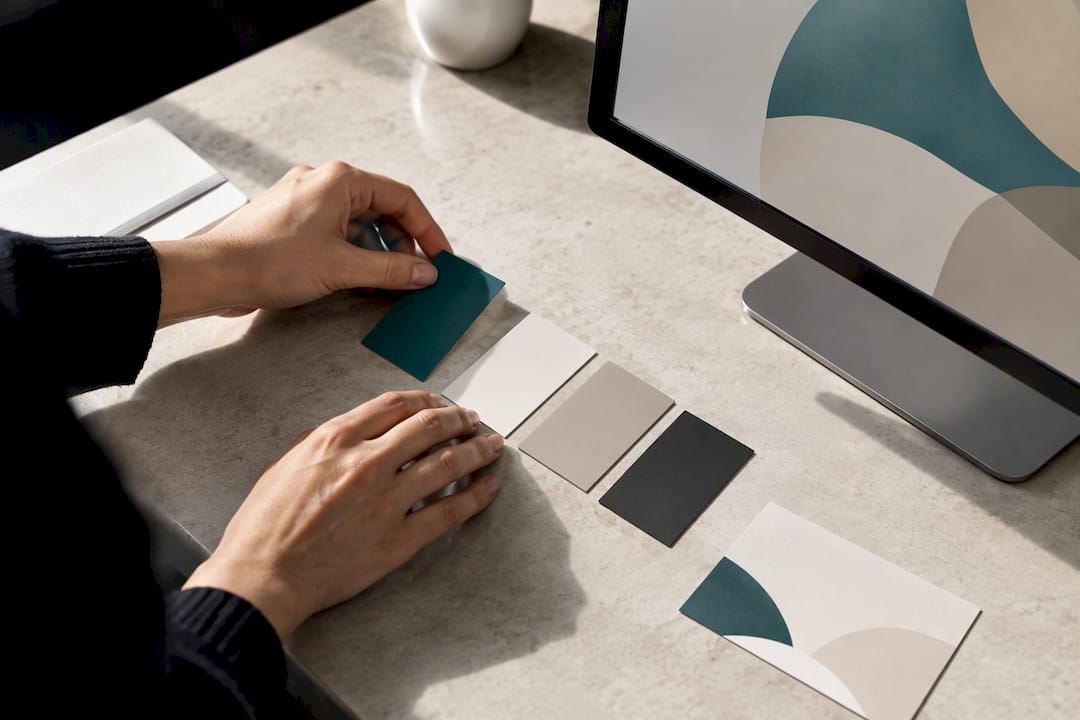
- Colour swatches: request a printed colour swatch or physical proof before approving a full run, especially for brand colours.
Common finishes and when to use them:
- Matt lamination: premium, tactile feel; reduces glare; popular for business cards and brochures.
- Gloss lamination: vivid colour reproduction; suits photography-heavy designs.
- Soft-touch lamination: velvety surface; high perceived value for premium packaging and folders.
- Spot UV: a gloss coating applied selectively over a matt base; draws the eye to logos or headlines.
- Foil blocking: metallic or holographic effect; used sparingly on covers and business cards for a luxury finish.
Canva’s print hub and Adobe Express both offer template-based design workflows that export print-ready files, which reduces the risk of specification errors. Vistaprint UK’s online portal includes built-in bleed guides and file-check tools, making it a practical starting point for smaller print runs. For print marketing ideas that go beyond standard formats, Fyldedigital’s print resources cover supplier coordination and artwork preparation in more detail.
Pro Tip: Order a sample of any new item before committing to a full production run. A physical sample reveals colour accuracy, material weight, and print quality in a way that a screen preview never can.
Typical costs and production timelines for UK promotional items
Costs vary depending on print method, order volume, decoration area, and material quality. Prices typically differ based on quantity, quality, and production speed, and additional fees for design, setup, delivery, and storage should be considered. For local print procurement in the North West, Fyldedigital’s printing services in Blackpool cover supplier coordination and fulfilment.
Key budgeting points:
- Setup fees (screen charges, die cuts) are a fixed cost that becomes negligible at high volumes.
- Shipping from overseas suppliers can add 2–4 weeks and customs complexity; UK-based suppliers offer more predictable lead times.
- Storage costs matter for large runs; factor in warehouse or office space if ordering more than 3 months’ supply.
How to choose the right promotional material for your campaign
A repeatable decision framework prevents impulse ordering and wasted budget. Work through these questions before placing any order:
- What is the campaign goal? Brand awareness favours high-volume, low-cost items. Lead generation favours items with a response mechanism (QR code, URL, or phone number). Retention favours premium, useful gifts.
- Who is the audience? B2C consumers at a festival respond differently to B2B procurement managers at an industry conference. Match perceived value to the relationship.
- How will the item be distributed? Event handout, direct mail, in-store, or sales visit? Each channel has different size, weight, and durability requirements.
- How many impressions per unit do you need? A reusable bottle generates daily impressions for months. A flyer may be read once. Cost-per-impression, not unit cost, is the real metric.
- What are your sustainability goals? Eco-conscious audiences notice when materials conflict with stated brand values.
- What is your budget per unit, including all costs? Include design, setup, production, delivery, and storage.
Red flags to avoid:
- Ordering items your audience has no practical use for (they go straight in the bin).
- Choosing items that conflict with your brand values (a single-use plastic item for a sustainability brand).
- Having no clear distribution plan before production begins.
Pre-order checklist: audience fit confirmed, prototype or sample approved, durability appropriate for distribution channel, cost-per-impression estimated, tracking mechanism in place (QR code, unique URL, or promo code).
How Fyldedigital integrated print with a digital campaign
The challenge in most integrated campaigns is keeping print and digital assets visually consistent when they are produced by different teams or suppliers. Fyldedigital’s approach to a recent campaign for a North West SME followed a structured process:
- Brief and asset audit: review existing brand assets, identify gaps in file quality (vector logos, brand colour codes in CMYK and RGB).
- Template creation: build a master design in Adobe Express and Canva that exports correctly for both print (CMYK PDF) and digital (RGB PNG/JPEG).
- Printer selection and sample approval: source a UK-based supplier with verified lead times; order physical samples before approving the full run.
- Distribution planning: map each item to a specific touchpoint (pull-up banner for the exhibition stand, postcards for direct mail follow-up, digital version for social ads).
- Tracking: assign a unique QR code or landing-page URL to each physical item so responses can be attributed back to the channel.
Measurable outcomes from this approach typically include higher event footfall conversion (visitors who engage with a well-branded stand are more likely to leave contact details) and improved direct-mail response rates when the physical piece matches the digital follow-up email in design and messaging. For a full view of Fyldedigital’s digital marketing services, the services page covers the complete range from web design through to print procurement.
Sustainable and ethical options for promotional materials
UK procurement trends tracked by the BPMA confirm that buyers are increasingly asking suppliers to demonstrate traceability and eco credentials before placing orders. Sustainable promotional materials are no longer a niche preference; they are becoming a baseline expectation for many brands.
Practical sustainable options include:
- Seed paper: fully plantable; zero waste after use.
- Recycled-fibre tote bags: made from post-consumer plastic bottles or organic cotton.
- Bamboo pens and utensils: rapidly renewable material; biodegradable.
- Reusable stainless-steel bottles: long product life means a low cost-per-impression over time.
- FSC-certified print stock: paper sourced from responsibly managed forests; ask your printer for FSC certification documentation.
Beyond materials, consider the supply chain. Shorter supply chains (UK-based suppliers) reduce transport emissions and give you more control over lead times. Avoid items that will be discarded immediately; a useful, durable item is always the more sustainable choice regardless of its material composition.
Distribution strategies that get your materials in front of the right people
Producing great materials is only half the job. Distribution determines whether they generate impressions or gather dust in a storeroom.
Event handouts work best when the item is relevant to the event context and easy to carry. Keep giveaway items lightweight and compact for trade shows where attendees are already carrying bags.
Direct mail remains one of the highest-response physical channels for B2B. A well-timed postcard or brochure arriving ahead of a sales call primes the conversation. Personalisation (the recipient’s name, their company logo on the envelope) lifts response rates noticeably.
In-store placement relies on position and visibility. Point-of-sale stands, counter cards, and shelf-edge strips work when they are placed at the exact moment of purchase decision. Rotate them regularly to maintain freshness.
Digital distribution of print assets extends reach at near-zero cost. A PDF brochure on your website, a postcard design shared as a social graphic, or a pull-up banner repurposed as a LinkedIn background image all multiply the value of a single design. Repurposing assets across print and digital is one of the most cost-effective tactics available to small-business marketers.
Measuring the ROI of your promotional materials
Most businesses underinvest in measurement and then struggle to justify the print budget at the next planning cycle. These methods give you trackable data:
- QR codes: unique per item type or campaign; scan data shows which physical touchpoint drove traffic.
- Unique landing-page URLs: assign a distinct URL (e.g. yourbrand.co.uk/event2026) to each distribution channel.
- Promo codes: track redemptions directly in your CRM or e-commerce platform.
- Direct enquiry attribution: ask new leads “How did you hear about us?” and record the answer consistently.
- Cost-per-impression calculation: divide total campaign cost (production + distribution) by estimated impressions to compare promotional materials against digital ad spend.
For a broader view of key marketing metrics that sit alongside print ROI, tracking digital and physical channels together gives the clearest picture of overall campaign performance.
Legal considerations when creating promotional materials
Copyright and trademark law applies to every element of your promotional materials, not just your own logo. Specific rules to follow:
- Fonts: many commercial fonts require a separate licence for use in printed materials. Check the licence terms before embedding a font in a print-ready PDF.
- Images and photography: stock images licensed for web use are not automatically licensed for print. Confirm print rights before using any third-party image.
- Trademarks: if your materials reference another brand (a partner, a platform, or an award), check their brand guidelines and obtain written permission where required.
- Competitions and promotions: promotional materials advertising a prize draw or competition must comply with the UK’s Gambling Commission guidelines and the CAP Code administered by the Advertising Standards Authority (ASA).
- GDPR: if your materials include a QR code or URL that captures personal data, your landing page must include a compliant privacy notice.
This article provides general guidance, not legal advice. Confirm specific requirements with a qualified solicitor or the relevant regulatory body before production.
Three rules that separate effective promotional campaigns from expensive clutter
Most businesses treat promotional materials as an afterthought, ordered in a rush two weeks before an event. The result is a box of generic pens that nobody wanted and a banner that does not quite match the brand colours on the website.
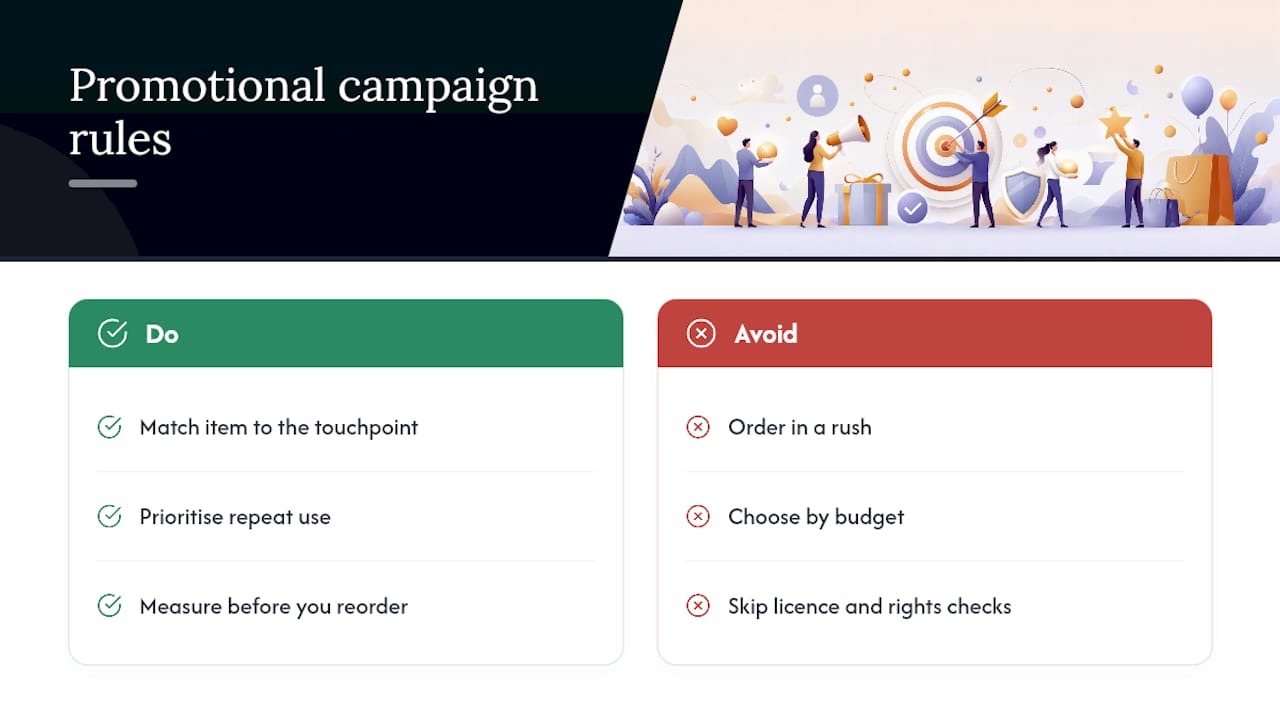
The first rule is to match the item to the touchpoint, not to the budget. A £0.50 pen handed to the right person at the right moment outperforms a £15 notebook given to someone who has no use for it. Distribution context should drive item selection, not the other way around.
The second rule is to prioritise repeat use. An item used once and discarded has a cost-per-impression that no marketing budget can justify. A reusable bottle, a quality notebook, or a well-made tote bag generates impressions for months. That is where the real return on promotional spend sits.
The third rule is to measure before you reorder. Assign a QR code or unique URL to every physical campaign, record the data, and use it to justify the next order. Without a tracking mechanism, you are guessing, and guessing is not a marketing strategy.
One caution worth stating plainly: always verify font licences, image rights, and trademark permissions before sending artwork to print. A reprint is expensive; a legal dispute is worse.
Fyldedigital’s print and promotional design service
Fyldedigital handles the full process from artwork creation through to print procurement and campaign integration, so you are not left coordinating between a designer, a printer, and a fulfilment house separately. The practical advantage for small and medium-sized businesses is a single point of contact who understands both the brand and the production requirements.
The service covers graphic design and brand-consistent artwork, supplier sourcing and sample approval, print production management, and advice on integrating physical materials with your digital campaigns. Whether you need a set of exhibition banners, a direct-mail postcard run, or a full onboarding pack for new clients, the process starts with a clear brief and ends with materials that actually match your brand.
Visit the print marketing services page to see what is included, or request a free marketing review to get a clear picture of where print fits into your current strategy. For bespoke artwork and brand identity work, the graphic design service covers logo files, brand guidelines, and print-ready templates.
Sources
- 22 examples of promotional materials | Adobe Express
- Definition of Promotional Materials: A Comprehensive Guide
- Custom Marketing Materials and Promotional Products | Canva
- Promotional Materials Examples: 25 Ideas
- How to Create Marketing Material – PaperTrue
- Lsi