Start today with three actions: audit your existing links in Google Search Console, identify one linkable asset you can create or update, and run a quick outreach sprint to reclaim unlinked brand mentions. Done consistently over several months, this approach builds the kind of authority that moves rankings and gets your business cited by AI answer engines like Perplexity and ChatGPT.
Your immediate action list:
- Audit (Day 1–3): Export your current backlink profile from Google Search Console. Note which pages attract links and which have none.
- Create one asset (Week 1–2): A localised data piece, a free calculator, or a well-researched guide. Tools like Ahrefs help you find what competitors are earning links with.
- Quick-win outreach (Week 2–4): Search for unlinked mentions of your brand and ask for the link. Fix broken inbound links. Both convert faster than cold guest-post pitches.
What to expect by timeline:
- 30 days: A cleaner link profile, a few reclaimed mentions, and one asset in production.
- 90 days: Early referral traffic from new links; keyword movement on pages you’ve internally linked to.
- 180 days: Compounding authority gains, measurable ranking improvements, and a repeatable outreach process. Link building is a long-term process, and digital PR in particular often takes months before delivering significant authority gains.
Fyldedigital works with UK SMBs at every stage of this journey, from the initial audit through to managed outreach campaigns.
Key takeaways
Building authority through backlinks requires a consistent, asset-first approach: start with quick wins, create one linkable resource, and measure referring domain growth monthly to confirm the strategy is working.
| Point | Details |
|---|---|
| Start with quick wins | Reclaim unlinked mentions and fix broken inbound links before investing in new asset creation. |
| Asset quality drives results | One well-researched guide or local data piece earns more links than ten low-value pages. |
| Measure referring domains monthly | Track new referring domains, referral sessions, and anchor-text mix in Google Search Console and Ahrefs or SEMrush. |
| Expect results within a few months | Keyword movement and compounding authority gains become measurable over time, generally within several months. |
| Fyldedigital manages the full cycle | From audit to outreach and monthly reporting, Fyldedigital runs managed link building campaigns for UK SMBs. |
Table of Contents
- Why do backlinks still matter so much in 2026?
- What makes a high-quality backlink in 2026?
- How to create assets that genuinely earn links
- Practical outreach tactics and step-by-step workflows
- How to funnel link authority into your commercial pages
- Which tools and KPIs should you track?
- What mistakes should you avoid when building backlinks?
- What is the right 90-day roadmap for your UK business?
- How Fyldedigital plans and runs link building campaigns
- What actually matters most in link building
- Fyldedigital’s link building services for UK SMBs
- Sources
Why do backlinks still matter so much in 2026?
A backlink is a hyperlink from one website to yours. Search engines read each link as a vote of confidence: the more credible the source, the more authority it passes. That mechanism has been central to Google’s ranking algorithm since PageRank, and it remains one of the strongest signals in 2026.
What has changed is the audience for those signals. Backlinks now influence AI/LLM visibility as well as traditional rankings. When Gemini, ChatGPT, or Perplexity decide which brands to cite in an answer, they draw on the same web of editorial co-citations and topical associations that search crawlers use. A business that earns links from credible, relevant sources builds brand associations that answer engines learn from. One that relies on low-quality directories does not.
Think of authority as a stack:
- Editorial links from relevant, credible publishers pass the strongest ranking signals.
- Contextual citations (mentions alongside trusted brands) build topical associations for AI systems.
- Ambient presence (consistent mentions, even without a link) reinforces brand recognition across both search and AI.
You can track your starting point in Google Search Console under the Links report. Understanding the importance of SEO in 2026 makes clear why off-page authority is no longer optional for competitive UK markets.
What makes a high-quality backlink in 2026?
A high-quality backlink serves four jobs: it passes authority, drives referral traffic, places your brand in editorial context for AI systems, and builds trust with new readers. Not every link does all four. Here is the checklist to evaluate any prospective link source:
- Topical relevance: Does the linking site cover your industry or a closely related one? A link from an irrelevant domain passes less authority and builds weaker topic associations.
- Editorial placement: Is the link embedded naturally within body content, or dropped in a footer, sidebar, or author bio? In-content links carry more weight.
- Source credibility: Check the domain’s own backlink profile. A site with strong, diverse referring domains is a better source than one with thin content and few inbound links.
- Link attributes: Dofollow links pass authority directly. Nofollow, UGC, and sponsored attributes signal the relationship to search engines without passing full equity. Both still contribute to brand visibility and AI citation potential.
- Anchor context: The words surrounding your link matter as much as the anchor text itself. A link placed next to phrases that describe your specialism reinforces topical relevance.
Pro Tip: For AI visibility specifically, watch for co-citation: being mentioned alongside established, trusted brands in the same paragraph or article. AI systems learn topic associations from these proximity signals, even when no link is present. Prioritise placements that put your brand in good company.
How to create assets that genuinely earn links
Outreach to low-value pages is usually high-effort and low-reward. The most reliable way to earn editorial links is to create something genuinely worth linking to. For UK SMBs, these asset types deliver the best return relative to the effort involved:
- Original data or local research: A survey of UK customers, a regional market snapshot, or a cost comparison specific to your sector. Journalists and bloggers link to primary data they cannot produce themselves.
- Free tools or calculators: A mortgage cost estimator, a carbon footprint calculator, or a project timeline builder. Tools attract links passively over months and years.
- Long-form cornerstone guides: Comprehensive, well-structured guides that answer a cluster of related questions. These earn links from other content creators who reference them. See Fyldedigital’s guidance on creative assets for campaigns for practical formats.
- Downloadable templates: Checklists, brief templates, or planning documents that save readers time.
Asset creation checklist:
- Define the brief: what question does this answer, and who will link to it?
- Identify your data source: original survey, public dataset, or proprietary client data.
- Set a methodology: be transparent about how figures were gathered.
- Plan promotion before you publish: which journalists, bloggers, or communities will you pitch?
Practical outreach tactics and step-by-step workflows
Reliable link building tactics cluster into a few proven categories. Here is how to execute the highest-return ones.
Broken link building
- Use Ahrefs or SEMrush to find pages in your niche with broken outbound links.
- Verify the broken URL returns a 404 and that your content is a genuine replacement.
- Email the site owner: identify the broken link, explain the problem, and suggest your page as a replacement. Keep the pitch to three sentences.
Guest posting
- Search for publications in your sector that accept contributed articles.
- Pitch a specific angle tied to their audience, not a generic topic.
- Deliver a well-written, original piece. Expect one contextual link within the body.
Digital PR
- Identify a data angle or expert opinion that is genuinely newsworthy.
- Produce a press-ready asset: a short release, a data visualisation, or a quote sheet.
- Pitch relevant journalists directly. Digital PR is scalable but resource-intensive, and results typically take months.
HARO and media responses
Platforms like Featured (formerly HARO) send daily journalist requests. Respond quickly with a concise, expert answer. A successful placement earns an editorial link from a credible publication with minimal asset creation required.

Reclaiming unlinked mentions
Search for your brand name in Google, then use SEMrush or Ahrefs to find pages that mention you without linking. A polite email asking for the link converts at a high rate because the writer already values your brand. Reclaiming mentions is often the quickest, highest-conversion opportunity for SMBs.
Priority matrix:
- Quick wins (start here): Reclaim mentions, fix broken inbound links, submit to a handful of high-quality, relevant directories.
- Strategic plays (build in parallel): Guest posting, original data assets, digital PR pitching.
How to funnel link authority into your commercial pages
Earning a backlink to a blog post is only half the job. Amplifying that authority with contextual internal linking is what moves your commercial pages in the rankings.
Internal linking checklist:
- Identify your pillar pages (the commercial pages you most want to rank).
- Add contextual links from newly linked blog posts to those pillar pages, using descriptive anchor text that reflects the target keyword.
- Avoid repeating the same exact-match anchor phrase across multiple internal links to the same page.
- Check canonical tags and noindex settings so authority is not leaking to duplicate or thin pages.
- Run a 301 redirect audit: if a page that earned links has moved or been deleted, redirect it to the closest live equivalent.
The authority flow works like this: an external link lands on a cluster post, which passes authority via an internal link to a pillar page, which in turn links to your money page. Each hop is deliberate. For a deeper look at how this fits into a broader SEO strategy step by step, Fyldedigital’s SMB guide covers the full picture.
Which tools and KPIs should you track?
Use Google Search Console for your link inventory, Ahrefs or SEMrush for historic backlink data and competitor gap analysis, and Google Analytics 4 for referral sessions. Together, these tools cover every layer of measurement you need.
Core KPIs to track monthly:
- New referring domains: The number of unique domains linking to your site. Growth here is the primary signal of a healthy campaign.
- Referral sessions: Traffic arriving via backlinks in GA4. A link that sends no traffic is worth less than one that does.
- Domain diversity: Are links coming from a range of different sites, or clustering around one or two sources?
- Anchor-text mix: A natural profile mixes branded, generic, and partial-match anchors. A profile dominated by exact-match anchors is a risk signal.
- Keyword movement: Track rankings for the priority pages you are internally linking to. Movement here confirms authority is flowing correctly.
Measurement cadence: In weeks 4–12, expect small gains in referring domains and the first referral sessions. By months 3–6, keyword movement on target pages becomes measurable, and the compounding effect of multiple links begins to show.
What mistakes should you avoid when building backlinks?
The risks in link building are real, and the penalties from Google for manipulative practices can take months to recover from.
Red flags to avoid:
- Paid link schemes or link exchanges at scale. Google’s guidelines treat these as manipulative, and the risk of a manual penalty outweighs any short-term gain.
- Low-value, irrelevant directories. A handful of quality, niche-relevant directories is fine; bulk submissions to generic lists are not.
- Over-optimised anchor text. If 80% of your inbound anchors use the same exact keyword phrase, that pattern looks unnatural to search algorithms.
- Private blog networks (PBNs). These are detectable and carry significant penalty risk.
If you spot a toxic link, contact the linking site and request removal first. Only use Google’s Disavow Tool as a last resort, after manual outreach has failed. Follow Google’s link spam guidelines and treat link building as a long-term reputation exercise, not a shortcut.
What is the right 90-day roadmap for your UK business?
A prioritised approach matches effort to impact. Where you start depends on where your site is now.
| Where you are | Start with | What you are building |
|---|---|---|
| New site (few referring domains) | Reclaim mentions, relevant directory listings, one cornerstone guide | A credible baseline profile and first editorial links |
| Growing site (dozens of referring domains) | Guest posting, broken link outreach, one original data asset | Topical authority and referral traffic from credible publishers |
| Scaling site (many referring domains) | Digital PR, HARO responses, linkable tool or calculator | High-authority placements and AI citation presence |
Resource estimates: Expect to invest 3–5 hours per week for a solo owner running quick-win tactics. A dedicated in-house marketer or a managed agency retainer can sustain the strategic plays. For a broader view of how link building fits into your overall plan, Fyldedigital’s digital marketing guide for small businesses covers channel sequencing and budget allocation.
Pick one quick win and one strategic asset to work on concurrently from day one. Waiting until the asset is finished before starting outreach is the most common reason campaigns stall.
How Fyldedigital plans and runs link building campaigns
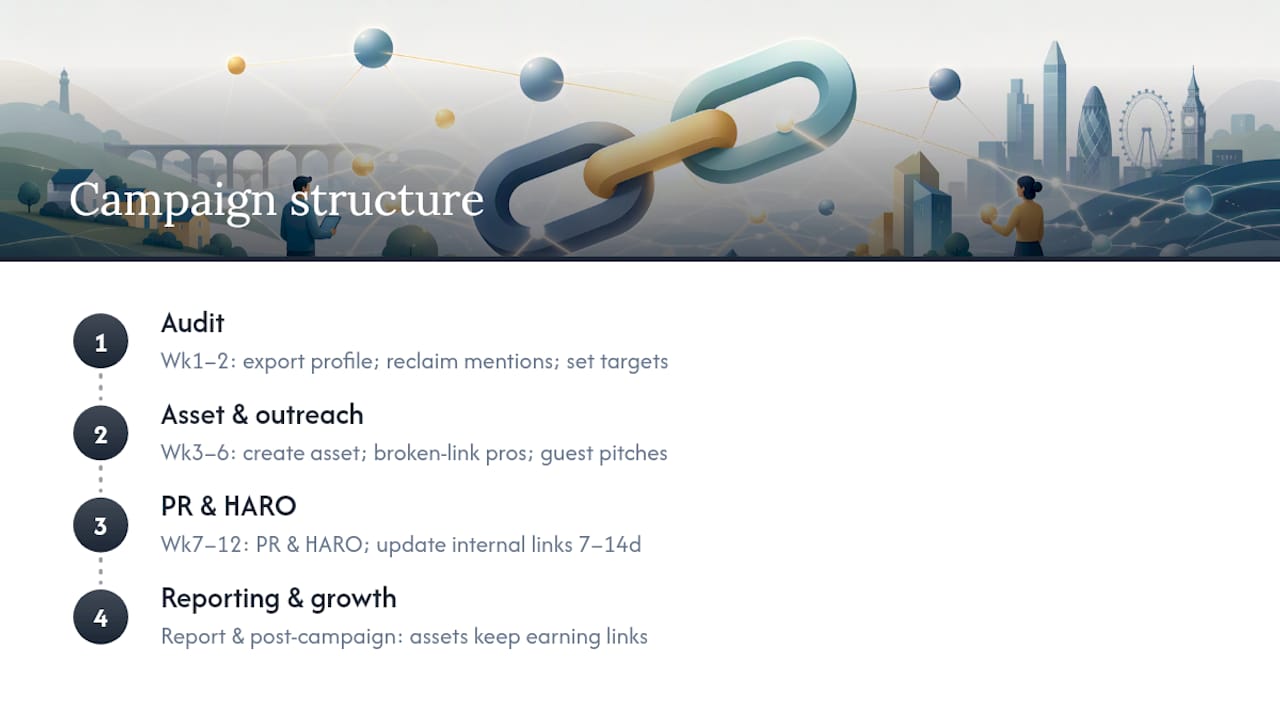
A 12-week Fyldedigital campaign follows a consistent structure. Weeks 1–2 cover the audit: exporting the existing link profile, identifying quick-win reclaim opportunities, and agreeing on the target pages. Weeks 3–6 focus on asset creation and initial outreach, typically combining broken link prospecting with the first guest post pitches. Weeks 7–12 shift to digital PR and HARO responses, with internal linking updates made within 7–14 days of each new link going live.
In one anonymised campaign for a UK professional services firm, the team identified 14 unlinked brand mentions in the first week. Converting those into live links produced measurable referral traffic within 30 days and contributed to a ranking improvement on two priority service pages by week 10. The asset created during the campaign, a sector-specific cost guide, continued earning links organically in the months that followed.
Fyldedigital’s services span SEO best practices, content creation, digital PR outreach, and full campaign reporting, giving UK SMBs a managed route to building authority without hiring a full in-house team.
What actually matters most in link building
The single habit that separates businesses that build lasting authority from those that spin their wheels is this: create something worth linking to before you ask anyone for a link. Every tactic in this guide works better when the destination page or asset is genuinely useful. Outreach without a strong asset is a cold call with nothing to offer.
Fyldedigital has seen this pattern consistently across UK SMB campaigns. The businesses that invest in one well-researched guide or one piece of original local data, then amplify it through structured outreach, outperform those chasing volume. Consistency matters more than intensity. A steady cadence of one new asset per quarter and weekly outreach activity compounds over 12–18 months into a profile that is genuinely hard to replicate.
Fyldedigital’s link building services for UK SMBs
Fyldedigital offers UK small and medium-sized businesses a managed path to building real search authority, without the overhead of an in-house SEO team. The agency handles the full campaign cycle: auditing your existing profile, identifying quick-win reclaim opportunities, producing linkable assets, running outreach, and reporting on referring domains, referral traffic, and keyword movement every month.
Where most businesses stall is the gap between knowing what to do and having the time and expertise to do it consistently. Fyldedigital closes that gap with a structured, transparent engagement: you agree the target pages and goals, the team handles the execution, and you receive clear monthly reporting tied to the KPIs that matter. To see how a managed SEO campaign could work for your business, visit the SEO best practices page or explore the full services overview to get started.
Sources
- Backlinks in 2026: What They Are & How to Get Them | Similarweb
- Beginner’s guide to link building | Moz
- The New Rules of High-Quality Backlinks (+ How to Build Them) | Backlinko
- Link Building for SEO: The Beginner’s Guide | Ahrefs
- How to Get Backlinks in 2026: 10 Tactics That Actually Work | SEMrush
- How to Build Backlinks: Step-by-Step Guide | SEOTakeoff Blog