SEO content writing is the practice of crafting valuable, readable content that ranks well in search engines while genuinely serving user intent. Get it right and your pages attract consistent organic traffic without paid advertising. Get it wrong and even well-written articles sit invisible on page four. This guide walks you through the full process, from keyword research and content briefs to metadata and ongoing updates, using tools like Clearscope, Grammarly, and Google Search Console to produce content that performs.
What do you need before writing SEO content?
Strong SEO content starts long before you open a blank document. The preparation stage determines whether your article ranks or wastes hours of effort.
Keyword research comes first. You need a primary keyword, but you also need semantic variants. These are related phrases and questions that signal to Google your content covers a topic thoroughly. Tools like Google Keyword Planner, Ahrefs, and Semrush all surface these variants quickly. Understanding SEO terminology helps you interpret what these tools are actually telling you.

A content brief keeps your writing on track. An effective SEO brief must include a primary keyword, 4–6 semantic variants, 8–12 long-tail questions, an intended reader profile, a format type, and key internal links. That level of detail sounds like admin, but it prevents the most common failure in SEO writing: producing content that answers the wrong question.
Before you write a single word, set these up:
- Primary keyword with monthly search volume confirmed
- 4–6 semantic variants covering related subtopics
- 8–12 long-tail questions drawn from People Also Ask and forums
- Intended format (guide, listicle, comparison, FAQ)
- Target word count based on competitor analysis
- Internal links you plan to include
Pro Tip: Analyse the top five ranking pages for your target keyword. Your target word count should sit approximately 15% above their average length. Longer does not mean better, but comprehensive coverage does.
Style guidelines matter too. Decide your reading level, tone, and whether you use first or second person before drafting. Consistency across your content builds brand recognition and makes editing faster.
How should you plan and structure SEO content?
Structure is not cosmetic. It directly affects how Google crawls your page and how readers decide whether to stay or leave.
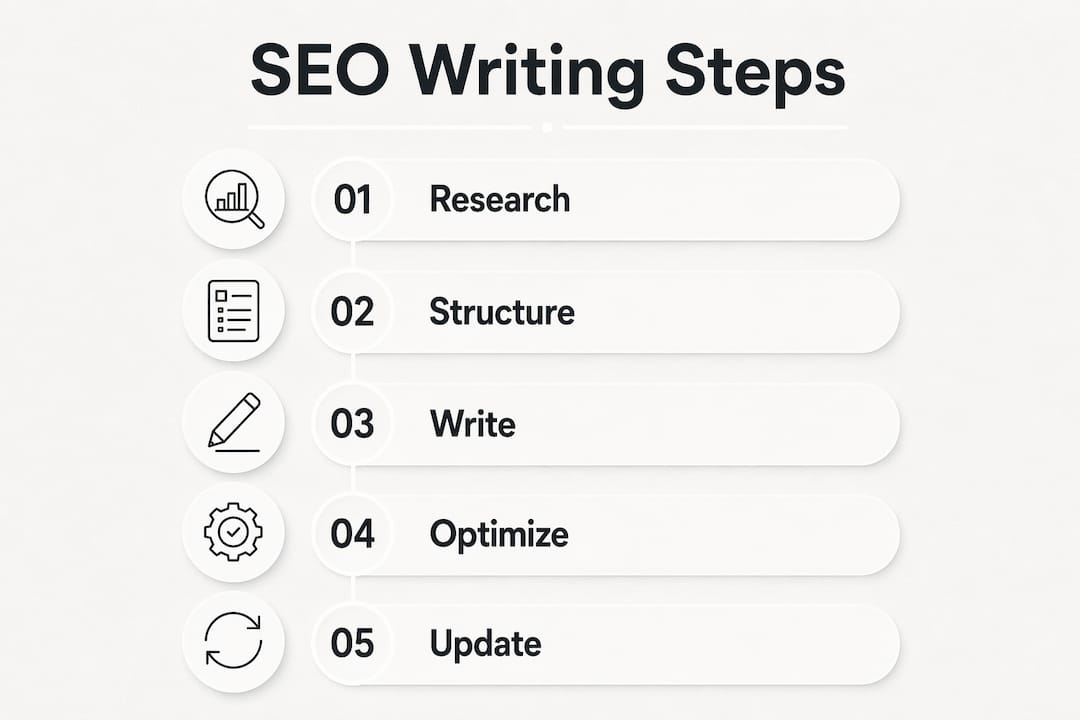
Analyse what already ranks
Open the top five results for your keyword. Note the format each uses, the depth of coverage, and the subtopics they address. This is not about copying. It is about understanding what Google already considers a satisfying answer. Intent alignment is the single biggest factor in whether keyword placement works at all. Mismatching intent nullifies everything else.
Build your heading hierarchy before you write
Creating your H1, H2, and H3 structure before drafting ensures logical flow and comprehensive coverage. It also prevents you from burying important subtopics or repeating yourself. Think of the heading hierarchy as a table of contents that both readers and search engine crawlers use to navigate your page.
The table below shows how different content formats suit different search intents:
| Search intent | Best content format | Example heading style |
|---|---|---|
| Informational | Long-form guide | “What is X?” / “How does X work?” |
| Navigational | Landing page | Brand or product name in H1 |
| Transactional | Product or service page | “Buy X” / “Get a quote for X” |
| Comparison | Listicle or table | “X vs Y: which is better?” |
| Local | Location page | “X services in [City]” |
Pro Tip: Place your primary keyword in the H1 and at least two H2 headings. Use semantic variants in the remaining H2s and H3s. This signals topical depth without repeating the same phrase mechanically.
Each section of your article should map to a specific user question or subtopic. If a heading does not answer something a reader would genuinely ask, cut it or reframe it. Padding out structure with vague headings like “Additional considerations” destroys both readability and crawlability.
Step-by-step guide to writing SEO content that ranks
With research done and structure built, the writing itself follows a clear process.
1. Write for the reader first
Google’s ranking systems reward content that satisfies users. Write naturally, then optimise. Forcing keywords into awkward positions signals low quality. Place your primary keyword in the title, within the first 100 words, and in two or three headings. After that, let semantic variants carry the load.
2. Keep paragraphs short and sentences varied
Paragraphs should contain 4–5 sentences maximum, with sentence length varying between 8 and 25 words. Short sentences create pace. Longer sentences allow nuance. Alternating between the two keeps readers engaged and improves AI summarisation of your content.
3. Use internal links with purpose
Internal links pass authority between pages and help Google understand your site structure. Link to relevant articles using descriptive anchor text. For example, a page about SEO writing might link to practical SEO strategies when discussing ranking techniques. Avoid linking the same URL twice in one article.
4. Optimise your metadata
Your title tag and meta description are the first things a searcher sees. Title tags under 60 characters and meta descriptions under 160 characters produce higher click-through rates. Write the title tag to include your primary keyword near the start. Write the meta description as a direct answer to the search query, not a summary of the article.
5. Add images with descriptive alt text
Every image needs an alt text that describes what is shown and, where natural, includes a keyword. Alt text serves two purposes: it helps visually impaired readers and it gives search engines additional context about your page’s topic.
The following elements belong in every piece of SEO content you publish:
- Primary keyword in title, first 100 words, and 2–3 headings
- Semantic variants distributed across body sections
- Internal links to related pages on your site
- External links to credible sources where relevant
- Title tag under 60 characters with primary keyword
- Meta description under 160 characters written as a direct answer
- Image alt text on every image
- FAQ section targeting People Also Ask questions
E-E-A-T (Experience, Expertise, Authoritativeness, Trustworthiness) is Google’s quality framework for ranking content. Injecting unique lived experience is the key ranking differentiator in 2026. Generic advice that could have been written by anyone ranks below content that demonstrates real knowledge.
How do you maintain and improve SEO content over time?
Publishing is not the finish line. Content that ranks well today can slip within months if left untouched.
Keyword stuffing still damages rankings. Repeating your primary keyword every other sentence reads as spam to both Google and real readers. Aim for natural density. If you find yourself forcing a keyword into a sentence, replace it with a semantic variant or pronoun.
Shallow content loses ground to competitors. If a rival publishes a more thorough answer to the same question, Google will favour theirs. Audit your existing content quarterly. Check whether top-ranking competitors have added sections, data, or examples you have not covered.
Pro Tip: Use Google Search Console to identify pages that rank on page two for valuable keywords. Updating those pages with additional depth, fresher data, and better internal links often moves them to page one faster than writing new content from scratch.
Maintaining strong SEO content means:
- Refreshing statistics and examples annually
- Adding FAQ sections to capture featured snippet opportunities
- Improving internal linking as you publish new related articles
- Monitoring bounce rate and average time on page in Google Analytics
Content cluster strategies also help here. Grouping related articles around a central pillar page builds topical authority across your site, not just on individual pages. This is how smaller sites compete against larger domains on competitive keywords.
Key takeaways
Effective SEO content writing requires intent alignment, structured planning, and consistent updates to maintain rankings and visibility.
| Point | Details |
|---|---|
| Research before writing | Build a brief with a primary keyword, 4–6 semantic variants, and 8–12 long-tail questions. |
| Structure drives rankings | Create your H1, H2, H3 hierarchy before drafting to ensure logical flow and full topic coverage. |
| Write for readers, optimise after | Place the primary keyword naturally in the title, first 100 words, and key headings. |
| Metadata lifts click-through rates | Keep title tags under 60 characters and meta descriptions under 160 characters. |
| Update content regularly | Quarterly audits and refreshes maintain rankings as competitors improve their pages. |
What I have learned from years of SEO writing
The biggest mistake I see content creators make is treating SEO as a checklist to complete after writing. Keyword density checked. Meta description added. Done. That approach produces content that technically ticks boxes but fails to rank because it never genuinely answered what the reader needed.
The shift that changed everything for me was treating SEO as a quality standard, not a separate genre. Good SEO writing is just good writing with structural awareness. When you start from the reader’s question and build outward, the keyword placement, the heading hierarchy, and the internal links all fall into place naturally.
I have also found that the content most likely to rank is the content that includes something no competitor has said. A specific example from your own experience. A data point you gathered yourself. A counter-intuitive observation. Google’s E-E-A-T framework rewards this. Generic content, however well-structured, is increasingly invisible.
The practical shortcut I return to constantly: read the top three ranking pages before writing a single word. Not to copy them, but to find the gap. What question do they all fail to answer clearly? Write the article that fills that gap and you have a genuine ranking opportunity.
— tibor
How Fyldedigital helps businesses get found online
Good SEO content does not exist in isolation. It works best when it sits on a well-structured, fast-loading website that Google trusts.

Fyldedigital works with businesses across the Fylde Coast and beyond to build websites and SEO campaigns that generate real enquiries. Whether you need a full SEO content strategy or a website that converts the traffic you already have, the team brings practical expertise to every project. If you are unsure where your current site stands, Fyldedigital offers a free SEO review to identify exactly where you are losing visibility and what to fix first. Reach out to find out what is holding your rankings back.
FAQ
What is SEO content writing?
SEO content writing is the practice of producing articles, pages, and other written content that rank well in search engines while genuinely serving reader intent. It combines keyword research, structural planning, and quality writing.
How do I choose the right keywords for SEO content?
Start with a primary keyword that matches your reader’s search intent, then identify 4–6 semantic variants using tools like Ahrefs, Semrush, or Google Keyword Planner. Long-tail questions from People Also Ask are particularly useful for FAQ sections.
How long should SEO content be?
Analyse the top five ranking pages for your target keyword and aim for a word count approximately 15% above their average. Length should reflect the depth needed to answer the question fully, not padding.
How often should I update existing SEO content?
Audit your content at least quarterly. Pages ranking on page two benefit most from updates. Refresh statistics, add new examples, and improve internal links to pages published since the original article went live.
What is E-E-A-T and why does it matter?
E-E-A-T stands for Experience, Expertise, Authoritativeness, and Trustworthiness. Google uses these signals to assess content quality. Including unique real-world insights and original observations is the most effective way to demonstrate E-E-A-T in 2026.