Yes, LinkedIn advertising earns its budget for most B2B businesses with a defined ideal customer profile and a deal size that justifies premium clicks. Start with Sponsored Content paired with native Lead Gen Forms, structure campaigns by audience type from day one, and test Thought Leader Ads once you have engaged employee voices to amplify. The rest is refinement: formats, targeting layers, budgets, and the measurement discipline that turns clicks into pipeline.
TL;DR:
- LinkedIn advertising works best for high-value deals, with longer sales cycles and a clear ideal customer profile, to justify its higher costs.
- Using audience layering and campaign separation improves targeting accuracy and prevents budget dilution across too-broad segments.
- Focus on engagement with tailored creative, especially headlines that address specific job functions and native Lead Gen Forms for better conversion rates.
- Key metrics to track include cost per lead and pipeline contribution, with proper tracking setup to measure actual impact on sales.
- Strengthening campaigns with employee amplification and disciplined audience management significantly increases pipeline results.
Table of Contents
- Why LinkedIn is a strong channel for B2B (and when it isn’t)
- LinkedIn ad formats and which to use for each objective
- How do you target the right B2B buyers on LinkedIn?
- Campaign structure, bidding and realistic budgets
- Creative and copy best practices specific to B2B
- What metrics actually matter for LinkedIn B2B campaigns?
- Common pitfalls and practitioner pro tips
- Getting started: six steps to launch a test campaign
- What running client LinkedIn programmes actually teaches you
- How Fylde Digital can help with LinkedIn ads for B2B
- Sources
Why LinkedIn is a strong channel for B2B (and when it isn’t)
LinkedIn’s advantage isn’t reach. It’s the professional targeting layer, matched against a buying mindset you won’t find on other platforms. You can put an ad in front of a Head of Procurement at a 200 to 500 employee manufacturer and know, with reasonable confidence, that the person seeing it can actually sign a purchase order. No other advertising platform offers that combination of job title, seniority, and company-level precision at scale.
That precision comes at a price, and it only makes sense under certain conditions.
- Deal value and lifetime value need headroom. If your average contract is worth thousands rather than tens, LinkedIn’s cost structure will eat your margin before it delivers a lead.
- Impulse or low-consideration products struggle here. LinkedIn users are in a work mindset, not a browsing one, so anything that depends on spontaneous purchase intent underperforms.
- Judge cost per opportunity, not cost per click. A £12 click that converts to a qualified sales conversation beats a £2 click that converts to nothing, every time.
- Longer sales cycles suit the platform better. B2B buying committees research for weeks or months, and LinkedIn’s professional context fits that rhythm.
Expect to pay more per click and per thousand impressions than you would on Meta or Google Display. The trade is quality: fewer, better-qualified leads rather than a flood of unqualified ones.
LinkedIn ad formats and which to use for each objective
Every campaign objective on LinkedIn maps to a specific format, and picking the wrong one is the fastest way to waste a test budget. Here’s the practical breakdown.
- Single image ads work for straightforward awareness and consideration campaigns. Simple, fast to produce, and a reliable baseline to test messaging against.
- Carousel ads suit storytelling and multi-point value propositions. Large-scale analyses of company posts found carousel content generates significantly more impressions than standard formats, which makes it worth the extra production time.
- Video ads are best for top-of-funnel awareness, particularly demo snippets or founder-led explainer content. The first three seconds carry the entire weight of the ad; if the hook doesn’t land immediately, the rest never gets watched.
- Document ads let prospects flip through a PDF natively in-feed. They perform well for whitepapers, benchmark reports, and short guides used as consideration-stage content.
- Thought Leader Ads promote an individual employee’s organic post as a sponsored unit. They need genuine engagement on the original post first. Don’t force this format on a post with no traction.
- Sponsored Messaging delivers directly to LinkedIn inboxes and works for event invitations, demo bookings, or account-specific outreach at the bottom of the funnel.
- Dynamic ads personalise creative using the viewer’s own profile data, useful for follower or job-application campaigns rather than lead generation.
- Connected TV ads extend brand campaigns to streaming devices; a niche tool for enterprise brand budgets, not a starting point for SMB testing.
- Lead Gen Forms aren’t a standalone format but a conversion mechanic layered onto other formats, pre-filling a prospect’s profile data to remove friction from form completion.
For a first test, pair single image or carousel creative with a Lead Gen Form, run one video ad for top-of-funnel reach, and hold Thought Leader Ads in reserve until an organic post proves itself.
Pro Tip: Keep carousels between five and eight slides. Fewer feels thin; more and you lose the swipe-through rate that makes the format work.
How do you target the right B2B buyers on LinkedIn?
Start by translating your ideal customer profile into LinkedIn’s targeting attributes rather than guessing at interests or behaviours. LinkedIn lets you stack job title, seniority, function, company size, and industry in ways no other social platform matches, and that stacking is where the real precision lives.
A workable ICP translation might combine “VP or Director level,” “Function: Marketing,” and “Company size: 51 to 500 employees” rather than relying on a single attribute alone. Layering two or three attributes narrows the audience to people who genuinely match your buyer, and building detailed buyer personas before you open the campaign builder makes that translation far faster.
- Matched Audiences let you upload CRM lists or target website visitors tagged by the Insight Tag, forming the backbone of any retargeting or account-based campaign.
- Company lists for ABM work best when kept tight. Fifty to two hundred named accounts is usually more effective than a broad industry filter.
- Predictive (lookalike) audiences need a decent seed list to function properly. Seed audiences of several hundred to a thousand conversions give the algorithm enough signal to find similar profiles reliably.
- Exclusions protect budget. Exclude existing customers from cold campaigns and exclude cold-audience clickers from retargeting once they’ve converted, so you’re never paying twice for the same person.
A common mistake is stacking so many attributes that the audience drops below 1,000 people, which starves the campaign of delivery. If your estimated audience size looks tiny, drop one filter rather than launching anyway.
Campaign structure, bidding and realistic budgets
Structure campaigns by audience type, not by creative variant. Cold prospecting, website retargeting, and account-based lists each behave differently, and mixing them in one campaign lets LinkedIn’s optimisation chase the cheapest conversions in that blend, which usually means the algorithm favours whichever segment clicks easiest rather than the segment most likely to buy.
- Build three separate campaign groups: cold audiences for awareness and top-of-funnel lead gen, retargeting audiences for warmer consideration content, and ABM lists for account-specific messaging.
- Choose your bid strategy by goal. Maximum Delivery suits early testing when you need volume of data fast. Manual CPC gives more control once you understand your audience’s typical cost. Target Cost works well for lead gen campaigns once you know your acceptable cost per result.
- Set a minimum viable test budget. You need enough spend to reach statistical confidence within two to four weeks, not two to four days.
- Design A/B tests with one variable at a time. Test headline against headline, or creative against creative, but not both simultaneously, or you won’t know which change drove the result.
- Scale winners gradually. Increase budget on a winning ad set by roughly 20 to 30% every few days rather than doubling it overnight, which resets the learning phase and temporarily inflates cost per result.
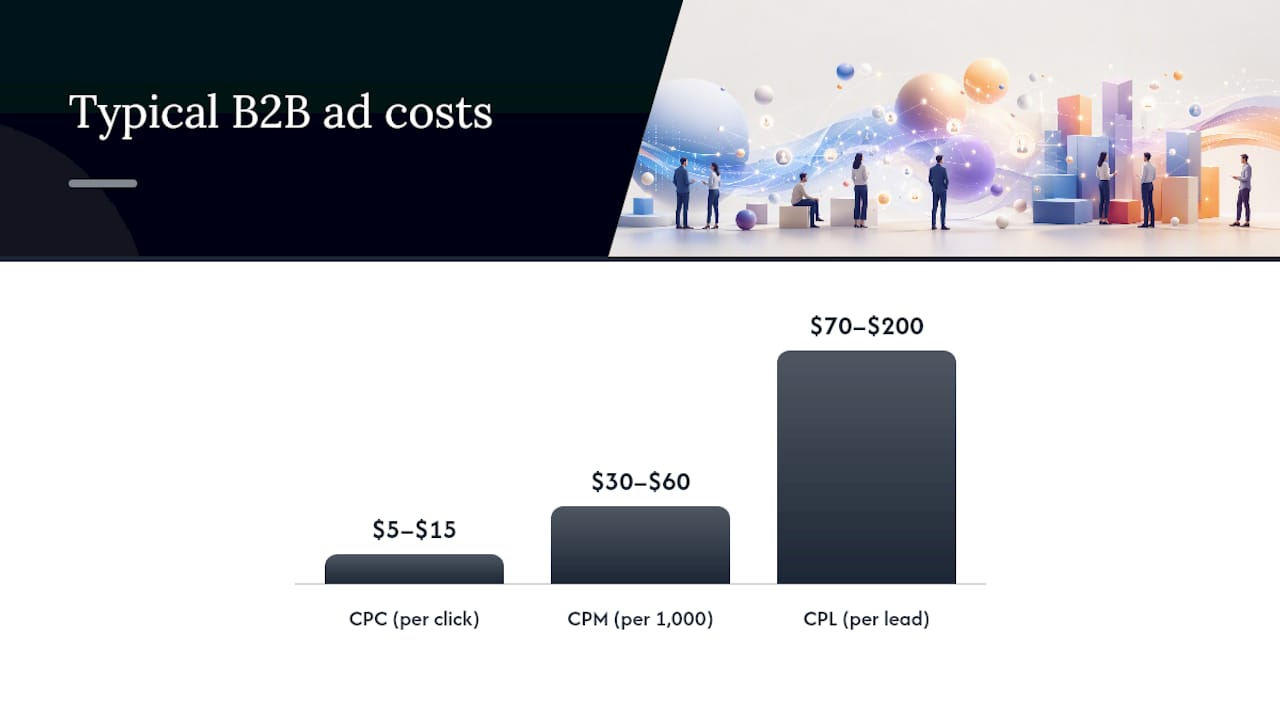
Typical B2B benchmarks put CPC in the $5 to $15 range and CPM around $30 to $60, with cost per lead varying widely by industry, often landing anywhere from $70 to $200. Small and mid-sized businesses testing a new campaign should plan for a monthly budget that can sustain at least 30 to 50 leads before drawing conclusions, since anything smaller makes the data too noisy to act on. Our guide to planning PPC budgets covers the same allocation logic in more depth if you’re building a media plan across channels.
Pro Tip: Give every new campaign at least 50 clicks before touching the bid or the audience. Early data lies.
Creative and copy best practices specific to B2B
The best-performing LinkedIn creative reads like a professional insight, not a slogan. A headline built around a specific job function (“Finance Directors: here’s what’s eating your Q1 margin”) consistently outperforms a generic brand line, because it signals immediately that the ad was written for that exact reader.
- Open with the problem, not the product. The first line needs to earn the scroll-stop before anyone reads what you’re selling.
- Design mobile-first. Most LinkedIn feed traffic is on a phone, so text on carousel slides needs to be legible at thumbnail size, and video needs captions burned in.
- Lead video with a hook in the first three seconds. A talking-head opener with no context loses the viewer before the message lands.
- Use Thought Leader Ads only on posts with organic traction. LinkedIn’s algorithm now rewards genuine engagement in the first 90 minutes after publishing, so a post that struggled organically won’t suddenly perform once you put budget behind it.
- Amplify employee voices, not just the company page. Personal profiles consistently earn more feed visibility than branded posts, which is exactly why Thought Leader Ads exist as a format.
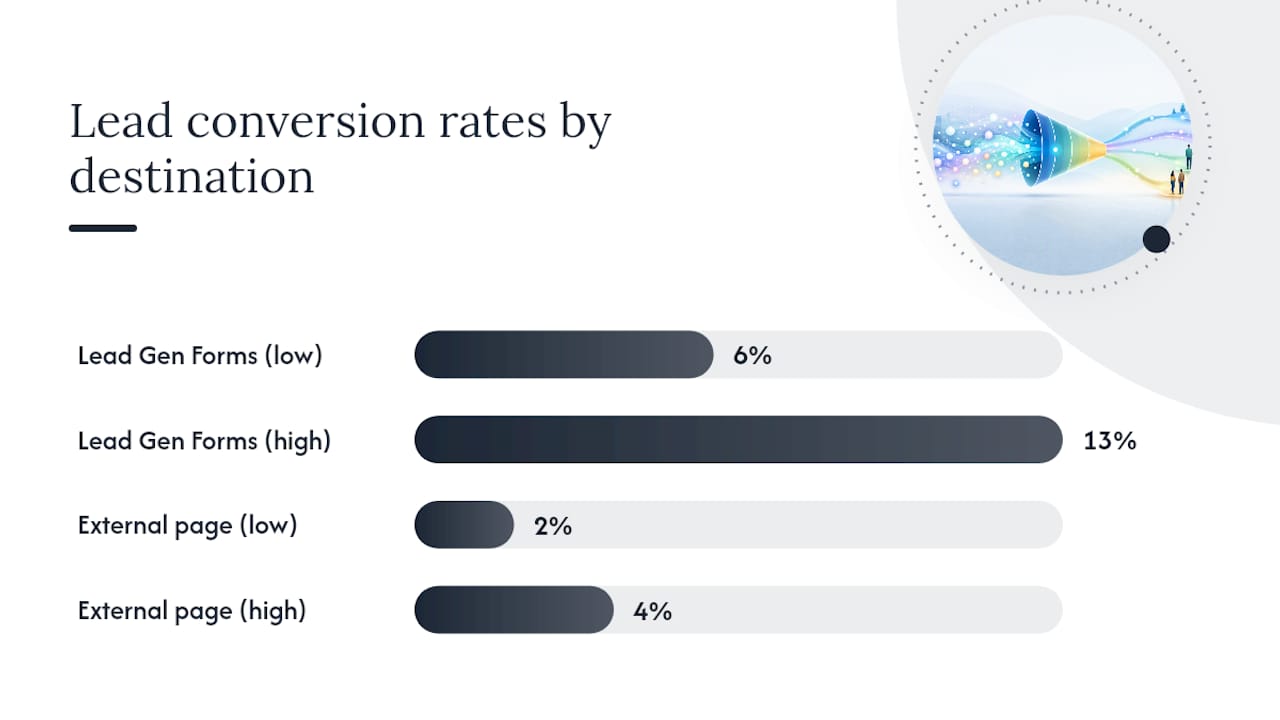
For the landing experience, native Lead Gen Forms typically convert at 6 to 13%, against roughly 2 to 4% for external landing pages, because they remove the friction of manual data entry. Use the native form for top-of-funnel offers like guides or webinars, and switch to an external landing page when you need to qualify harder or show more product detail before capturing contact information. Fylde Digital’s guide to landing pages that generate leads covers when that trade-off is worth making.
Pro Tip: Write three headline variants before you write any body copy. If none of them work without the image, the concept isn’t strong enough yet.
What metrics actually matter for LinkedIn B2B campaigns?
Every LinkedIn metric maps to a specific stage of the funnel, and reading the wrong metric for your objective is one of the most common ways teams misjudge a campaign’s performance.
- Reach and CPM tell you whether an awareness campaign is delivering efficiently, nothing more.
- CTR and engagement rate signal whether the creative and hook are working at the consideration stage.
- Landing page views (LPV) show whether the click actually resulted in a loaded page, which catches technical or targeting problems that CTR alone hides.
- Cost per lead (CPL) is the headline number for lead gen campaigns, but only meaningful alongside lead quality.
- Pipeline contribution and cost per opportunity are the numbers that actually justify the spend to a finance team.
Install the LinkedIn Insight Tag on your site before you launch anything, and connect it to your CRM so leads captured through Lead Gen Forms sync automatically rather than sitting in an export nobody checks. That single step is the difference between knowing your CPL and knowing your cost per closed deal.
Attribution note: B2B sales cycles rarely close in the same week a lead converts, so use a lead-to-opportunity attribution window of 30 to 90 days rather than judging a campaign on last-click data alone. If a channel’s CPL looks high but its lead-to-opportunity rate is strong, that’s a reallocation signal towards more spend, not less. Fylde Digital’s breakdown of measuring PPC success properly walks through building that measurement window in practice.
Common pitfalls and practitioner pro tips
Most wasted LinkedIn budget traces back to one of a handful of repeatable mistakes.
- Mixing audience types in one campaign lets the algorithm chase the cheapest conversions, which is usually the wrong segment.
- Underfunding the learning phase and then panicking at day three cost-per-result data, before the algorithm has had time to find its footing.
- Widening targeting before tightening it when a campaign underperforms, when the fix is almost always the opposite.
- Weak first lines and vague CTAs (“Learn More” tells a prospect nothing about what happens next).
- Overusing hashtags in ad copy, which reads as amateurish in a feed built for professional context.
Pro Tip: Three quick wins for faster impact: get two or three employees posting weekly so Thought Leader Ads have material to amplify, build a retargeting cadence that re-engages website visitors within 14 days of their first visit, and shoot every video ad vertically or square, never landscape.
Getting started: six steps to launch a test campaign
You can have a genuine test live within a single working week if you follow this order.
- Confirm your ICP and pick one objective. Lead generation or website conversions, not both, for the first test.
- Install the LinkedIn Insight Tag on your site so tracking is live before the campaign launches, not after.
- Prepare your primary asset, either a Lead Gen Form offer or a landing page with a clear single call to action.
- Build your audiences as separate campaign groups: one cold, one retargeting, one ABM if you have the account list ready.
- Select your formats (single image or carousel plus a Lead Gen Form) and set a bid strategy suited to volume, typically Maximum Delivery for the first fortnight.
- Set your budget at a level that can sustain at least 30 to 50 leads before you draw conclusions.
Check performance daily for the first week, then weekly. If cost per result is wildly unstable after day ten, tighten targeting before you touch the budget. If delivery is too low, widen by one attribute rather than several at once.
What running client LinkedIn programmes actually teaches you
Two lessons repeat themselves across almost every LinkedIn account worth watching. First, the campaigns that move real pipeline are structured with almost boring discipline: cold, retargeting, and ABM kept strictly apart, budgets reviewed weekly rather than daily, and creative refreshed before fatigue sets in rather than after. Second, the single biggest lever most businesses ignore is employee amplification. A founder or salesperson posting consistently, then having that post boosted through Thought Leader Ads, routinely outpulls a polished company-page ad built from scratch.
Some agencies run PPC and social advertising engagements for small and mid-sized businesses that need this discipline applied without hiring an in-house media buyer. The pattern holds across sectors: the clients who treat LinkedIn as a structured, measured channel get further than those who treat it as an occasional boosted post. If you want a second opinion on how your current setup compares, a campaign review is a sensible next step before you commit more budget.
— tibor
How Fylde Digital can help with LinkedIn ads for B2B
Some agencies are practical alternatives to hiring a full-time media buyer or muddling through campaign settings alone: offering PPC management, landing-page design, and analytics tracking bundled under one team, without a lengthy onboarding process before anything goes live.
Running LinkedIn ads well means managing three moving parts at once: the campaign structure covered above, a landing experience that actually converts, and tracking that connects ad spend to real pipeline. Fylde Digital’s PPC management service handles campaign build and bid strategy, while the team’s landing page work makes sure the click doesn’t go to waste once it lands. Analytics setup, including Insight Tag installation and CRM syncing, means you see cost per opportunity rather than guessing at cost per click.
If you’re weighing up whether LinkedIn deserves a slice of your marketing budget, request a free campaign review and get a straight answer on where your current setup is losing leads and where it’s already working.
Sources
- B2B LinkedIn Strategy for the New Algorithm
- 13+ data-driven LinkedIn tactics for B2B marketers and founders
- LinkedIn ads guide (Hootsuite)
- LinkedIn ads for B2B: the tactical guide (2026)