A lot of business owners ask the same question when leads are slow and growth feels stuck: should you invest in seo or google ads? It sounds like a simple either-or decision, but for most businesses, the right answer comes down to timing, budget, competition and how quickly you need results.
If your website is not bringing in enough enquiries, choosing the wrong channel can waste both money and momentum. Choose well, and you can build a marketing engine that not only attracts traffic, but turns it into genuine commercial value.
SEO or Google Ads: what is the real difference?
SEO helps your website appear in the organic search results. You are not paying for each click, but you are investing in the work needed to earn visibility – technical improvements, page content, keyword targeting, site structure and authority over time.
Google Ads puts you at the top of the page much faster through paid placements. You bid on search terms, pay when someone clicks, and gain immediate visibility for the services or products you want to promote.
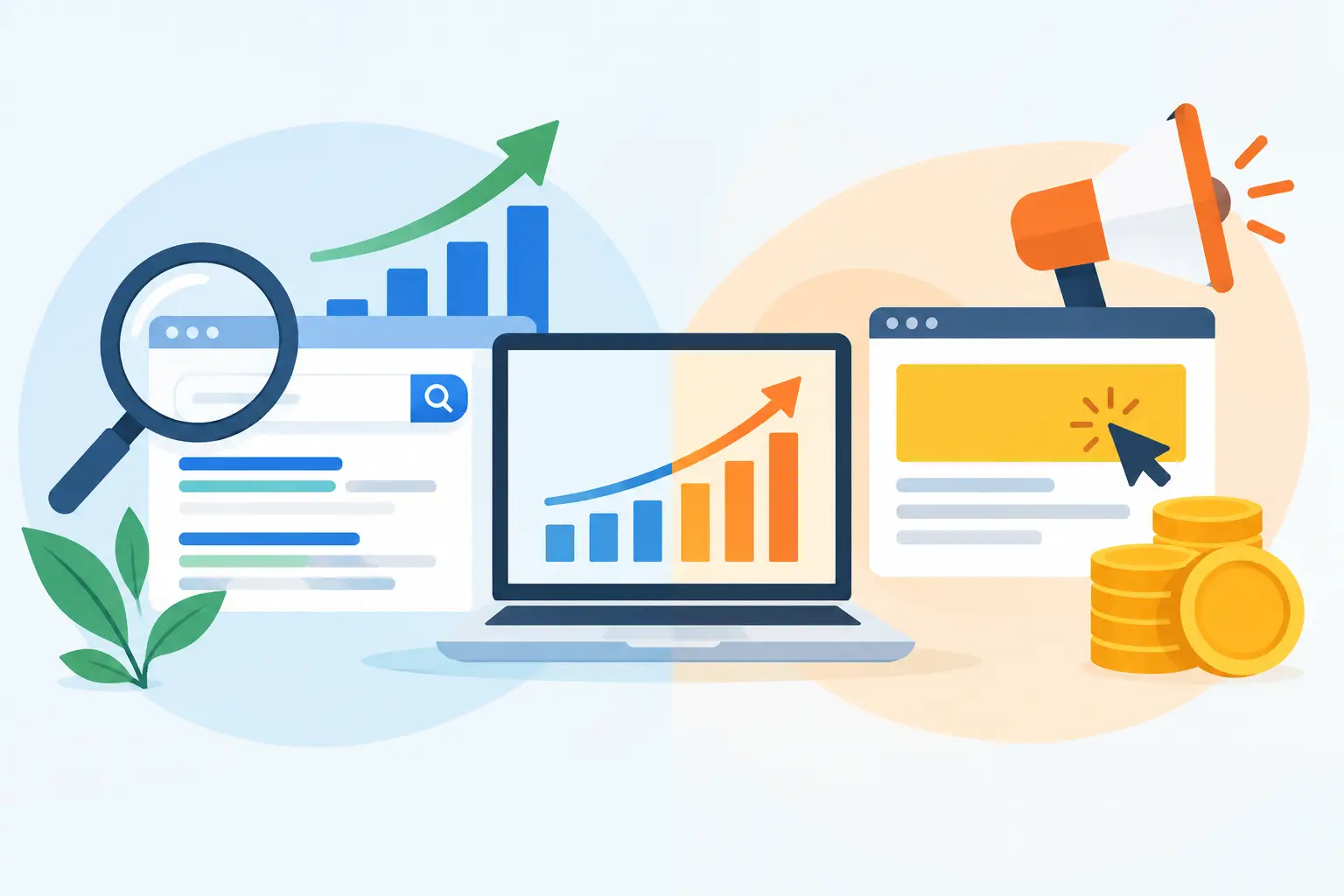
That difference matters. SEO is usually slower to build but can create long-term value. Google Ads is faster to launch but stops the moment you stop funding it. One builds an asset. The other buys attention.
Neither is automatically better. The stronger question is which one fits your business stage, your market and your sales goals.
When SEO is the better investment
SEO tends to suit businesses that want sustained growth rather than a short burst of leads. If you offer services people search for regularly, and you want to reduce reliance on paid media over time, SEO is often the smarter long-term move.
For example, if you are a local trades business, dental practice, gym, solicitor or retailer with steady demand, strong organic visibility can keep delivering enquiries month after month. Once key pages begin ranking well, each additional lead often costs less than it would through paid clicks.
That said, SEO is not instant. In competitive sectors, it can take months to build traction. If your website is weak, slow, poorly structured or thin on content, progress may take even longer. This is where some businesses get frustrated. They invest for a few weeks, see no immediate shift, and assume it does not work.
The real value of SEO is that it keeps working beyond the first campaign window. A well-optimised site can become a dependable source of enquiries, especially when paired with strong web design and clear conversion paths.
SEO works well when:
- you want lower lead costs over time
- your customers research before they buy
- you need long-term visibility in your local area
- your website can be improved into a stronger sales tool
If your ambition is to build a more resilient digital presence, SEO deserves serious attention.
When Google Ads makes more sense
Google Ads is often the right choice when speed matters. If you need leads quickly, have a clear offer, and can handle enquiries now, paid search can put you in front of the right audience almost immediately.
This is especially useful for new websites with no existing search authority. It also suits seasonal campaigns, service launches, promotions and high-value lead generation where one new customer can justify a healthy cost per acquisition.
There is also more control. You can target specific keywords, locations, times of day and landing pages. That makes Google Ads highly practical for testing. If you want to know whether people are searching for a service before investing heavily in organic content, ads can give you that answer quickly.
But there is a trade-off. Clicks can be expensive, especially in competitive sectors. If campaigns are poorly managed, budget disappears fast. Sending paid traffic to a weak website only magnifies the problem. You pay for every visit, so the quality of your landing pages, messaging and offer matters just as much as the ad itself.
Google Ads works well when:
- you need leads in the short term
- you are entering a new market
- you have a time-sensitive campaign
- you want quick data on buyer demand
For businesses that need traction now, it can be a strong commercial lever.
SEO or Google Ads for local businesses?
For many businesses across Blackpool, Lancashire and the wider Fylde Coast, local intent changes the picture. People searching for nearby services often want a fast, trustworthy answer. That means both SEO and Google Ads can perform well, but in slightly different ways.
Local SEO helps you show up when people search for services in your area. It supports map visibility, location-based searches and ongoing credibility. If someone repeatedly sees your business ranking well, trust grows before they even click.
Google Ads can capture that same local demand immediately, especially for high-intent searches such as emergency services, appointments or urgent quotes. If someone needs a plumber, accountant or driving instructor today, being visible at the top of the page can make the difference.
The key is understanding customer urgency. If your audience researches carefully and compares providers, SEO often compounds well. If they need action quickly, ads may convert faster.
Cost, speed and return on investment
This is where the decision becomes commercial rather than technical.
SEO usually requires upfront investment in strategy, on-site improvements, content and ongoing optimisation. Results take longer, but if your rankings strengthen, your cost per lead often improves over time. The return can be excellent, especially if your business relies on repeat search demand.
Google Ads gives you immediate access to traffic, but every click has a price. In some sectors that price is manageable. In others, it is steep. Good campaign management can improve efficiency, but paid media always needs budget to keep producing results.
If your question is purely about speed, Google Ads wins. If your question is about building a channel that grows in value over time, SEO usually has the edge.
If your question is about ROI, it depends on how well your whole funnel performs. Strong ads with poor landing pages will struggle. Strong SEO on a dated website will also underperform. Traffic matters, but conversion matters more.
Why the best answer is often both
The strongest marketing strategy is not always seo or google ads. Very often, it is SEO and Google Ads working together.
Ads can generate leads while SEO builds momentum. SEO can reduce long-term dependence on paid traffic. The search data from Google Ads can reveal which keywords convert best, helping shape your organic content strategy. At the same time, strong SEO landing pages can improve ad performance by giving paid visitors a better experience.
This joined-up approach is where many businesses see the best results. Rather than forcing one channel to do everything, each one does the job it is best suited to.
For example, a business might use Google Ads to target high-intent service searches straight away, while investing in SEO for broader service pages, location pages and long-term search growth. Over time, paid spend can be refined around the most profitable terms while organic visibility continues to expand.
That is a far more commercially sensible approach than treating channels in isolation.
How to choose the right option for your business
Start with three practical questions.
How quickly do you need leads? If the answer is immediately, Google Ads is likely to be part of the plan. If you can invest with a longer view, SEO becomes more attractive.
What is the value of a new customer? If a single sale or contract is worth a healthy amount, paid clicks may still offer strong returns. If margins are tighter, building organic visibility may be more sustainable.
Is your website ready to convert traffic? This is the question too many businesses skip. If your site is outdated, unclear or difficult to use, neither SEO nor ads will reach their potential. Before scaling traffic, make sure the website can do its job properly.
This is why joined-up digital marketing matters. A channel decision should never happen in isolation from design, content, conversion and brand positioning. If your online presence looks sharp but does not generate enquiries, something is missing. If it generates clicks but not sales, the issue may not be the traffic source at all.
At Fylde Digital, that is the thinking behind a more integrated approach. Creative work needs commercial purpose, and performance marketing works best when the full digital picture is aligned.
The smart way to think about seo or google ads
Do not treat this as a debate where one side wins outright. Think of it as choosing the right tool for the next stage of your growth.
If you need immediate visibility, Google Ads can get you moving. If you want to build authority and reduce lead costs over time, SEO is a strong long-term asset. If you want the best chance of sustainable growth, combining both usually gives you more control, more data and better resilience.
The right strategy is the one that matches your goals, your budget and your capacity to turn attention into business. Start there, and your marketing becomes far easier to scale.