An SEO strategy step by step is a structured process that moves your business from technical audits through keyword research, content planning, on-page optimisation, and performance tracking to deliver sustainable organic growth. Most small business owners treat SEO as a one-off task. It is not. It is a repeating workflow that compounds over time. The industry term for this approach is an SEO strategy workflow, and it covers everything from fixing crawl errors to writing service pages that convert. This guide gives you the exact process, grounded in 2026 best practices including AI-driven search behaviour, so you can build visibility that lasts.
What does an SEO strategy step by step actually involve?
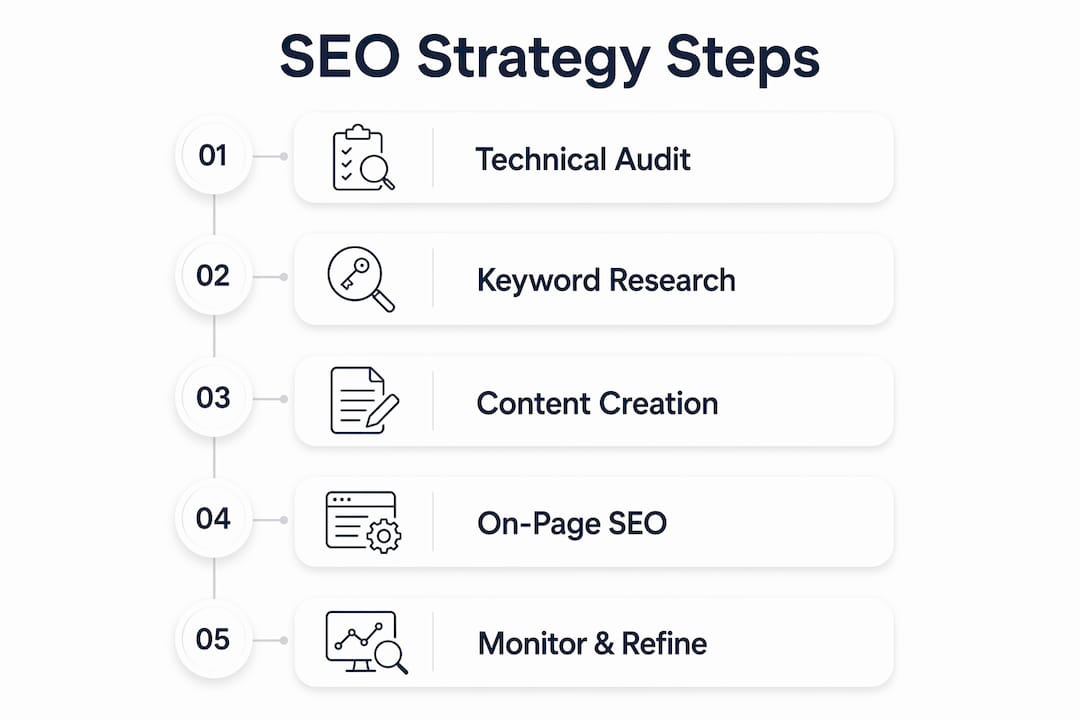
An SEO strategy is a sequence of deliberate steps, not a collection of random tactics. Each step builds on the last. Skip one and the whole structure weakens. The process begins with a technical audit, moves through keyword research and content creation, and ends with ongoing measurement and refinement. Google Search Console sits at the centre of the monitoring phase, giving you impressions, crawl frequency, and position changes that tell you what is working and what needs attention.

The reason most SEO efforts stall is not a lack of effort. Most strategies fail because they prioritise keyword lists over understanding the user’s journey. A keyword list without a content plan is just a spreadsheet. A content plan without a technical foundation is a house built on sand. Following a clear, ordered process is what separates businesses that chip away at real results from those that spin their wheels.
How to conduct a technical SEO audit
A technical SEO audit is the first step in any credible SEO strategy workflow. It tells you whether search engines can actually find, crawl, and index your site. Without this foundation, every other effort is undermined.
An initial audit takes roughly 4 hours in the first week. After that, expect to spend 4–5 hours per week on ongoing technical fixes. That time investment is not optional. Technical debt compounds quickly, and a site riddled with broken links or duplicate content will not rank no matter how good the content is.
Audit checklist: what to look for
- Broken internal and external links
- Duplicate or thin content across pages
- Missing or duplicate title tags and meta descriptions
- Mobile usability errors
- Slow page load speeds (especially on mobile)
- Crawl errors flagged in Google Search Console
- Missing XML sitemap or robots.txt issues
- Unoptimised images without alt text
Google Search Console is the primary dashboard for spotting crawl errors and indexing issues. Pair it with a site crawl tool to catch broken links and duplicate content at scale. Once you have a clean list of issues, prioritise by impact. Fix crawl blocks and mobile errors first. They affect every page on your site.
Pro Tip: Re-run your full audit every 2–3 months. Technical debt accumulates silently. A quarterly check catches problems before they compound into ranking drops.
For a detailed walkthrough of what to check, Fyldedigital’s SEO audit checklist covers each item with practical guidance for small business sites.
How do you perform keyword research aligned to user intent?
Keyword research is the process of identifying the exact words and phrases your potential customers type into search engines. The goal is not to find the highest-volume terms. The goal is to find terms that match what your buyer is actually trying to do.
Modern keyword research splits intent into four categories: informational (learning), navigational (finding a brand), commercial (comparing options), and transactional (ready to buy). Your service pages need transactional and commercial keywords. Your blog content handles informational queries. Mixing these up is one of the most common mistakes small businesses make.
Target keywords must appear in the first 100 words of a page to signal relevance to both traditional search engines and AI-driven answer engines. That means your opening paragraph does real ranking work. Do not bury your main keyword three paragraphs down.
Factors to prioritise when selecting keywords
- Search volume relative to your market size
- Keyword difficulty versus your current domain authority
- Commercial or transactional intent for revenue-driving pages
- Local modifiers for geographically targeted businesses
- Semantic variants that cover related questions
Pro Tip: Before writing any new page, analyse the SERP for your target query. Look at what types of content rank: articles, service pages, videos, or local listings. Match your format to what Google is already rewarding for that query.
Fyldedigital’s guide on keyword research for 2026 goes deeper on matching keyword types to content formats for small business sites.
How to create and optimise content for 2026 search
Content planning follows directly from keyword mapping. Once you know which terms you are targeting and what intent they carry, you can assign each keyword to a specific page type. Service pages handle transactional intent. Blog posts handle informational queries. Landing pages handle campaign-specific commercial intent.
The first 300 words on a service page are the primary ranking signal for both search engines and AI models. Those words must directly answer the buyer’s question. State the service, name the problem it solves, and tell the reader who it is for. Do not open with your company history.
A well-built service page functions as a lead magnet. Service pages designed around buyer intent with a clear call to action consistently outperform generic pages in both rankings and conversions. The structure matters as much as the words.
Must-have sections for a high-converting service page
- A clear headline naming the service and the outcome
- An opening paragraph (first 300 words) answering the buyer’s core question
- A list of specific problems the service solves
- Social proof: testimonials, case studies, or client results
- A transparent explanation of your process or approach
- A direct, low-friction call to action
Pro Tip: Updating existing underperforming pages delivers a faster return than writing new ones. Content updates are the highest-ROI SEO activity in 2026. Identify pages ranking in positions 11–20 and refresh the opening section, add schema markup, and improve internal linking.
What are the on-page and technical SEO best practices for 2026?
On-page SEO is the practice of optimising individual pages so search engines understand their content and rank them for the right queries. In 2026, this means going beyond meta tags. On-page SEO now requires making content AI-readable through schema markup and clear heading hierarchies. AI answer engines pull from structured, logically organised pages. Unstructured pages rarely appear in AI-generated results.
Structured, well-organised content improves user engagement and increases the chance of appearing in AI snippets. That means using H2 and H3 headings consistently, keeping paragraphs short, and placing your primary keyword in the title tag, the first paragraph, and at least one subheading.
| Optimisation element | Impact | Common error |
|---|---|---|
| Title tag (50–60 characters) | High: direct ranking signal | Too long, keyword missing |
| Meta description (150–160 characters) | Medium: affects click-through rate | Generic or duplicated |
| Schema markup (FAQ, Service, Article) | High: enables AI snippet inclusion | Not implemented at all |
| Internal linking | Medium: distributes page authority | Orphan pages with no links |
| Page speed (Core Web Vitals) | High: ranking factor on mobile | Uncompressed images, render-blocking scripts |
| URL structure | Medium: clarity for crawlers and users | Long, parameter-heavy URLs |
Pro Tip: Check your Core Web Vitals scores in Google Search Console under the Experience tab. Pages that fail the Largest Contentful Paint threshold lose ranking ground on mobile, where the majority of local searches happen.
How do you monitor and refine your SEO strategy over time?
Tracking is not optional. Without data, you are guessing. Google Search Console provides the core metrics: impressions, clicks, average position, and crawl stats. Check these weekly for any sudden drops, which usually signal a technical issue or a Google algorithm update.
Backlinks and brand mentions build the authority that underpins long-term rankings. Track your referring domain count monthly. A page with strong content but no external links will plateau. Authority building is a slow process, but it is the one that separates businesses that rank consistently from those that fluctuate.
Common tracking pitfalls to avoid
- Checking rankings daily and reacting to normal fluctuations
- Ignoring crawl stats and only watching keyword positions
- Failing to segment traffic by page type (service pages vs. blog posts)
- Not setting a baseline before making changes, so you cannot measure impact
- Treating a ranking drop as a content problem when it is often a technical one
Pro Tip: Pages stuck in positions 11–20 (page two of Google) are your best short-term opportunity. A content refresh, improved internal linking, and added schema markup can push them onto page one faster than building a new page from scratch.
Key takeaways
A successful SEO strategy requires a clean technical foundation, intent-matched keywords, structured content, and consistent monitoring to deliver lasting organic growth.
| Point | Details |
|---|---|
| Start with a technical audit | Fix crawl errors and mobile issues before any other SEO work begins. |
| Match keywords to buyer intent | Assign transactional terms to service pages and informational terms to blog content. |
| Prioritise the first 300 words | Service pages must answer the buyer’s core question immediately to rank and be cited by AI. |
| Use schema and clear structure | AI-readable content with logical headings earns more snippet placements in 2026. |
| Refresh before you create | Updating underperforming pages delivers faster ROI than writing new ones from scratch. |
What I have learned from implementing SEO for small businesses
After working through SEO strategies with dozens of small and medium-sized businesses, the pattern is consistent. The businesses that see results are not the ones with the biggest budgets. They are the ones that follow the process without skipping steps and stay patient long enough for the work to compound.
The most common mistake I see is treating SEO as a launch activity. A business invests in a new website, does a round of keyword research, publishes a few pages, and then stops. Six months later, they wonder why nothing has moved. SEO is maintenance work as much as it is creative work. The technical audit, the content refresh, the internal linking review: these are not one-off tasks. They are the ongoing engine.
The shift to AI-driven search has changed the game in one important way. Structured content now matters more than keyword density ever did. A page that clearly answers a question, uses logical headings, and carries schema markup will outperform a keyword-stuffed page every time. That is actually good news for small businesses. It rewards clarity and genuine expertise over volume.
My honest advice: align your SEO to your business objectives from day one. If you sell services locally, your priority is local transactional keywords and a technically clean site. If you sell nationally, topical authority through consistent content matters more. There is no universal playbook, but there is a universal process. Follow it, measure it, and adapt it as the search environment evolves.
— tibor
How Fyldedigital can support your SEO strategy
Putting an SEO strategy into practice takes time, expertise, and consistency. Fyldedigital works with small and medium-sized businesses to build and manage practical SEO strategies that deliver measurable results, from technical audits and keyword research through to content planning and on-page optimisation.
A well-designed website and a strong SEO strategy work together. Fyldedigital’s web design and SEO services are built to complement each other, so your site is both technically sound and built to convert. If you want to know exactly where your site stands right now, request a free SEO review for your business and get a clear picture of what to fix first.
FAQ
What is the first step in an SEO strategy?
The first step is a technical SEO audit. It identifies crawl errors, mobile usability issues, and indexing problems that prevent search engines from ranking your pages.
How long does an SEO strategy take to show results?
Most businesses see meaningful ranking improvements within 3–6 months of consistent effort. Technical fixes and content updates on existing pages tend to produce results faster than building new pages from scratch.
What is on-page SEO?
On-page SEO is the process of optimising individual web pages so search engines understand their content. In 2026, this includes schema markup, clear heading hierarchies, and keyword placement within the first 100 words.
How often should I audit my website for SEO?
Run a full technical audit every 2–3 months. Weekly checks of Google Search Console metrics catch sudden drops or crawl issues between full audits.
What makes a service page rank well?
A service page ranks well when the first 300 words directly answer the buyer’s question, the page carries schema markup, and it targets a specific transactional keyword. Clear calls to action improve both conversion and dwell time.