Technical SEO is the practice of optimising a website’s infrastructure so that search engines and AI systems can crawl, render, index, and understand your content effectively. According to Semrush, it covers everything from XML sitemaps and canonical tags to Core Web Vitals and structured data. Without a solid technical foundation, even the best content and strongest backlink profile will fail to deliver rankings. Think of it as the groundwork beneath every other SEO effort you make. Get it wrong, and search engines simply cannot reach your pages.
What is technical SEO and why does it matter?
Technical SEO is defined as the optimisation of a website’s backend infrastructure, entirely distinct from content creation or link building. It focuses on making your site accessible, fast, and interpretable for search engines. Crawlability is often the biggest leak in a marketing funnel, causing lost traffic before a single word of your content is ever read.
The importance of technical SEO cannot be overstated. Content and backlinks cannot rank a page that search engines cannot crawl or index. Technical SEO provides the prerequisites for everything else to work.
Here are the core components every website owner needs to understand:
- Crawlability and site architecture. Search engine bots follow links to discover pages. A poorly structured site wastes crawl budget and leaves important pages undiscovered.
- Indexability. Using
noindextags or canonical tags incorrectly can prevent pages from appearing in search results entirely. - Page speed and Core Web Vitals. Google measures Largest Contentful Paint (LCP), Interaction to Next Paint (INP), and Cumulative Layout Shift (CLS). LCP delays correlate with bounce rates exceeding 80%, which directly weakens rankings.
- Mobile usability. Google indexes the mobile version of your site first. Responsive design is not optional; it is a ranking requirement.
- HTTPS security. An SSL certificate is a baseline expectation. Sites without HTTPS face trust warnings and ranking disadvantages.
- Structured data. Implementing Schema.org markup helps search engines understand your content and can unlock rich results like star ratings and FAQs in the search listings.
Poor technical SEO leads to penalties, missed indexing, and in severe cases, complete removal from search results. Broken site architecture, blocked crawlers, and canonical errors are the most common culprits.
Pro Tip: Use Google Search Console’s Coverage report to identify pages that are indexed, excluded, or blocked. Fix exclusions caused by noindex tags or canonical misconfigurations before investing in content.

How does technical SEO differ from on-page and off-page SEO?
The three pillars of SEO serve distinct purposes, and confusing them leads to wasted effort. Here is how they break down:
| SEO pillar | What it covers | Depends on technical SEO? |
|---|---|---|
| Technical SEO | Site infrastructure, crawlability, speed, indexing, structured data | Foundation for all other pillars |
| On-page SEO | Content quality, keyword usage, meta titles, headings, internal links | Yes. Pages must be indexed to rank |
| Off-page SEO | Backlinks, brand mentions, social signals, authority building | Yes. Links to unindexed pages carry no value |
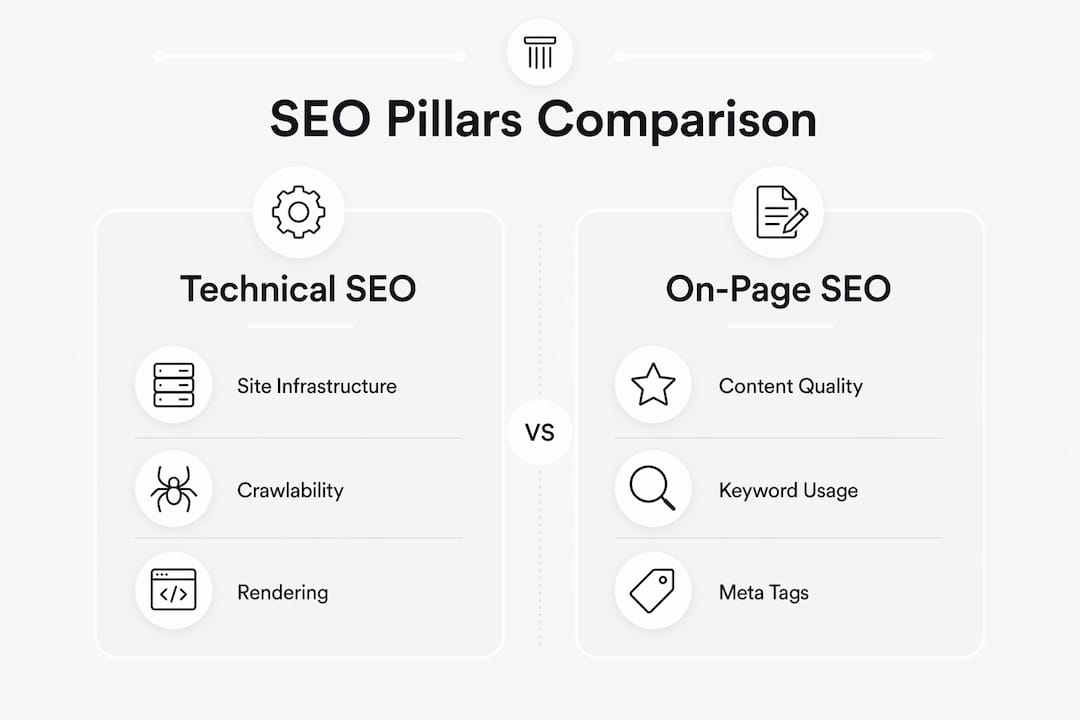
On-page SEO focuses on what appears on the page: your content, keyword placement, meta descriptions, and heading structure. Off-page SEO builds your site’s authority through external signals, primarily backlinks from other websites. Technical SEO is the infrastructure that supports both.
Technical SEO underpins crawlability, indexability, and rendering. These are the prerequisites for any ranking to occur. A page with brilliant content and 50 high-quality backlinks will not rank if a misconfigured robots.txt file is blocking search engine access. That is why technical SEO is the foundation, not an afterthought.
A practical way to think about it: on-page and off-page SEO are the fuel, and technical SEO is the engine. Without the engine working correctly, the fuel goes nowhere. If you are planning a website redesign, this distinction matters enormously. Redesigns frequently break technical SEO without anyone noticing until traffic drops.
How to audit and improve your technical SEO
A structured audit is the starting point for any improvement. A technical SEO audit begins with a complete site crawl that details URLs, status codes, metadata, and indexability. The two most widely used tools for this are Screaming Frog SEO Spider and Google Search Console.
Follow these steps to audit and improve your site’s technical health:
- Crawl your site with Screaming Frog. Run a full crawl to identify broken links (404 errors), redirect chains, missing meta tags, and duplicate content. Export the results and prioritise fixes by page importance.
- Review Google Search Console. Check the Coverage report for indexing errors, the Core Web Vitals report for speed issues, and the Mobile Usability report for device-specific problems.
- Fix crawl errors and redirect chains. Redirect chains slow down crawl speed and dilute link equity. Resolve them by pointing redirects directly to the final destination URL.
- Optimise page speed. Compress images using tools like TinyPNG or ShortPixel, enable browser caching, and minify CSS and JavaScript. Aim for an LCP under 2.5 seconds.
- Submit your XML sitemap. Submitting XML sitemaps and configuring your
robots.txtfile correctly guides search engines to your most important pages and reduces crawl waste. - Check mobile usability. Use Google’s Mobile-Friendly Test to confirm your site renders correctly on smartphones. Mobile-first indexing means any mobile rendering failure directly affects your rankings.
- Implement structured data. Add Schema.org markup for your business type, articles, products, or FAQs. Validate it using Google’s Rich Results Test.
For a detailed checklist you can work through systematically, the SEO audit checklist from Fyldedigital covers the key areas in a practical format.
Pro Tip: Schedule a full Screaming Frog crawl once a month and set up automated alerts in Google Search Console. Automated monitoring catches silent technical breaks like redirect chains or canonical tag errors before they degrade your rankings.
How does technical SEO affect AI-driven search in 2026?
AI search platforms have changed how discoverability works. Strong technical SEO is now crucial for AI-driven platforms like ChatGPT and Google AI Overviews to surface and cite your content. Pages that are easily crawlable and properly indexed have a significantly higher chance of appearing in AI-generated answers.
Here is why technical SEO matters specifically for AI search:
- Clean crawlability. AI systems rely on the same crawled and indexed data as traditional search engines. If your pages are blocked or poorly structured, AI platforms cannot access them.
- Structured data accuracy. AI search engines rely on accurate structured data and clean JavaScript rendering to correctly extract and cite answers. Schema.org markup gives AI systems a clear, machine-readable summary of your content.
- Fast load times. Slow pages are deprioritised in crawl schedules, reducing the frequency with which AI systems re-index your latest content.
- Clean code and rendering. JavaScript-heavy pages that do not render correctly for bots are effectively invisible to AI extraction tools.
“Pages easily crawlable and indexed via sound technical foundations have higher chances of inclusion in AI-generated answers.” — Semrush
The 2026 search environment is hybrid. Users receive answers from Google AI Overviews, ChatGPT browsing, and Perplexity alongside traditional organic results. A site with strong technical foundations appears across all of these channels. A site with technical problems is excluded from most of them. For ecommerce businesses in particular, this distinction directly affects revenue.
Key takeaways
Technical SEO is the non-negotiable infrastructure layer that determines whether search engines and AI platforms can find, understand, and rank your content.
| Point | Details |
|---|---|
| Technical SEO is foundational | Content and backlinks cannot rank pages that search engines cannot crawl or index. |
| Core Web Vitals affect rankings | LCP, INP, and CLS scores directly influence where your pages appear in search results. |
| Mobile-first indexing is active | Google indexes the mobile version of your site first, making responsive design a ranking requirement. |
| Structured data aids AI visibility | Schema.org markup helps both traditional search engines and AI platforms extract and cite your content. |
| Audits must be ongoing | Website updates frequently introduce new technical issues; scheduled crawls catch problems before they cost you traffic. |
Technical SEO: my honest view after years in the field
Most website owners treat technical SEO as a one-time project. They fix the obvious issues, tick the box, and move on. That approach works until the next site update quietly breaks something.
I have seen it happen repeatedly. A well-intentioned developer adds a noindex tag to a staging environment and forgets to remove it before launch. Six weeks later, the client notices organic traffic has collapsed. The content was fine. The backlinks were fine. The technical foundation had been silently undermined.
The uncomfortable truth is that technical SEO is a continuous discipline, not a project with a finish line. Every CMS update, every new page template, every plugin installation carries the risk of introducing a regression. Automated monitoring is not a luxury; it is the only reliable way to catch these issues before they compound.
What I find most interesting is the feedback loop between technical SEO and user experience. Better site speed and mobile usability improve engagement metrics, which in turn strengthen rankings. The two are not separate concerns. A faster site earns more trust from visitors and more favour from Google simultaneously.
My advice is straightforward. Combine technical excellence with quality content and you have a genuinely competitive advantage. Most of your competitors are neglecting one or the other. Nail both, and the gap between you and them widens every month.
— tibor
Want expert help with your technical SEO?
Getting technical SEO right from the start saves months of troubleshooting later. Fyldedigital builds websites with technical SEO baked in from day one, not bolted on afterwards. Every site we design is built with clean code, mobile-first layouts, fast load times, and structured data as standard.

If your current site is losing visibility or you are planning a new build, our team can carry out a full technical audit and identify exactly what is holding your rankings back. We work with businesses across Blackpool and the Fylde Coast to improve their organic search performance. Explore our web design services in Blackpool or review our SEO best practices guide to see how we approach search visibility for local businesses.
FAQ
What does technical SEO involve?
Technical SEO involves optimising your website’s infrastructure so search engines can crawl, render, index, and understand your content. It covers site speed, mobile usability, structured data, XML sitemaps, HTTPS, and canonical tags.
Why is technical SEO important for rankings?
Without sound technical SEO, search engines cannot reliably access or index your pages, meaning your content and backlinks cannot contribute to rankings. It is the prerequisite for all other SEO activity to function.
How often should I audit my technical SEO?
A full technical audit should be carried out at least once a month using tools like Screaming Frog and Google Search Console. Automated alerts help catch issues between scheduled audits.
Does technical SEO affect AI search results?
Yes. AI platforms like Google AI Overviews and ChatGPT rely on crawled and indexed data. Pages with strong technical foundations, particularly structured data and clean rendering, are more likely to be cited in AI-generated answers.
What is the difference between technical SEO and on-page SEO?
On-page SEO focuses on content, keywords, and meta tags visible on the page. Technical SEO focuses on the backend infrastructure that makes those pages accessible to search engines in the first place.