Unified online branding is defined as the practice of presenting a consistent identity, including your name, visuals, voice, and content, across every digital channel your business occupies. Businesses that maintain consistent branding across all digital platforms can see a revenue increase of up to 23%. That figure alone makes brand consistency one of the highest-return activities available to a small business. Knowing how to unify online branding starts with understanding that it is not a one-off project. It is a discipline, and the industry term for it is integrated branding. Get it right, and 46% of consumers will pay more for your products or services simply because they trust you.
What are the key pillars of unifying online branding?
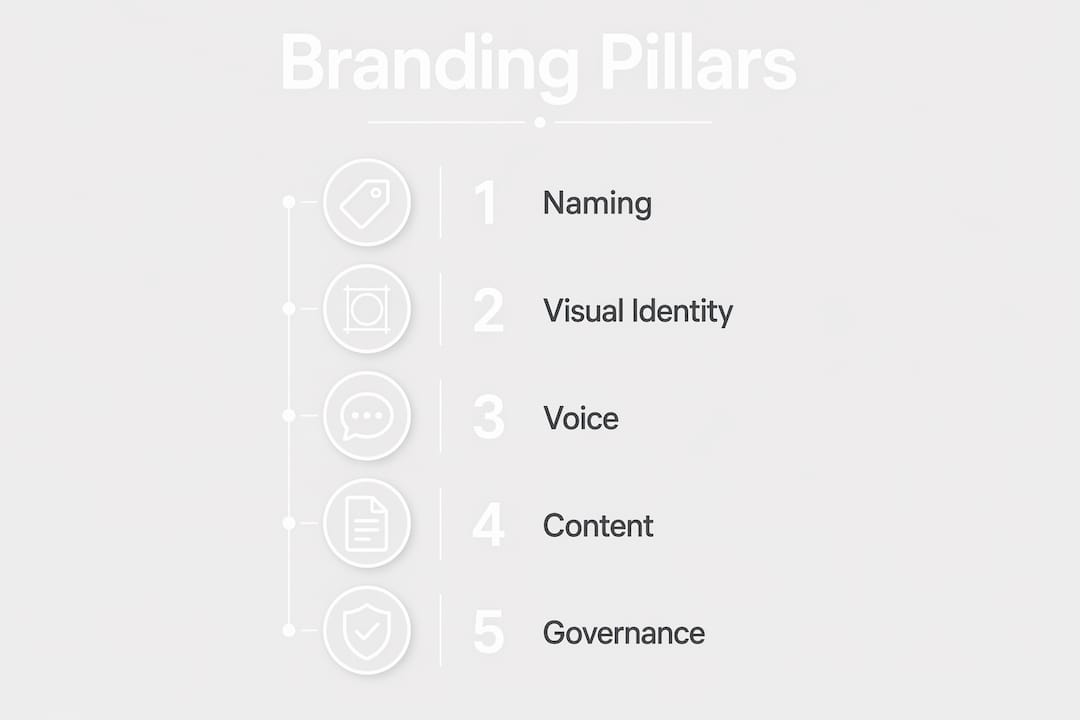
Integrated branding rests on five distinct pillars. Each one reinforces the others, and a weakness in any single area will undermine the whole.
- Unified naming. Your domain, social handles, and business listings should all use the same name. Discrepancies here create confusion and erode trust before a customer even reads a word of your content.
- Visual identity. Your logo, colour palette, and typography must be consistent across your website, social profiles, email templates, and any paid advertising. A customer who sees your Facebook ad and then visits your website should feel they are in the same place.
- Voice and tone. The way you write, whether on Instagram, in a newsletter, or on a product page, should feel like it comes from the same person. Formal on LinkedIn and flippant on your website sends mixed signals.
- Content strategy. Your topics, posting frequency, and messaging themes should align across channels. Repetition of core ideas builds authority rather than boring your audience.
- Reputation management. Monitoring brand mentions and responding consistently protects the identity you have built. One unaddressed negative review can contradict months of careful positioning.
Pro Tip: Before auditing your visuals or content, run a simple name check across your website domain and your top three social platforms. Inconsistencies here are the fastest thing to fix and the first thing a new customer notices.
The essential branding elements that underpin each pillar are worth mapping out before you start making changes. Knowing what you have makes it far easier to identify what needs fixing.

How do you secure consistent brand naming and handles?
Your brand name is the anchor of your entire online presence. If your domain is “smithplumbing.co.uk” but your Instagram handle is “@smithplumb_official” and your Facebook page is “Smith Plumbing Services Ltd”, you are already working against yourself.
Follow these steps to lock down consistent naming:
- Choose one base name. Pick the shortest, most memorable version of your business name and commit to it across every platform.
- Check availability simultaneously. Tools like NameSniper let you search domain and social handle availability at the same time, saving hours of manual checking.
- Apply a uniform prefix or suffix if the exact name is taken. Inconsistent usernames across social platforms undermine brand recognition. If “@smithplumbing” is taken, use “@getsmithplumbing” everywhere rather than a different variation on each platform.
- Match your domain as closely as possible to your handles. The closer the match, the less friction a customer experiences when searching for you.
- Register variations to protect your name. Secure common misspellings and the .com version alongside your .co.uk to prevent competitors or bad actors from occupying them.
| Platform | Ideal handle format | Acceptable alternative |
|---|---|---|
| Domain | yourbrandname.co.uk | getbrandname.co.uk |
| @yourbrandname | @getyourbrandname | |
| /yourbrandname | /yourbrandnameuk | |
| /company/yourbrandname | /company/yourbrandname-uk | |
| X (Twitter) | @yourbrandname | @yourbrandnameuk |
Pro Tip: Once you have secured your handles, create a simple spreadsheet listing every platform, the handle used, and the login email. This single document saves enormous time when onboarding staff or agencies.
How do you create a consistent visual identity across all channels?
Your visual identity is the most immediate signal of professionalism. A customer forms a first impression within seconds, and mismatched visuals tell them your business lacks attention to detail.
- Build a brand style guide. Document your exact logo files, hex colour codes, approved fonts, and image style. A style guide removes guesswork for anyone producing content on your behalf.
- Apply your identity everywhere. Your website, social media headers, email signatures, and digital adverts should all draw from the same style guide. The logos and branding work that Fyldedigital produces for clients always starts with this document, because it is the single source of truth for every asset that follows.
- Standardise your image style. If your website uses bright, clean product photography, your Instagram feed should not be full of dark, moody stock images. Consistency in photographic style is as important as consistency in colour.
- Avoid common pitfalls. The most frequent mistake is using slightly different shades of your brand colour across platforms, often because someone has used a JPEG logo with a white background instead of a transparent PNG. Always use vector or high-resolution files.
Pro Tip: Export your logo in at least three formats: a full-colour version, a white version for dark backgrounds, and a monochrome version. Store them in a shared folder that everyone in your team can access.
A well-designed website is the centrepiece of your visual identity. If your site does not reflect your brand accurately, every other channel is working to compensate for it. Understanding what effective web design actually requires is a good starting point before you invest in any refresh.
How do you align brand voice, tone, and content strategy?
Visual consistency gets attention. Voice consistency builds trust. The two together create a brand that people remember and return to.
Follow this process to align your messaging across channels:
- Write a voice and tone document. Define three to five adjectives that describe how your brand communicates. “Friendly, direct, and knowledgeable” is a useful starting point for most SMBs. Include examples of on-brand and off-brand sentences so the difference is clear.
- Create content pillars. Choose three to four core themes that your business will consistently talk about. A local accountancy firm might focus on tax planning, business growth, and financial wellbeing. Every piece of content should fit within one of these pillars.
- Reuse and adapt content across channels. Coordinating content reuse across channels boosts efficiency and reinforces a unified brand voice. A blog post becomes a LinkedIn article summary, three social posts, and a newsletter section. The core message stays the same; the format changes.
- Use SEO to reinforce your authority. AI search engines now use brand authority signals including consistent content publishing and verified mentions in their ranking algorithms. Publishing regularly on a focused set of topics signals expertise to both search engines and readers.
- Monitor and respond to brand mentions. Set up Google Alerts for your business name. Responding to reviews and comments in a consistent tone is part of maintaining the voice you have defined. Silence is also a brand statement, and it is rarely a positive one.
The discipline of integrated branding across channels is what separates businesses that grow their audience from those that simply maintain one.
How do you maintain brand consistency as your business grows?
Growth introduces the biggest threat to brand cohesion. New team members, new agencies, and new platforms all create opportunities for your brand to fragment.
- Focus on two to three core platforms first. Limiting your channel count to the platforms where your audience is most active prevents diluted messaging and keeps quality high. A business trying to maintain a presence on six platforms with a team of three will do all of them badly.
- Implement brand governance. This means written guidelines, regular audits, and a named person responsible for brand standards. Traditional brand guidelines alone are insufficient without ongoing monitoring and tool support to maintain consistency across distributed teams. Guidelines in a drawer are not governance.
- Brief agencies and freelancers thoroughly. Anyone producing content or design on your behalf needs access to your style guide, voice document, and brand assets before they start. A short briefing call is worth more than a lengthy email chain after the work is done.
- Watch for warning signs. Mixed messaging, visual mismatches between your website and social profiles, and inconsistent responses to customer reviews are all early indicators that your brand is drifting. Catching these early costs far less than a full rebrand.
66% of marketers managing eleven or more digital channels report that maintaining brand consistency is a primary challenge. The solution is not more tools. It is fewer channels, clearer guidelines, and consistent enforcement.
Pro Tip: Schedule a quarterly brand audit. Spend one hour reviewing your website, your top two social profiles, and your most recent email newsletter side by side. If they feel like they come from different businesses, you have work to do.
Keeping up with the challenges of digital marketing as your business scales requires the same discipline as the branding work itself: regular attention, clear priorities, and a willingness to fix problems before they compound.
Key takeaways
Unified online branding requires consistent naming, a documented visual identity, a defined brand voice, and active governance across every channel you occupy.
| Point | Details |
|---|---|
| Consistent branding drives revenue | Businesses with unified branding across digital platforms can see revenue increase by up to 23%. |
| Naming consistency comes first | Secure the same handle across your domain and all social platforms before building anything else. |
| A style guide is non-negotiable | Document your logo files, hex codes, and fonts so every team member and agency works from the same reference. |
| Focus on fewer channels | Two to three core platforms done well outperform six platforms done poorly every time. |
| Governance prevents drift | Assign ownership of brand standards and audit your channels quarterly to catch inconsistencies early. |
Why I think most SMBs overcomplicate this
Working with small businesses across the Fylde Coast and beyond, the pattern I see most often is not neglect. It is overambition. A business owner reads that they need to be on Instagram, LinkedIn, Facebook, X, TikTok, and YouTube, and they try to do all of it at once. Within three months, half the profiles are abandoned, the visuals are inconsistent, and the voice has drifted into whoever happened to write the last post.
The businesses I have seen build genuinely strong online brands do the opposite. They pick two platforms, get those right, and only expand once the system is working. They treat their style guide as a living document, not a PDF that gets filed away after the rebrand. They also understand that brand consistency is not about being boring. It is about being recognisable. You can be creative, funny, and surprising within a consistent framework. The framework is what makes the creativity land.
The revenue and trust data backs this up. Consumers who pay more for brands they trust are not paying for perfection. They are paying for familiarity and reliability. Those qualities come from repetition, not from being everywhere at once. If you are a small business owner reading this, the most useful thing you can do today is not sign up for another platform. It is to open your existing profiles side by side and ask honestly whether they look and sound like the same business.
If the answer is no, start with your style guide. Everything else follows from there.
— tibor
How Fyldedigital can help you build a unified brand online
If your website, social profiles, and digital assets feel disconnected, Fyldedigital can help you bring them together. The team specialises in web design for small businesses across Blackpool and the wider Fylde Coast, building sites that reflect your brand accurately and give every other channel a strong foundation to work from.
From logo creation and brand style guides through to SEO and social media management, Fyldedigital offers the full range of services an SMB needs to present a consistent identity online. Whether you are starting from scratch or bringing order to an existing presence, the team works with you to create something that represents your business properly. Request a free website review today and find out exactly where your brand stands.
FAQ
What does it mean to unify online branding?
Unifying online branding means presenting a consistent identity, including your name, visuals, voice, and content, across every digital channel your business uses. The goal is for customers to recognise your business instantly, regardless of where they encounter it.
How much can consistent branding increase revenue?
Businesses that maintain a consistent brand identity across all digital platforms can see a revenue increase of up to 23%. That figure reflects the compounding effect of trust, recognition, and professionalism on purchasing decisions.
How many social media platforms should a small business use?
Focus on two to three core platforms where your audience is most active. Spreading your efforts across too many channels leads to inconsistent quality and diluted messaging.
What should a brand style guide include?
A brand style guide should document your logo files in all formats, your exact hex colour codes, your approved fonts, your image style, and your voice and tone guidelines. This document is the single reference point for everyone who creates content on your behalf.
Why do brand guidelines fail without ongoing enforcement?
Traditional brand guidelines alone are insufficient without ongoing monitoring and tool support, particularly when distributed teams or external agencies are involved. Assign a named person to own brand standards and schedule regular audits to keep consistency in place.