Choose managed marketing when you need continuous, specialist-led output across SEO, PPC, content, and social — without the cost and risk of building a full in-house team. It delivers a full bench of specialists with a more cost-effective and predictable monthly spend compared to building a full in-house team, offering compounding results that one-off projects simply cannot replicate. Forbes frames managed marketing as a next-generation model for smaller organisations, drawing a direct parallel with how IT managed service providers (MSPs) work: you externalise a core function, gain expert capability immediately, and keep your internal resource focused on running the business.
Before you commit to a provider, run a quick capability gap check:
- Do you have in-house specialists across SEO, paid media, content, and analytics?
- Is your current marketing producing measurable pipeline growth?
- Could you hire, onboard, and retain those specialists for less than a managed retainer?
- Do you need results that compound over 12 months, not just a one-off campaign?
If you answered no to most of those, a managed marketing engagement — starting with a 90-day pilot — is worth serious evaluation.
Table of Contents
- What managed marketing actually is (and how it differs from agency projects)
- The real benefits of choosing managed marketing
- What a managed marketing service typically includes
- Managed marketing vs in-house vs project agency: which fits your business?
- Which businesses benefit most from managed marketing?
- How to choose a managed marketing provider
- What to expect in the first 90–180–365 days
- Fyldedigital: a managed marketing partner for UK SMBs
- Key takeaways
- The case for continuity: why managed marketing compounds
- Further reading and sources
What managed marketing actually is (and how it differs from agency projects)
Managed marketing is an ongoing, retainer-style arrangement where an external provider takes operational accountability for recurring marketing execution and measurable outcomes. The provider does not just advise — they handle execution directly: keyword research, content drafting, publishing, technical SEO fixes, paid campaign management, and regular reporting. That “done for you” framing is what separates it from consultancy, where a provider recommends and you execute.
The contrast with project-based agency work is significant. A project engagement has a defined scope, a start date, and an end date. Once the campaign or website build is delivered, the relationship closes. Managed marketing has no such cliff edge. The provider stays accountable month after month, which means SEO domain authority accumulates, content compounds, and paid campaigns are continuously refined rather than reset from scratch.
| Dimension | Managed marketing | Project-based agency | In-house team |
|---|---|---|---|
| Accountability | Provider owns execution and outcomes | Provider delivers scope; client owns results | Internal team owns everything |
| Continuity | Ongoing, month-to-month optimisation | Stops at project end | Continuous, but dependent on staff retention |
| Cost shape | Predictable monthly retainer | Variable per project | Fixed salary + tools + NI + benefits |
| Specialist depth | Full team across channels | Varies by project brief | Limited to who you can afford to hire |
| Compounding effects | High (SEO, content, domain authority) | Low | High, if team is stable |
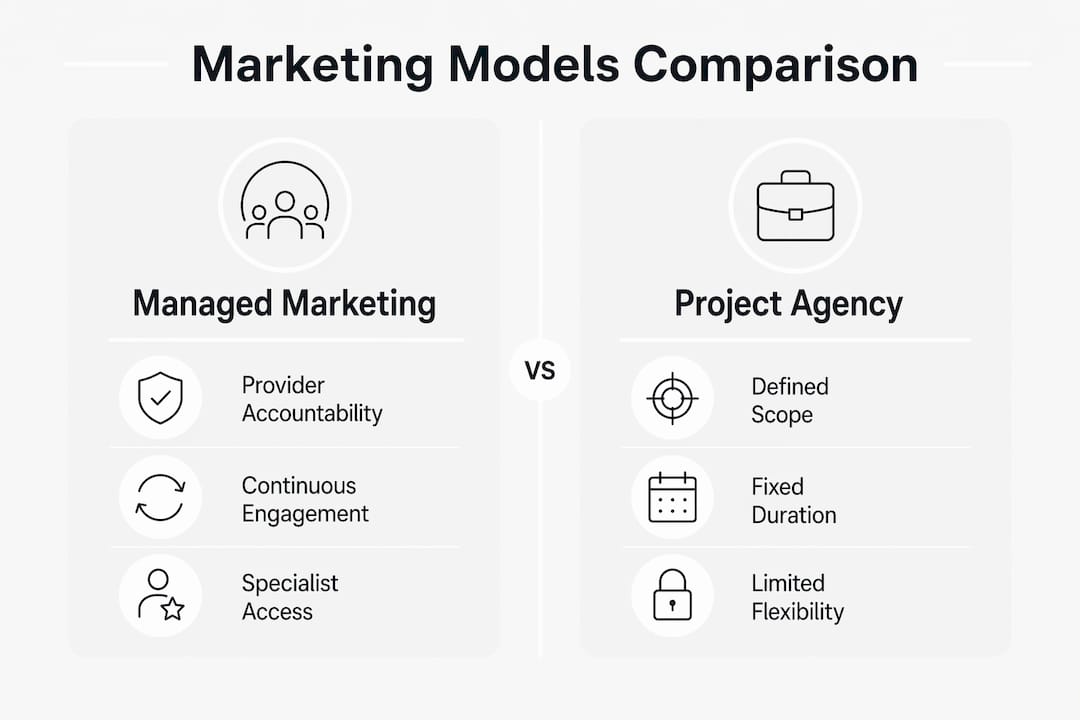
Three common delivery models sit under the managed marketing umbrella. A fully in-house provider team handles everything under one roof. A fractional CMO model pairs senior strategic oversight with a delivery team, useful when you need board-level thinking without a full-time hire. AI-enabled managed platforms handle high-volume, standardised tasks such as systematic content and technical SEO at speed, while human-led agencies remain the stronger choice for bespoke creative and strategic positioning.
The real benefits of choosing managed marketing
The most immediate gain is access to specialist skills you almost certainly do not have in-house. A managed provider brings an SEO specialist, a paid media manager, a content lead, a designer, and an analytics resource — all working on your account from day one. Recruiting that team independently takes months and costs considerably more once you factor in salaries, employer National Insurance, pension contributions, and software licences.

Managed providers invest in tools — analytics platforms, keyword research software, CRM integrations, paid-media accounts — that would be expensive and complex for an SMB to run independently. You get immediate access to that martech stack without procurement, setup, or training overhead.
Scalability is another practical advantage. If you have a product launch in Q4 or a seasonal spike in demand, a managed provider can flex resource up without you hiring temporary staff. When demand normalises, the scope adjusts. That kind of elasticity is genuinely difficult to replicate with a fixed headcount.
Pro Tip: Ask any prospective provider to show you a 12-month content and SEO output calendar from a current client. If they cannot, they are likely operating reactively rather than strategically.
Cost predictability matters to boards and finance directors. A fixed monthly retainer makes marketing spend a known line item, not a variable surprise. For many UK SMBs, the five most common triggers for switching to managed marketing are: marketing treated as an afterthought, poor results with current approaches, lack of specialist expertise, stagnating sales, and the need to control costs. Managed marketing addresses all five in a single engagement.
Continuity is where the compounding argument becomes clearest. A consistent 12-month engagement with regular content production substantially outperforms short, sporadic bursts because it allows ongoing optimisation. SEO domain authority, organic rankings, and content-driven lead generation all build on prior work. Stop-start campaigns reset that progress every time.
What a managed marketing service typically includes
A well-structured managed engagement covers more ground than most business owners expect. The core service components you should see in any proposal:
- Content and editorial: blog posts, landing pages, case studies, and email copy produced to a regular calendar
- SEO: technical audits and fixes, on-page optimisation, link-building, and targeted SEO campaigns built around commercial keywords
- Paid media (PPC): Google Ads and paid social campaign setup, management, bid optimisation, and conversion tracking
- Social media management: channel strategy, scheduling, community management, and performance reporting
- Email and CRM campaigns: list segmentation, automated sequences, and campaign analytics
- Analytics and reporting: monthly performance reviews tied to agreed KPIs, not just traffic dashboards
- Creative and design: ad creative, social graphics, landing page design, and occasional print or promotional material
The martech stack a provider brings typically includes a keyword research platform, a technical SEO crawler, analytics access (usually Google Analytics 4), a paid-media management interface, a social scheduling tool, and a CRM or email platform. You should not need to procure any of these independently.
The team structure behind a managed account usually looks like this: an account lead or strategist who owns the relationship and commercial outcomes; a content lead responsible for editorial quality and calendar; an SEO specialist handling technical and on-page work; a paid-media specialist managing PPC and paid social; a designer or developer for creative and web updates; and a reporting analyst who translates data into decisions. Not every provider staffs all six roles, so ask explicitly who covers each function.
Managed marketing vs in-house vs project agency: which fits your business?
The right model depends on your stage, budget, and what you actually need marketing to do for you. Understanding the differences between in-house and agency models is a useful starting point, but managed marketing introduces a third option that sits between them.
Managed marketing suits organisations that need continuous output across multiple channels, want predictable spend, and cannot justify the cost of a full specialist team. The main risk is vendor dependency: if the relationship breaks down, you may have limited internal capability to fall back on. Mitigate this by ensuring IP (content, ad accounts, analytics access) stays in your name from day one.

In-house teams give you the deepest brand knowledge and the fastest internal communication. The red flag is single-hire dependence: one generalist cannot cover SEO, paid media, content, and analytics to a specialist standard. When that person leaves, you lose continuity entirely.
Project-based agency work is right for discrete, time-bound deliverables: a website build, a brand refresh, a product launch campaign. The problem is stop-start visibility. Once the project closes, organic rankings, paid learning, and content momentum all stall. For businesses that need pipeline flowing continuously, this model creates gaps.
A practical decision checklist:
- Revenue stage: are you generating enough turnover to justify a monthly retainer (typically £1,000–£3,000+ for SMBs)?
- Internal skills: do you have anyone who can brief, review, and manage an external team?
- Continuous outcomes: do you need SEO rankings and organic leads to grow month-on-month?
- Hiring capacity: can you realistically recruit and retain three to five specialists in the next six months?
- Budget predictability: does your board prefer fixed monthly costs over variable project spend?
If you need continuous outcomes and cannot hire a full team, managed marketing is the logical fit. If you have a one-off need and strong internal capability, a project agency works. If you have the budget and the talent pipeline, in-house gives you the most control.
Which businesses benefit most from managed marketing?
The clearest fit is an SMB or scale-up that needs consistent marketing output but cannot afford a full specialist team. That covers a wide range of UK businesses: a professional services firm generating steady enquiries through organic search; a B2B technology company running paid lead generation alongside content; a retailer managing seasonal peaks across paid social and email; a local service business building visibility through digital marketing in their region.
Businesses in a growth phase — expanding into new markets, launching new products, or recovering from a period of underinvestment in marketing — benefit particularly well. The managed model means they can scale up quickly without a lengthy recruitment process.
Organisations with fluctuating demand also gain from the flexible resourcing that managed providers offer. A hospitality business with strong summer peaks, or a B2B firm with a heavy Q1 pipeline push, can increase scope during high-demand periods without permanent headcount changes.
Managed marketing is less suitable for a mature enterprise with a deep in-house capability already in place, or for a business undergoing high-stakes brand repositioning that requires bespoke creative retained internally. At larger scale, many organisations adopt a hybrid model: strategy and brand oversight stay in-house, while execution — content production, paid media management, technical SEO — is outsourced to a managed provider.
How to choose a managed marketing provider
1. Evaluate case studies and proof of outcomes
Ask for case studies that show commercial results, not just activity metrics. Organic sessions and impressions tell you a campaign ran; qualified leads, pipeline value, and keyword ranking improvements tell you it worked. Look for examples from businesses similar to yours in size, sector, or growth stage.
2. Clarify who actually does the work
Some providers use subcontractors for content, design, or technical SEO without disclosing it. Ask directly: is every deliverable produced by your in-house team? If subcontractors are involved, who manages quality control? Transparency here is a basic trust signal.
3. Check the reporting structure
A provider that reports only vanity metrics — traffic, impressions, follower counts — is optimising optics rather than outcomes. Insist on reporting that ties activity to pipeline: keyword rankings with conversion context, cost per lead from paid channels, and content attribution to MQL or revenue. Track key digital marketing metrics from the first month.
4. Understand the contract and exit terms
Providers that offer short pilots (3–6 months) or month-to-month terms after onboarding typically demonstrate confidence in their work and reduce lock-in risk for you. Ask what happens to your ad accounts, content, and analytics access if you leave. Everything should transfer to you cleanly.
5. Confirm the onboarding process
A structured discovery phase of 2–4 weeks is a strong signal of a provider that takes performance seriously. Providers that skip discovery and start publishing immediately tend to produce generic content that fails to convert.
6. Ask about SLAs and account management
What response times are guaranteed? Who is your named account lead? How often do you meet to review performance? Monthly reporting calls with a named strategist are a minimum; quarterly strategy reviews are better.
Questions to ask in procurement:
- What does your discovery process look like, and what do you deliver at the end of it?
- Which KPIs will you report on, and how do they connect to our revenue targets?
- Who specifically will work on our account, and what is their experience in our sector?
- What tools do you use, and will we retain access to accounts and data if we leave?
- What are your notice period and exit terms?
KPI reference by goal:
| Goal | Primary KPI | Secondary KPI |
|---|---|---|
| Organic growth (SEO) | Organic sessions, keyword rankings | Domain authority, MQL from organic |
| Paid lead generation | Cost per lead (CPL), ROAS | Click-through rate, conversion rate |
| Content marketing | Leads attributed to content | Time on page, content-to-MQL rate |
| Social media | Engagement rate, reach | Follower growth, social-driven traffic |
| Overall commercial | Pipeline value attributed | Revenue influenced by marketing |
Pricing shapes to expect (illustrative):
Retainer models for UK SMBs typically start at £1,000–£1,500 per month for a focused single-channel engagement (SEO or paid media only) and rise to £3,000–£5,000+ for a full multi-channel managed service. Tiered scope models let you add channels as budget grows. Performance-incentivised arrangements, where a portion of the fee is tied to agreed KPIs, are available from some providers and can align incentives well — but read the measurement methodology carefully before agreeing.
What to expect in the first 90–180–365 days
Managed marketing is not a switch you flip. The first 90 days are foundational, and the compounding value builds from month four onwards.
The single most common reason managed marketing underperforms is a rushed start. Providers that skip a rigorous discovery phase and begin publishing within the first week typically produce generic content that misses the buyer’s actual questions, fails to reflect the brand’s positioning, and converts poorly. A structured 2–4 week discovery is not a delay — it is the work that makes everything else perform.
Weeks 1–4: Discovery
Audit existing content, analytics, and paid accounts. Define the ideal customer profile (ICP), map the buyer journey, and agree on primary KPIs. Identify technical SEO issues and quick wins. Deliver a prioritised action plan.
Weeks 5–12: Quick wins and foundations
Fix critical technical SEO issues. Launch or optimise paid campaigns with conversion tracking in place. Publish the first content pieces against a signed-off editorial calendar. Establish the reporting cadence — monthly at minimum, with a shared dashboard.
Months 4–6: Optimisation
Refine paid campaigns based on early data. Build on content performance: update underperforming pieces, expand topics that are gaining traction. Begin link-building for SEO. Review KPIs against targets and adjust scope if needed.
Months 7–12: Compounding growth
Organic rankings improve as domain authority builds. Content-driven leads begin to appear in pipeline reporting. Paid campaigns reach optimised cost-per-lead targets. Strategy review at month nine sets the direction for the following year.
Fyldedigital: a managed marketing partner for UK SMBs
If you have read this far and recognise your business in the profile above, Fyldedigital offers the full range of managed marketing services UK SMBs need to grow consistently: web design and development, SEO, PPC, social media management, content creation, graphic design, and print. These services combine in a retainer model that gives you a named account team, clear monthly reporting, and a structured onboarding process from day one.
Fyldedigital works with small and medium-sized businesses across the UK, and positions itself as a full-service digital partner rather than a project agency. The agency offers a free website and SEO review as a no-commitment starting point — a practical way to identify where your current marketing is losing ground before you commit to a retainer. You can see the full range of services and request your free review directly from the services page.
Key takeaways
Managed marketing delivers the highest return when it replaces a gap in specialist capability with a continuous, accountable external team — not when it duplicates work an in-house team already does well.
| Point | Details |
|---|---|
| Managed marketing vs projects | Retainer-based managed services compound over time; project work stops at delivery and resets momentum. |
| Full team for SMB cost | SMBs typically access a full specialist team (SEO, PPC, content, analytics) for the cost of one generalist hire. |
| Discovery is non-negotiable | A structured 2–4 week discovery phase is the single strongest predictor of managed marketing performance. |
| KPIs must link to pipeline | Insist on reporting that connects activity to cost per lead, keyword rankings, and revenue attribution — not just traffic. |
| Fyldedigital as managed partner | Fyldedigital provides retainer-based SEO, PPC, web design, social, and content for UK SMBs, with a free website and SEO review to start. |
The case for continuity: why managed marketing compounds
Most businesses underestimate how much of their marketing value is lost between campaigns. A paid campaign that runs for eight weeks builds audience data, conversion learning, and keyword intelligence — and then stops. The next campaign starts from scratch. SEO work that runs for three months and then pauses loses ranking momentum precisely when it was beginning to build. The compounding argument for managed marketing is not theoretical; it is what you see in the data when you compare a consistent 12-month engagement against a series of disconnected projects covering the same total spend.
The other thing that gets underestimated is accountability. In a project model, the agency delivers the scope and the relationship ends. If the campaign underperforms, there is no mechanism for the provider to fix it — the contract is closed. A managed provider has skin in the game every month. Their renewal depends on your results, which means their incentives align with yours in a way that project work structurally cannot replicate.
What I would tell any marketing manager evaluating this decision: do not choose managed marketing because it sounds efficient. Choose it because you have identified a specific capability gap, you need that gap filled continuously, and you have the internal clarity to brief and hold a provider accountable. Without that clarity, even the best managed provider will drift. With it, the compounding effects are real and measurable within six months.
Further reading and sources
- Managed Marketing Services: A Next-Gen Model For SMBs — Forbes Agency Council piece framing managed marketing as the SMB equivalent of IT managed services; useful for the strategic rationale.
- Managed Marketing Services: The Full Breakdown — Aumata’s detailed breakdown of delivery models, discovery phases, and the AI-first vs human-led distinction; practical for evaluating providers.
- 5 Reasons You May Need Marketing as a Managed Service — ImpactMyBiz on the five common triggers for switching to managed marketing; good for self-assessment.
- Benefits of Managed Marketing Services — Salesflying on the martech and cost-efficiency arguments; supports the tools and ROI sections.
- Media agencies and managed service models — JobsHype overview of agency model differences; useful context for comparing managed vs project approaches.
- Fylde Digital: about and services — Fyldedigital’s own positioning, portfolio, and trust signals for readers assessing the agency as a managed marketing partner.
- How to choose SEO agency support — Practical guidance on evaluating SEO-specific managed support; relevant for the vendor selection criteria in this article.