Most business owners think a website update means a fresh coat of paint — new colours, a different font, maybe a new hero image. But that thinking leaves serious money on the table. Your website is often the first salesperson a potential customer encounters, and if it is slow, outdated, or difficult to navigate on a mobile phone, that salesperson is quietly losing you business every single day. Strategic website updates go far beyond aesthetics. They directly influence your search engine rankings, customer trust, conversion rates, and your ability to compete in a fast-moving market.
Table of Contents
- Understanding the need for website updates
- How website updates improve SEO and rankings
- Business benefits of regularly updating your website
- Pitfalls of neglecting updates and how to avoid them
- A fresh perspective: why updating your website is a strategic investment, not just a technical necessity
- How Fylde Digital helps you stay ahead with strategic website updates
- Frequently asked questions
Key Takeaways
| Point | Details |
|---|---|
| SEO is essential | Every website update must preserve and enhance SEO elements or risk losing valuable search rankings. |
| Business growth relies on updates | Modern, regularly updated websites attract more customers, support new products, and respond quickly to market changes. |
| Avoid common pitfalls | Neglecting technical details like migration checklists leads to lost traffic and performance issues. |
| Strategic updates pay dividends | Treating updates as strategic investments gives you lasting competitive advantage and credibility. |
Understanding the need for website updates
Regular website updates are not optional extras for businesses serious about growth. They are a fundamental part of staying competitive online. Your website is a living asset, and treating it as a one-time project is one of the most common and costly mistakes a business owner can make.
Search engines like Google continuously update their algorithms to reward websites that offer fresh, relevant, and technically sound content. A site left untouched for years signals stagnation, both to search engines and to the customers browsing it. Updating your content, structure, and technical performance keeps your site in good standing with search engines and improves your chances of appearing higher in search results.
Mobile users now account for the majority of web traffic globally. If your website was built before mobile-first design became the standard, there is a strong chance it performs poorly on smartphones and tablets. Poor mobile experience leads to high bounce rates, which means visitors are leaving your site almost immediately. This directly reduces enquiries and sales. A modern update ensures your site is responsive, loads quickly, and delivers a smooth experience across all devices.
There are also security and accessibility considerations. Outdated websites are more vulnerable to cyberattacks, and failing to meet accessibility standards can exclude a significant portion of your potential customers. Updating your site to meet current Web Content Accessibility Guidelines (WCAG) shows both professionalism and care for all users. A solid small business website guide will always highlight these points as non-negotiable.
Key areas that regular updates should address include:
- Content freshness: Updated copy, new blog posts, and current product or service information
- Technical performance: Faster page load speeds, clean code, and up-to-date plugins or frameworks
- Security patches: Protecting customer data and your business reputation
- Accessibility improvements: Ensuring all users can navigate your site effectively
- Mobile responsiveness: Delivering a seamless experience on any device
Documenting current performance and crawl mapping are essential for understanding which elements drive website success before you change anything. Knowing what is already working means you can protect it during any update, rather than accidentally dismantling the foundations of your online presence.
How website updates improve SEO and rankings
SEO (search engine optimisation) and website updates are inseparable. Every time you redesign a page, restructure your navigation, or migrate to a new platform, your SEO is directly affected. The question is whether that effect is positive or negative, and the answer depends entirely on how carefully the update is planned.
A website refresh should treat SEO as part of the redesign method, requiring you to document what is working, crawl the existing site, and preserve high-risk SEO elements during migration. This is not a step you can skip or return to later. By the time an update goes live without proper SEO groundwork, the damage to your rankings may already be done.
Many businesses invest heavily in a visual redesign, only to see their organic search traffic drop significantly in the weeks following launch. The reason is almost always the same: critical SEO elements such as title tags, meta descriptions, internal linking structures, and URL paths were changed or lost during the update without proper redirects or documentation in place.

The table below shows the critical SEO elements you must preserve and monitor during any website update:
| SEO element | Why it matters | Action during update |
|---|---|---|
| URL structure | Existing pages may have earned rankings and backlinks | Implement 301 redirects for all changed URLs |
| Page titles and meta descriptions | Directly influence click-through rates from search results | Carry over or improve, never delete without replacement |
| Internal linking | Distributes ranking signals across your site | Audit and replicate the structure in the new design |
| Structured data (schema) | Helps search engines understand page content | Re-implement and test after migration |
| Page speed | Core Web Vitals are a confirmed ranking factor | Test thoroughly post-launch with real device testing |
| Image alt text | Supports accessibility and image search rankings | Migrate all alt tags to the updated site |
Pro Tip: Before making any significant website changes, use a tool like Screaming Frog to crawl your existing site and export a full list of URLs, title tags, and meta descriptions. This gives you a clear baseline to work from and makes it far easier to spot anything that has been lost after the update goes live.
Taking an SEO-driven website redesign approach means the visual and technical goals of your update are always aligned. You are not choosing between a better-looking site and a higher-ranking one. With the right process, you achieve both. Following established SEO best practices throughout the update cycle ensures your gains are sustainable, not short-lived.
Business benefits of regularly updating your website
Beyond SEO, regular website updates deliver a range of practical business benefits that compound over time. A well-maintained, modern website communicates professionalism and builds the kind of trust that turns browsers into buyers.
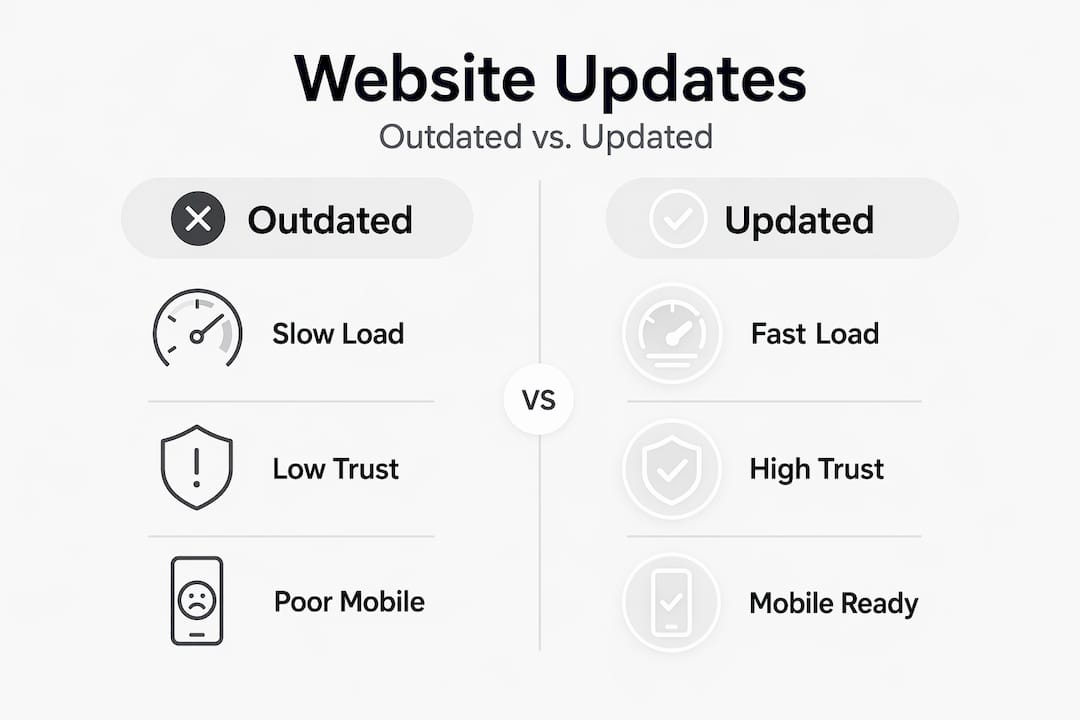
Consider the difference between an outdated website and an updated one in terms of real business outcomes:
| Factor | Outdated website | Updated website |
|---|---|---|
| First impression | Looks dated, erodes trust | Modern, credible, confidence-inspiring |
| Mobile experience | Difficult to navigate, poor layout | Responsive, fast, user-friendly |
| Conversion rate | Lower due to friction and poor UX | Higher due to clear calls to action |
| Search visibility | Declining rankings from stale content | Improved visibility from fresh content and technical health |
| Customer confidence | Customers question your credibility | Customers see an active, professional business |
| Security | Vulnerable to attacks and data breaches | Protected with current security measures |
Redesigning without an SEO process can result in lost rankings, mitigated only by preserving SEO-critical structures using a migration-aware checklist. That single risk alone justifies a structured approach to every update.
Here is a practical, numbered approach to making your website updates work harder for your business:
- Audit your current content: Identify which pages drive traffic and enquiries, and prioritise keeping those intact and improving them.
- Refresh your user experience (UX): Simplify navigation, improve calls to action, and make it easy for visitors to find what they need within two or three clicks.
- Update your products and services: Ensure all listings, pricing, and descriptions are accurate and reflect your current offer.
- Strengthen your security posture: Update your CMS (content management system), plugins, and SSL certificate to protect both you and your customers.
- Test before you launch: Run the updated site through mobile usability tests, speed tests, and cross-browser checks before going live.
- Measure the impact: Track changes in traffic, bounce rate, and conversions after the update using tools like Google Analytics and Google Search Console.
Knowing how to design a business website that attracts and converts means understanding that the design process does not end at launch. Ongoing updates allow your site to respond to market changes, seasonal demand, and new customer expectations without falling behind competitors who are actively investing in their online presence.
Pitfalls of neglecting updates and how to avoid them
Ignoring website updates is rarely a neutral decision. The longer a site goes without attention, the more costly it becomes to fix later, both financially and in terms of lost business opportunity.
The most common pitfalls businesses fall into include:
- Ignoring SEO during redesign: Changing URLs or restructuring pages without proper redirects destroys the ranking equity built up over months or years
- Poor migration planning: Moving to a new platform without testing results in broken pages, missing content, and confused visitors
- No testing before launch: Launching updates without cross-device testing leads to a broken experience for a significant portion of your audience
- Outdated plugins and frameworks: Leaving old software in place creates security vulnerabilities and compatibility issues
- Forgetting analytics: Failing to set up tracking after an update leaves you unable to measure whether the changes made any difference
“Edge case: if you redesign without a redesign-for-SEO process, you can lose rankings even if the visuals improve; the mitigation is to preserve and redirect SEO-critical structures using a migration-aware checklist.”
This is not a theoretical risk. It happens regularly to businesses who invest in a new website design, celebrate the launch, and then watch their organic enquiries drop over the following weeks. The visual improvement is real, but if the underlying SEO infrastructure has been disrupted, the traffic simply will not come.
Pro Tip: Always create a staging environment (a private copy of your website) where you can test every change before it goes live. This one habit prevents the majority of post-launch disasters and gives you a safety net to catch errors before real customers see them.
Your complete website redesign guide should include a pre-launch checklist that covers SEO, performance, accessibility, and content accuracy. Equally important is improving website UX at every stage of the update, because even technically perfect sites lose customers if the experience of using them is confusing or frustrating.
A fresh perspective: why updating your website is a strategic investment, not just a technical necessity
Here is something most guides on website updates will not tell you: the businesses that treat their website as a strategic asset consistently outperform those that treat it as a technical obligation.
There is a common pattern we see with small and medium-sized businesses. They build a website, it works reasonably well for a year or two, and then they leave it alone because it is not obviously broken. But markets shift. Competitors invest. Customer expectations evolve. And quietly, that website that once generated leads starts to become a liability rather than an asset.
Updating your website is an opportunity to reposition your brand, not simply to refresh its appearance. A new layout or improved copy can signal to your market that your business is growing, that you are keeping pace with your industry, and that you take your customers’ experience seriously. These are powerful messages, and they are communicated instantly the moment someone lands on your site.
We have seen businesses transform their enquiry rates not through expensive advertising campaigns, but through thoughtful, evidence-backed website updates that addressed real friction points in the customer journey. Better navigation. Clearer service descriptions. Faster load times. Genuine testimonials placed where they matter most. Small changes with measurable results.
Custom website design delivers lasting results precisely because it is built around your specific business goals, audience, and market position rather than a generic template that could belong to anyone. That intentionality is what separates a website that quietly converts enquiries from one that simply exists.
The businesses that will thrive over the next few years are those investing now in websites that are fast, accessible, optimised for search, and built to adapt. That is not a technical checklist. It is a strategic mindset.
How Fylde Digital helps you stay ahead with strategic website updates
If this article has prompted you to look critically at your own website, that is exactly the right response. Understanding the problem is the first step. Acting on it is where the growth happens.
At Fylde Digital, we work with small and medium-sized businesses across the Fylde Coast and beyond to deliver website updates that make a measurable difference. Our approach combines web design in Blackpool with a strong focus on SEO, performance, and conversion. Whether you need a full redesign or targeted improvements to an existing site, we build every update around your business goals. We also offer a free website and SEO review, so you can see exactly where your site stands before committing to anything. Explore our SEO-driven redesign services and our practical SEO best practices resources to understand what a properly planned update can achieve for your business.
Frequently asked questions
How often should I update my website?
For most businesses, reviewing your site every one to two years and making updates as new needs arise keeps both performance and appearance fresh and competitive.
Will updating my website affect my SEO?
Updating your site can improve SEO but must be handled carefully. A website refresh should treat SEO as part of the redesign method, preserving high-risk elements during migration to avoid ranking drops.
What are the signs that my website needs updating?
If your website looks outdated, loads slowly, or lacks mobile usability, it is almost certainly losing you visitors and enquiries that should be turning into customers.
Can I update my website without losing my current rankings?
Yes. Using a migration-aware checklist and preserving SEO-critical structures with proper redirects in place helps you retain the rankings your site has already earned.
Is it worth paying for professional website updates?
Expert updates deliver better performance, improved customer trust, and sustainable growth because they address the technical, visual, and strategic dimensions of your site simultaneously.