Branding is not a luxury reserved for large corporations with deep pockets. For small and medium-sized businesses, it is one of the most practical tools available for driving visibility, earning trust, and converting more enquiries into paying customers. A brand identity is a strategic asset that clarifies who you are, makes your marketing more effective, and helps you stand out in a crowded market. This guide walks you through what branding actually means for SMEs, why it matters, and how to apply it even on a limited budget.
Table of Contents
- What is branding and why does it matter?
- Brand recognition, trust, and credibility: How brands win
- Consistent branding and digital channels: The engine for growth
- Branding for small budgets: Strategy over spend
- Why branding’s true value lies beyond awareness
- Next steps: Enhance your digital branding with expert support
- Frequently asked questions
Key Takeaways
| Point | Details |
|---|---|
| Branding drives business results | A clear, consistent brand improves recognition, trust, and lifts revenue for small businesses. |
| Digital channels amplify brand impact | Websites and social media help SMEs establish legitimacy and expand reach affordably. |
| Strategy matters more than spend | Focusing on your brand message and consistent delivery outweighs high-budget marketing. |
| Promise and delivery must align | Brands erode trust and lose customers when promises don’t match real experiences. |
| Long-term brand building predicts loyalty | Sustained branding investments support customer loyalty and business resilience. |
What is branding and why does it matter?
Many business owners still think of branding as simply having a logo and a colour scheme. In reality, it goes much further than that. Branding is the total impression your business leaves on every customer, prospect, and partner who encounters you. It includes your visual identity, yes, but it also encompasses your tone of voice, your customer service, your values, and the experience people have at every touchpoint.
For a small business, this distinction matters enormously. You may not have the marketing budget to run national advertising campaigns, but you absolutely can control how your business looks, sounds, and feels to the people you want to reach.
Branding covers several layers that work together:
- Visual identity: Your logo, colour palette, typography, and imagery. These are the instant signals that trigger recognition.
- Brand voice: The language and tone you use in emails, on your website, and across social media.
- Customer experience: How people feel when they interact with your team, your products, or your service.
- Brand promise: The expectation you set for customers before they buy, and whether you consistently meet it.
Explore how logos and branding come together visually and why a cohesive identity is the foundation of any effective branding strategy. Your business website guide is also a useful starting point if you are building your digital presence from scratch.
The psychological dimension of branding is often underestimated. When customers see a consistent, professional brand, they subconsciously interpret that as a signal of reliability. They are more likely to remember you, return to you, and recommend you. Research confirms that brand associations drive measurable outcomes including reduced churn and improved loyalty through the value customers perceive.
“Your brand is what other people say about you when you are not in the room.” This is as true for a local plumber as it is for a global technology firm.
Brand recognition, trust, and credibility: How brands win
Recognition and trust are the two most powerful outcomes that consistent branding creates. They are not soft, intangible ideals either. They translate directly into purchase decisions.
Recognition is about being remembered. When a potential customer sees your business name, logo, or social media content repeatedly, they build a mental association. Over time, that recognition lowers the perceived risk of doing business with you. It means when they are ready to buy, your name comes to mind first.
Trust works differently. It is earned through consistency. If your website looks professional, your emails are well-written, and your social media reflects the same tone and values, customers begin to trust that your business is credible and dependable. Trust and credibility are core components of brand strength that shape purchase decisions and shopper choice, particularly in competitive categories where options are plentiful.
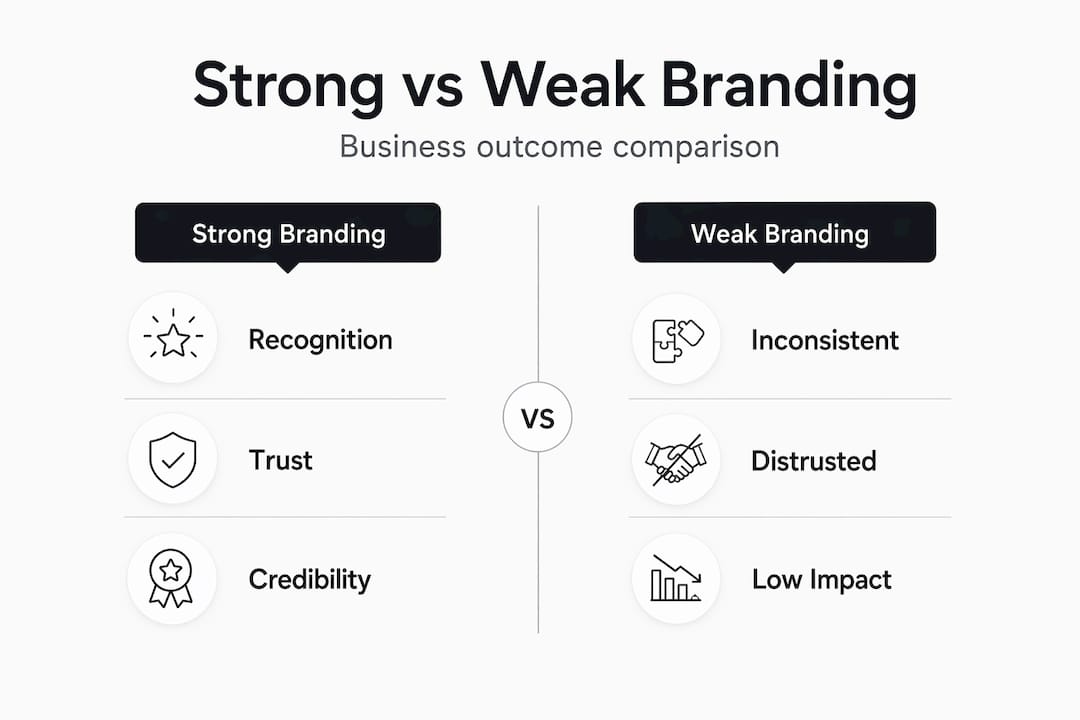
Here is a clear comparison of what strong versus weak branding looks like in practice:
| Factor | Strong branding | Weak branding |
|---|---|---|
| Visual consistency | Uniform across all channels | Varies by platform or document |
| Tone of voice | Clear and consistent | Inconsistent or unclear |
| Customer perception | Credible, professional, reliable | Uncertain, forgettable |
| Enquiry conversion rate | Higher, due to trust signals | Lower, due to unclear identity |
| Customer retention | Stronger loyalty and repeat business | Higher churn and low recognition |
| Referrals | Easier to recommend | Harder to describe or share |
The table above shows that weak branding is not merely an aesthetic problem. It has direct commercial consequences. When your brand is inconsistent, customers find it harder to trust you, harder to remember you, and harder to recommend you to others.
The research backs this up. Customer outcomes including loyalty are connected to the value customers perceive from brands, which means branding is not a vanity exercise. It feeds directly into revenue and retention.
Key benefits of strong brand recognition and trust include:
- Lower cost of conversion because prospects already trust you before they enquire
- Higher average order values as trusted brands command a premium
- Stronger word-of-mouth referrals from loyal customers
- Better results from digital marketing for small business because your brand amplifies every campaign
- Greater resilience in competitive markets where reputation matters
Pro Tip: Make sure your brand promises and your actual delivery are always aligned. The fastest way to erode trust is to promise one thing on your website and deliver something different in practice. A professionally designed website that reflects your real capabilities is a solid starting point.
Consistent branding and digital channels: The engine for growth
Once your brand identity is clear, the next challenge is consistency across every digital channel you use. This is where many small businesses lose ground. They have a decent logo and a reasonable website, but then their social media looks completely different, and their email newsletters use a different colour scheme entirely. To customers, this sends mixed signals.

Consistent digital branding across touchpoints is linked to higher revenue and stronger performance outcomes for SMBs. That connection between consistency and revenue is not accidental. When every channel reinforces the same message and visual identity, customers experience a coherent brand story. That coherence builds confidence and drives action.
Your website is the anchor. It is often the first place a potential customer goes to validate whether your business is legitimate. Digital channels for visibility are critical for small businesses, and a website serves as a brand and experience anchor that signals legitimacy to visitors. If your site looks dated, loads slowly, or fails to reflect your brand values, you are losing customers before they have even made contact.
Here is a practical data comparison showing the difference branding consistency makes:
| Business type | Consistent branding | Inconsistent branding |
|---|---|---|
| Revenue trend | Upward, supported by trust | Stagnant or unpredictable |
| Customer retention rate | Higher over 12 months | Lower, with frequent drop-off |
| Social media engagement | More shares and interactions | Low engagement, poor reach |
| Website conversion | More enquiries per visit | Fewer conversions, higher bounce |
| Brand awareness growth | Steady and compounding | Slow and fragmented |
To make your branding consistent across all digital touchpoints, follow these steps:
- Audit your current presence: Check your website, social profiles, email templates, and any printed materials. Note where they differ visually or tonally.
- Define your brand standards: Create a simple brand guide documenting your logo usage, colour codes, fonts, and tone of voice.
- Update your website first: It is your primary brand anchor. Make sure it reflects your current identity accurately.
- Align your social media: Update profile images, cover photos, and bios to match your website identity.
- Standardise email communications: Use a consistent email signature and template that reflects your brand.
- Review regularly: Set a quarterly reminder to check all channels and correct any drift from your brand standards.
Digital outreach for visibility works far better when your brand is consistent, because every piece of content you publish reinforces the same identity and builds on the recognition you have already earned.
Pro Tip: Review all your digital touchpoints every quarter. Businesses grow, services change, and brand materials can drift over time. Use the audit process above to keep everything aligned. Tools for social media management can also help you maintain a consistent publishing schedule and visual style across platforms. If your cash flow is under pressure while you invest in branding, it is worth reading up on cash flow management tips to ensure your investment is sustainable.
When designing a business website, think about how every page, every call to action, and every image reflects and reinforces your brand. The goal is for visitors to feel a coherent experience from the moment they land to the moment they make an enquiry.
Branding for small budgets: Strategy over spend
One of the most persistent myths about branding is that it requires significant investment. Large businesses certainly spend considerable sums on brand campaigns, but the core elements of effective branding do not require a large budget. What they require is clarity, consistency, and commitment.
When you have limited resources, strategy matters more than spend. A small business with a clear brand message and a tidy, consistent online presence will outperform a larger competitor that presents a confusing or outdated identity. Branding reduces uncertainty for customers, especially during digital discovery moments when they are comparing options and deciding who to trust.
Here are practical, low-cost branding strategies that work for SMEs:
- Define your positioning clearly: Know who you serve, what problem you solve, and why you do it better than others. Write this down in two or three sentences and use it consistently.
- Invest in a professional logo: This is not an area to cut corners. A clean, memorable logo built by a professional makes every other marketing effort more effective.
- Create a simple brand guide: Even a one-page document covering your colours, fonts, and tone makes a significant difference to consistency across your team.
- Use free and low-cost digital tools: Social media profiles, Google Business Profile, and email marketing platforms are free or low-cost ways to amplify your brand to a wide audience.
- Focus on photography and imagery: High-quality, consistent visuals signal professionalism. Even smartphone photography can look excellent with the right lighting and composition.
- Be consistent in your tone: Whether you are writing a social media post or responding to a customer email, your voice should feel recognisably yours.
Affordable graphic design services can help you build a professional visual identity without the price tag of a full agency retainer. Getting the foundations right early pays dividends as your business grows.
Pro Tip: The three elements that deliver the highest return for small business branding are a memorable logo, a compelling and clear message, and a cohesive online presence. Get these three things right first, and everything else becomes easier and more effective.
Why branding’s true value lies beyond awareness
Most conversations about branding stop at awareness. Get your name out there, make people recognise your logo, and the business will follow. That thinking is too shallow, and it leads many SMEs to underinvest in the dimensions of branding that actually drive long-term commercial outcomes.
Branding’s real power is not awareness. It is the ongoing fulfilment of a promise. Every time a customer interacts with your business and gets exactly what they expected, your brand grows stronger. Every time a customer is disappointed, your brand takes a hit. This is not a subtle or gradual effect. Ingredient changes that reshape brand perception show that when brand promises do not match delivery, trust erodes quickly and churn follows. Brand strength depends on consistency and credibility, not just recognition.
We see this play out with SMEs all the time. A business invests in a beautiful new website and a fresh logo, drives traffic, and generates enquiries. But if the follow-up email is slow, the service experience is inconsistent, or the product does not match the marketing, those customers do not come back. Worse, they tell others.
The businesses that build lasting brand value are the ones that tie their branding to outcome metrics: customer loyalty rates, repeat purchase frequency, referral volume, and churn rates. These are the numbers that tell you whether your brand is actually working, not just your social media follower count or your website traffic figures.
For SMEs, this is an opportunity. You can create personal, consistent, high-quality experiences far more easily than a large organisation can. Your size is an advantage here. Lean into it by making every customer interaction a deliberate reinforcement of your brand values. That is how you build a brand that compounds in value over time.
If you are looking at how professional web design drives growth, remember that the website must deliver on the promise it makes. A visually excellent site that is backed by an equally excellent customer experience creates the consistency that builds lasting brand equity.
Next steps: Enhance your digital branding with expert support
Understanding branding strategy is valuable. Putting it into action is where the real results happen. If your digital presence is not yet reflecting the quality and credibility of your business, now is the time to address it.
At Fylde Digital, we work with small and medium-sized businesses to build digital brands that attract attention and convert interest into enquiries. Our web design services are built around your brand, your goals, and your audience, creating websites that look professional and perform commercially. We also provide graphic design solutions to give your visual identity the polish it deserves. And when your brand is ready to grow, our social media management service ensures your message reaches the right people consistently. Get in touch today for a free website and SEO review.
Frequently asked questions
How does branding impact business growth?
Branding increases trust, visibility, and customer loyalty, which directly lifts revenue and reduces churn. Consistent digital branding across touchpoints is linked to higher revenue and stronger performance outcomes for SMBs.
Can small businesses achieve effective branding without a big budget?
Yes, by focusing on clarity, consistency, and digital-first strategies, SMEs can build strong brands affordably. Branding reduces uncertainty for customers, which makes even a modest but consistent brand highly effective.
What is the risk if brand promises do not match business delivery?
A mismatch drives customer churn and erodes trust quickly, causing brand value to fall even when awareness is high. Trust erosion from delivery gaps shows that brand strength depends on consistency and credibility above all else.
Why is a website important for brand legitimacy?
A website acts as the primary anchor for your brand identity and signals legitimacy, trust, and quality to potential customers. Digital channels and a website provide small businesses with control over their brand experience and customer relationships.