If you have ever sat across the table from a digital marketing agency and nodded along to terms you did not fully understand, you are not alone. Misinterpreting just a handful of key concepts, like confusing organic traffic with paid traffic, or conflating impressions with conversions, can lead to misallocated budgets, poorly measured campaigns, and real missed growth opportunities. This guide is built to change that. We will walk you through the essential digital marketing vocabulary every small and medium-sized business owner should know, explain how results are measured, and show you how sharper terminology leads directly to smarter strategy.
Table of Contents
- Why digital marketing terminology matters for SMBs
- Essential digital marketing terms every business owner should know
- Understanding attribution: who gets credit for your results?
- Multi-touch attribution (MTA) vs marketing mix modelling (MMM)
- Our take: why mastering terminology is your unfair advantage
- Get expert help decoding digital marketing for your business
- Frequently asked questions
Key Takeaways
| Point | Details |
|---|---|
| Know the core terms | Understanding digital marketing jargon empowers you to make smarter strategy decisions. |
| Select the right attribution model | Choosing the best way to track results can maximise your marketing ROI. |
| Different methods, different strengths | SEO, PPC, and content marketing each offer unique benefits and should be used strategically. |
| Triangulate your measurement | Cross-check data from multiple attribution models for the truest picture of your marketing impact. |
| Turn knowledge into action | Apply the right terminology to confidently brief teams or agencies and grow your business. |
Why digital marketing terminology matters for SMBs
Digital marketing has developed its own specialised language, and that language moves fast. New platforms, new tools, and new measurement frameworks mean the vocabulary keeps evolving. For a small or medium-sized business (SMB) owner, keeping up with this can feel overwhelming. But here is the problem: when you do not understand the terminology, you cannot effectively evaluate whether your agency or in-house team is delivering value.
Imagine approving a campaign without understanding what a conversion rate actually measures, or signing off on an SEO package without knowing the difference between on-page and off-page optimisation. These gaps in knowledge create an environment where budget gets wasted and campaigns underperform. According to small business marketing data, SMBs invest an average of 7 to 8% of their revenue on marketing, with B2C businesses spending around 9.6% and B2B businesses closer to 6.8%. That is a significant slice of revenue. Every misunderstood term is a potential leak in that investment.
Understanding digital marketing terminology helps you in several very practical ways:
- Evaluate agency proposals more confidently, asking the right questions and spotting vague promises
- Set realistic expectations for how long SEO takes versus PPC to deliver results
- Measure performance accurately, knowing which metrics actually indicate growth
- Communicate clearly with your team, agency, or freelancers without confusion
- Make smarter budget decisions based on what each channel truly delivers
For a broader grounding in the subject, our digital marketing guide for small business is a solid starting point.
Now that you see what’s at stake, let us start with the core concepts.
Essential digital marketing terms every business owner should know
With the importance established, here are the most vital terms explained in context.
SEO (Search Engine Optimisation) is the process that improves website visibility in organic search results. When someone searches on Google for a service you offer, SEO is what determines whether your website appears near the top of those results or gets buried on page four. It involves optimising your website content, technical structure, and earning links from reputable external websites.

PPC (Pay Per Click) is paid advertising where you pay a fee each time a user clicks on your advert. Google Ads is the most common PPC platform. Unlike SEO, PPC can start driving traffic immediately, but the moment you stop paying, the traffic stops too. For local businesses, it is a powerful way to appear at the top of search results fast.
Content marketing is the practice of creating valuable content to attract and retain an audience over time. Blog posts, videos, guides, and case studies all fall under this umbrella. The goal is not to sell directly, but to build trust and authority so that when someone is ready to buy, they already know and respect your brand.
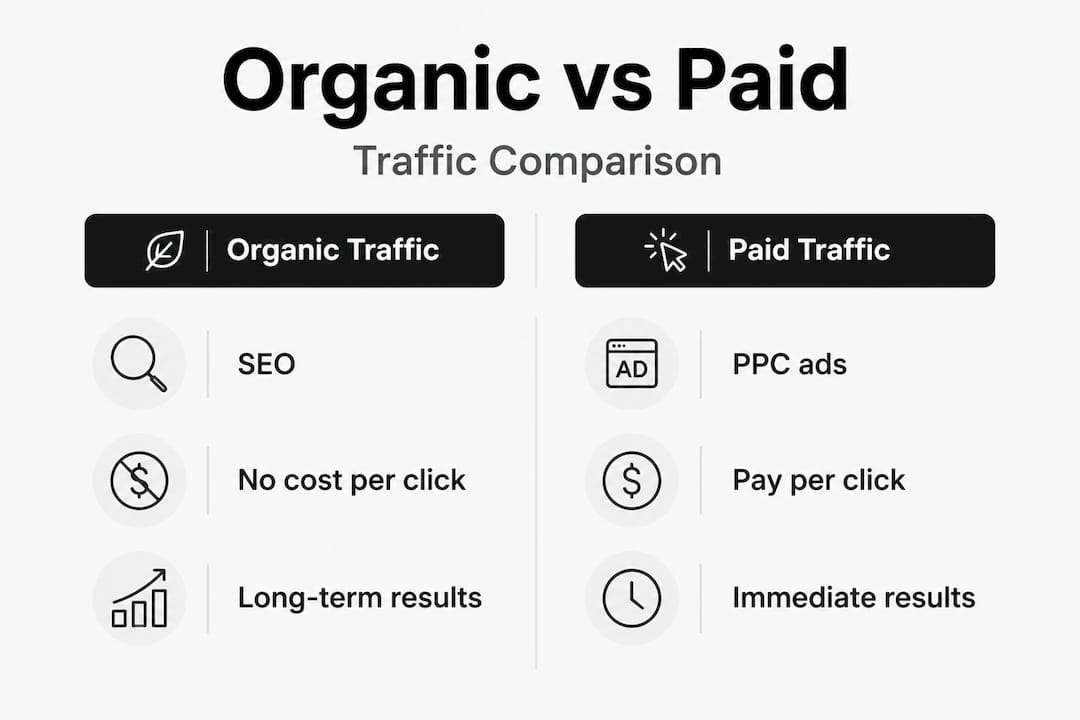
Organic vs paid traffic: Organic traffic comes from unpaid search results, driven by your SEO efforts. Paid traffic comes from adverts you pay for, like PPC campaigns. Both are valuable, but they work differently and require different investment levels and timeframes.
Impressions refer to how many times your content or advert is displayed to users, regardless of whether they click. A high impression count with a low click rate could indicate your message is not resonating.
CTR (Click-Through Rate) is the percentage of people who see your content and then click on it. If 1,000 people see your advert and 50 click, your CTR is 5%. A healthy CTR varies by platform and industry, but it is a key indicator of how compelling your messaging is.
Conversion is when a user completes a desired action, such as making a purchase, submitting an enquiry form, or booking a call. Conversion rate is one of the most important metrics in all of digital marketing, measuring the quality of your traffic, not just the quantity.
Branding in the digital context refers to how your business presents itself across all online channels. It includes your visual identity (logo, colours, typography), your tone of voice, and the overall impression your business makes at every touchpoint.
Here is a quick comparison to put the three main channels in perspective:
| Channel | Primary purpose | Cost structure | Time to results |
|---|---|---|---|
| SEO | Long-term organic visibility | Fixed monthly investment | 3 to 6 months minimum |
| PPC | Immediate paid traffic | Pay per click or impression | Immediate |
| Content marketing | Build authority and trust | Time and resource investment | 6 to 12 months |
For a more detailed breakdown, see our guide on SEO and PPC explained, and if you want to go deeper on organic search tactics, our article on SEO best practices covers practical strategies for higher rankings. Businesses running paid campaigns locally will also benefit from reading our thoughts on Google Ads for local businesses.
Pro Tip: Many business owners mix up organic and paid results when reviewing their analytics. Organic traffic builds compounding value over time and does not disappear when budgets are paused. Paid traffic delivers speed. Know which is which, because tracking them separately is the only way to accurately measure your return on investment.
Understanding attribution: who gets credit for your results?
Once you grasp core terms, it is time to dig into how results get measured and attributed.
Attribution in digital marketing answers a simple but important question: which marketing channel deserves credit when a customer converts? The reality is that most customers interact with your brand multiple times before taking action. They might see a social media post, then click a Google Ads result, then return via an organic search a week later. So which touchpoint gets the credit?
Attribution models are the frameworks that determine how credit is assigned across the customer journey. Here are the six most common models:
| Model | How credit is assigned | Strength | Weakness | Best for |
|---|---|---|---|---|
| Last-click | 100% to the final touchpoint | Simple and easy to set up | Ignores all earlier touchpoints | Direct response campaigns |
| First-click | 100% to the first touchpoint | Values awareness channels | Ignores conversion-stage activity | Brand discovery analysis |
| Linear | Equal credit across all touchpoints | Fair and balanced | Treats all touchpoints as equal | Full-funnel understanding |
| Time-decay | More credit to recent touchpoints | Reflects buying decisions well | Undervalues top-of-funnel effort | Short sales cycles |
| Position-based (U-shaped) | 40% to first, 40% to last, 20% spread | Recognises key journey points | Complex to interpret | Mixed funnel strategies |
| Data-driven | Credit based on statistical analysis | Most accurate when scaled | Requires substantial data volume | Large campaigns with rich data |
One of the biggest mistakes SMBs make is trusting each platform to report its own results accurately. Google Ads, Facebook Ads, and email marketing platforms all have a natural tendency to claim credit for conversions. When you look at each channel’s reporting in isolation, the numbers almost always add up to more than 100% of your actual sales. Cross-referencing your data and understanding attribution models protects you from this distortion.
“The channel that appears last in a conversion path is not always the channel that did the most work. A customer might have discovered you through a blog post six months before they ever clicked your advert.”
Common attribution mistakes SMBs make include:
- Relying solely on last-click attribution and undervaluing their SEO content
- Comparing channels without aligning them to the same attribution model
- Trusting platform-reported conversions without cross-checking against actual revenue
- Ignoring assisted conversions, which show how channels support each other
Understanding attribution is central to the SEO vs PPC comparison debate, because the answer often depends on which touchpoints you are giving credit to.
Multi-touch attribution (MTA) vs marketing mix modelling (MMM)
To take measurement further, let us see how experts look at the big picture and user journeys.
Multi-touch attribution (MTA) and marketing mix modelling (MMM) are two of the more advanced measurement techniques used in digital marketing. They are often mentioned together but serve quite different purposes. MTA focuses on user-level journeys whilst MMM analyses aggregate spend impact across all marketing activity.
MTA tracks individual customer interactions across digital touchpoints and assigns value to each one. It is granular and digital-first, making it useful for understanding the specific role of email, search, display, and social in driving conversions at the individual user level.
MMM, on the other hand, takes a much broader view. It uses statistical modelling to assess the overall impact of all marketing activity, including offline channels like print and TV, on business outcomes like revenue. It cannot tell you what one specific user did, but it can tell you what happened to your sales when you increased spend on a particular channel across a given period.
Here is when each approach makes most sense:
- Use MTA when you want to understand which digital channels and content types are driving individual customer conversions
- Use MTA when you are optimising digital campaign spend at the channel or ad group level
- Use MTA when your sales cycle is short and customers interact primarily through digital channels
- Use MMM when you need to evaluate the performance of both online and offline marketing together
- Use MMM when privacy changes limit individual-level tracking (such as the impact of cookie deprecation)
- Use MMM when you are making long-term budget decisions across multiple marketing channels
Knowing which tool to apply prevents you from drawing the wrong conclusions from your data. If you are a small business with primarily digital channels and a short buying journey, MTA will almost certainly give you more actionable insights than MMM. If you are spending across print, events, and digital simultaneously, MMM paints a truer picture of what is working.
Our full range of marketing services explained shows how these measurement frameworks apply across different digital disciplines.
Pro Tip: Never rely on a single attribution model or measurement method alone. Triangulate your findings across MTA reports, platform analytics, and direct customer feedback to build a more accurate picture of what is genuinely driving your growth.
Our take: why mastering terminology is your unfair advantage
Here is a perspective that does not get said enough: the businesses we see growing the fastest are not necessarily the ones with the biggest budgets. They are the ones where the owner, director, or marketing lead actually understands what they are buying.
When you know the difference between an impression and a click, between a session and a conversion, or between last-click and data-driven attribution, you stop being a passive recipient of agency reports and start being an active participant in your own growth strategy. That matters far more than most people realise.
We have seen businesses spend years paying for SEO packages that were not moving the needle, simply because they did not know what questions to ask. And we have seen equally under-confident business owners transform their results simply by learning the vocabulary well enough to challenge assumptions and redirect effort.
Agencies are not always wrong, but they are sometimes under-challenged. When you can speak the language, you hold the agency accountable in a way that benefits everyone. Your campaigns get sharper, your budget gets used more strategically, and your results improve. The owners who learn the language outperform those who delegate blindly, not because they micromanage, but because they guide.
This thinking aligns with a broader shift we explore in our work on website redesign for growth: sustainable growth comes from informed decision-making, not just from spending more.
Get expert help decoding digital marketing for your business
Understanding the theory is genuinely valuable. But knowing what MTA means does not automatically translate into running better campaigns. That is where expert support bridges the gap between clarity and results.
At Fylde Digital, we work with small and medium-sized businesses across the Fylde Coast and beyond to turn digital marketing knowledge into measurable outcomes. Whether you need a well-designed website for business that converts visitors into leads, or a team of specialists who understand web design in Blackpool and the local market, we provide tailored guidance that fits your goals. Our approach to SEO best practices ensures your investment builds lasting visibility, not short-term noise. Get in touch for a free review and let us show you exactly what your marketing should be doing.
Frequently asked questions
What is the difference between SEO and PPC?
SEO improves organic rankings through content and technical optimisation, whilst PPC is paid advertising where you pay each time someone clicks your advert, delivering immediate but cost-dependent traffic.
Why do attribution models matter in digital marketing?
Attribution models determine which touchpoints receive credit for a conversion, helping you understand where your budget is genuinely working and where it is being wasted.
How much should a small business spend on marketing?
Most SMBs invest 7 to 8% of revenue on marketing each year, though B2C businesses tend to spend slightly more at around 9.6% compared to B2B businesses at 6.8%.
What is multi-touch attribution (MTA)?
MTA tracks user-level journeys across digital touchpoints and assigns value to each interaction, rather than giving all the credit to just the first or last channel a customer engaged with.
Is content marketing the same as digital marketing?
Content marketing is one important component of digital marketing, specifically focused on creating valuable content to attract and retain an audience, but digital marketing also includes SEO, PPC, social media, and email marketing.
Recommended
- What is digital marketing? A guide for small business success
- Services – Fylde Digital – Web Design SEO Social Media
- Home – Fylde Digital – Web Design SEO Social Media
- What Is SEO and PPC for Business Growth? – Fylde Digital – Web Design SEO Social Media
- Advanced Diploma Digital Marketing Australia | AI-Powered Marketing Career | CTDI — Canterbury Training and Development Institute