Your online presence is either working for you or against you. Every day a potential customer searches for what you offer, finds a competitor with a cleaner website, more reviews, and a consistent Google Business Profile, and never reaches you at all. The good news is that improving your digital presence is a systematic process, not a mystery. Here is what actually moves the needle for UK small businesses in 2026.
The core steps, in order of impact:
- Build a mobile-optimised website that loads quickly and acts as your permanent digital hub
- Maintain entity consistency — identical name, address, and phone number across every platform — as this is the highest-return local SEO task available to you
- Claim and complete your Google Business Profile fully, including photos, categories, and regular updates
- Implement on-page SEO with targeted keywords, meta titles, and schema markup for both traditional and AI-powered search
- Choose 2–3 social media platforms where your audience is active and commit to them consistently
- Publish valuable content regularly, including video, to build authority and support search rankings
- Use paid advertising on Google Ads or Meta Ads to accelerate visibility when organic growth needs a boost
- Monitor performance monthly using Google Analytics and platform insights, then adjust accordingly
- Build credibility through genuine reviews, prompt responses, and a professional customer experience
- Automate repetitive tasks such as social scheduling and review requests to maintain consistency without burnout
Each of these areas is covered in depth below.
How to improve your online presence with a strong website foundation
Your website is your most valuable digital asset. Unlike a social media profile, you own it outright. No algorithm change can remove it, no platform can shut it down, and it works for your business around the clock. Think of it as your first salesperson: it needs to make a strong impression, answer the right questions, and make it easy for visitors to get in touch.

Mobile responsiveness is non-negotiable. Google uses mobile-first indexing, which means it ranks your site based on how it performs on a phone, not a desktop. If your pages load slowly, display poorly on smaller screens, or require excessive scrolling to find basic information, visitors leave. Google’s Core Web Vitals measure exactly these factors, and poor scores directly affect your search rankings.
Your About page deserves more attention than most business owners give it. When someone searches your business name, the About page typically ranks prominently and is the page most often cited in AI-generated summaries. It should include your full company name exactly as it appears everywhere else, your founding date, brief leadership bios, and a clear statement of what you do and who you serve. Consistency here is an entity trust signal that search engines and AI systems both read.
Schema markup is the technical layer that helps search engines and AI tools correctly identify your business. Implementing Organisation, LocalBusiness, and Person schema tells Google, Gemini, and Perplexity precisely who you are, what you do, and where you operate. It functions as both a traditional SEO asset and a Generative Engine Optimisation (GEO) asset, which matters increasingly as AI-powered search becomes a primary research channel.
Practical website essentials worth checking today:
- Fast load times across mobile and desktop (test with Google PageSpeed Insights)
- Clear navigation with no more than five or six top-level menu items
- A prominent contact form or phone number on every key page
- High-quality images that reflect your brand professionally (see Fyldedigital’s visual web design guide for practical guidance)
- A media kit or brand assets page so journalists and partners use your correct logo and imagery
- SSL certificate for security (the padlock in the browser bar)
Pro Tip: Host all your social media links, brand assets, and key content on your website. Owned platforms give you permanent control over your narrative. Social media profiles are rented space; your website is the property you actually own.
SEO strategies that work for UK small businesses
Search engine optimisation is how potential customers find you when they are not already looking for you by name. For a UK small business, the most practical SEO work falls into three areas: local optimisation, on-page fundamentals, and building authority over time.
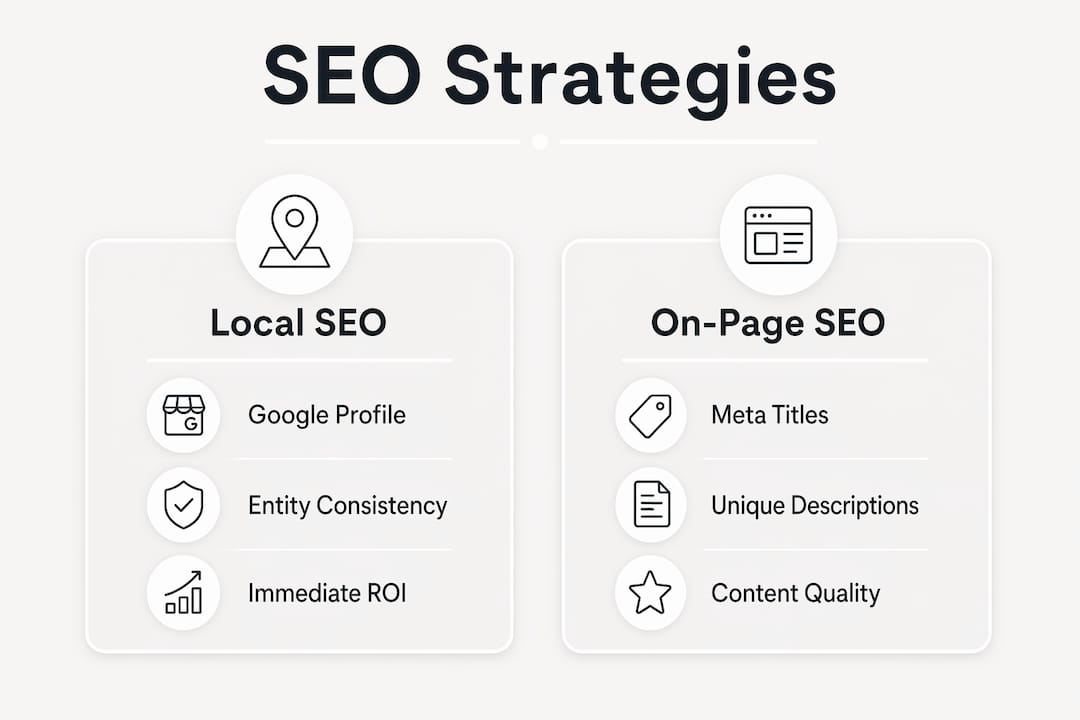
Start with local SEO for small businesses because the return is immediate and measurable. Google Business Profile is the highest-leverage single asset for local exposure. It controls what appears in Google Maps, in the local search pack, and increasingly in AI-generated responses to location-based queries. Complete every field: business name identical to your website and every other platform, address, phone number, website URL, hours, service categories, and a description that leads with what you do. Respond to every review. Use the Q&A feature to answer common questions before customers even need to ask.
Entity consistency underpins all of it. When your name, address, and phone number appear differently across your website, Google Business Profile, LinkedIn, and local directories, search engines and AI systems generate conflicting information about your business. The fix is a single focused session: update every platform to identical information. The downstream benefit compounds over time.
On-page SEO covers the elements within your own website. Each page should have a unique meta title and description that includes your target keyword naturally. Headings should follow a logical hierarchy (H1, H2, H3). Content should answer the questions your customers are actually searching for, not just describe your services in general terms. A local bakery in Preston, for example, benefits far more from a page optimised for “sourdough bread Preston” than a generic “artisan bakery” page with no location signals.
Building authority takes longer but produces lasting results. Backlinks from reputable UK publications, trade directories, and local press carry significantly more weight than self-published content. A single article in a relevant trade publication outweighs a dozen blog posts in terms of authority transfer. Earned media, whether press coverage, podcast appearances, or contributed articles, builds the kind of third-party validation that Google’s systems reward.
Avoid these common pitfalls:
- Duplicate listings on Google Business Profile (claim and merge any duplicates)
- Outdated NAP information on old directory listings
- Thin pages with little content that offer no real value to the reader
- Keyword stuffing, which Google penalises and readers notice immediately
Which social media platforms should your business actually use?
The most common mistake small business owners make with social media is trying to be everywhere at once. Spreading effort across six platforms produces six mediocre presences. Focusing on 2–3 platforms where your audience is genuinely active produces one or two strong ones. That distinction matters more than any individual tactic.

LinkedIn is the priority for any B2B business or professional service. It ranks prominently in Google results for name searches, and investors, partners, and prospective clients check it before making contact. If you do nothing else on social media, maintain a complete, active LinkedIn presence.
Instagram suits product-based businesses, hospitality, food, interiors, fashion, and any brand with strong visual content. The platform rewards consistency and quality over frequency. Reels, in particular, drive significantly higher reach than static posts.
Facebook remains relevant for local service businesses and community-focused brands. Its events feature and local groups give small businesses genuine ways to connect with nearby customers, and its advertising platform offers precise geo-targeting that suits UK local businesses well.
YouTube is worth considering if you can commit to regular video content. It functions as both a social platform and a search engine, and videos rank in Google results. A plumber in Blackpool explaining how to prevent frozen pipes in winter has a genuine chance of ranking for that search term.
Practical social media principles:
- Complete every profile field, including a professional profile photo, cover image, and bio that matches your website exactly
- Post consistently rather than in bursts; two quality posts per week beats seven rushed ones
- Respond to comments and messages promptly, as responsiveness signals credibility to both followers and algorithms
- Use platform analytics to identify which content types generate the most engagement, then do more of that
Pro Tip: Use scheduling tools such as Buffer or Later to plan a week’s content in one sitting. Pair them with AI tools like ChatGPT for content ideas and caption drafts, then add your own voice before publishing. Consistency without burnout is the goal.
For a deeper look at managing your channels effectively, Fyldedigital’s social media management guide covers platform-specific strategy in practical detail.
Content marketing: how to build authority and attract the right customers
Content marketing is the practice of publishing genuinely useful material that answers your customers’ questions, solves their problems, and demonstrates your expertise. It supports SEO, builds trust, and gives you something worth sharing across every channel you operate.
The starting point is understanding what your customers are actually searching for. Keyword research tools reveal the exact phrases people type into Google when they have a problem you can solve. A solicitor in Lancaster, for example, might discover that “how to contest a will in the UK” generates consistent search volume from people who need exactly the services they offer. A blog post answering that question thoroughly, written with genuine expertise, attracts qualified traffic and builds credibility simultaneously.
Vary your content formats. Blog posts work well for detailed explanations and SEO. Short-form video dominates engagement across Instagram, TikTok, and YouTube Shorts, driving higher interaction than any other format in 2026. Infographics suit complex processes or statistics that benefit from visual presentation. Guides and downloadable resources generate leads when placed behind a simple email sign-up form.
Publish on a realistic schedule and stick to it. One well-researched, genuinely useful article per fortnight beats four thin posts per week. Search engines reward freshness and quality; readers reward consistency and depth. Promote each piece of content across your email list and social channels to extend its reach beyond organic search.
Content also builds the kind of authority that AI search systems draw from. When ChatGPT or Perplexity generates a response about businesses in your category, it synthesises from authoritative content, consistent directory profiles, and well-structured website material. Publishing content that demonstrates real expertise and earns third-party links puts you in the pool those systems draw from.
How to use paid advertising without wasting your budget
Paid advertising gives you immediate visibility while organic SEO builds over time. The two approaches work best together: SEO provides sustainable long-term traffic, while paid campaigns fill the gap during the early months or target specific promotions and seasonal peaks.
Google Ads and Meta Ads allow precise audience targeting by location, demographics, interests, and search intent. For a UK small business, geo-targeting is particularly valuable. You can restrict your Google Ads campaigns to specific postcodes, towns, or regions, ensuring your budget reaches only the people who can realistically become customers.
The most common paid advertising mistakes:
- Sending ad traffic to your homepage rather than a dedicated landing page aligned with the ad’s message
- Setting a budget and forgetting it, without monitoring which keywords or audiences are converting
- Running ads before your website is ready, wasting spend on traffic that bounces immediately
- Focusing on impressions and clicks rather than actual enquiries or sales
Google Ads works best for capturing demand that already exists: people actively searching for your service. Meta Ads (Facebook and Instagram) works better for building awareness among people who match your customer profile but are not yet searching. LinkedIn Ads suits B2B businesses targeting specific job titles or industries, though the cost per click is higher than other platforms.
Set a clear objective before you spend a penny. Whether that is phone calls, form submissions, or product purchases, your campaign structure, ad copy, and landing page should all point toward that single outcome. For guidance on when paid advertising makes sense versus organic growth, Fyldedigital’s SEO vs PPC comparison is a practical starting point.
How to monitor and adapt your online presence over time
You cannot improve what you do not measure. Monitoring your digital presence is not a one-off task; it is an ongoing process that tells you what is working, what has changed, and where to focus next.
Google Analytics remains the most useful free tool for understanding website performance. Track traffic sources to see whether visitors are arriving from organic search, social media, paid ads, or direct visits. Monitor bounce rate and time on page to gauge whether your content is engaging. Set up conversion tracking so you know which channels are actually generating enquiries or sales, not just visits.
Beyond your website, monitor your broader digital footprint:
- Set Google Alerts for your business name and key personnel to catch mentions across the web
- Check your Google Business Profile insights monthly for direction requests, calls, and website clicks
- Review your social media analytics platform by platform to identify which content types perform best
- Conduct a monthly branded search: type your business name into Google and review everything on page one
The monitoring step most businesses skip is the AI audit. Once a month, search your business name and key services in ChatGPT, Google Gemini, and Perplexity. Read what they say. AI-generated search results frequently contain errors that are invisible in traditional search monitoring, and catching them early protects your reputation in a channel that a growing proportion of customers now use for research.
Schedule a quarterly review of your overall strategy. Algorithm updates on both Google and social platforms can shift your visibility without warning. Staying informed and adjusting your approach is part of the work, not an optional extra.
Building credibility and improving customer experience online
A Salesforce survey found that 85% of consumers research online before making a purchase, with websites (74%) and social media (38%) being the most used channels. That means your digital presence is almost always the first impression you make, often before a customer has spoken to anyone at your business.
Credibility online comes from consistency, authenticity, and responsiveness. A business with a professional website, accurate contact details, recent positive reviews, and active social profiles reads as legitimate and trustworthy. One with an outdated website, no reviews, and a Facebook page last updated two years ago raises doubts, even if the underlying business is excellent.
Reviews are among the most powerful trust signals available to a small business. Encourage satisfied customers to leave reviews on Google, Trustpilot, or industry-specific platforms. Respond to every review, positive and negative. A thoughtful response to a critical review demonstrates professionalism and accountability in a way that no marketing copy can replicate. Businesses that maintain updated, high-quality photos on their online profiles receive significantly more direction requests and website contact clicks than those that neglect their visual assets.
Personalisation strengthens the customer experience without requiring complex technology. Addressing customers by name in email communications, referencing their previous purchases or enquiries, and tailoring content to their interests all signal that your business pays attention. At the website level, clear contact options, fast response times, and a straightforward mobile experience remove friction at the point where a potential customer is deciding whether to get in touch.
Testimonials and case studies add a layer of social proof that generic marketing cannot provide. A brief case study showing how you helped a specific type of client achieve a specific outcome is far more persuasive than a list of services. Place these prominently on your website, particularly on service pages and your About page.
What the latest research tells us about digital presence in 2026
The most significant shift in digital presence over the past two years is the rise of AI-powered search as a primary research channel. When a potential customer asks ChatGPT or Perplexity to recommend a web designer in Blackpool or a solicitor in Preston, the response draws from the same sources that traditional SEO has always prioritised: authoritative content, consistent entity information, and strong review profiles. The difference is that AI systems require more deliberate structuring to cite your business correctly.
Generative Engine Optimisation (GEO) is the practice of structuring your content and schema markup so that AI search agents can correctly identify, attribute, and cite your business. Implementing explicit schema markup for Organisation, Person, and LocalBusiness types is the most direct technical step. When Gemini or Perplexity generates a summary about businesses in your category, schema markup is among the signals they draw from.
Entity consistency is the foundational requirement for both traditional and AI search. When your name, address, phone number, founding date, and business description appear differently across your website, Google Business Profile, LinkedIn, and directories such as Yell or Thomson Local, AI systems generate responses with conflicting information. The fix is a single focused pass: update every platform to identical information. It is the cheapest fix with the highest return in local SEO.
Research insight: A strong online presence has four essential qualities: it must be visible, accurate, authoritative, and positive. Most businesses achieve two or three. Building all four requires a systematic approach applied consistently.
Pro Tip: Run a monthly AI audit by querying your business name and key services in ChatGPT, Perplexity, and Google Gemini. Note any errors or gaps in how your business is described. These errors will not appear in Google Search Console, making manual checks the only reliable detection method.
The GOV.UK social media playbook reinforces that consistency between owned platforms (your website and email list) and rented platforms (social media) determines long-term control over your brand narrative. Social media profiles are valuable, but they are rented space. Your website is the property everything else points back to.
UK data protection and privacy regulations: what your online presence must comply with
Operating a digital presence in the UK means working within a specific legal framework. The UK General Data Protection Regulation (UK GDPR), which sits alongside the Data Protection Act 2018, governs how you collect, store, and use personal data from website visitors and customers. Getting this right is not just a legal requirement; it is a trust signal that customers notice.
The practical implications for your website and digital marketing:
- Cookie consent: Your website must obtain informed consent before placing non-essential cookies (analytics, advertising, social media trackers). A clear, accessible cookie banner with genuine opt-in and opt-out options is required. Pre-ticked boxes do not constitute valid consent under UK GDPR.
- Privacy policy: Every website that collects personal data needs a clear, plain-English privacy policy explaining what data you collect, why you collect it, how long you keep it, and how users can request its deletion.
- Email marketing: Under the Privacy and Electronic Communications Regulations (PECR), you need explicit consent to send marketing emails to individuals. Buying email lists and sending unsolicited marketing is both illegal and damaging to your sender reputation.
- Contact forms: Any form that collects names, email addresses, or phone numbers must be covered by your privacy policy and must not collect more data than you genuinely need.
- Data storage: Personal data must be stored securely. If you use third-party tools such as Mailchimp, HubSpot, or a CRM, check that they are compliant and that your data processing agreements are in place.
The Information Commissioner’s Office (ICO) is the UK’s data protection regulator. Its website provides free guidance for small businesses on UK GDPR compliance, including a self-assessment tool. Non-compliance carries financial penalties, but more practically, a business that handles customer data carelessly loses the trust it has worked to build.
One area that catches small businesses out is Google Analytics. The default configuration of Google Analytics collects IP addresses, which constitutes personal data under UK GDPR. Configuring IP anonymisation, or switching to a privacy-focused analytics tool, keeps you compliant without losing the performance data you need.
How to use online review platforms to manage your reputation
Your reputation online is shaped by what other people say about you, not just what you say about yourself. Review platforms rank prominently in branded search results. Your Google Business Profile listing, your Trustpilot profile, and any industry-specific review sites are all potential page-one results when someone searches your business name. Claiming and actively managing these profiles is part of building a credible digital presence.
The most relevant review platforms for UK small businesses:
- Google Business Profile reviews carry the most weight for local search rankings and are the first thing most customers see
- Trustpilot is widely recognised by UK consumers and ranks well in branded searches
- Facebook reviews matter for businesses with an active Facebook presence and local customer base
- Industry-specific platforms such as Checkatrade (trades), Treatwell (beauty), or TripAdvisor (hospitality) reach customers who are specifically looking for your type of service
Generating reviews requires a process, not just a hope. The most effective approach is a simple post-interaction follow-up: send a short email or text message to satisfied customers with a direct link to your preferred review platform. Make it as easy as possible. Most customers who have had a good experience will leave a review if asked promptly and given a direct link.
Responding to reviews is as important as generating them. Thank customers for positive reviews with a specific, genuine response rather than a copy-pasted template. For negative reviews, respond promptly, acknowledge the concern, and offer to resolve it offline. A calm, professional response to a critical review often impresses prospective customers more than the negative review itself deters them.
Never incentivise reviews with discounts or gifts without clear disclosure, and never post fake reviews. The Competition and Markets Authority (CMA) has enforcement powers over fake and misleading reviews, and platforms actively remove them. The reputational damage of being caught far outweighs any short-term gain.
Showcase your best reviews beyond the platforms themselves. Embedding Google reviews on your website, sharing positive feedback on social media, and including testimonials on service pages all extend the reach of your reputation and reinforce trust at the moments that matter most.
Key takeaways
A strong online presence for a UK small business in 2026 requires consistent entity information across every platform, a mobile-optimised website as the central hub, and a systematic approach to SEO, content, reviews, and AI search visibility.
| Point | Details |
|---|---|
| Entity consistency is the priority | Identical name, address, and phone number across every platform is the highest-return local SEO task. |
| Your website is your permanent asset | Unlike social media profiles, your website gives you full control over your brand and content. |
| Google Business Profile drives local visibility | Complete every field and respond to every review to maximise local search and map rankings. |
| Focus on 2–3 social platforms | Consistent presence on the right channels outperforms a thin presence across many. |
| AI search requires deliberate structuring | Schema markup and entity consistency help AI tools like ChatGPT and Perplexity cite your business correctly. |
Ready to build a stronger digital presence?
Fyldedigital works with small businesses across the Fylde Coast and beyond to build websites that convert, SEO strategies that rank, and social media presences that actually engage. Whether you need a professional website in Blackpool built from the ground up or a targeted SEO strategy to improve your visibility in search, the team at Fyldedigital delivers practical, measurable results. Get in touch for a free website and SEO review and find out exactly where your digital presence stands today.