The best print marketing ideas for UK businesses right now
Print marketing delivers results that digital alone cannot match. Targeted direct mail postcards sent to specific postcodes achieve response rates well above most digital advertising benchmarks. Physical materials occupy real space in a customer’s environment, whether on a desk, a kitchen counter, or a wallet, and that presence builds brand recall in a way a disappearing social post simply cannot.
The top print marketing ideas for UK businesses in 2026 are:
- Premium business cards with soft-touch lamination, spot UV, or 400gsm stock that people actually keep
- Targeted direct mail postcards segmented by postcode with a single compelling offer and a QR code
- A5 or A4 flyers for local drops, countertop displays, and community venues
- Event and exhibition banners with high-resolution graphics and branded colours
- Branded packaging including custom boxes, tissue paper, and stickers that turn deliveries into shareable moments
- Loyalty cards (stamp or QR-based) that keep your brand in a customer’s wallet daily
- Door hangers for hyper-local targeting without needing a mailing list
- Catalogue mailers for product-heavy businesses driving repeat orders
- Vehicle wraps and magnetic signs generating thousands of impressions per day
- Branded merchandise such as notepads, tote bags, and desk calendars with genuine utility
- Variable data printing (VDP) to personalise each piece with the recipient’s name, location, or purchase history
- NFC-enabled cards and QR-linked postcards that bridge physical print to digital landing pages
Pro Tip: Invest in premium finishes such as soft-touch lamination or spot UV on your logo. A card or mailer that feels high quality gets kept rather than binned, extending your campaign’s lifespan at minimal extra cost.
Which print materials work best, and when?
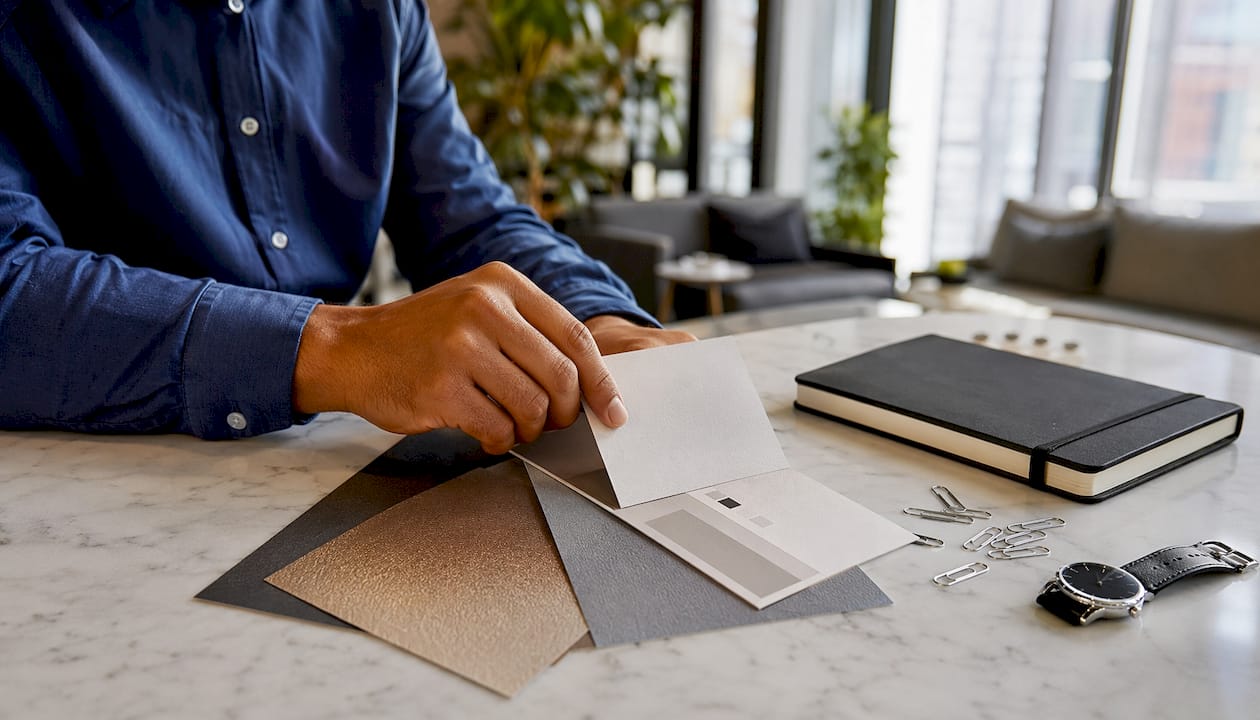
Different formats suit different goals. Choosing the right material before you brief a designer saves both budget and time.
- Brochures and booklets: Best for detailed product or service information. Use quality paper stocks and a UV-coated cover to signal authority. Ideal for trade shows, sales meetings, and high-value prospect packs.
- Flyers and leaflets: Cost-effective for local awareness, event promotion, and grand openings. A double-sided A5 flyer placed in complementary businesses reaches warm local prospects at very low cost per impression.
- Business cards: Your most portable sales tool. A card with bold branding and a QR code linking to your Google reviews page or a special offer bridges print and digital in a trackable way.
- Direct mail (postcards, letters, catalogues): Suited to customer acquisition, retention, and re-engagement. Physical catalogues contribute to increased sales compared with digital-only viewing, with catalogue mailers typically driving sales increases of around 15%, making them particularly powerful for product-heavy retailers.
- Posters and large-format print: High-traffic locations, events, and storefront promotions. High-contrast colours and concise wording make them readable from distance.
- Promotional merchandise: Branded pens, mugs, and tote bags keep your name visible for months after the initial investment. Choose items your audience will actually use.
- Vehicle wraps: Branded vehicles generate tens of thousands of daily impressions in urban areas at a fixed one-time cost, making this one of the lowest cost-per-impression formats available.
Distribution matters as much as design. For local businesses, postcode-targeted drops, community noticeboards, and complementary retail counters all extend reach without significant spend. For events, place materials at registration desks and networking tables where dwell time is highest.

How to build print into your overall marketing strategy
Print works hardest when it is planned alongside your digital activity, not bolted on afterwards. Consistent fonts, colours, and logo placement across print and digital materials significantly drives brand trust, so start with your brand guidelines before briefing any printer.
Steps to integrate print and digital effectively:
- Unify your visual identity. Use the same colour palette, typography, and tone of voice across every printed piece and every digital channel. Inconsistency erodes credibility fast.
- Add trackable elements to every piece. QR codes, personalised URLs (PURLs), unique promo codes, and dedicated phone numbers let you attribute leads and sales directly to print. Without these, you are guessing at ROI. For a practical framework on measuring campaign performance, the same attribution principles that apply to paid digital apply equally to print.
- Segment your audience before you print. Postcode data, purchase history, and demographic profiles all allow you to tailor messaging. A door hanger for a cleaning business works best on streets within a 2-mile radius of your base, not distributed at random.
- Pair print drops with digital reinforcement. Running a social media ad to the same postcodes you are mailing means prospects see your brand twice, and repeated exposure increases conversion likelihood.
- Plan a print calendar. Quarterly campaigns outperform one-off drops because brand recognition builds through repetition. A January postcard, an April flyer, a summer banner, and an autumn direct mail piece create a consistent presence throughout the year.
Statistic callout: Personalised print campaigns using variable data printing create a stronger brand affinity than generic mass mailings, with Royal Mail research confirming that tailored direct mail drives higher engagement across all age groups, including Gen Z audiences.
Budgeting for print does not require a large outlay. Flyers, business cards, and door hangers offer the lowest cost per impression for local businesses. Catalogue mailers and vehicle wraps require more upfront investment but deliver returns over a longer period. Prioritise formats that match your current growth stage: foundational materials first, premium formats as revenue grows.
Why combining print and digital gives you a real edge
Print slows the message down. That is not a weakness; it is the point. Print allows marketers to tell a deeper, richer brand story that builds trust before digital channels take over for speed and conversion. A well-produced brochure or direct mail piece establishes credibility that a Google ad, seen and forgotten in seconds, rarely achieves on its own.
Physical materials carry an emotional weight that digital formats struggle to replicate. A printed catalogue sits on a coffee table. A branded notepad stays on a client’s desk for a year. These touchpoints keep reinforcing your brand long after the initial contact, which is why aligning print with digital creates a synergistic effect that maximises customer engagement rather than simply supplementing it.
Statistic callout: Royal Mail research confirms that personalised print marketing creates a one-to-one feel that resonates personally with consumers, boosting brand affinity and conversion likelihood across multiple audience segments.
Print also benefits from reduced competition. Digital inboxes are crowded; a well-produced piece of print stands out more, not less, as digital volume increases. For brand visibility online to compound the effect, your print materials should drive traffic to a landing page that continues the conversation with the same visual identity and messaging.
Pro Tip: Use a unique QR code on each printed format, not just each campaign. Separate codes for your flyer, postcard, and brochure tell you exactly which format is generating the most leads, so you can invest more in what works.
Fyldedigital handles both sides of the campaign for you
Print marketing ideas are only as good as the execution behind them. Fyldedigital is a full-service marketing agency covering web design, SEO, PPC, social media management, and print production, which means your printed materials and your digital presence are built to work together from the start.
For UK businesses that want print and digital to feel like one joined-up campaign rather than two separate projects, Fyldedigital designs and delivers both. Your brand guidelines stay consistent across every flyer, postcard, and landing page. Your QR codes link to pages that are built to convert. And your print investment is tracked properly so you know what is generating enquiries. Visit Fyldedigital’s services page to see the full range of print and digital marketing options, or get in touch to discuss a campaign built around your specific goals.
Key takeaways
Print marketing ideas work best when they are specific, trackable, and integrated with your digital activity from the outset.
| Point | Details |
|---|---|
| Postcard response rates | Targeted postcards by postcode achieve 4–9% response rates, outperforming most digital ad formats. |
| Catalogue sales uplift | Physical catalogues typically drive sales increases of around 15% compared with digital-only viewing. |
| Vehicle wrap impressions | Branded vehicles generate 30,000–70,000 daily impressions in urban areas at a fixed one-time cost. |
| Track every print piece | Use QR codes, PURLs, or unique phone numbers on each format to attribute leads directly to print. |
| Fyldedigital’s approach | Fyldedigital delivers integrated print and digital campaigns with consistent branding and measurable results for UK businesses. |
Recommended
- Guide to Small Business Branding That Drives Growth – Fylde Digital – Web Design SEO Social Media
- Services – Fylde Digital – Web Design SEO Social Media
- Google Ads for Local Businesses That Convert – Fylde Digital – Web Design SEO Social Media
- When Should Businesses Use PPC? – Fylde Digital – Web Design SEO Social Media