Tracking competitor marketing matters because it hands you early, actionable signals that let you defend market share before it slips, and grab openings before rivals notice them. The single biggest payoff is speed: businesses that watch competitor activity react to threats and openings in days, not quarters. Three things make this worth your time.
- Lead indicators — shifts in ad spend, content and messaging usually show up months before they affect your sales figures.
- Faster decisions — you stop guessing and start responding to what’s actually happening in your market.
- Opportunity spotting — gaps in a competitor’s content, pricing or service reveal exactly where you can win.
The rest of this guide covers what to track, a simple weekly process, and the tools that make it manageable even with a small team.
Key Takeaways
Tracking competitor marketing works because it converts public signals, ad spend, content shifts, pricing moves, into early warnings that let you act before market share is lost.
| Point | Details |
|---|---|
| Marketing signals lead outcomes | Ad spend and content shifts often show up months before revenue changes. |
| Watch Excess Share of Voice | Rising competitor visibility across channels often predicts future market share gains. |
| Automate the boring parts | Alerts and dashboards free your team to interpret signals instead of collecting them. |
| Match tools to channels | Semrush, Ahrefs, SimilarWeb, SpyFu, BuzzSumo, Google Trends, Sprout Social, and Mention/BrandMentions each cover different signals. |
| Get expert setup support | Fyldedigital configures monitoring dashboards and alert feeds so insights reach you automatically. |
Table of Contents
- What does tracking competitor marketing actually mean?
- Why track competitor marketing: the business case
- What to monitor: signals worth watching by channel
- How to build a repeatable monitoring process
- Tools and platforms for tracking competitor marketing
- Choosing tools and building a lean monitoring stack
- Staying on the right side of the law
- Turning competitor signals into real decisions
- Get help setting up your competitor monitoring
- Frequently asked questions
- Sources
What does tracking competitor marketing actually mean?
Tracking competitor marketing means continuously collecting public signals about what rival businesses are doing across search, social, ads, content and pricing, then feeding what you learn into your own planning. It’s not the same as a one-off competitor analysis you do before writing a business plan. That’s a snapshot. Monitoring is ongoing, and it’s what turns a single competitor audit into a live intelligence system.
It’s also worth separating monitoring from anything murky. Watching public-facing marketing activity (a competitor’s ads, blog posts, social captions, pricing pages) is fair game. Scraping private data, impersonating a customer to extract confidential terms, or buying leaked information is not, and we’ll come back to that later.
For most small businesses, the practical choice comes down to manual checks versus automated tools:
- Manual monitoring — Google Alerts, periodically browsing competitor social feeds and websites. Free, but slow and easy to forget.
- Automated monitoring — dashboards and alert tools that flag changes as they happen. Costs money or time to set up, but scales far better once you’re tracking more than one or two rivals.
A structured competitor analysis framework that identifies competitors, analyses their channels, and applies a SWOT-style synthesis gives manual checks some much-needed discipline, even before you add tools.
Why track competitor marketing: the business case
The clearest reason to track competitor marketing is that marketing activity is a leading indicator of a competitor’s strategy, often visible months before their revenue or market share moves. By the time a rival’s growth shows up in an industry report, they’ve usually been signalling the shift through ad spend, new content themes, or pricing changes for a while.
Here’s what that looks like in practice:
- Excess Share of Voice as an early warning system. Marketing researchers use the concept of Excess Share of Voice (eSOV): when a brand’s share of voice outpaces its market share, it tends to gain ground over time, according to YouGov’s analysis of competitor monitoring. Watching a competitor’s visibility creep up across ads and social is often the first sign they’re about to take share from you.
- Faster tactical responses. A local landscaping firm notices a competitor’s Google Ads suddenly targeting “emergency tree removal” and adjusts its own bids within a day rather than losing the click.
- Product and pricing intelligence. A café spots a rival quietly dropping lunch-deal prices on Instagram Stories and runs a targeted counter-offer to loyal customers before the weekend rush.
- Content and channel signals. A accountancy practice sees a competitor publishing three posts on “R&D tax credits” in a fortnight and fast-tracks its own guide, catching the same search demand.
- Risk detection. Sudden hiring for a “Head of E-commerce” role at a competitor can flag an online expansion long before it launches.
Pro Tip: Don’t just log what a competitor does. Note the date and the channel, so you can later check whether their move actually paid off before copying it.
Harvard Business Review’s guidance on watching competitors makes an important caveat here: monitoring only works when it’s selective. Trying to track every rival on every channel produces noise, not insight.
What to monitor: signals worth watching by channel
Not every signal deserves equal attention. The trick is mapping each channel to the specific things that actually predict a competitor’s next move, rather than tracking everything indiscriminately.
- SEO — keyword ranking movements, new pages targeting fresh keywords, sudden backlink surges.
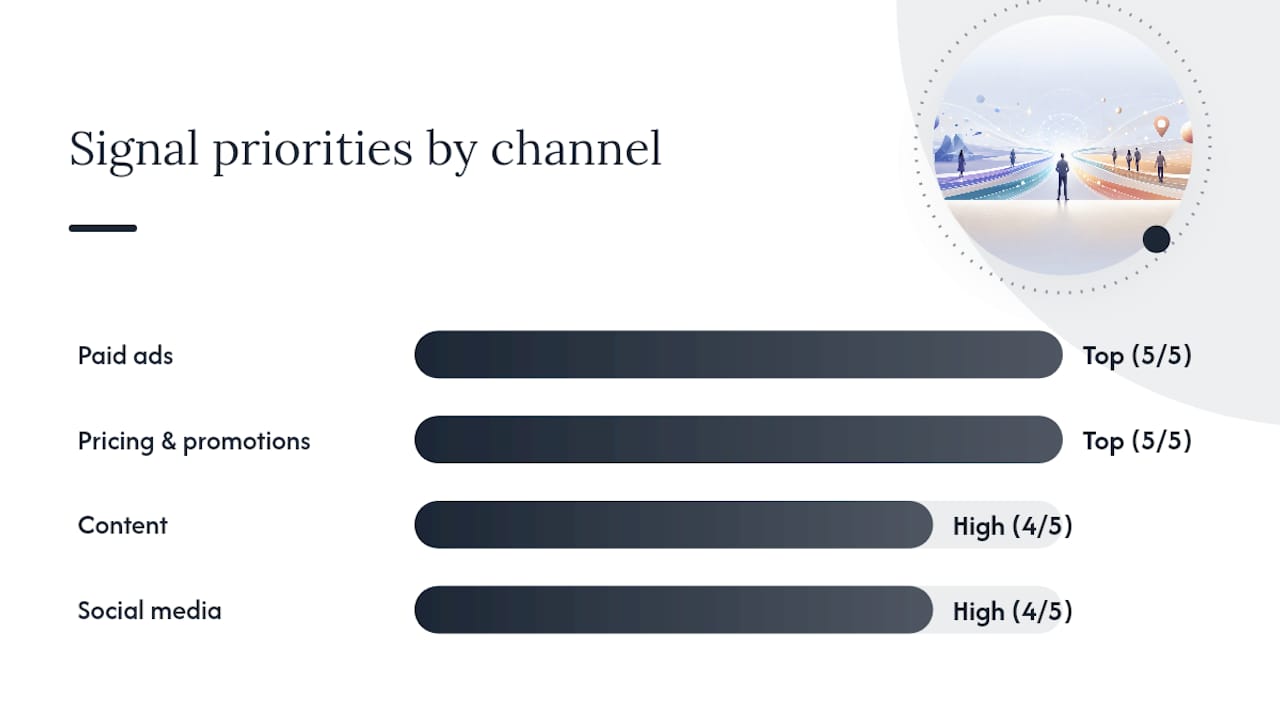
- Paid ads — new ad creative, landing page offers, and how often ads rotate (a proxy for spend velocity).
- Social media — top-performing posts, engagement spikes, new influencer or partnership tie-ups.
- Content — publishing frequency, topic clusters, and format changes (video versus blog versus newsletter).
- Email marketing — send frequency, subject line patterns, and promotional cadence around key dates.
- Pricing and promotions — discount timing, bundle changes, loyalty scheme tweaks.
- Product and feature announcements — new services, packaging changes, app updates.
- Hiring and funding — new job listings and funding rounds, which often reveal expansion plans well before a formal announcement.
Ad creative and landing pages deserve particular attention because they’re high-signal, low-noise sources: a competitor rarely runs a landing page test without a reason, and that reason usually tells you something about their funnel.
Pro Tip: If you’re starting from zero, prioritise the signals that touch your own conversion funnel directly, paid ads and pricing, before broadening out to content and social. You’ll get a faster return on the time invested.
How to build a repeatable monitoring process
A monitoring habit only sticks if it has a clear owner, a defined cadence, and somewhere the findings actually go. Ad-hoc watching produces interesting anecdotes, not strategy.
- Define objectives and pick two to four priority competitors. Trying to watch every player in your sector dilutes attention where it matters least.
- Choose the signals that map to your goals, using the channel list above as a starting point.
- Set up feeds and alerts so information arrives automatically instead of relying on someone remembering to check.
- Assign an owner for triage, even if that’s a single marketing manager checking a dashboard once a week.
- Document findings in a shared log, not scattered across inboxes and screenshots.
- Feed insights into planning meetings on a fixed schedule, so intelligence actually changes decisions rather than sitting in a folder.
A sample cadence for a small team might look like this:
| Frequency | Activity |
|---|---|
| Daily | Check paid ad alerts and any spend or creative changes |
| Weekly | Screenshot competitor social and ad creative for a quick comparison |
| Monthly | Review SEO ranking shifts and content publishing trends |
| Quarterly | Full competitor review feeding into strategy and budget planning |
Roles matter more than most SMBs assume:
- Alert owner — the person who receives and skims incoming notifications.
- Triage lead — decides which signals are noise and which need escalating.
- Actioner — the person (often you) who decides whether a signal becomes a campaign change, a content brief, or a pricing tweak.
Competitive intelligence pays off most when it’s continuous and routed straight into decision-making, rather than compiled into a report nobody reads until the next quarterly meeting.
Tools and platforms for tracking competitor marketing
Different tools are built for different signals, and no single platform covers everything well. Building a monitoring stack means matching tool categories to the channels you actually care about.
- SEO monitoring — Semrush and Ahrefs both track keyword rankings, backlink growth, and organic traffic estimates for any domain. Ahrefs tends to have the stronger backlink index; Semrush pairs SEO data with paid search intelligence.
- Website traffic and channel mix — SimilarWeb estimates a competitor’s traffic sources, showing roughly how much of their visibility comes from search, social, or direct visits.
- Paid search intelligence — SpyFu shows which keywords a competitor bids on and how their ad copy has changed historically, useful for spotting new campaign angles.
- Content performance — BuzzSumo reveals which competitor content gets shared and linked to most, helping you spot topics worth covering yourself.
- Search interest trends — Google Trends is free and shows whether interest in a competitor’s brand or a shared keyword is rising or falling over time.
- Social listening — Sprout Social and Mention (also known by its related tool BrandMentions) track brand mentions, engagement spikes, and sentiment across social platforms and the wider web.
Comparing these by what actually matters to a small business owner looks like this:
| Category | Best for | Pricing tier | Channels covered | Ease of setup |
|---|---|---|---|---|
| SEO tools (Semrush, Ahrefs) | Rankings, backlinks, keyword gaps | Mid to high | Search, some paid search | Moderate |
| Traffic estimator (SimilarWeb) | Overall channel mix, traffic volume | Free tier + paid | Web, referral, social | Easy |
| Paid search tracker (SpyFu) | Ad copy history, keyword bids | Low to mid | Paid search | Easy |
| Content intelligence (BuzzSumo) | Top-performing content, shares | Mid | Content, social | Easy |
| Trend tracker (Google Trends) | Search interest over time | Free | Search | Very easy |
| Social listening (Sprout Social, Mention/BrandMentions) | Brand mentions, engagement, sentiment | Mid to high | Social, web mentions | Moderate |

Most of these tools integrate with Slack or export to a shared spreadsheet, which matters more than it sounds. If insights don’t land where your team already works, they get ignored.
Choosing tools and building a lean monitoring stack
Before subscribing to anything, run through a short checklist: which signals do you actually need, what’s your monthly budget, how fresh does the data need to be, and can one team member realistically manage the setup?
- Signals required — don’t pay for social listening if your competitors barely post.
- Budget — most SMBs can start free and upgrade one category at a time.
- Data freshness — daily alerts matter for ads; monthly checks are fine for SEO trends.
- Ease of setup — a tool nobody configures properly is worse than no tool.
- Integrations — Slack or email digests keep insight visible without extra logins.
Two starting points work well for most small teams:
- Lean stack: Google Alerts, Google Trends, and manual weekly checks of competitor social and ad libraries. Free, but requires discipline.
- Balanced stack: one multi-channel tool such as Semrush for SEO and paid search, paired with Sprout Social or Mention for social and brand mentions. A modest monthly cost that saves hours of manual checking.
Trial before you commit. Most of these platforms offer free trials, and the monday.com competitive analysis guide recommends measuring whether monitoring actually changes a decision within the first month, not just whether it generates interesting data.
Staying on the right side of the law
Monitoring public marketing activity is entirely legitimate. Problems start when businesses cross into territory that’s either illegal or simply unethical, and it’s worth being explicit about where that line sits.
- Never scrape personal data or private customer information from a competitor’s site or systems.
- Never impersonate a customer or supplier to extract confidential pricing or contract terms.
- Never buy leaked internal documents, stolen data, or unauthorised customer lists.
- Never misrepresent your findings publicly in a way that could be seen as defamatory.
If your monitoring ever touches personal data (customer reviews with names, for instance), you need a lawful basis for processing it under UK data protection rules, and it’s worth getting legal advice for anything borderline.
Pro Tip: Keep a simple log with the date, source URL, and a screenshot for every significant finding. If a decision is ever questioned, that trail shows exactly what you knew and when.
Turning competitor signals into real decisions
Not every signal deserves a reaction. A useful rule of thumb: act immediately on anything touching your paid ad auctions or pricing (these move fast and cost you money if ignored), investigate anything content or product related over a week or two, and ignore isolated, one-off posts that don’t repeat.
Three examples show how this plays out:
- Campaign defence — a competitor launches aggressive ads on your branded keywords, so you tighten your own bids and add negative keyword protection within 48 hours.
- Content gap exploitation — you notice a competitor ranking for a topic you’ve never covered, so you brief a new page and publish within two weeks.
- Early product-signal response — a rival starts hiring for “app development” roles, prompting you to accelerate your own mobile roadmap discussion at the next planning meeting.
Before acting on anything bigger than a quick tactical fix, run it through a short checklist: state the hypothesis, define the test, pick one metric to watch, and set a timeframe to review it. That stops a single interesting signal from triggering an overreaction.
Where teams should actually start
Start with one competitor and one channel, paid ads, are usually the fastest to show a payoff, and automate the boring parts before worrying about sophisticated dashboards.
Pro Tip: Analysis paralysis kills more monitoring efforts than lack of tools ever does. Write down your assumptions before you start watching, then check whether the data actually challenges them.
Fold this into your existing planning cycle rather than treating it as a side project nobody owns after the first month.
Get help setting up your competitor monitoring
Fyldedigital sets up competitor monitoring for small businesses that don’t have a spare afternoon a week to chase alerts, dashboards, and screenshots themselves. We build the alert feeds, configure the dashboards, and deliver a first-month digest that prioritises the three or four signals actually worth acting on, rather than a pile of raw data.
If competitor pricing or ad activity has been eating into your enquiries, that’s usually a paid search problem as much as a monitoring one, and it’s worth reading when your business should use PPC alongside your monitoring setup. When you’re ready to have someone handle the whole process, from tracking through to acting on it, get in touch about our SEO and PPC support and we’ll talk through what a monitoring stack would look like for your market.
Frequently asked questions
Why track competitor marketing if my business is small?
Small businesses often compete for the same narrow pool of local customers, which makes early signals more valuable, not less. A single competitor pricing change or new ad campaign can affect you faster than it would a larger firm with a bigger customer base.
How often should I check on competitors?
Daily for paid ads, weekly for social and creative snapshots, and monthly for SEO and content trends works well for most SMBs, based on the cadence recommended by monday.com’s competitive analysis guide.
What’s the difference between competitor analysis and competitor monitoring?
Competitor analysis is typically a one-off deep dive, often done during planning. Monitoring is the ongoing, ideally automated, tracking of competitor activity that feeds insights into your team continuously.
Is it legal to track competitor marketing?
Yes, watching public-facing marketing activity like ads, social posts, and pricing pages is legal. It becomes a problem when you scrape private data, impersonate customers, or misuse personal information without a lawful basis.
Which tool should I start with if I only pick one?
Google Trends is free and shows search interest shifts immediately. If you’re ready to invest, Semrush covers both SEO and paid search signals in one place, which suits most small teams better than juggling several point tools.
Sources
- YouGov — competitor monitoring
- Monday
- Coursera — competitor analysis guide
- UK Data Services — competitive intelligence