Persona-driven marketing means building campaigns around detailed profiles of your real customer types, rather than a generic audience. Teams that use buyer personas properly see sharper messaging, better ad targeting and higher conversion rates because they are writing to a specific person instead of a vague crowd. These profiles are built from CRM data, customer interviews and analytics, not guesswork.
- Persona-driven marketing = campaigns targeted at semi-fictional customer profiles built from real data
- The biggest win: messaging that speaks to specific pains and goals converts better than generic copy
- Grounded in evidence: CRM data, direct interviews, website analytics and sales feedback all feed the profile
Pro Tip: If your “persona” is just an age range and a job title, you have a segment, not a persona. Real ones capture what someone does all day and what keeps them up at night.
Key Takeaways
Persona-driven marketing works because it replaces broad targeting with messaging built from real customer data, sales feedback and validated interviews.
| Point | Details |
|---|---|
| Start small | Build three to five core personas before adding more, to avoid diluting your content budget. |
| Use three layers | Attributes, behaviours and psychology all need to be captured, not just demographics. |
| Validate before launch | Check every persona with sales and product teams before it shapes a campaign. |
| Map to the funnel | Assign each persona a channel and content type at every buyer’s journey stage. |
| Get help activating | Fyldedigital turns validated personas into website copy, SEO content and paid campaigns. |
Table of Contents
- What is persona-driven marketing and how does it differ from segmentation?
- What are the benefits of persona-driven marketing?
- What types of buyer personas should you build?
- How do you build a data-driven buyer persona step by step?
- What should a persona profile include?
- How do you map personas to channels and the buyer’s journey?
- What do sample persona templates look like?
- How do you validate and maintain buyer personas over time?
- What tools help you collect data and build personas?
- How does an agency run a compact persona project?
- What do agencies get wrong about buyer personas most often?
- How Fylde Digital turns persona research into working campaigns
- Frequently asked questions
- Sources
What is persona-driven marketing and how does it differ from segmentation?
Persona-driven marketing goes further than demographic segmentation. A persona is a semi-fictional profile built from real data, one that captures a person’s goals, daily frustrations and decision triggers, not just their age or industry. A market segment groups people by shared traits (company size, location, spend). An ideal customer profile (ICP) describes the type of company worth targeting. A persona sits underneath both: it’s the individual human inside that segment or company you’re actually writing copy for.
- Segment: broad grouping, useful for media planning and budget allocation
- ICP: defines which companies fit your product, used mostly in B2B sales targeting
- Persona: the specific person, their motivations, and how they make decisions
Persona work matters most where buying journeys are complicated. Think B2B purchases involving multiple stakeholders, or B2C products where content needs to feel personal rather than mass-produced. A persona-based approach drills into the needs of individual roles inside a buying committee, which is precisely where blanket messaging falls flat.
What are the benefits of persona-driven marketing?
Personas turn scattergun marketing into targeted effort. Once you know exactly who you’re writing for, ad spend stops being wasted on people who were never going to convert, and content resources get allocated against profiles that actually matter to revenue.
- Higher engagement rates because messaging matches real pain points
- Improved conversion rates from landing pages and email sequences written for a specific reader
- More efficient PPC budgets as targeting tightens around genuine buyers
- Sharper content relevance across blogs, social and paid channels
KPIs that typically move: open rates on email, conversion rate on landing pages, time on page, and cost per acquisition. Beyond the numbers, personas give marketing, sales and product teams a shared reference point, so a sales rep’s pitch and a marketer’s ad copy stop contradicting each other.
What types of buyer personas should you build?
Not every business needs the same persona set, and building too many is one of the fastest ways to dilute the whole exercise. Start with a manageable number, a manageable number commonly recommended to avoid dilution, and add more only once the first batch is proving useful.
- Role-based personas (B2B): represent individual members of a buying committee, such as a finance director who cares about cost justification versus an operations manager who cares about implementation time
- Demographic and content-preference personas (B2C): useful when tailoring tone, imagery and channel choice for consumer audiences with different lifestyles
- Behavioural personas: grouped by what people actually do, browsing habits, purchase frequency, response to discounts, rather than who they are on paper
- Negative personas: describe who you should not target, saving ad spend by excluding poor-fit leads before they enter the funnel
A small business selling directly to consumers might need two or three demographic personas plus one negative persona to filter out bargain-hunters who never convert. A B2B agency, meanwhile, often needs one persona per buying-committee role.
How do you build a data-driven buyer persona step by step?
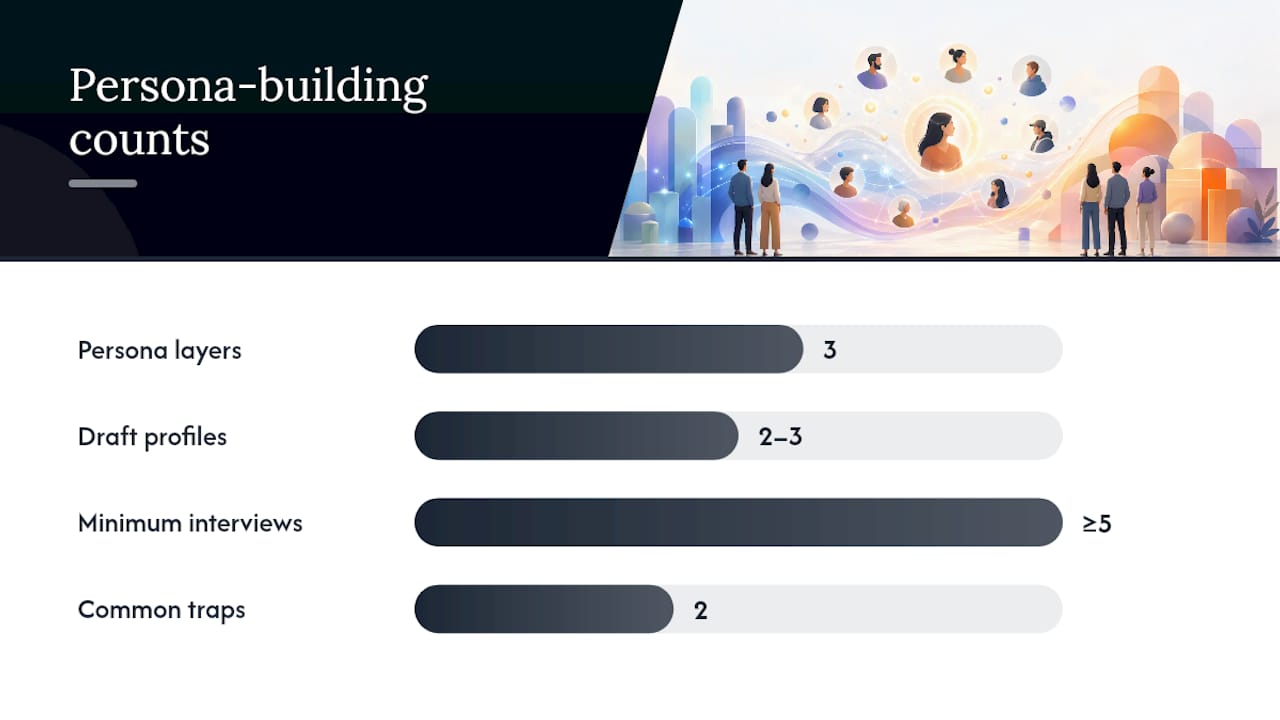
Building a persona properly means combining what your systems already know with what only a conversation can reveal. Usable personas need three layers: attributes (who they are), behaviours (what they do) and psychology (why they think that way). Skip the last two and you’ve built a demographic sheet, not a persona.
- Define objective and scope. Decide which product line, campaign or team this persona will serve before you collect a single data point.
- Gather quantitative data. Pull from CRM records, website analytics and past campaign performance to spot patterns in who buys, when and why they drop off.
- Conduct qualitative research. Interview real customers, review support logs, and talk to sales reps who hear objections firsthand.
- Identify patterns and form hypotheses. Group recurring goals, frustrations and language into two or three draft profiles.
- Document full persona profiles. Write up goals, tasks, pain points, objections and preferred channels for each one.
- Validate with sales and product teams. Their frontline feedback is a quick reality check that catches assumptions before they go live.
- Test and iterate. Run campaigns against the persona, measure results, and revise the profile as real behaviour proves or disproves your hypotheses.
Sample interview questions worth asking customers, sales reps and support staff:
- What problem were you trying to solve when you first looked for a product like this?
- What almost stopped you from buying?
- What information did you need before you felt confident deciding?
- Which channel or person influenced that decision most?
Pro Tip: Talking to real customers reveals motivations that no CRM report will ever surface. Book at least five conversations before you finalise a single profile.
Two traps catch almost everyone. First, over-relying on demographics because they’re easy to pull from a spreadsheet, when behaviour and psychology are what actually predict how someone responds to your marketing. Second, building too many personas because every department wants their own, which spreads your content budget so thin that none of them get used properly.
What should a persona profile include?
A persona document earns its keep only if every field maps to something you’ll actually do differently in a campaign. Keep it to one page; a ten-page profile nobody opens is worse than no profile at all.
- Persona name and role (gives the team a shared shorthand)
- Demographics, where genuinely relevant to messaging or channel choice
- Goals and daily tasks
- Pain points and objections
- Decision triggers, what tips them from “considering” to “buying”
- Preferred channels and content formats
| Field | What it informs |
|---|---|
| Goals and tasks | Which benefits to lead with in copy |
| Pain points | Which objections your landing page needs to pre-empt |
| Decision triggers | Timing and calls to action in email sequences |
| Preferred channels | Where you spend paid media budget |
| Content preferences | Format choice: video, long-form guide, or quick social post |
Store persona documents somewhere the whole team can reach, a shared drive folder or a lightweight wiki works better than a slide deck buried in someone’s inbox. The format matters less than whether people actually open it before writing a brief.
How do you map personas to channels and the buyer’s journey?
A persona only earns its keep once it changes what you actually publish and where. Cross-funnel persona marketing means applying that insight consistently from first touch to final decision, not just in one campaign.
| Funnel stage | Typical channel | Example content type |
|---|---|---|
| Top of funnel | Organic social, blog content | Problem-awareness articles, short explainer videos |
| Middle of funnel | Email, paid search | Comparison guides, case studies, webinars |
| Bottom of funnel | Landing pages, retargeting ads | Product demos, pricing pages, testimonials |
Channel-specific tips worth applying immediately:
- Email: segment sends by persona, not just by list, so subject lines match what that person actually cares about
- Organic social: match tone and format to the persona’s platform habits rather than posting identical content everywhere
- Paid search: write ad copy around the objection that persona raises most often in sales calls
- Landing pages: swap headline and hero image per persona segment where traffic volume justifies it
Record these mappings inside your campaign briefs and content calendar template, so anyone joining the team later can see which persona a piece of content was written for and why.
What do sample persona templates look like?
B2B example: “Procurement Priya”
Role: Operations manager at a 50 person logistics firm. Goals: cut supplier costs without disrupting delivery times. Pains: too many vendor calls eating into her week, unclear ROI on new software. Content preference: short case studies with hard numbers, not brochures.

B2C example: “Weekend Runner Sam”
Role: Marketing executive, trains for 10k races on weekends. Goals: find gear that lasts without overspending. Pains: sizing inconsistency between brands, slow delivery before race day. Content preference: short Instagram reels showing product in use.
Checklist for your first persona session:
- Pull the last twelve months of CRM and analytics data
- Book five to eight customer or prospect interviews
- Interview two sales reps and one support team member
- Draft the profile and circulate for validation before publishing
Treat the first version as a working draft, not a finished document. It gets better the more campaigns test it.
How do you validate and maintain buyer personas over time?
A persona is only as good as its last reality check. Validate with sales and product teams before publishing, then keep testing after launch rather than treating the document as finished.
- Run A/B tests on messaging built for that persona versus generic copy
- Survey recent customers on message resonance, does the language sound like something they’d say?
- Gather sales feedback after calls to check whether the persona’s objections still match reality
- Run cohort analysis to see whether conversion rates by persona are moving in the right direction
Watch conversion rate by persona, engagement rate on persona-targeted content, and lead quality scores from sales. A review every quarter or two keeps personas current, and any sudden shift in buying behaviour, a new competitor, a pricing change, a product pivot, should trigger an ad hoc update rather than waiting for the scheduled review.
What tools help you collect data and build personas?
You don’t need an expensive stack to start. CRM systems (many UK small businesses already run HubSpot or Zoho), behaviour analytics platforms like Google Analytics, survey tools such as Typeform, and simple interview recording apps cover most of the data-gathering work. Collaborative templates in Notion or a shared Google Doc handle documentation well enough for most teams starting out.
- CRM: HubSpot, Zoho, or whatever system already holds your customer records
- Behaviour analytics: Google Analytics or your website’s built-in reporting
- Survey tools: Typeform or Google Forms for quick resonance checks
- Interview recording: any call recording tool with consent enabled
- Collaborative templates: Notion, Google Docs or a shared drive folder
One line worth remembering: any interview or survey collecting personal data needs a GDPR-compliant consent process, so check your data collection method before you start recording calls or storing responses. Industry blogs and template libraries from HubSpot and similar platforms are a solid starting point for further reading.
How does an agency run a compact persona project?
A tight persona project typically runs two to four weeks and produces three deliverables: full persona profiles, a persona-to-channel mapping, and a creative brief ready to hand to whoever writes the copy.
- Week one: data gathering, CRM export, analytics review, stakeholder kick-off
- Week two: customer and team interviews, pattern identification
- Week three: draft profiles circulated for validation with sales and product
- Week four: final documents delivered alongside channel mapping and a creative brief
Deliverables checklist: persona profiles (one page each), a channel mapping table, a creative brief for the next campaign, and a short handover note explaining how to use them.
Pro Tip: The handover meeting matters more than the documents themselves. If content and operations teams don’t sit in the room when personas launch, the profiles sit unused within a month.
What do agencies get wrong about buyer personas most often?
The most common mistake isn’t building the wrong persona, it’s building a good one and then filing it away. We’ve seen plenty of businesses invest properly in interviews and data, produce a sharp profile, then never open the document again once the workshop ends.
Personas are working tools, meant to shape the next ad, the next landing page, the next email subject line, not a report that proves due diligence to a client or a boss. The businesses that get real value revisit their personas every time they brief a campaign. That habit, more than any template, is what turns research into results, which is exactly where the right implementation partner earns their fee.
How Fylde Digital turns persona research into working campaigns
Building a persona is one job. Turning it into copy, a landing page, and an ad campaign that actually performs is another, and that’s where most small businesses run out of time or in-house skill. Fyldedigital runs persona workshops, data-led research and channel mapping as part of a wider campaign build, so the profiles you create actually shape the website, the SEO content and the paid ads people see.
A typical engagement covers persona interviews, a channel mapping document, a creative brief, and activation across your website, SEO strategy and social channels, whether that’s a single project or an ongoing retainer depends on how much activation you need. For a specialist example of persona work in a regulated sector, medical aesthetics providers face similar challenges around patient trust and decision triggers. Get in touch for a free website and marketing review, and we’ll show you exactly how your current site measures up against the personas you’re trying to reach.
Frequently asked questions
What is persona-driven marketing in simple terms?
It’s marketing built around detailed profiles of your real customer types, using data from your CRM, interviews and analytics, rather than broad demographic targeting.
How is a buyer persona different from a target audience?
A target audience is a broad group defined by shared traits. A buyer persona is one specific representative person within that audience, complete with goals, frustrations and daily behaviour.
How many personas should a small business start with?
Most businesses do well starting with three to five core personas, adding more only once the first set is proving useful in real campaigns.
Do personas work for B2C as well as B2B?
Yes. B2C personas focus more on demographics and content preference, while B2B personas usually represent individual roles within a buying committee.
How often should personas be updated?
A review every quarter or two is a sensible baseline, with ad hoc updates triggered by major shifts like a new competitor or pricing change.
Sources
The sources below cover both the theory behind persona-driven marketing and ready-to-adapt templates, treat them as starting points, not fixed rules.
- Persona-Based Marketing
- What is a buyer persona? A comprehensive guide
- What Is Persona Marketing? Design Steps, Templates, and Success Patterns | Xtrategy
- How and why you should use cross-funnel persona marketing to influence buyers
- What Is Persona Based Marketing or PBM?